SolveIt is under development
SolveItNCERT · CBSE · NEET

NCERT Exemplar · Class 12 Mathematics Linear Programming

45 questions · 45 still being checked

EXERCISE 12.3 31–40 (part 4 of 5)

  1. Choose the correct answer from the given four options in each of the Exercises $\displaystyle 26$ to 34.

    Exercise 31

    Refer to Exercise 30. Minimum value of F is
    (A)
    0\displaystyle 0 (B) −16\displaystyle -16
    (C)
    12\displaystyle 12
    (D)
    does not exist
    NCERT_Question_Class12_Maths_Exemplar_Ch12_Ex12-3_Q31

    Matches the book, not yet reviewed

    This working reaches the answer NCERT prints. It has not yet been read through by hand.

    NCERT’s answer
    D
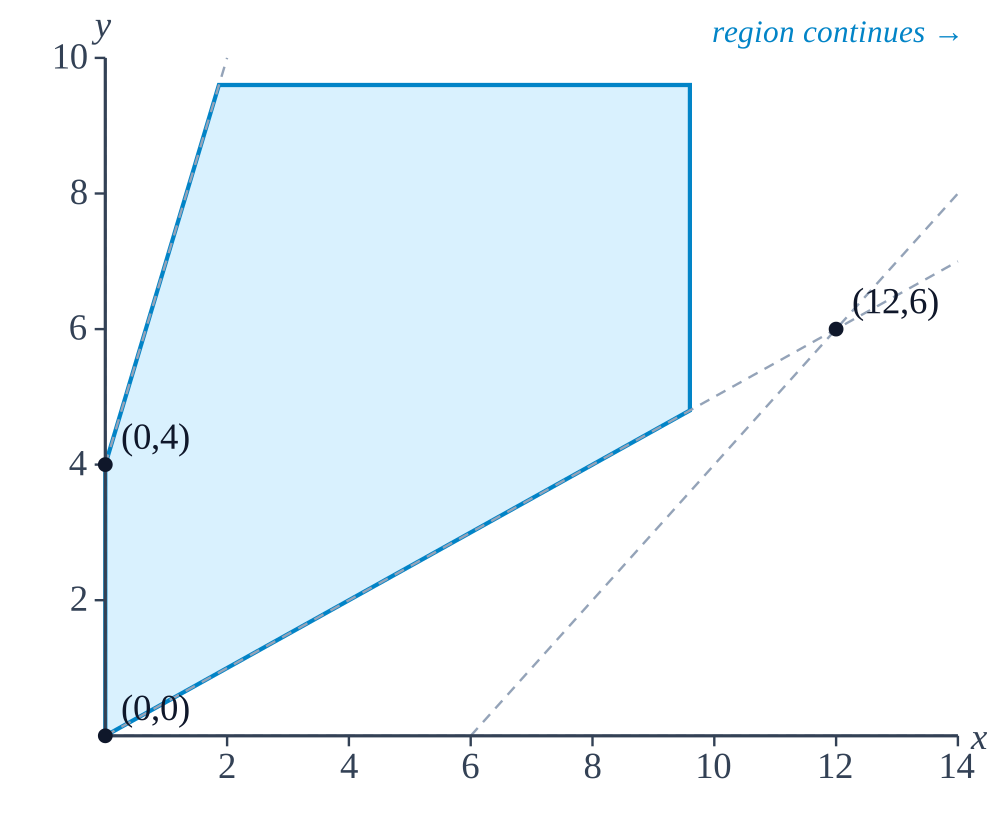
    (D) does not exist. From its labels, Fig. $\displaystyle 12.13$ is the region \[x\ge 0,\quad x-2y\le 0,\quad x-y\le 6,\quad -3x+y\le 4 \] with corner points and values \[F(0,0)=0,\quad F(0,4)=-16,\quad F(12,6)=12 \] NCERT_Solution_Class12_Maths_Exemplar_Ch12_Ex12-3_Q31 The region is unbounded. For \(\displaystyle t\ge 0\), the point \(\displaystyle (t,\,3t+4)\) is feasible: \[t-2(3t+4)=-5t-8\le 0,\quad t-(3t+4)=-2t-4\le 6 \] \[F=3t-4(3t+4)=-9t-16\to-\infty \] so \(\displaystyle F\) has no least value.
  2. Exercise 32

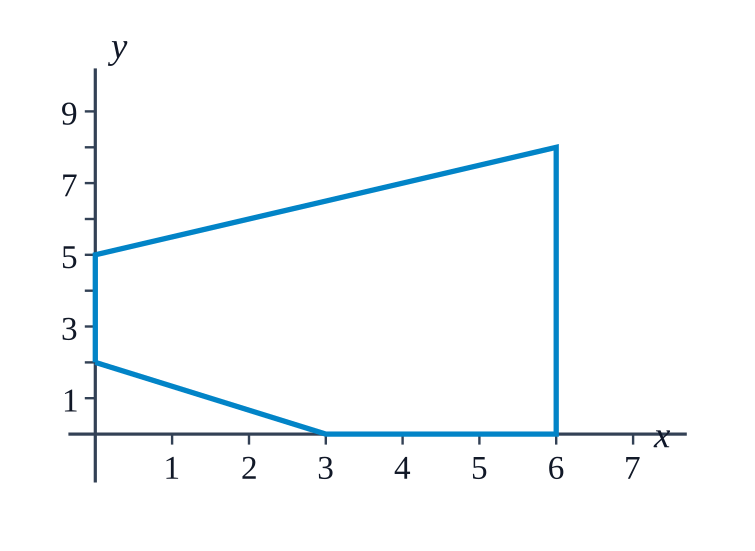
    Corner points of the feasible region for an LPP are (0,2)\displaystyle (0, 2), (3,0)\displaystyle (3, 0), (6,0),(6,8)\displaystyle (6,0),(6,8) and (0,5)\displaystyle (0, 5). Let F=4x+6y\displaystyle \mathrm{F}=4 x+6 y be the objective function. The Minimum value of F occurs at
    (A)
    (0,2)\displaystyle (0,2) only
    (B)
    (3,0)\displaystyle (3,0) only
    (C)
    the mid point of the line sgment joining the points (0,2)\displaystyle (0,2) and (3,0)\displaystyle (3,0) only
    (D)
    any point on the line segment joining the points (0,2)\displaystyle (0,2) and (3,0)\displaystyle (3,0).

    Matches the book, not yet reviewed

    This working reaches the answer NCERT prints. It has not yet been read through by hand.

    NCERT’s answer
    D
    (D) any point on the line segment joining \(\displaystyle (0,2)\) and \(\displaystyle (3,0)\).\[F(0,2)=12,\quad F(3,0)=12,\quad F(6,0)=24 \] \[F(6,8)=24+48=72,\quad F(0,5)=30 \] NCERT_Solution_Class12_Maths_Exemplar_Ch12_Ex12-3_Q32 The region is bounded, so \(\displaystyle \min F=12\), reached at two adjacent corners. Both lie on one edge, and F is constant along it: \[4x+6y=12 \text{ on the segment from } (0,2) \text{ to } (3,0) \]
  3. Exercise 33

    Refer to Exercise 32\displaystyle 32, Maximum of F−\displaystyle \mathrm{F}- Minimum of F=\displaystyle \mathrm{F}=
    (A)
    60\displaystyle 60
    (B)
    48\displaystyle 48
    (C)
    42\displaystyle 42
    (D)
    18\displaystyle 18

    Matches the book, not yet reviewed

    This working reaches the answer NCERT prints. It has not yet been read through by hand.

    NCERT’s answer
    A
    (A) \(\displaystyle 60\). The region is bounded, so the extreme values of \(\displaystyle F=4x+6y\) occur at corner points.\[F(0,2)=12 \] \[F(3,0)=12 \] \[F(6,0)=24 \] \[F(6,8)=72 \] \[F(0,5)=30 \] \[\text{Maximum}-\text{Minimum}=72-12=60 \]
  4. Exercise 34

    Corner points of the feasible region determined by the system of linear constraints are (0,3)\displaystyle (0, 3), (1,1)\displaystyle (1,1) and (3,0)\displaystyle (3, 0). Let Z=px+qy\displaystyle \mathrm{Z}=p x+q y, where p,q>0\displaystyle p, q>0. Condition on p\displaystyle p and q\displaystyle q so that the minimum of Z occurs at (3,0)\displaystyle (3,0) and (1,1)\displaystyle (1, 1) is
    (A)
    p=2q\displaystyle p=2 q
    (B)
    p=q2\displaystyle p=\frac{q}{2}
    (C)
    p=3q\displaystyle p=3 q
    (D)
    p=q\displaystyle p=q

    Matches the book, not yet reviewed

    This working reaches the answer NCERT prints. It has not yet been read through by hand.

    NCERT’s answer
    B
    (B) \(\displaystyle p=\dfrac{q}{2}\). The minimum occurs at both \(\displaystyle (3,0)\) and \(\displaystyle (1,1)\), so \(\displaystyle Z\) has equal values there.\[Z(3,0)=3p,\qquad Z(1,1)=p+q \] \[3p=p+q \;\Rightarrow\; q=2p \;\Rightarrow\; p=\frac{q}{2} \]The third corner point is not lower:\[Z(0,3)=3q=6p>3p \]
  5. Fill in the blanks in each of the Exercises $\displaystyle 35$ to 41.

    Exercise 35

    In a LPP, the linear inequalities or restrictions on the variables are called ____.

    Matches the book, not yet reviewed

    This working reaches the answer NCERT prints. It has not yet been read through by hand.

    NCERT’s answer
    Linear constraints
    linear constraints. Conditions of the form\[a_1x+b_1y\le c_1,\qquad x\ge 0,\qquad y\ge 0 \]restrict the variables, and together they define the feasible region.
  6. Exercise 36

    In a LPP, the objective function is always ____

    Matches the book, not yet reviewed

    This working reaches the answer NCERT prints. It has not yet been read through by hand.

    NCERT’s answer
    Linear
    linear. The objective function is a linear function of the decision variables:\[Z=ax+by \]
  7. Exercise 37

    If the feasible region for a LPP is ____, then the optimal value of the objective function Z=ax+by\displaystyle \mathrm{Z}=a x+b y may or may not exist.

    Matches the book, not yet reviewed

    This working reaches the answer NCERT prints. It has not yet been read through by hand.

    NCERT’s answer
    Unbounded
    unbounded. On an unbounded region \(\displaystyle Z\) can grow without limit, so an optimum need not exist. For example:\[x+y\ge 1,\qquad x\ge 0,\qquad y\ge 0 \] \[Z=x+y\ge 1 \quad \text{(minimum }1\text{)} \] \[Z\to\infty \quad \text{(no maximum)} \]
  8. Exercise 38

    In a LPP if the objective function Z=ax+by\displaystyle \mathrm{Z}=a x+b y has the same maximum value on two corner points of the feasible region, then every point on the line segment joining these two points give the same ____ value.

    Matches the book, not yet reviewed

    This working reaches the answer NCERT prints. It has not yet been read through by hand.

    NCERT’s answer
    Maximum
    maximum. Let \(\displaystyle P(x_1,y_1)\) and \(\displaystyle Q(x_2,y_2)\) give the same value \(\displaystyle M\):\[Z(P)=Z(Q)=M \]A point \(\displaystyle R\) on segment \(\displaystyle PQ\) is\[R=\big((1-t)x_1+tx_2,\;(1-t)y_1+ty_2\big),\qquad 0\le t\le 1 \] \[Z(R)=(1-t)(ax_1+by_1)+t(ax_2+by_2) \] \[Z(R)=(1-t)M+tM=M \]The region is convex, so \(\displaystyle R\) is feasible and gives the maximum value \(\displaystyle M\).
  9. Exercise 39

    A feasible region of a system of linear inequalities is said to be ____ if it can be enclosed within a circle.

    Matches the book, not yet reviewed

    This working reaches the answer NCERT prints. It has not yet been read through by hand.

    NCERT’s answer
    Bounded
    bounded. There is a circle, say centred at the origin, enclosing every point of the region:\[x^2+y^2\le r^2 \quad \text{for some } r>0 \text{ and all } (x,y) \text{ in the region} \]Otherwise the region is unbounded.
  10. Exercise 40

    A corner point of a feasible region is a point in the region which is the ____ of two boundary lines.

    Matches the book, not yet reviewed

    This working reaches the answer NCERT prints. It has not yet been read through by hand.

    NCERT’s answer
    Intersection
    intersection. A corner point satisfies both boundary equations at once:\[a_1x+b_1y=c_1 \] \[a_2x+b_2y=c_2 \]Solving them gives its coordinates \(\displaystyle (x,y)\).