SolveIt is under development
SolveItNCERT · CBSE · NEET

NCERT Exemplar · Class 12 Mathematics Linear Programming

45 questions · 45 still being checked

EXERCISE 12.3 41–45 (part 5 of 5)

  1. Fill in the blanks in each of the Exercises $\displaystyle 35$ to 41.

    Exercise 41

    The feasible region for an LPP is always a ____ polygon.

    Matches the book, not yet reviewed

    This working reaches the answer NCERT prints. It has not yet been read through by hand.

    NCERT’s answer
    Convex
    convexEach constraint has the form \(\displaystyle a_i x + b_i y \le c_i\). Take \(\displaystyle P(x_1, y_1)\) and \(\displaystyle Q(x_2, y_2)\) in the region, and a point \(\displaystyle R\) on segment \(\displaystyle PQ\):\[R = \big(t x_1 + (1-t)x_2,\; t y_1 + (1-t)y_2\big), \quad 0 \le t \le 1 \]\[a_i x_R + b_i y_R = t\,(a_i x_1 + b_i y_1) + (1-t)\,(a_i x_2 + b_i y_2) \]\[a_i x_R + b_i y_R \le t c_i + (1-t)c_i = c_i \]NCERT_Solution_Class12_Maths_Exemplar_Ch12_Ex12-3_Q41\(\displaystyle R\) satisfies every constraint, so the whole segment \(\displaystyle PQ\) lies in the region.
  2. State whether the statements in Exercises $\displaystyle 42$ to $\displaystyle 45$ are True or False.

    Exercise 42

    If the feasible region for a LPP is unbounded, maximum or minimum of the objective function Z=ax+by\displaystyle \mathrm{Z}=a x+b y may or may not exist.

    Matches the book, not yet reviewed

    This working reaches the answer NCERT prints. It has not yet been read through by hand.

    NCERT’s answer
    True
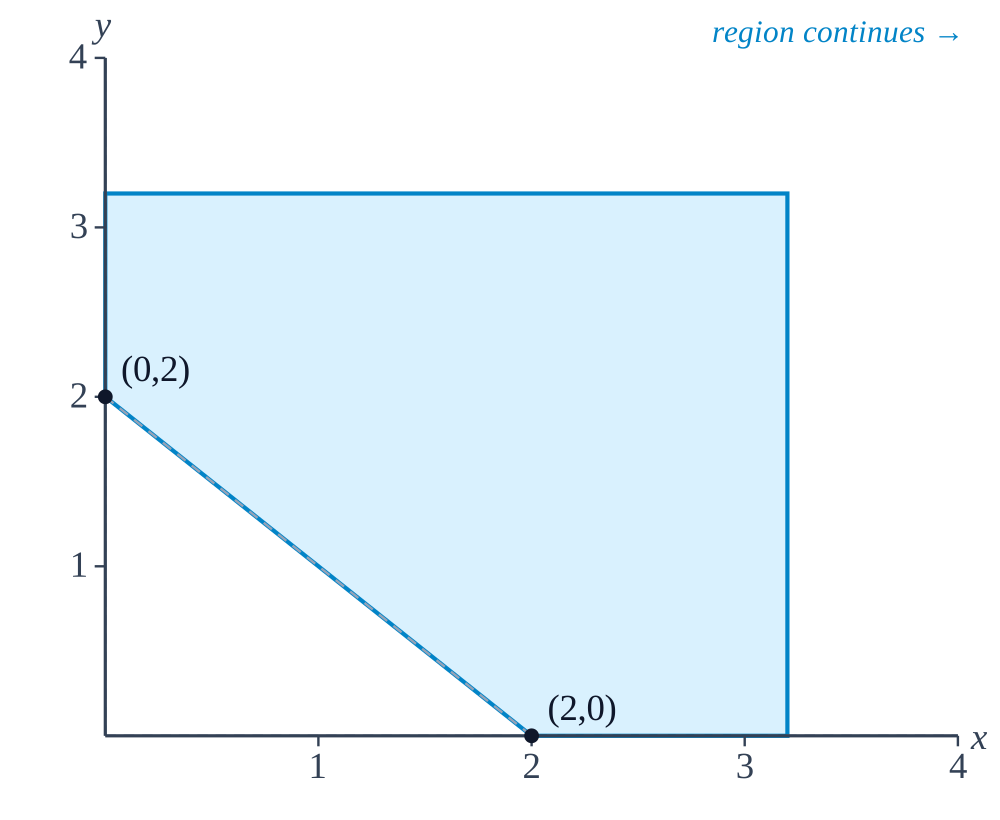
    True: an unbounded region can give a minimum but no maximum.Take \(\displaystyle Z = x + y\) on \(\displaystyle x \ge 0,\ y \ge 0,\ x + y \ge 2\).\[Z(2, 0) = 2, \qquad Z(0, 2) = 2 \]\[Z = x + y \ge 2 \quad \text{throughout the region} \]\[Z(t, 0) = t \quad (t \ge 2) \]NCERT_Solution_Class12_Maths_Exemplar_Ch12_Ex12-3_Q42The minimum \(\displaystyle 2\) exists; \(\displaystyle Z\) grows without limit, so there is no maximum.
  3. Exercise 43

    Maximum value of the objective function Z=ax+by\displaystyle \mathrm{Z}=a x+b y in a LPP always occurs at only one corner point of the feasible region.

    Matches the book, not yet reviewed

    This working reaches the answer NCERT prints. It has not yet been read through by hand.

    NCERT’s answer
    False
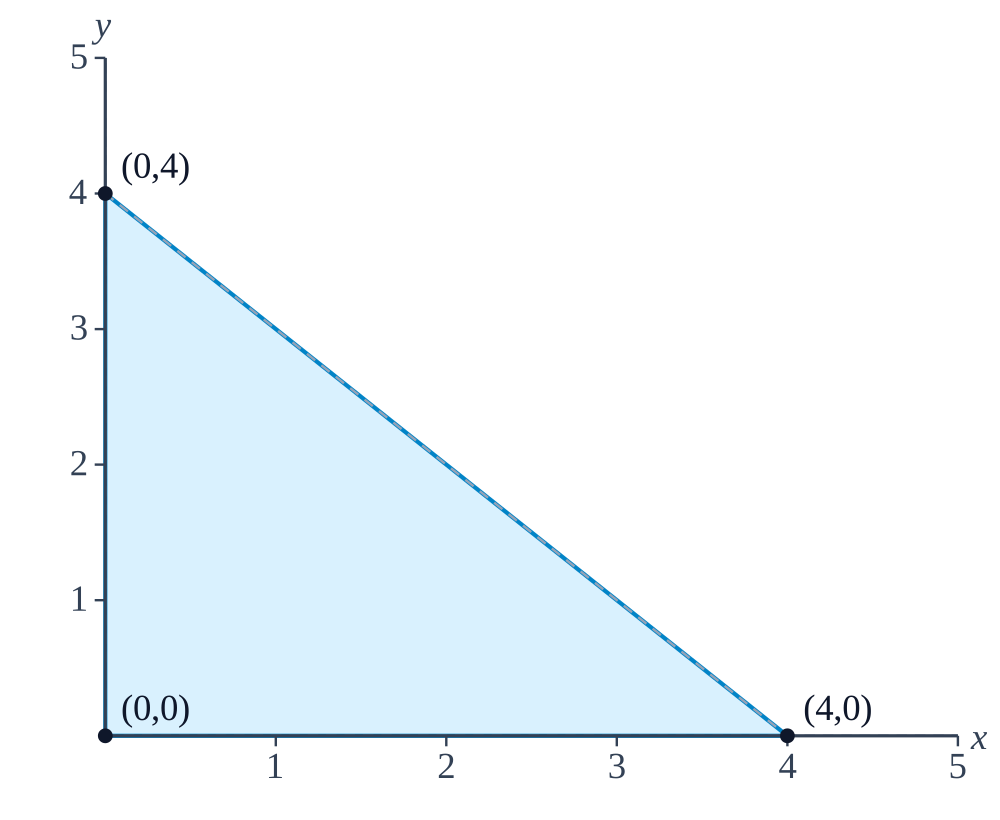
    False: the maximum can occur at two adjacent corner points, and then at every point of the segment joining them.Take \(\displaystyle Z = x + y\) on \(\displaystyle x \ge 0,\ y \ge 0,\ x + y \le 4\).\[Z(0, 0) = 0, \qquad Z(4, 0) = 4, \qquad Z(0, 4) = 4 \]\[Z(t, 4-t) = t + (4 - t) = 4 \quad (0 \le t \le 4) \]NCERT_Solution_Class12_Maths_Exemplar_Ch12_Ex12-3_Q43
  4. Exercise 44

    In a LPP, the minimum value of the objective function Z=ax+by\displaystyle \mathrm{Z}=a x+b y is always 0\displaystyle 0 if origin is one of the corner point of the feasible region.

    Matches the book, not yet reviewed

    This working reaches the answer NCERT prints. It has not yet been read through by hand.

    NCERT’s answer
    False
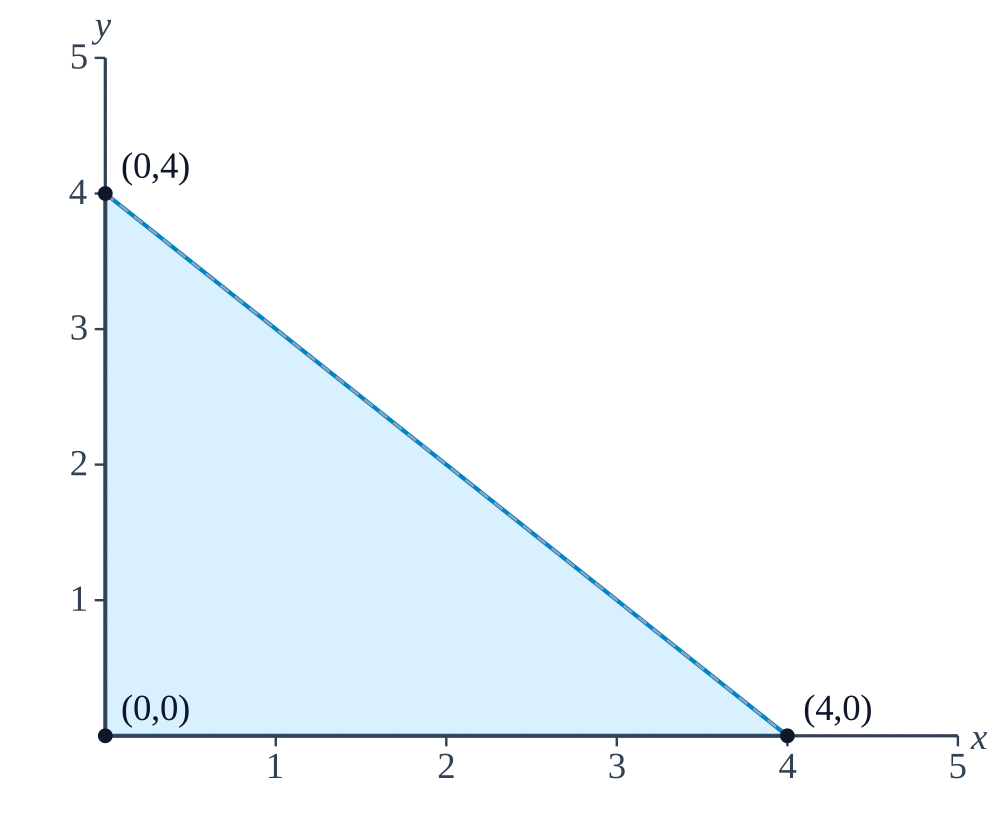
    False: the origin gives \(\displaystyle Z = 0\), but another corner point can give a smaller value.Take \(\displaystyle Z = x - y\) on \(\displaystyle x \ge 0,\ y \ge 0,\ x + y \le 4\).\[Z(0, 0) = 0, \qquad Z(4, 0) = 4, \qquad Z(0, 4) = -4 \]NCERT_Solution_Class12_Maths_Exemplar_Ch12_Ex12-3_Q44The minimum is \(\displaystyle -4\), not \(\displaystyle 0\).
  5. Exercise 45

    In a LPP, the maximum value of the objective function Z=ax+by\displaystyle \mathrm{Z}=a x+b y is always finite.

    Matches the book, not yet reviewed

    This working reaches the answer NCERT prints. It has not yet been read through by hand.

    NCERT’s answer
    True
    True: a maximum, when it exists, occurs at a corner point \(\displaystyle (x_0, y_0)\) of the feasible region.\[Z_{\max} = a x_0 + b y_0 \]\[a,\ b,\ x_0,\ y_0 \in \mathbb{R} \ \Rightarrow\ Z_{\max} \in \mathbb{R} \]So the maximum value is a finite number; if \(\displaystyle Z\) is unbounded, it has no maximum at all.