SolveIt is under development
SolveItNCERT · CBSE · NEET

NCERT Exemplar · Class 12 Mathematics Linear Programming

45 questions · 45 still being checked

EXERCISE 12.3 1–10 (part 1 of 5)

  1. Exercise 1

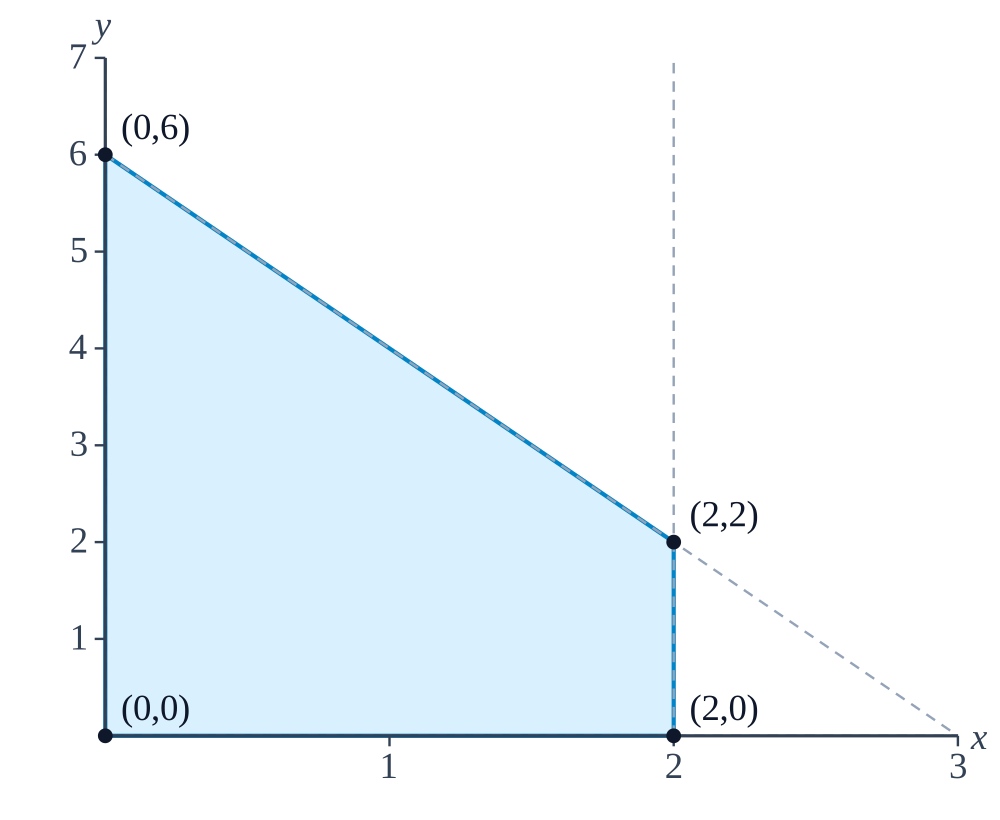
    Determine the maximum value of Z=11x+7y\displaystyle \mathrm{Z}=11 x+7 y subject to the constraints : 2x+y≤6,x≤2,x≥0,y≥0\displaystyle 2 x+y \leq 6, x \leq 2, x \geq 0, y \geq 0.

    Matches the book, not yet reviewed

    This working reaches the answer NCERT prints. It has not yet been read through by hand.

    NCERT’s answer
    $\displaystyle 42$
    The feasible region is bounded, so \(\displaystyle Z\) is largest at a corner point.\[x=2,\; 2x+y=6 \Rightarrow y=2 \]NCERT_Solution_Class12_Maths_Exemplar_Ch12_Ex12-3_Q1Corner points: \(\displaystyle (0,0)\), \(\displaystyle (2,0)\), \(\displaystyle (2,2)\), \(\displaystyle (0,6)\).\[Z(0,0)=0 \] \[Z(2,0)=11(2)=22 \] \[Z(2,2)=22+14=36 \] \[Z(0,6)=7(6)=42 \]Answer: Maximum \(\displaystyle Z=42\) at \(\displaystyle (0,6)\).
  2. Exercise 2

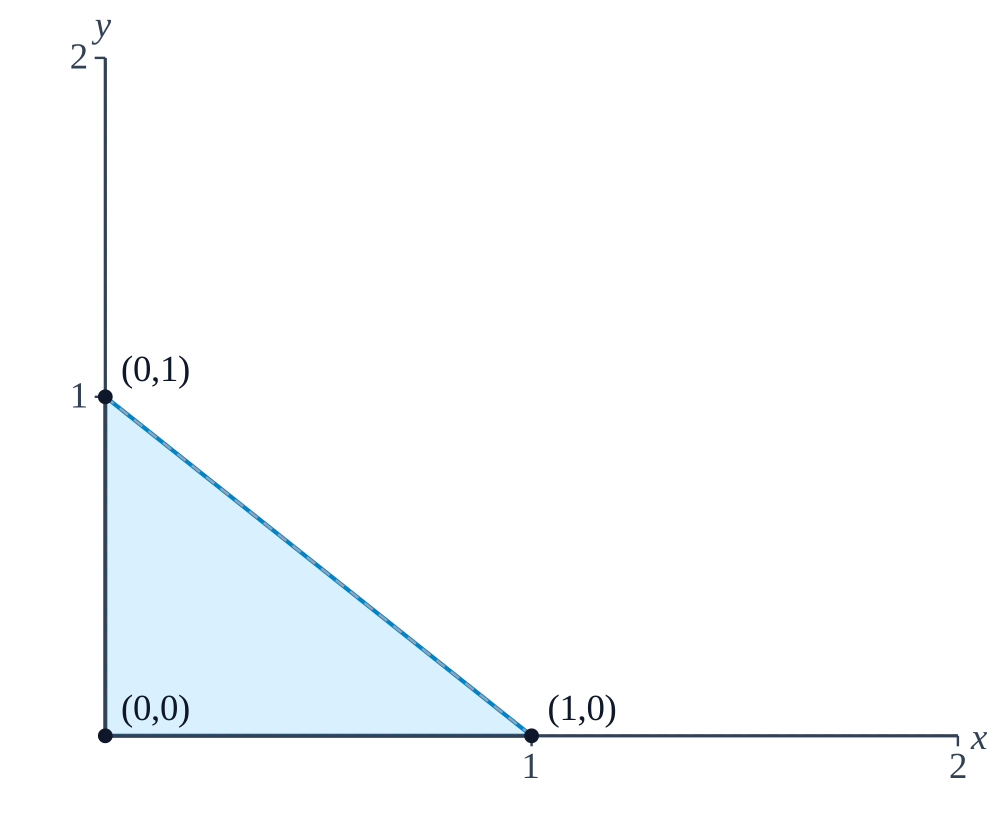
    Maximise Z=3x+4y\displaystyle \mathrm{Z}=3 x+4 y, subject to the constraints: x+y≤1,x≥0,y≥0\displaystyle x+y \leq 1, x \geq 0, y \geq 0.

    Matches the book, not yet reviewed

    This working reaches the answer NCERT prints. It has not yet been read through by hand.

    NCERT’s answer
    $\displaystyle 4$
    The feasible region is the triangle below \(\displaystyle x+y=1\) in the first quadrant, so \(\displaystyle Z\) is largest at a corner point.NCERT_Solution_Class12_Maths_Exemplar_Ch12_Ex12-3_Q2Corner points: \(\displaystyle (0,0)\), \(\displaystyle (1,0)\), \(\displaystyle (0,1)\).\[Z(0,0)=0 \] \[Z(1,0)=3(1)=3 \] \[Z(0,1)=4(1)=4 \]Answer: Maximum \(\displaystyle Z=4\) at \(\displaystyle (0,1)\).
  3. Exercise 3

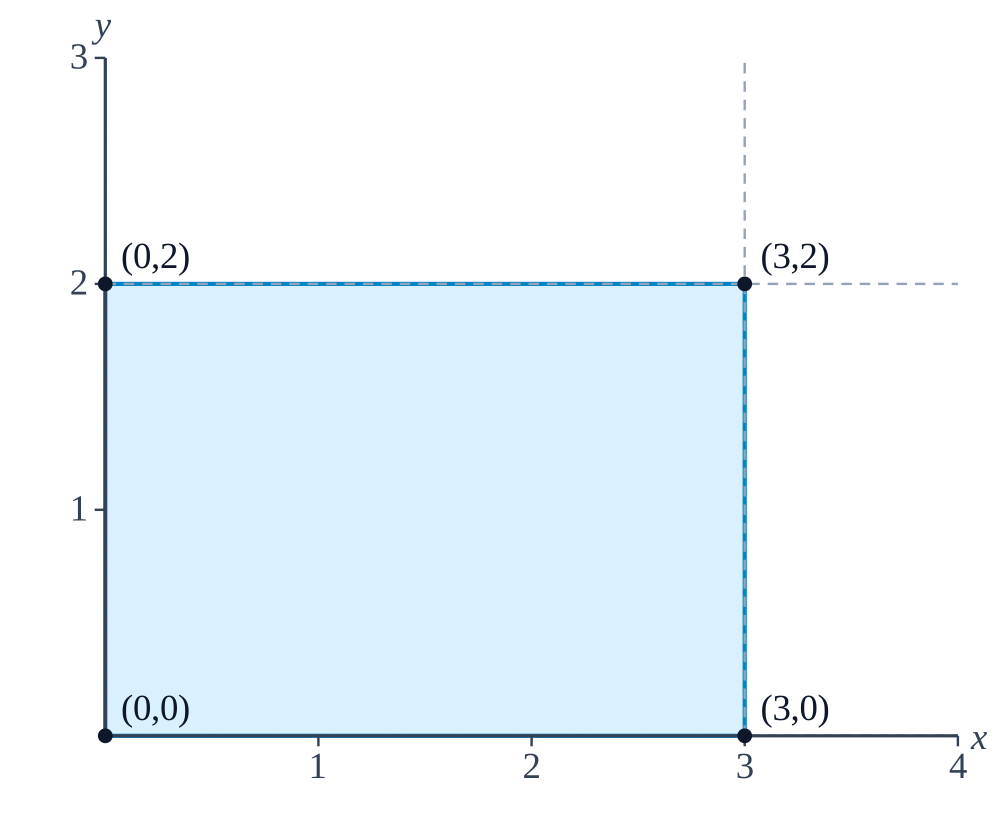
    Maximise the function Z=11x+7y\displaystyle \mathrm{Z}=11 x+7 y, subject to the constraints: x≤3,y≤2\displaystyle x \leq 3, y \leq 2, x≥0,y≥0\displaystyle x \geq 0, y \geq 0.

    Matches the book, not yet reviewed

    This working reaches the answer NCERT prints. It has not yet been read through by hand.

    NCERT’s answer
    $\displaystyle 47$
    The feasible region is the rectangle cut off by \(\displaystyle x=3\) and \(\displaystyle y=2\), so \(\displaystyle Z\) is largest at a corner point.NCERT_Solution_Class12_Maths_Exemplar_Ch12_Ex12-3_Q3Corner points: \(\displaystyle (0,0)\), \(\displaystyle (3,0)\), \(\displaystyle (3,2)\), \(\displaystyle (0,2)\).\[Z(0,0)=0 \] \[Z(3,0)=11(3)=33 \] \[Z(3,2)=33+14=47 \] \[Z(0,2)=7(2)=14 \]Answer: Maximum \(\displaystyle Z=47\) at \(\displaystyle (3,2)\).
  4. Exercise 4

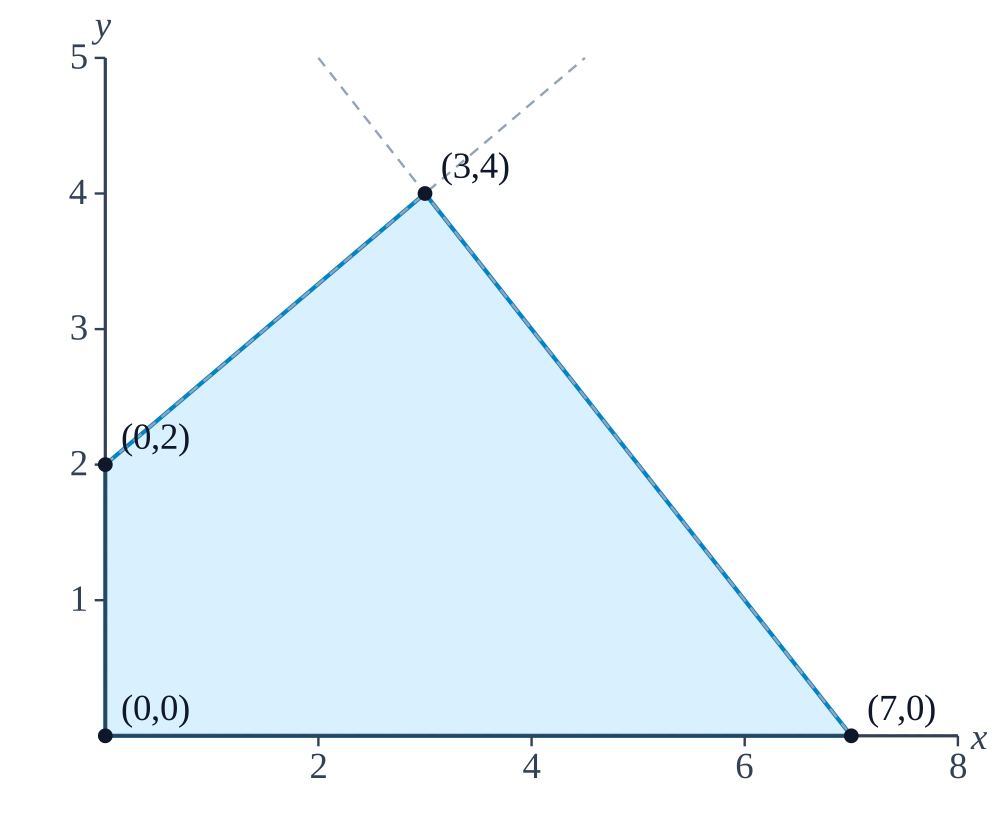
    Minimise Z=13x−15y\displaystyle \mathrm{Z}=13 x-15 y subject to the constraints : x+y≤7,2x−3y+6≥0,x≥0,y≥0\displaystyle x+y \leq 7,2 x-3 y+6 \geq 0, x \geq 0, y \geq 0.

    Matches the book, not yet reviewed

    This working reaches the answer NCERT prints. It has not yet been read through by hand.

    NCERT’s answer
    $\displaystyle 30$
    The feasible region is bounded, so \(\displaystyle Z\) is smallest at a corner point.\[x+y=7,\; 2x-3y+6=0 \Rightarrow 2(7-y)-3y=-6 \] \[5y=20 \Rightarrow y=4,\; x=3 \]NCERT_Solution_Class12_Maths_Exemplar_Ch12_Ex12-3_Q4Corner points: \(\displaystyle (0,0)\), \(\displaystyle (7,0)\), \(\displaystyle (3,4)\), \(\displaystyle (0,2)\).\[Z(0,0)=0 \] \[Z(7,0)=13(7)=91 \] \[Z(3,4)=39-60=-21 \] \[Z(0,2)=-15(2)=-30 \]Answer: Minimum \(\displaystyle Z=-30\) at \(\displaystyle (0,2)\).
  5. Exercise 5

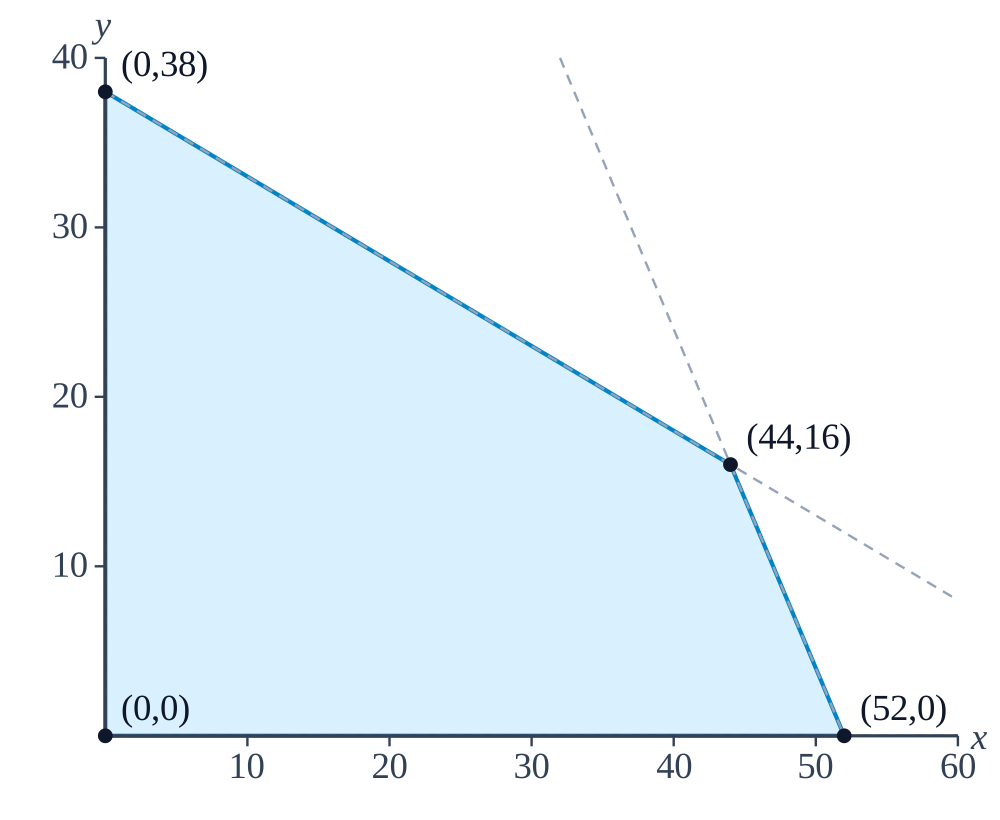
    Determine the maximum value of Z=3x+4y\displaystyle \mathrm{Z}=3 x+4 y if the feasible region (shaded) for a LPP is shown in Fig.12.7. NCERT_Question_Class12_Maths_Exemplar_Ch12_Ex12-3_Q5

    Matches the book, not yet reviewed

    This working reaches the answer NCERT prints. It has not yet been read through by hand.

    NCERT’s answer
    $\displaystyle 196$
    The shaded region \(\displaystyle OAED\) is bounded, so \(\displaystyle Z\) is largest at a corner point.\[x+2y=76,\; x=0 \Rightarrow D=(0,38) \] \[2x+y=104,\; y=0 \Rightarrow A=(52,0) \]\(\displaystyle E\) is where the two lines meet:\[2(x+2y)-(2x+y)=2(76)-104 \Rightarrow 3y=48 \] \[y=16,\quad x=76-2(16)=44 \Rightarrow E=(44,16) \]NCERT_Solution_Class12_Maths_Exemplar_Ch12_Ex12-3_Q5\[Z(O)=0 \] \[Z(A)=3(52)=156 \] \[Z(E)=3(44)+4(16)=132+64=196 \] \[Z(D)=4(38)=152 \]Answer: Maximum \(\displaystyle Z=196\) at \(\displaystyle E(44,16)\).
  6. Exercise 6

    Feasible region (shaded) for a LPP is shown in Fig. 12.8. Maximise Z=5x+7y\displaystyle \mathrm{Z}=5 x+7 y. NCERT_Question_Class12_Maths_Exemplar_Ch12_Ex12-3_Q6

    Matches the book, not yet reviewed

    This working reaches the answer NCERT prints. It has not yet been read through by hand.

    NCERT’s answer
    $\displaystyle 43$
    The shaded region is bounded, so \(\displaystyle Z\) is largest at a corner point.Corner points from the figure: \(\displaystyle O(0,0)\), \(\displaystyle A(7,0)\), \(\displaystyle B(3,4)\), \(\displaystyle (0,2)\).\[Z(0,0)=0 \] \[Z(7,0)=5(7)=35 \] \[Z(3,4)=15+28=43 \] \[Z(0,2)=7(2)=14 \]Answer: Maximum \(\displaystyle Z=43\) at \(\displaystyle B(3,4)\).
  7. Exercise 7

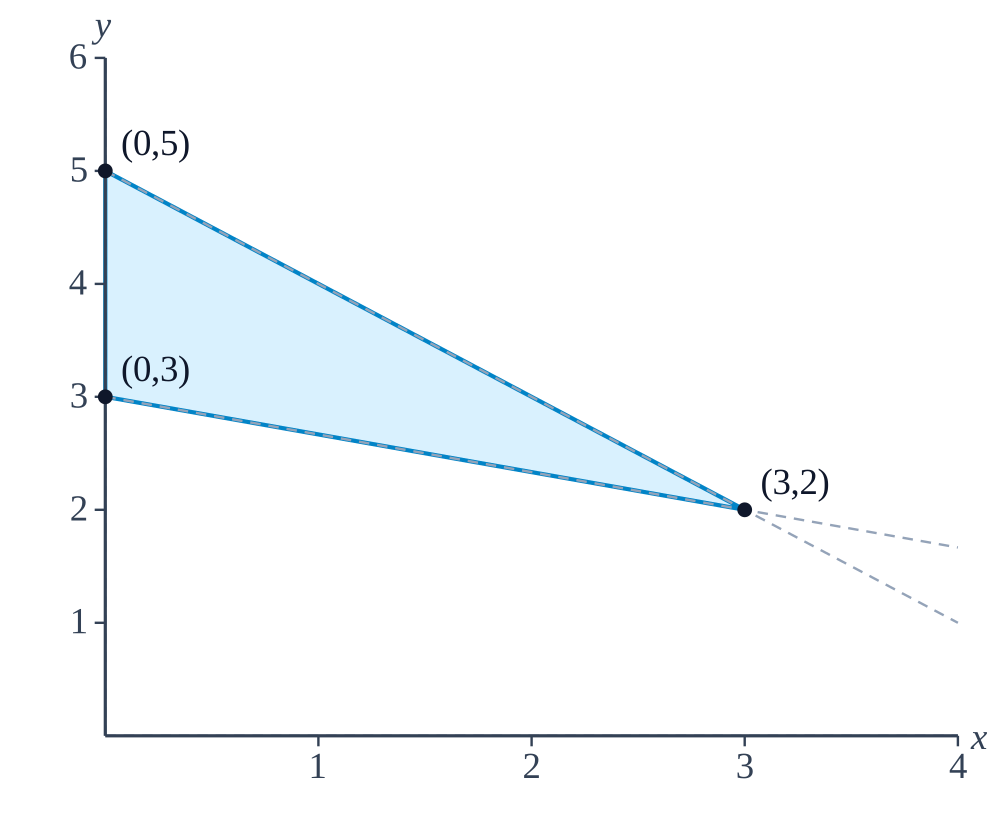
    The feasible region for a LPP is shown in Fig. 12.9. Find the minimum value of Z=11x+7y\displaystyle \mathrm{Z}=11 x+7 y. NCERT_Question_Class12_Maths_Exemplar_Ch12_Ex12-3_Q7

    Matches the book, not yet reviewed

    This working reaches the answer NCERT prints. It has not yet been read through by hand.

    NCERT’s answer
    $\displaystyle 21$
    The shaded triangle is bounded, so \(\displaystyle Z\) is smallest at a corner point.\[x+y=5,\; x=0 \Rightarrow (0,5) \] \[x+3y=9,\; x=0 \Rightarrow (0,3) \] \[(x+3y)-(x+y)=9-5 \Rightarrow 2y=4 \] \[y=2,\; x=5-2=3 \Rightarrow (3,2) \]NCERT_Solution_Class12_Maths_Exemplar_Ch12_Ex12-3_Q7\[Z(0,5)=7(5)=35 \] \[Z(0,3)=7(3)=21 \] \[Z(3,2)=33+14=47 \]Answer: Minimum \(\displaystyle Z=21\) at \(\displaystyle (0,3)\).
  8. Exercise 8

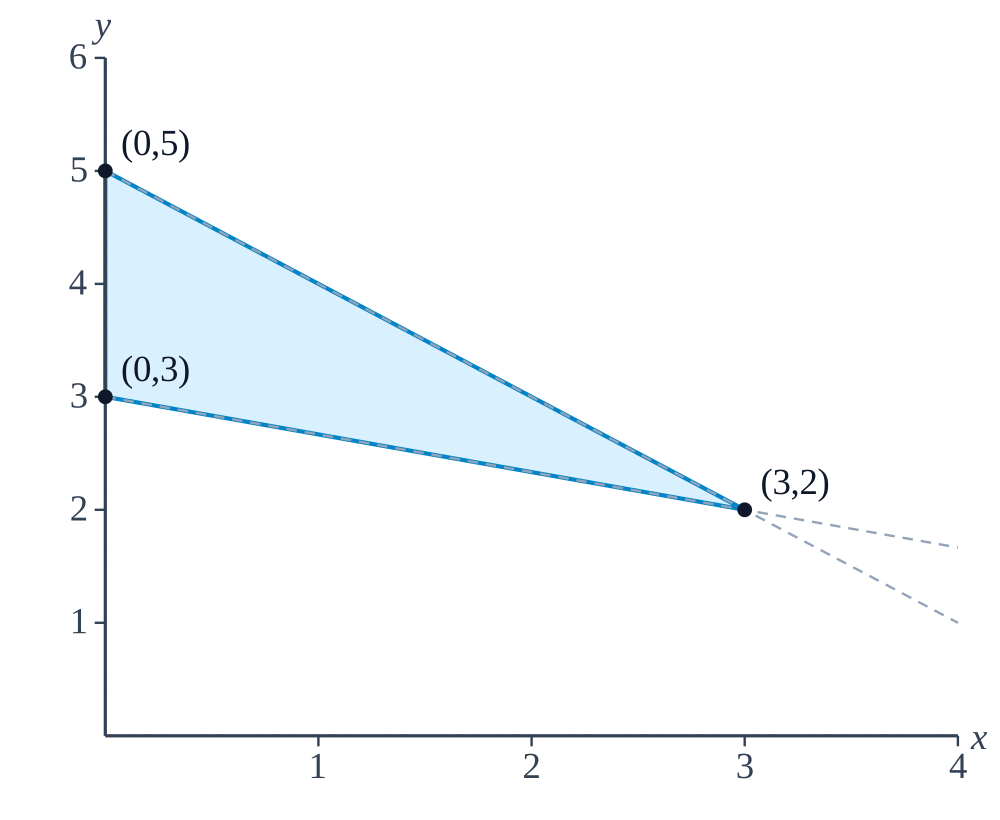
    Refer to Exercise 7\displaystyle 7 above. Find the maximum value of Z. NCERT_Question_Class12_Maths_Exemplar_Ch12_Ex12-3_Q8

    Matches the book, not yet reviewed

    This working reaches the answer NCERT prints. It has not yet been read through by hand.

    NCERT’s answer
    $\displaystyle 47$
    The feasible triangle is bounded, so \(\displaystyle Z\) is largest at a corner point.\[x+y=5,\; x+3y=9 \Rightarrow 2y=4 \Rightarrow (3,2) \]NCERT_Solution_Class12_Maths_Exemplar_Ch12_Ex12-3_Q8Corner points: \(\displaystyle (0,5)\), \(\displaystyle (0,3)\), \(\displaystyle (3,2)\).\[Z(0,5)=7(5)=35 \] \[Z(0,3)=7(3)=21 \] \[Z(3,2)=33+14=47 \]Answer: Maximum \(\displaystyle Z=47\) at \(\displaystyle (3,2)\).
  9. Exercise 9

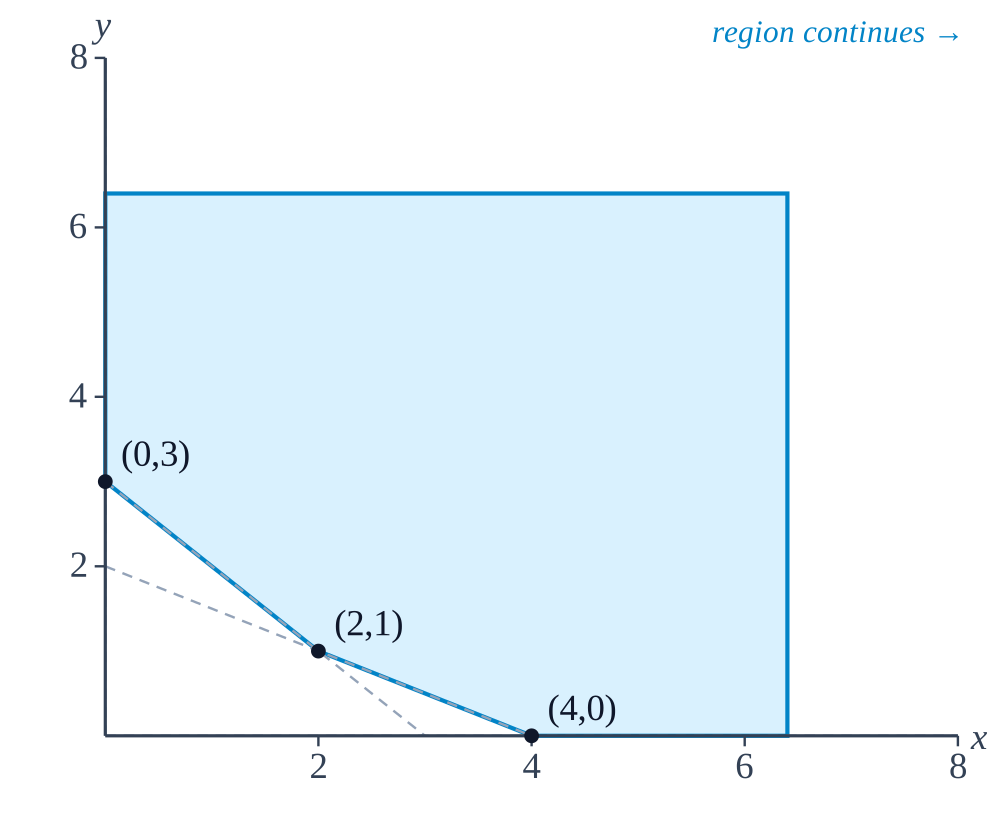
    The feasible region for a LPP is shown in Fig. 12.10. Evaluate Z=4x+y\displaystyle \mathrm{Z}=4 x+y at each of the corner points of this region. Find the minimum value of Z, if it exists. NCERT_Question_Class12_Maths_Exemplar_Ch12_Ex12-3_Q9

    Matches the book, not yet reviewed

    This working reaches the answer NCERT prints. It has not yet been read through by hand.

    NCERT’s answer
    Minimum value \(\displaystyle =3\)
    The arrows give the region:\[x \ge 0,\quad y \ge 0,\quad x+y \ge 3,\quad x+2y \ge 4 \]Corner points:\[x=0,\ x+y=3 \;\Rightarrow\; (0,3) \] \[x+y=3,\ x+2y=4 \;\Rightarrow\; (2,1) \] \[y=0,\ x+2y=4 \;\Rightarrow\; (4,0) \]NCERT_Solution_Class12_Maths_Exemplar_Ch12_Ex12-3_Q9\[Z(0,3)=4(0)+3=3 \] \[Z(2,1)=4(2)+1=9 \] \[Z(4,0)=4(4)+0=16 \]The region is unbounded, so check that \(\displaystyle 4x+y<3\) misses it. In the region \(\displaystyle y \ge 3-x\), so\[4x+y \ge 4x+(3-x)=3+3x \ge 3 \quad (x \ge 0) \]Hence the minimum exists.Answer: Minimum \(\displaystyle Z=3\) at \(\displaystyle (0,3)\).
  10. Exercise 10

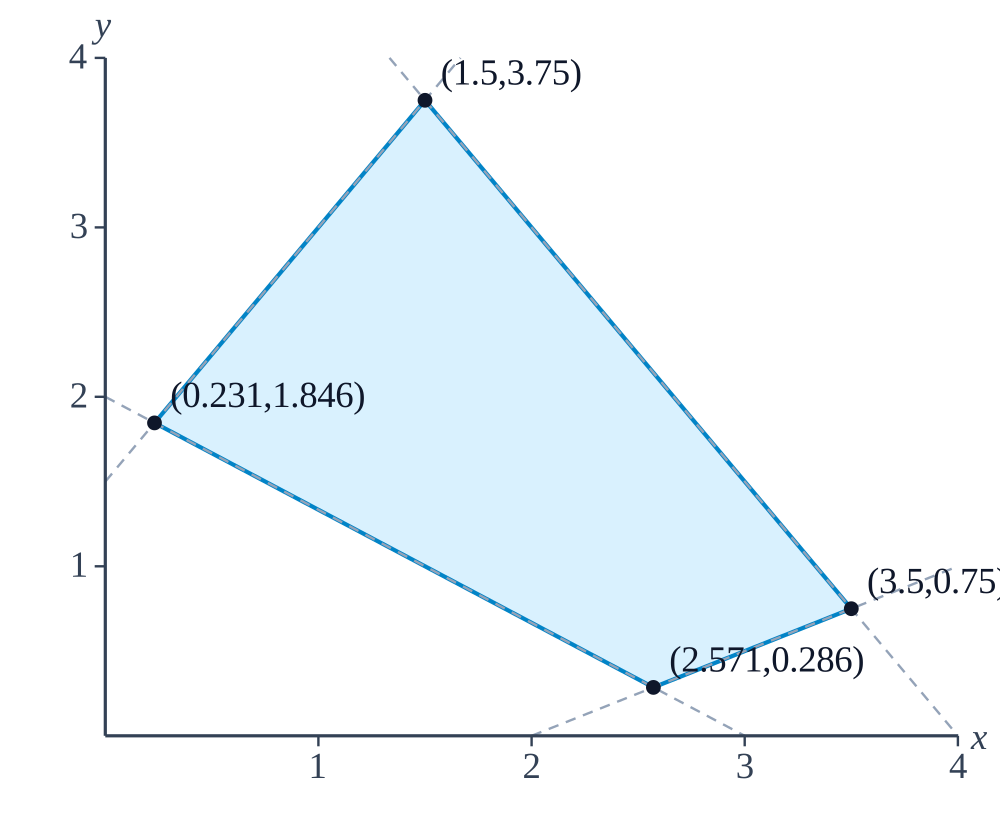
    In Fig. 12.11\displaystyle 12.11, the feasible region (shaded) for a LPP is shown. Determine the maximum and minimum value of Z=x+2y\displaystyle \mathrm{Z}=x+2 y NCERT_Question_Class12_Maths_Exemplar_Ch12_Ex12-3_Q10

    Matches the book, not yet reviewed

    This working reaches the answer NCERT prints. It has not yet been read through by hand.

    NCERT’s answer
    Maximum \(\displaystyle =9\), minimum \(\displaystyle =3 \frac{1}{7}\)
    Corner points from the figure: \(\displaystyle P\left(\tfrac{3}{13},\tfrac{24}{13}\right)\), \(\displaystyle Q\left(\tfrac32,\tfrac{15}{4}\right)\), \(\displaystyle R\left(\tfrac72,\tfrac34\right)\), \(\displaystyle S\left(\tfrac{18}{7},\tfrac27\right)\).NCERT_Solution_Class12_Maths_Exemplar_Ch12_Ex12-3_Q10\[Z(P)=\tfrac{3}{13}+2\cdot\tfrac{24}{13}=\tfrac{51}{13} \] \[Z(Q)=\tfrac32+2\cdot\tfrac{15}{4}=9 \] \[Z(R)=\tfrac72+2\cdot\tfrac34=5 \] \[Z(S)=\tfrac{18}{7}+2\cdot\tfrac27=\tfrac{22}{7} \]The region is bounded, so both extremes occur at corners:\[\tfrac{22}{7}<\tfrac{51}{13}<5<9 \]Answer: Maximum \(\displaystyle Z=9\) at \(\displaystyle Q\left(\tfrac32,\tfrac{15}{4}\right)\); minimum \(\displaystyle Z=\tfrac{22}{7}\) at \(\displaystyle S\left(\tfrac{18}{7},\tfrac27\right)\).