SolveIt is under development
SolveItNCERT · CBSE · NEET

NCERT Exemplar · Class 12 Mathematics Linear Programming

45 questions · 45 still being checked

EXERCISE 12.3 11–20 (part 2 of 5)

  1. Exercise 11

    A manufacturer of electronic circuits has a stock of 200\displaystyle 200 resistors, 120\displaystyle 120 transistors and 150\displaystyle 150 capacitors and is required to produce two types of circuits A and B. Type A requires 20\displaystyle 20 resistors, 10\displaystyle 10 transistors and 10\displaystyle 10 capacitors. Type B requires 10\displaystyle 10 resistors, 20\displaystyle 20 transistors and 30\displaystyle 30 capacitors. If the profit on type A circuit is Rs 50\displaystyle 50 and that on type B circuit is Rs 60\displaystyle 60, formulate this problem as a LPP so that the manufacturer can maximise his profit.

    Matches the book, not yet reviewed

    This working reaches the answer NCERT prints. It has not yet been read through by hand.

    NCERT’s answer
    Maximise \(\displaystyle \mathrm{Z}=50 x+60 y\), subject to: \[2 x+y \leq 20, x+2 y \leq 12, x+3 y \leq 15, x \geq 0, y \geq 0 \]
    Let \(\displaystyle x\) circuits of type A and \(\displaystyle y\) of type B be produced.\[\text{Maximise } Z=50x+60y \]subject to\[20x+10y\le 200 \;\Rightarrow\; 2x+y\le 20 \quad \text{(resistors)} \] \[10x+20y\le 120 \;\Rightarrow\; x+2y\le 12 \quad \text{(transistors)} \] \[10x+30y\le 150 \;\Rightarrow\; x+3y\le 15 \quad \text{(capacitors)} \] \[x\ge 0,\ y\ge 0 \]Answer: Maximise \(\displaystyle Z=50x+60y\) subject to \(\displaystyle 2x+y\le 20,\ x+2y\le 12,\ x+3y\le 15,\ x,y\ge 0\).
  2. Exercise 12

    A firm has to transport 1200\displaystyle 1200 packages using large vans which can carry 200\displaystyle 200 packages each and small vans which can take 80\displaystyle 80 packages each. The cost for engaging each large van is Rs 400\displaystyle 400 and each small van is Rs 200. Not more than Rs 3000\displaystyle 3000 is to be spent on the job and the number of large vans can not exceed the number of small vans. Formulate this problem as a LPP given that the objective is to minimise cost.

    Matches the book, not yet reviewed

    This working reaches the answer NCERT prints. It has not yet been read through by hand.

    NCERT’s answer
    Minimise \(\displaystyle \mathrm{Z}=400 x+200 y\), subject to: \[\begin{aligned} & 5 x+2 y \geq 30 \\ & 2 x+y \leq 15 \\ & x \leq y, x \geq 0, y \geq 0 \end{aligned} \]
    Let \(\displaystyle x\) large vans and \(\displaystyle y\) small vans be engaged.\[\text{Minimise } Z=400x+200y \]subject to\[200x+80y\ge 1200 \;\Rightarrow\; 5x+2y\ge 30 \quad \text{(packages)} \] \[400x+200y\le 3000 \;\Rightarrow\; 2x+y\le 15 \quad \text{(money)} \] \[x\le y \quad \text{(large vans not more than small)} \] \[x\ge 0,\ y\ge 0 \]Answer: Minimise \(\displaystyle Z=400x+200y\) subject to \(\displaystyle 5x+2y\ge 30,\ 2x+y\le 15,\ x\le y,\ x,y\ge 0\).
  3. Exercise 13

    A company manufactures two types of screws A and B. All the screws have to pass through a threading machine and a slotting machine. A box of Type A screws requires 2\displaystyle 2 minutes on the threading machine and 3\displaystyle 3 minutes on the slotting machine. A box of type B screws requires 8\displaystyle 8 minutes of threading on the threading machine and 2\displaystyle 2 minutes on the slotting machine. In a week, each machine is available for 60\displaystyle 60 hours. On selling these screws, the company gets a profit of Rs 100\displaystyle 100 per box on type A screws and Rs 170\displaystyle 170 per box on type B screws. Formulate this problem as a LPP given that the objective is to maximise profit.

    Matches the book, not yet reviewed

    This working reaches the answer NCERT prints. It has not yet been read through by hand.

    NCERT’s answer
    Maximise \(\displaystyle \mathrm{Z}=100 x+170 y\) subject to : \[3 x+2 y \leq 3600, x+4 y \leq 1800, x \geq 0, y \geq 0 \]
    Let \(\displaystyle x\) boxes of type A and \(\displaystyle y\) boxes of type B be made. Each machine has \(\displaystyle 60\times 60=3600\) minutes a week.\[\text{Maximise } Z=100x+170y \]subject to\[2x+8y\le 3600 \;\Rightarrow\; x+4y\le 1800 \quad \text{(threading)} \] \[3x+2y\le 3600 \quad \text{(slotting)} \] \[x\ge 0,\ y\ge 0 \]Answer: Maximise \(\displaystyle Z=100x+170y\) subject to \(\displaystyle x+4y\le 1800,\ 3x+2y\le 3600,\ x,y\ge 0\).
  4. Exercise 14

    A company manufactures two types of sweaters : type A and type B. It costs Rs 360\displaystyle 360 to make a type A sweater and Rs 120\displaystyle 120 to make a type B sweater. The company can make at most 300\displaystyle 300 sweaters and spend at most Rs 72000\displaystyle 72000 a day. The number of sweaters of type B cannot exceed the number of sweaters of type A by more than 100. The company makes a profit of Rs 200\displaystyle 200 for each sweater of type A and Rs 120\displaystyle 120 for every sweater of type B. Formulate this problem as a LPP to maximise the profit to the company.

    Matches the book, not yet reviewed

    This working reaches the answer NCERT prints. It has not yet been read through by hand.

    NCERT’s answer
    Maximise \(\displaystyle \mathrm{Z}=200 x+120 y\) subject to : \[x+y \leq 300,3 x+y \leq 600, y \leq x+100, x \geq 0, y \geq 0 \]
    Let \(\displaystyle x\) sweaters of type A and \(\displaystyle y\) of type B be made in a day.\[\text{Maximise } Z=200x+120y \]subject to\[x+y\le 300 \quad \text{(at most 300 sweaters)} \] \[360x+120y\le 72000 \;\Rightarrow\; 3x+y\le 600 \quad \text{(cost)} \] \[y-x\le 100 \quad \text{(B exceeds A by at most 100)} \] \[x\ge 0,\ y\ge 0 \]Answer: Maximise \(\displaystyle Z=200x+120y\) subject to \(\displaystyle x+y\le 300,\ 3x+y\le 600,\ -x+y\le 100,\ x,y\ge 0\).
  5. Exercise 15

    A man rides his motorcycle at the speed of 50\displaystyle 50 km/hour. He has to spend Rs 2\displaystyle 2 per km on petrol. If he rides it at a faster speed of 80\displaystyle 80 km/hour, the petrol cost increases to Rs 3\displaystyle 3 per km. He has atmost Rs 120\displaystyle 120 to spend on petrol and one hour's time. He wishes to find the maximum distance that he can travel. Express this problem as a linear programming problem.

    Matches the book, not yet reviewed

    This working reaches the answer NCERT prints. It has not yet been read through by hand.

    NCERT’s answer
    Maximise \(\displaystyle \mathrm{Z}=x+y\), subject to \[2 x+3 y \leq 120,8 x+5 y \leq 400, x \geq 0, y \geq 0 \]
    Let \(\displaystyle x\) km be ridden at $\displaystyle 50$ km/h and \(\displaystyle y\) km at $\displaystyle 80$ km/h.\[\text{Maximise } Z=x+y \]subject to\[2x+3y\le 120 \quad \text{(petrol money)} \] \[\frac{x}{50}+\frac{y}{80}\le 1 \;\Rightarrow\; 8x+5y\le 400 \quad \text{(time)} \] \[x\ge 0,\ y\ge 0 \]Answer: Maximise \(\displaystyle Z=x+y\) subject to \(\displaystyle 2x+3y\le 120,\ 8x+5y\le 400,\ x,y\ge 0\).
  6. Exercise 16

    Refer to Exercise 11. How many of circuits of Type A and of Type B, should be produced by the manufacturer so as to maximise his profit? Determine the maximum profit.

    Check this one against your book

    NCERT’s printed answer for this exercise does not match its own question. This working follows the question as printed.

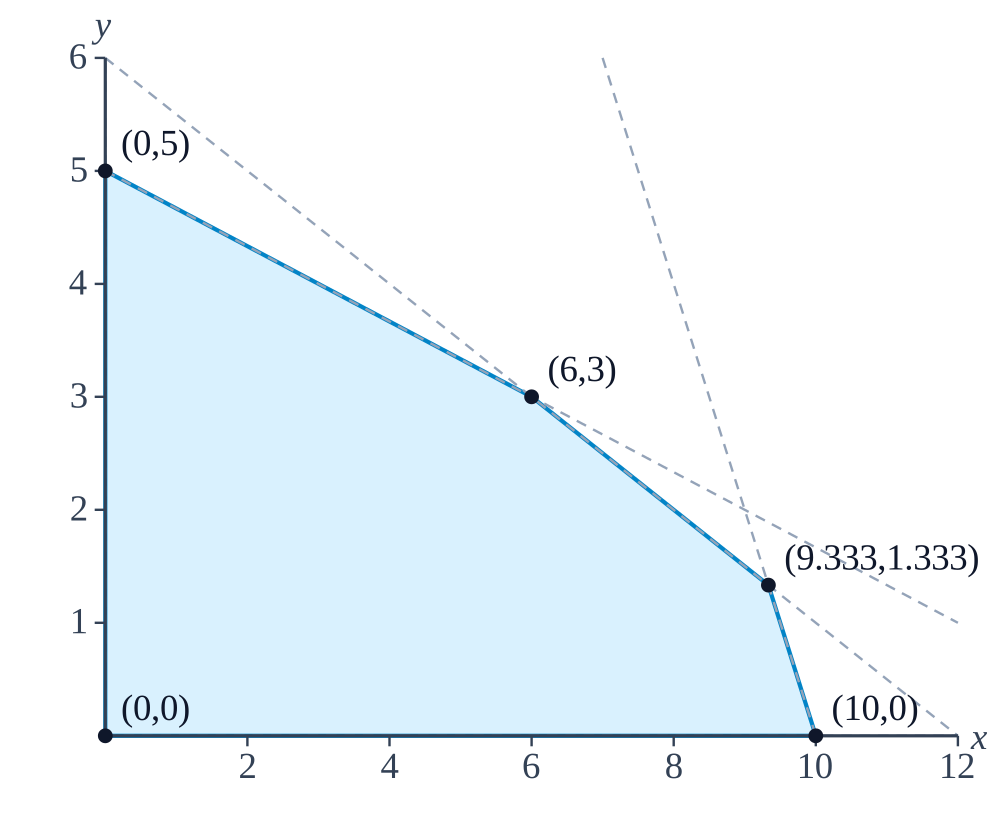
    \[\text{Maximise } Z=50x+60y \] \[2x+y\le 20,\quad x+2y\le 12,\quad x+3y\le 15,\quad x,y\ge 0 \]NCERT_Solution_Class12_Maths_Exemplar_Ch12_Ex12-3_Q16Corner points:\[2x+y=20,\ x+2y=12 \;\Rightarrow\; \left(\tfrac{28}{3},\tfrac43\right) \] \[x+2y=12,\ x+3y=15 \;\Rightarrow\; (6,3) \] \[\text{on the axes: } (0,0),\ (10,0),\ (0,5) \]\[Z(0,0)=0 \] \[Z(10,0)=500 \] \[Z\left(\tfrac{28}{3},\tfrac43\right)=\tfrac{1400}{3}+80=\tfrac{1640}{3} \] \[Z(6,3)=300+180=480 \] \[Z(0,5)=300 \]The largest value is \(\displaystyle \tfrac{1640}{3}\). Circuits are whole numbers, so the best whole-number plan is also noted:\[Z(8,2)=400+120=520 \]Answer: As an LPP, \(\displaystyle \tfrac{28}{3}\) of type A and \(\displaystyle \tfrac43\) of type B give the maximum profit Rs \(\displaystyle \tfrac{1640}{3}\); in whole circuits, $\displaystyle 8$ of type A and $\displaystyle 2$ of type B give Rs 520.
  7. Exercise 17

    Refer to Exercise 12. What will be the minimum cost?

    Matches the book, not yet reviewed

    This working reaches the answer NCERT prints. It has not yet been read through by hand.

    NCERT’s answer
    $\displaystyle 2571.43$
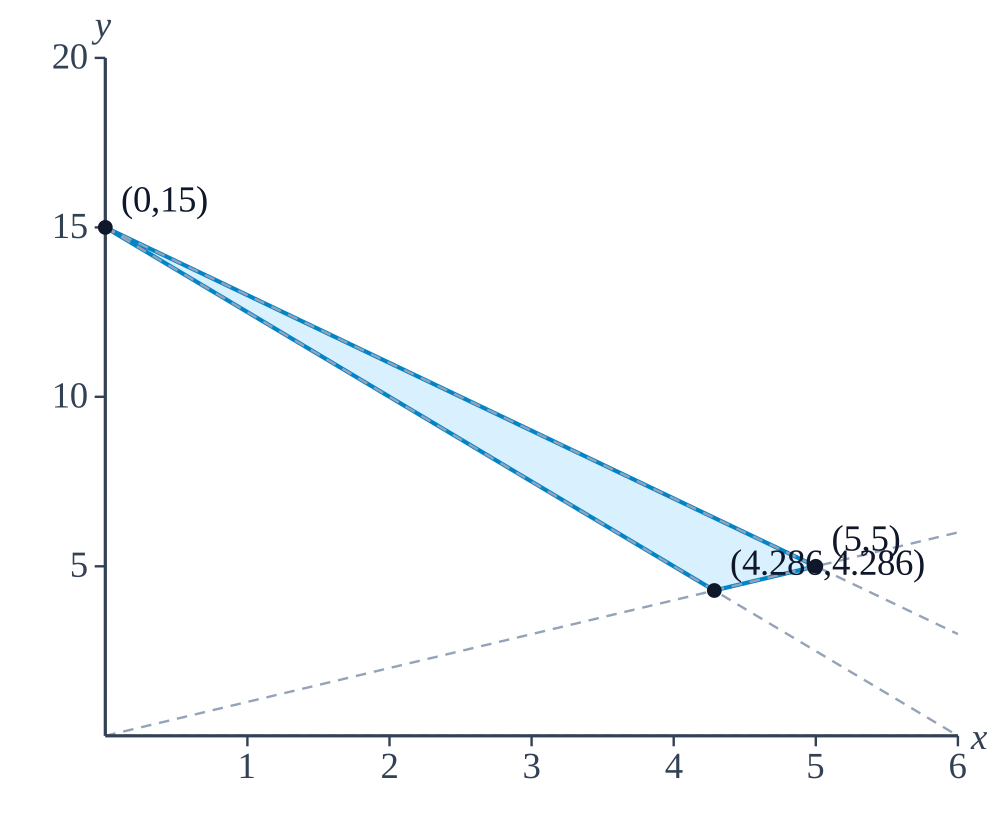
    Let \(\displaystyle x\) = number of large vans, \(\displaystyle y\) = number of small vans.\[\text{Minimise } Z = 400x + 200y \] \[200x + 80y \ge 1200 \;\Rightarrow\; 5x + 2y \ge 30 \] \[400x + 200y \le 3000 \;\Rightarrow\; 2x + y \le 15 \] \[x \le y, \quad x, y \ge 0 \] NCERT_Solution_Class12_Maths_Exemplar_Ch12_Ex12-3_Q17 Corner points: \[5x + 2y = 30,\ x = y \;\Rightarrow\; \left(\tfrac{30}{7}, \tfrac{30}{7}\right) \] \[2x + y = 15,\ x = y \;\Rightarrow\; (5,5) \] \[5x + 2y = 30,\ 2x + y = 15 \;\Rightarrow\; (0,15) \] The region is bounded, so \(\displaystyle Z\) is least at a corner point: \[\left(\tfrac{30}{7}, \tfrac{30}{7}\right):\ Z = 600\cdot\tfrac{30}{7} = \tfrac{18000}{7} \approx 2571.43 \] \[(5,5):\ Z = 2000 + 1000 = 3000 \] \[(0,15):\ Z = 3000 \] Answer: Minimum cost Rs \(\displaystyle \tfrac{18000}{7} \approx 2571.43\), at \(\displaystyle x = y = \tfrac{30}{7}\).
  8. Exercise 18

    Refer to Exercise 13. Solve the linear programming problem and determine the maximum profit to the manufacturer.

    Matches the book, not yet reviewed

    This working reaches the answer NCERT prints. It has not yet been read through by hand.

    NCERT’s answer
    $\displaystyle 138600$
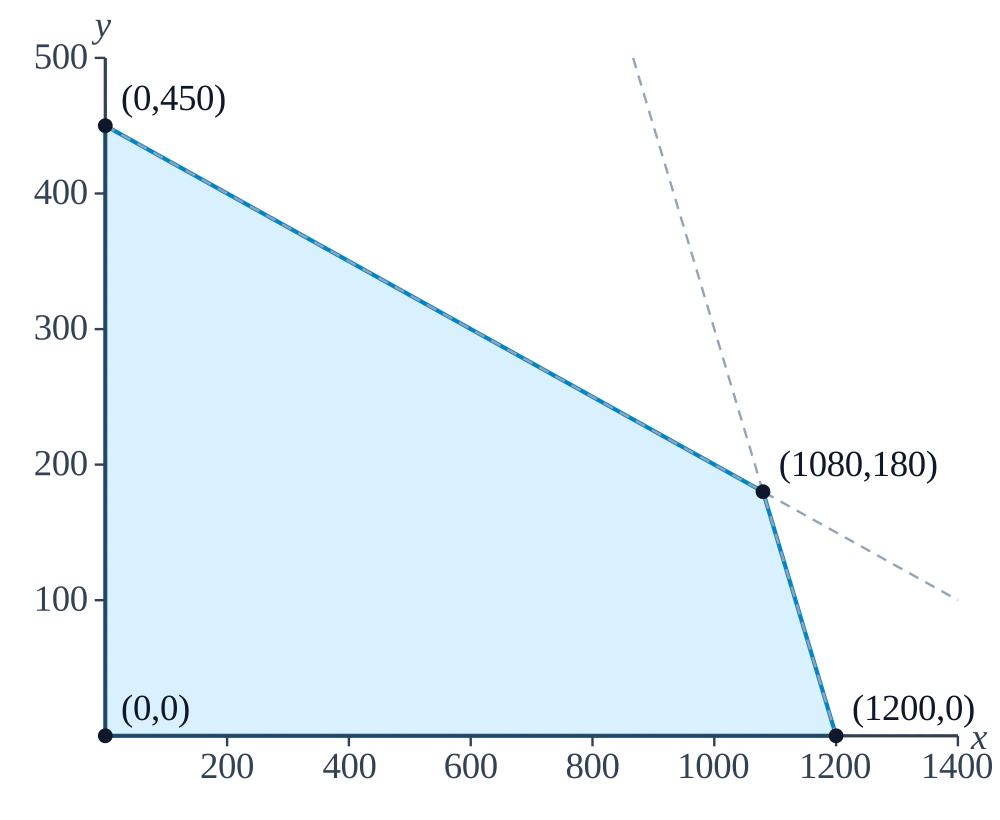
    Let \(\displaystyle x\) boxes of type A and \(\displaystyle y\) boxes of type B; \(\displaystyle 60\) h \(\displaystyle = 3600\) min.\[\text{Maximise } Z = 100x + 170y \] \[2x + 8y \le 3600 \;\Rightarrow\; x + 4y \le 1800 \] \[3x + 2y \le 3600 \] \[x, y \ge 0 \] NCERT_Solution_Class12_Maths_Exemplar_Ch12_Ex12-3_Q18 Meeting point of the two lines: \[3(1800 - 4y) + 2y = 3600 \;\Rightarrow\; 10y = 1800 \;\Rightarrow\; y = 180,\ x = 1080 \] Value of \(\displaystyle Z\) at the corners: \[Z(0,0) = 0 \] \[Z(1200, 0) = 120000 \] \[Z(0, 450) = 76500 \] \[Z(1080, 180) = 108000 + 30600 = 138600 \] Answer: Maximum profit Rs \(\displaystyle 138600\), at \(\displaystyle 1080\) boxes of type A and \(\displaystyle 180\) boxes of type B.
  9. Exercise 19

    Refer to Exercise 14. How many sweaters of each type should the company make in a day to get a maximum profit? What is the maximum profit.

    Matches the book, not yet reviewed

    This working reaches the answer NCERT prints. It has not yet been read through by hand.

    NCERT’s answer
    $\displaystyle 150$ sweaters of each type and maximum profit = Rs $\displaystyle 48{,}000$
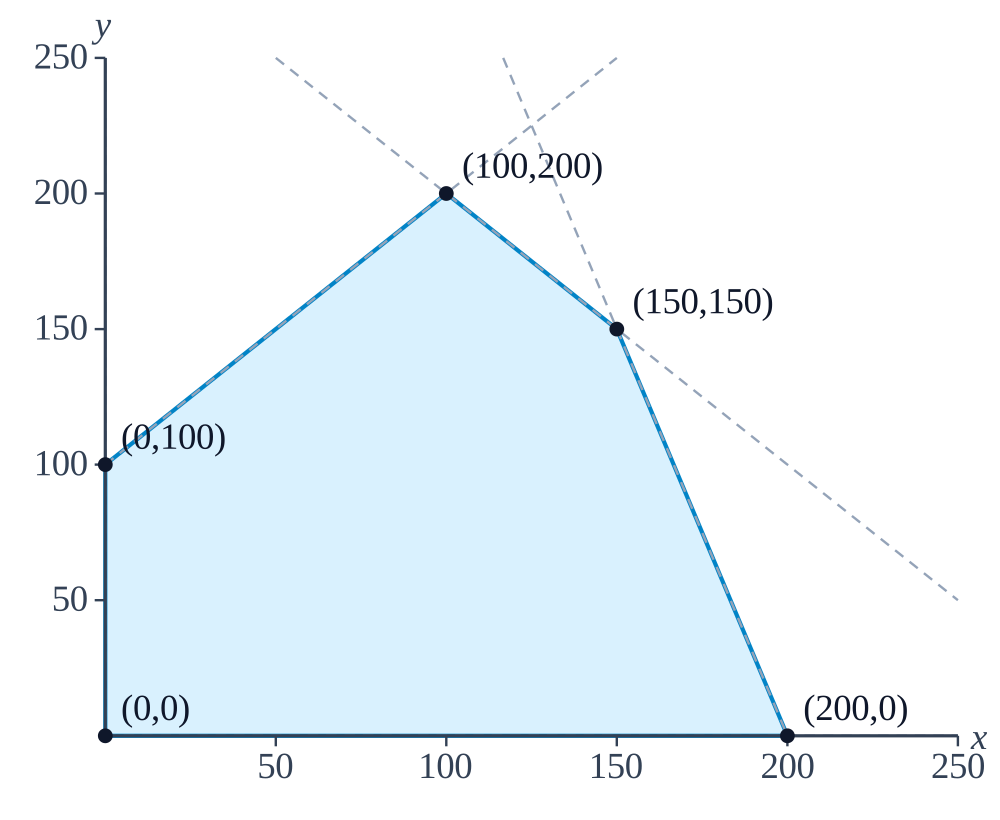
    Let \(\displaystyle x\) sweaters of type A and \(\displaystyle y\) of type B.\[\text{Maximise } Z = 200x + 120y \] \[x + y \le 300 \] \[360x + 120y \le 72000 \;\Rightarrow\; 3x + y \le 600 \] \[y \le x + 100 \] \[x, y \ge 0 \] NCERT_Solution_Class12_Maths_Exemplar_Ch12_Ex12-3_Q19 Corner points: \[3x + y = 600,\ x + y = 300 \;\Rightarrow\; 2x = 300 \;\Rightarrow\; (150, 150) \] \[x + y = 300,\ y = x + 100 \;\Rightarrow\; (100, 200) \] Value of \(\displaystyle Z\): \[Z(0,0) = 0 \] \[Z(200, 0) = 40000 \] \[Z(150, 150) = 30000 + 18000 = 48000 \] \[Z(100, 200) = 20000 + 24000 = 44000 \] \[Z(0, 100) = 12000 \] Answer: \(\displaystyle 150\) sweaters of each type; maximum profit Rs \(\displaystyle 48000\).
  10. Exercise 20

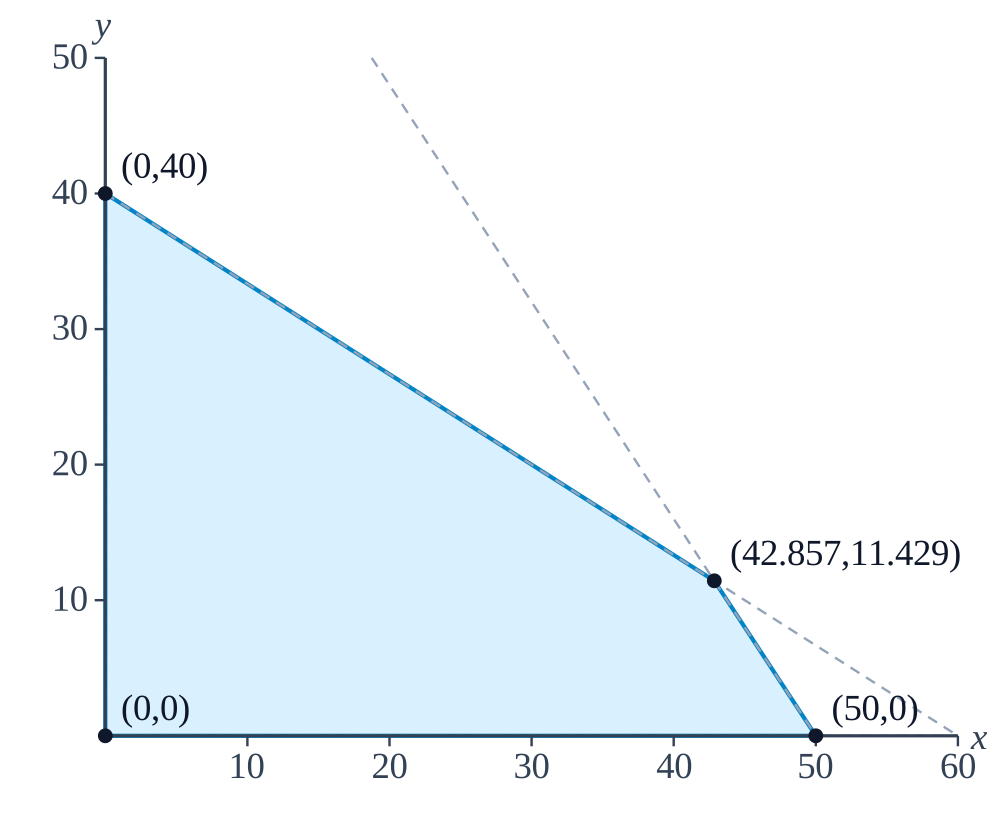
    Refer to Exercise 15. Determine the maximum distance that the man can travel.

    Matches the book, not yet reviewed

    This working reaches the answer NCERT prints. It has not yet been read through by hand.

    NCERT’s answer
    \(\displaystyle 54 \frac{2}{7} \mathrm{~km}\).
    Let \(\displaystyle x\) km be ridden at \(\displaystyle 50\) km/h and \(\displaystyle y\) km at \(\displaystyle 80\) km/h.\[\text{Maximise } Z = x + y \] \[\tfrac{x}{50} + \tfrac{y}{80} \le 1 \;\Rightarrow\; 8x + 5y \le 400 \] \[2x + 3y \le 120 \] \[x, y \ge 0 \] NCERT_Solution_Class12_Maths_Exemplar_Ch12_Ex12-3_Q20 Meeting point of the two lines: \[4(2x + 3y) - (8x + 5y) = 480 - 400 \;\Rightarrow\; 7y = 80 \] \[y = \tfrac{80}{7}, \quad x = \tfrac{300}{7} \] Value of \(\displaystyle Z\) at the corners: \[Z(0,0) = 0 \] \[Z(50, 0) = 50 \] \[Z(0, 40) = 40 \] \[Z\left(\tfrac{300}{7}, \tfrac{80}{7}\right) = \tfrac{380}{7} \approx 54.29 \] Answer: Maximum distance \(\displaystyle \tfrac{380}{7} \approx 54.29\) km (\(\displaystyle \tfrac{300}{7}\) km at \(\displaystyle 50\) km/h and \(\displaystyle \tfrac{80}{7}\) km at \(\displaystyle 80\) km/h).