SolveIt is under development
SolveItNCERT · CBSE · NEET

NCERT Exemplar · Class 12 Mathematics Linear Programming

45 questions · 45 still being checked

EXERCISE 12.3 21–30 (part 3 of 5)

  1. Exercise 21

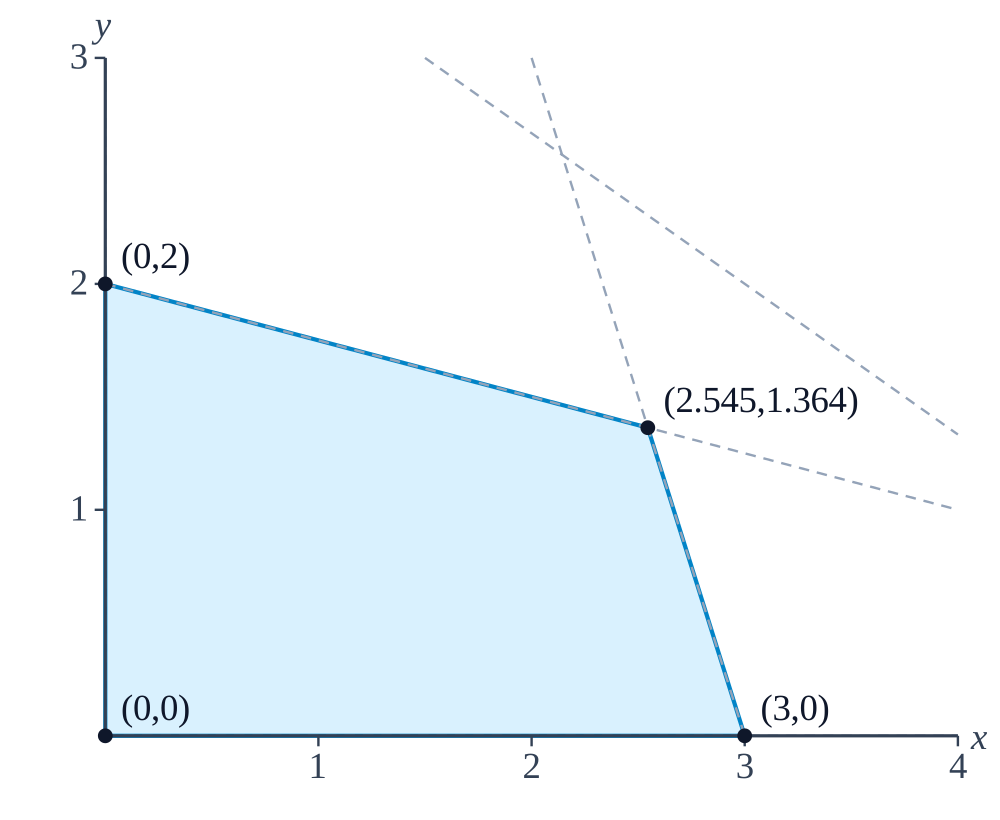
    Maximise Z=x+y\displaystyle \mathrm{Z}=x+y subject to x+4y≤8,2x+3y≤12,3x+y≤9,x≥0,y≥0\displaystyle x+4 y \leq 8,2 x+3 y \leq 12,3 x+y \leq 9, x \geq 0, y \geq 0.

    Matches the book, not yet reviewed

    This working reaches the answer NCERT prints. It has not yet been read through by hand.

    NCERT’s answer
    \(\displaystyle 3 \frac{10}{11}\)
    \[\text{Maximise } Z = x + y \] NCERT_Solution_Class12_Maths_Exemplar_Ch12_Ex12-3_Q21 The lines \(\displaystyle x + 4y = 8\) and \(\displaystyle 3x + y = 9\) meet where \[3(8 - 4y) + y = 9 \;\Rightarrow\; 11y = 15 \;\Rightarrow\; \left(\tfrac{28}{11}, \tfrac{15}{11}\right) \] \[2x + 3y = \tfrac{56 + 45}{11} = \tfrac{101}{11} < 12 \] So \(\displaystyle 2x + 3y \le 12\) is satisfied there (and at \(\displaystyle (3,0)\), \(\displaystyle (0,2)\)). Value of \(\displaystyle Z\): \[Z(0,0) = 0 \] \[Z(3,0) = 3 \] \[Z(0,2) = 2 \] \[Z\left(\tfrac{28}{11}, \tfrac{15}{11}\right) = \tfrac{43}{11} \] Answer: Maximum \(\displaystyle Z = \tfrac{43}{11}\), at \(\displaystyle x = \tfrac{28}{11},\ y = \tfrac{15}{11}\).
  2. Exercise 22

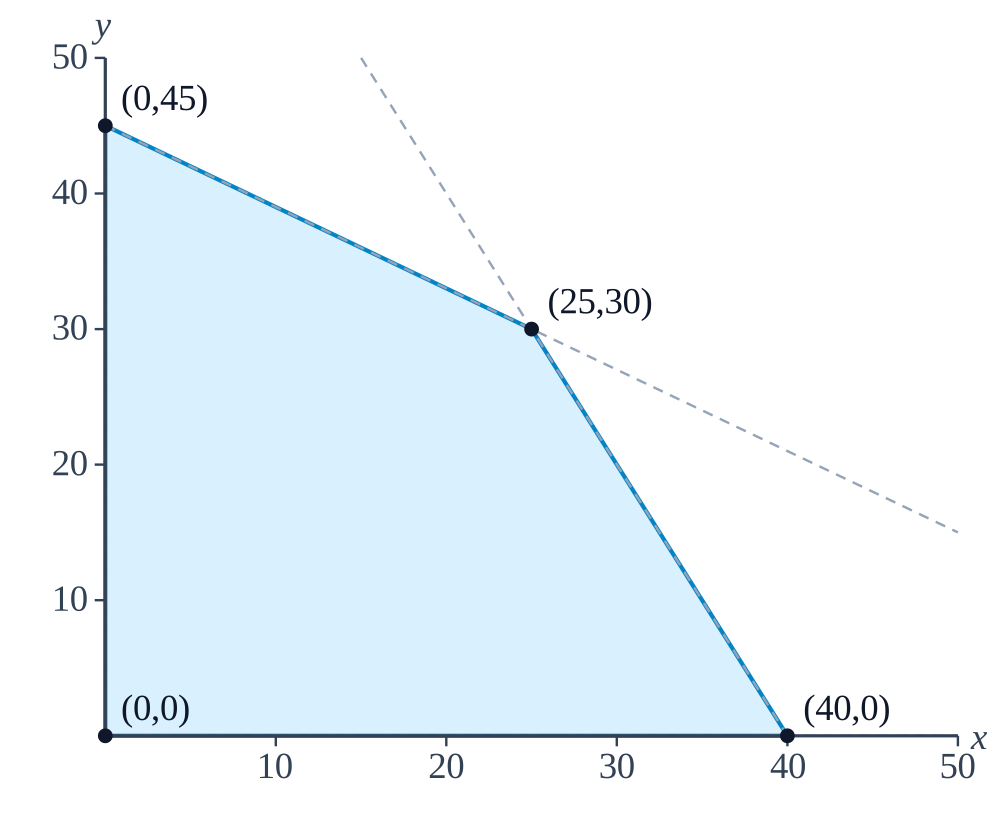
    A manufacturer produces two Models of bikes - Model X and Model Y. Model X takes a 6\displaystyle 6 man-hours to make per unit, while Model Y takes 10\displaystyle 10 man-hours per unit. There is a total of 450\displaystyle 450 man-hour available per week. Handling and Marketing costs are Rs 2000\displaystyle 2000 and Rs 1000\displaystyle 1000 per unit for Models X and Y respectively. The total funds available for these purposes are Rs 80,000\displaystyle 80{,}000 per week. Profits per unit for Models X and Y are Rs 1000\displaystyle 1000 and Rs 500\displaystyle 500, respectively. How many bikes of each model should the manufacturer produce so as to yield a maximum profit? Find the maximum profit.

    Matches the book, not yet reviewed

    This working reaches the answer NCERT prints. It has not yet been read through by hand.

    NCERT’s answer
    Model X : $\displaystyle 25$, Model Y : $\displaystyle 30$ and maximum profit = Rs $\displaystyle 40{,}000$
    Let \(\displaystyle x\) bikes of Model X and \(\displaystyle y\) of Model Y per week.\[\text{Maximise } Z = 1000x + 500y = 500(2x + y) \] \[6x + 10y \le 450 \;\Rightarrow\; 3x + 5y \le 225 \] \[2000x + 1000y \le 80000 \;\Rightarrow\; 2x + y \le 80 \] \[x, y \ge 0 \] NCERT_Solution_Class12_Maths_Exemplar_Ch12_Ex12-3_Q22 Meeting point of the two lines: \[3x + 5(80 - 2x) = 225 \;\Rightarrow\; -7x = -175 \;\Rightarrow\; (25, 30) \] Value of \(\displaystyle Z\): \[Z(0,0) = 0 \] \[Z(0, 45) = 22500 \] \[Z(40, 0) = 40000 \] \[Z(25, 30) = 25000 + 15000 = 40000 \] The two best corners lie on \(\displaystyle 2x + y = 80\), so every point of that edge gives the same value: \[Z = 500 \cdot 80 = 40000, \qquad 25 \le x \le 40 \] Answer: Maximum profit Rs \(\displaystyle 40000\), for example \(\displaystyle 25\) bikes of Model X and \(\displaystyle 30\) of Model Y (any \(\displaystyle (x,\ 80 - 2x)\) with \(\displaystyle 25 \le x \le 40\) gives the same profit).
  3. Exercise 23

    In order to supplement daily diet, a person wishes to take some X and some wishes Y tablets. The contents of iron, calcium and vitamins in X and Y (in milligrams per tablet) are given as below:
    TabletsIronCalciumVitamin
    X6\displaystyle 63\displaystyle 32\displaystyle 2
    Y2\displaystyle 23\displaystyle 34\displaystyle 4
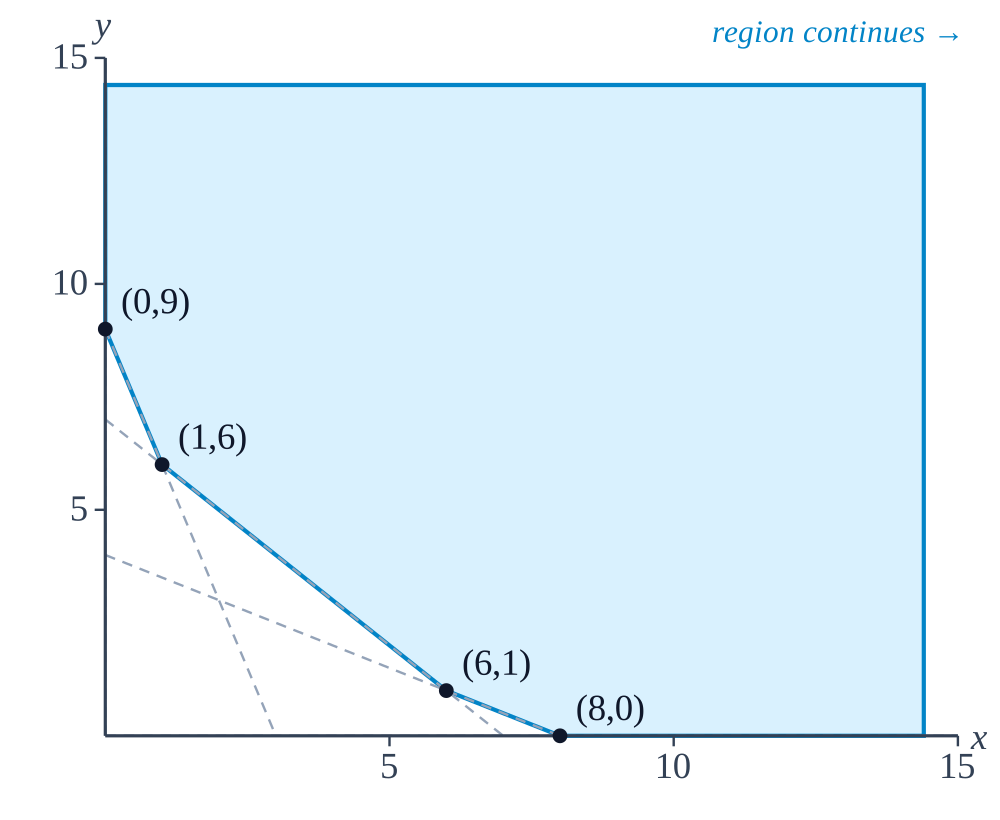
    The person needs at least 18\displaystyle 18 milligrams of iron, 21\displaystyle 21 milligrams of calcium and 16\displaystyle 16 milligram of vitamins. The price of each tablet of X and Y is Rs 2\displaystyle 2 and Re 1\displaystyle 1 respectively. How many tablets of each should the person take inorder to satisfy the above requirement at the minimum cost?

    Matches the book, not yet reviewed

    This working reaches the answer NCERT prints. It has not yet been read through by hand.

    NCERT’s answer
    Tablet X : $\displaystyle 1$, Tablet Y : $\displaystyle 6$
    Let \(\displaystyle x\) tablets of X and \(\displaystyle y\) tablets of Y.\[\text{Minimise } Z = 2x + y \] \[6x + 2y \ge 18 \;\Rightarrow\; 3x + y \ge 9 \] \[3x + 3y \ge 21 \;\Rightarrow\; x + y \ge 7 \] \[2x + 4y \ge 16 \;\Rightarrow\; x + 2y \ge 8 \] \[x, y \ge 0 \] NCERT_Solution_Class12_Maths_Exemplar_Ch12_Ex12-3_Q23 Corner points: \[3x + y = 9,\ x + y = 7 \;\Rightarrow\; (1, 6) \] \[x + y = 7,\ x + 2y = 8 \;\Rightarrow\; (6, 1) \] \[Z(0, 9) = 9 \] \[Z(1, 6) = 8 \] \[Z(6, 1) = 13 \] \[Z(8, 0) = 16 \] The region is unbounded, so check that no point gives less than \(\displaystyle 8\): \[2x + y = \tfrac12(3x + y) + \tfrac12(x + y) \ge \tfrac{9 + 7}{2} = 8 \] Answer: \(\displaystyle 1\) tablet of X and \(\displaystyle 6\) of Y; minimum cost Rs \(\displaystyle 8\).
  4. Exercise 24

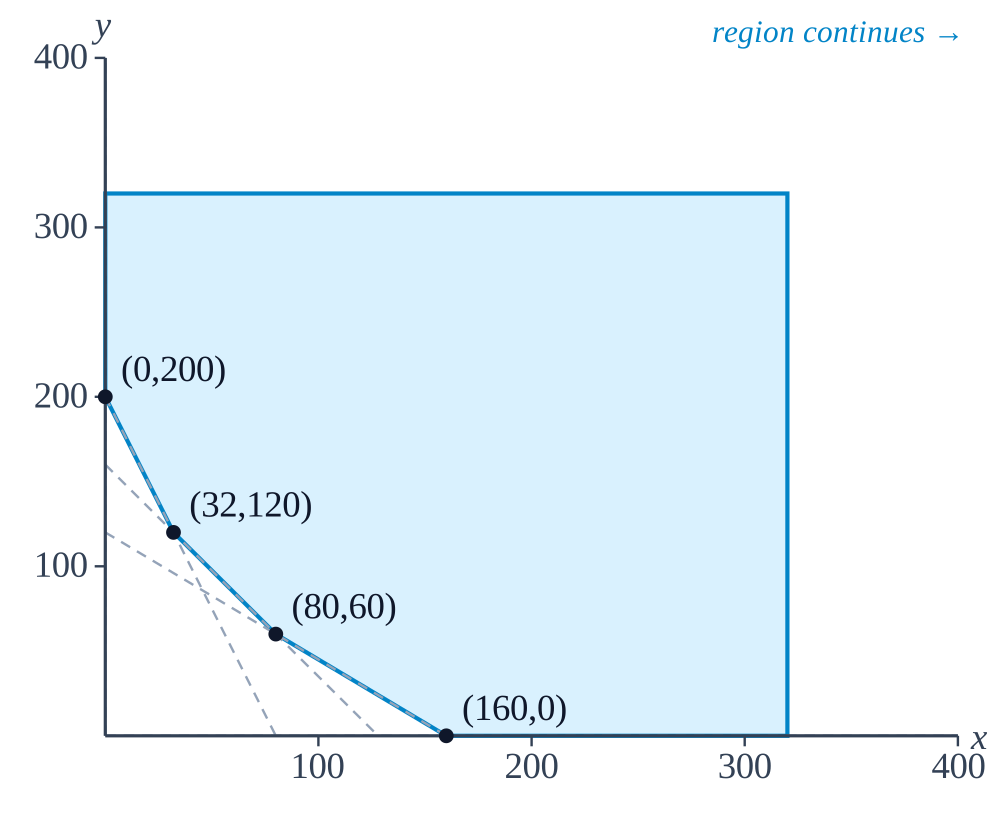
    A company makes 3\displaystyle 3 model of calculators: A, B and C at factory I and factory II. The company has orders for at least 6400\displaystyle 6400 calculators of model A, 4000\displaystyle 4000 calculator of model B and 4800\displaystyle 4800 calculator of model C. At factory I, 50\displaystyle 50 calculators of model A, 50\displaystyle 50 of model B and 30\displaystyle 30 of model C are made every day; at factory II, 40\displaystyle 40 calculators of model A, 20\displaystyle 20 of model B and 40\displaystyle 40 of model C are made everyday. It costs Rs 12000\displaystyle 12000 and Rs 15000\displaystyle 15000 each day to operate factory I and II, respectively. Find the number of days each factory should operate to minimise the operating costs and still meet the demand.

    Matches the book, not yet reviewed

    This working reaches the answer NCERT prints. It has not yet been read through by hand.

    NCERT’s answer
    Factory I : $\displaystyle 80$ days, Factory II : $\displaystyle 60$ days
    Let factory I run \(\displaystyle x\) days and factory II \(\displaystyle y\) days.\[\text{Minimise } Z = 12000x + 15000y \] \[50x + 40y \ge 6400 \;\Rightarrow\; 5x + 4y \ge 640 \] \[50x + 20y \ge 4000 \;\Rightarrow\; 5x + 2y \ge 400 \] \[30x + 40y \ge 4800 \;\Rightarrow\; 3x + 4y \ge 480 \] \[x, y \ge 0 \] NCERT_Solution_Class12_Maths_Exemplar_Ch12_Ex12-3_Q24 Corner points: \[5x + 4y = 640,\ 3x + 4y = 480 \;\Rightarrow\; (80, 60) \] \[5x + 4y = 640,\ 5x + 2y = 400 \;\Rightarrow\; (32, 120) \] \[Z(0, 200) = 3000000 \] \[Z(32, 120) = 384000 + 1800000 = 2184000 \] \[Z(80, 60) = 960000 + 900000 = 1860000 \] \[Z(160, 0) = 1920000 \] The region is unbounded, so check that no point gives less than \(\displaystyle 1860000\): \[Z = 375(5x + 4y) + 3375(3x + 4y) \ge 375(640) + 3375(480) = 1860000 \] Answer: Factory I for \(\displaystyle 80\) days and factory II for \(\displaystyle 60\) days; minimum cost Rs \(\displaystyle 1860000\).
  5. Exercise 25

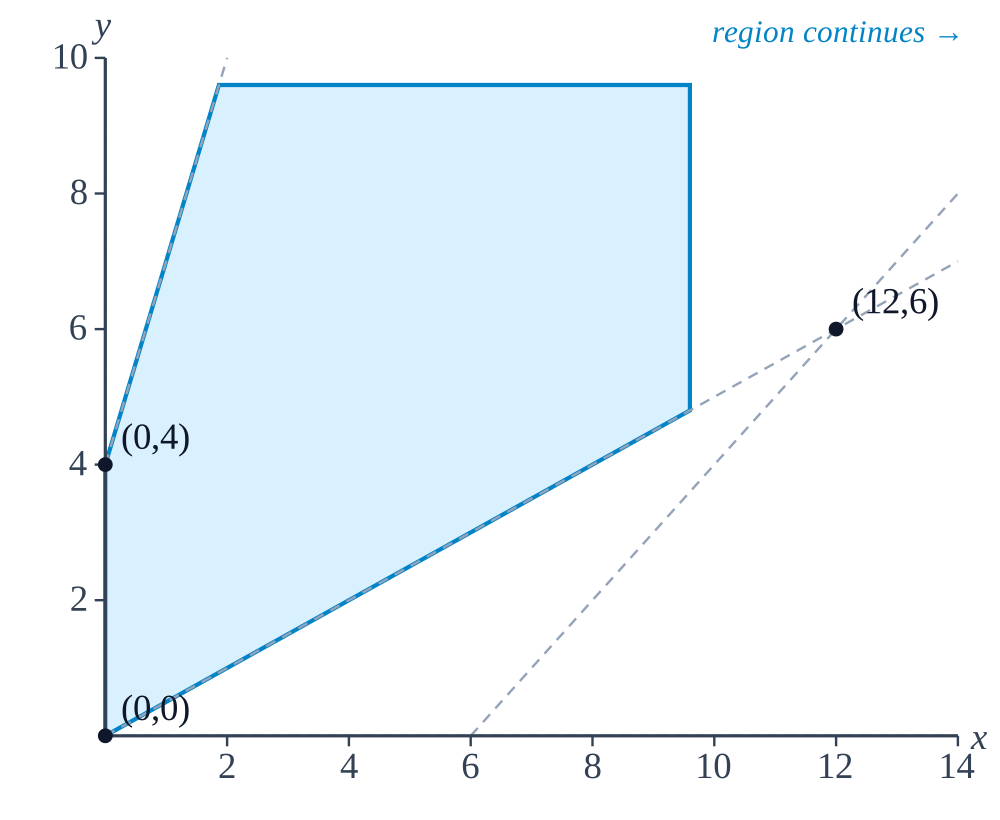
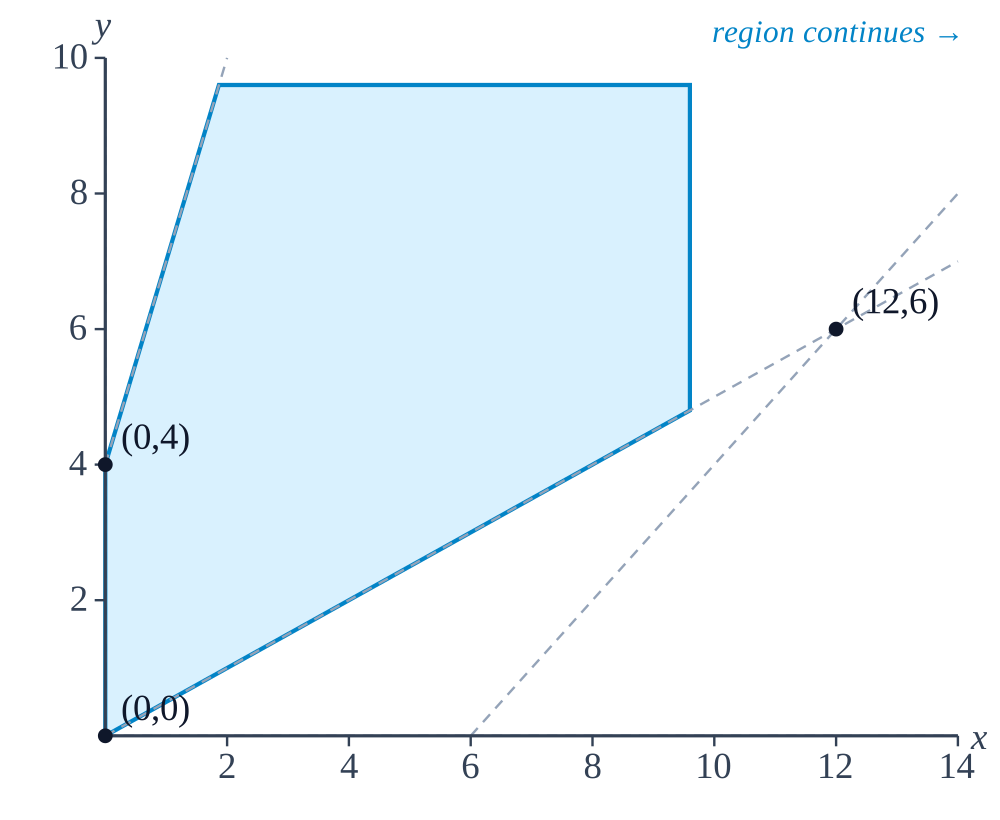
    Maximise and Minimise Z=3x−4y\displaystyle \mathrm{Z}=3 x-4 y subject to x−2y≤0−3x+y≤4x−y≤6x,y≥0\begin{gathered} x-2 y \leq 0 \\ -3 x+y \leq 4 \\ x-y \leq 6 \\ x, y \geq 0 \end{gathered}

    Matches the book, not yet reviewed

    This working reaches the answer NCERT prints. It has not yet been read through by hand.

    NCERT’s answer
    Maximum : $\displaystyle 12$, Minimum does not exist
    Corner points (every other intersection breaks a constraint): \[x=0,\ x-2y=0 \Rightarrow (0,0) \] \[x=0,\ -3x+y=4 \Rightarrow (0,4) \] \[x-2y=0,\ x-y=6 \Rightarrow (12,6) \] NCERT_Solution_Class12_Maths_Exemplar_Ch12_Ex12-3_Q25 \[Z(0,0)=0,\quad Z(0,4)=-16,\quad Z(12,6)=36-24=12 \] The region is unbounded, so test the whole region. \[x-2y\le 0 \Rightarrow 4y\ge 2x \Rightarrow Z\le 3x-2x=x \] \[x-y\le 6 \Rightarrow 4y\ge 4x-24 \Rightarrow Z\le 3x-4x+24=24-x \] \[2Z\le 24 \Rightarrow Z\le 12 \] For the minimum, take a point of the region far above: \[(10,30):\ x-2y=-50\le 0,\quad -3x+y=0\le 4,\quad x-y=-20\le 6 \] \[Z(10,30)=30-120=-90<-16 \] A minimum would sit at a corner, yet Z falls below \(\displaystyle -16\) inside the region, so none exists. Answer: Maximum \(\displaystyle Z=12\) at \(\displaystyle (12,6)\); no minimum value exists.
  6. Choose the correct answer from the given four options in each of the Exercises $\displaystyle 26$ to 34.

    Exercise 26

    The corner points of the feasible region determined by the system of linear constraints are (0,0)\displaystyle (0, 0), (0,40)\displaystyle (0, 40), (20,40)\displaystyle (20, 40), (60,20)\displaystyle (60, 20), (60,0)\displaystyle (60, 0). The objective function is Z=4x+3y\displaystyle \mathrm{Z}=4 x+3 y.
    Compare the quantity in Column A and Column B
    Column AColumn B
    Maximum of Z325\displaystyle 325
    (A)
    The quantity in column A is greater
    (B)
    The quantity in column B is greater
    (C)
    The two quantities are equal
    (D)
    The relationship can not be determined on the basis of the information supplied

    Matches the book, not yet reviewed

    This working reaches the answer NCERT prints. It has not yet been read through by hand.

    NCERT’s answer
    B
    (B) The quantity in column B is greater.The region is a bounded polygon, so Z is largest at a corner. \[Z(0,0)=0,\quad Z(0,40)=120,\quad Z(20,40)=80+120=200 \] \[Z(60,20)=240+60=300,\quad Z(60,0)=240 \] \[\max Z=300<325 \]
  7. Exercise 27

    The feasible solution for a LPP is shown in Fig. 12.12. Let Z=3x−4y\displaystyle \mathrm{Z}=3 x-4 y be the objective function. Minimum of Z occurs at
    (A)
    (0,0)\displaystyle (0,0)
    (B)
    (0,8)\displaystyle (0,8)
    (C)
    (5,0)\displaystyle (5,0)
    (D)
    (4,10)\displaystyle (4,10)
    NCERT_Question_Class12_Maths_Exemplar_Ch12_Ex12-3_Q27

    Matches the book, not yet reviewed

    This working reaches the answer NCERT prints. It has not yet been read through by hand.

    NCERT’s answer
    B
    (B) \(\displaystyle (0,8)\)The region is bounded, so Z is least at a corner read from the figure. \[Z(0,0)=0,\quad Z(0,8)=-32,\quad Z(4,10)=12-40=-28 \] \[Z(6,8)=18-32=-14,\quad Z(6,5)=18-20=-2,\quad Z(5,0)=15 \] \[\min Z=-32 \text{ at } (0,8) \]
  8. Exercise 28

    Refer to Exercise 27. Maximum of Z occurs at
    (A)
    (5,0)\displaystyle (5,0)
    (B)
    (6,5)\displaystyle (6,5)
    (C)
    (6,8)\displaystyle (6,8)
    (D)
    (4,10)\displaystyle (4,10)
    NCERT_Question_Class12_Maths_Exemplar_Ch12_Ex12-3_Q28

    Matches the book, not yet reviewed

    This working reaches the answer NCERT prints. It has not yet been read through by hand.

    NCERT’s answer
    A
    (A) \(\displaystyle (5,0)\)The region is bounded, so Z is greatest at a corner. \[Z(0,0)=0,\quad Z(0,8)=-32,\quad Z(4,10)=-28 \] \[Z(6,8)=-14,\quad Z(6,5)=-2,\quad Z(5,0)=15 \] \[\max Z=15 \text{ at } (5,0) \]
  9. Exercise 29

    Refer to Exercise 27. (Maximum value of Z+\displaystyle \mathrm{Z}+ Minimum value of Z) is equal to
    (A)
    13\displaystyle 13
    (B)
    1\displaystyle 1 (C) −13\displaystyle -13
    (D)
    −17\displaystyle -17
    NCERT_Question_Class12_Maths_Exemplar_Ch12_Ex12-3_Q29

    Matches the book, not yet reviewed

    This working reaches the answer NCERT prints. It has not yet been read through by hand.

    NCERT’s answer
    D
    (D) \(\displaystyle -17\)Corner values of \(\displaystyle Z=3x-4y\): \(\displaystyle 0,\ -32,\ -28,\ -14,\ -2,\ 15\). \[\max Z=Z(5,0)=15,\qquad \min Z=Z(0,8)=-32 \] \[15+(-32)=-17 \]
  10. Exercise 30

    The feasible region for an LPP is shown in the Fig. 12.13. Let F=3x−4y\displaystyle \mathrm{F}=3 x-4 y be the objective function. Maximum value of F is.
    (A)
    0\displaystyle 0 (B) 8\displaystyle 8 (C) 12\displaystyle 12
    (D)
    −18\displaystyle -18
    NCERT_Question_Class12_Maths_Exemplar_Ch12_Ex12-3_Q30

    Matches the book, not yet reviewed

    This working reaches the answer NCERT prints. It has not yet been read through by hand.

    NCERT’s answer
    C
    (C) \(\displaystyle 12\). From its labels, Fig. $\displaystyle 12.13$ is the region \[x\ge 0,\quad x-2y\le 0,\quad x-y\le 6,\quad -3x+y\le 4 \] The point \(\displaystyle (12,6)\) lies on both slanted lines: \[12-2(6)=0,\quad 12-6=6 \] Its corner points are \[(0,0),\quad (0,4),\quad (12,6) \] NCERT_Solution_Class12_Maths_Exemplar_Ch12_Ex12-3_Q30 \[F(0,0)=0,\quad F(0,4)=-16,\quad F(12,6)=36-24=12 \] The region is unbounded, but \[F-12=(x-2y)+2(x-y-6)\le 0 \] so \(\displaystyle F\le 12\) at every feasible point.