SolveIt is under development
SolveItNCERT · CBSE · NEET

NCERT Exemplar · Class 11 Mathematics Straight Lines

59 questions · 59 still being checked

EXERCISE 10.3 31–40 (part 4 of 6)

  1. Choose the correct answer from the given four options in Exercises $\displaystyle 22$ to $\displaystyle 41$

    Exercise 31

    The distance between the lines y=mx+c1\displaystyle y=m x+c_1 and y=mx+c2\displaystyle y=m x+c_2 is
    (A)
    c1−c2m2+1\displaystyle \frac{c_1-c_2}{\sqrt{m^2+1}}
    (B)
    ∣c1−c2∣1+m2\displaystyle \frac{\left|c_1-c_2\right|}{\sqrt{1+m^2}}
    (C)
    c2−c11+m2\displaystyle \frac{c_2-c_1}{\sqrt{1+m^2}}

    Matches the book, not yet reviewed

    This working reaches the answer NCERT prints. It has not yet been read through by hand.

    NCERT’s answer
    B
    (B) \(\displaystyle \dfrac{|c_1-c_2|}{\sqrt{1+m^2}}\)Write both lines as \(\displaystyle mx-y+c=0\) and use the parallel-line distance. A distance cannot be negative, so the modulus is needed.\[d=\frac{|c_1-c_2|}{\sqrt{m^2+(-1)^2}}=\frac{|c_1-c_2|}{\sqrt{1+m^2}} \]
  2. Exercise 32

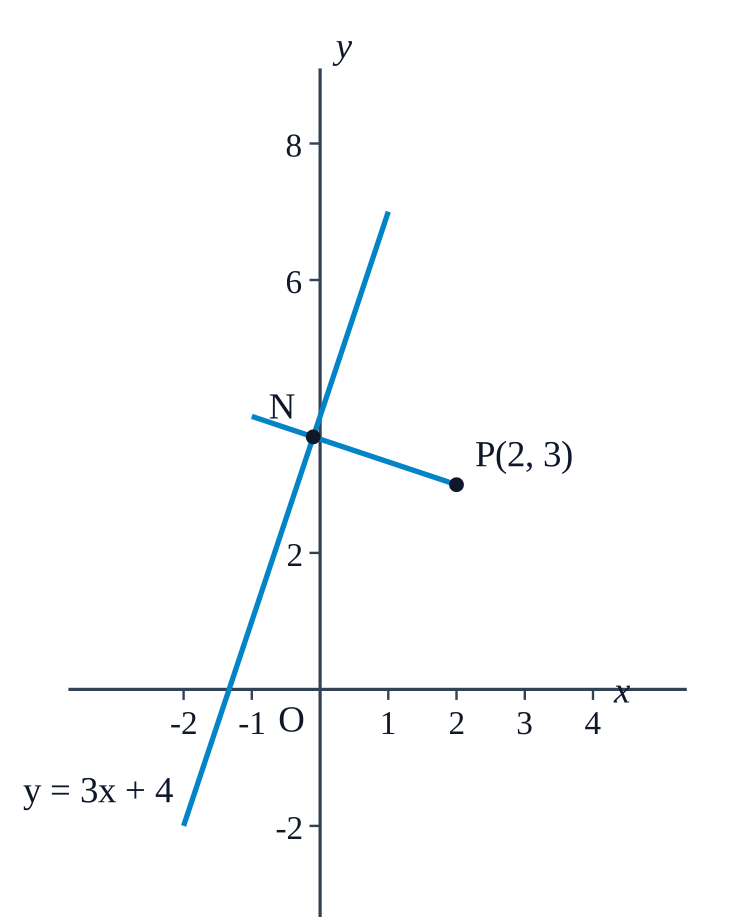
    The coordinates of the foot of perpendiculars from the point (2,3)\displaystyle (2,3) on the line y=3x+4\displaystyle y=3 x+4 is given by
    (A)
    (3710,−110)\displaystyle \left(\frac{37}{10}, \frac{-1}{10}\right)
    (B)
    (−110,3710)\displaystyle \left(\frac{-1}{10}, \frac{37}{10}\right)
    (C)
    (1037,−10)\displaystyle \left(\frac{10}{37},-10\right)
    (D)
    (23,−13)\displaystyle \left(\frac{2}{3},-\frac{1}{3}\right)

    Matches the book, not yet reviewed

    This working reaches the answer NCERT prints. It has not yet been read through by hand.

    NCERT’s answer
    B
    (B) \(\displaystyle \left(-\dfrac{1}{10},\dfrac{37}{10}\right)\)The line \(\displaystyle y=3x+4\) has slope \(\displaystyle 3\), so the perpendicular through \(\displaystyle (2,3)\) has slope \(\displaystyle -\tfrac13\).NCERT_Solution_Class11_Maths_Exemplar_Ch10_Ex10-3_Q32\[y-3=-\frac13(x-2)\Rightarrow x+3y=11 \]Meet it with \(\displaystyle y=3x+4\):\[x+3(3x+4)=11\Rightarrow 10x=-1\Rightarrow x=-\frac{1}{10} \] \[y=3\left(-\frac{1}{10}\right)+4=\frac{37}{10} \]
  3. Exercise 33

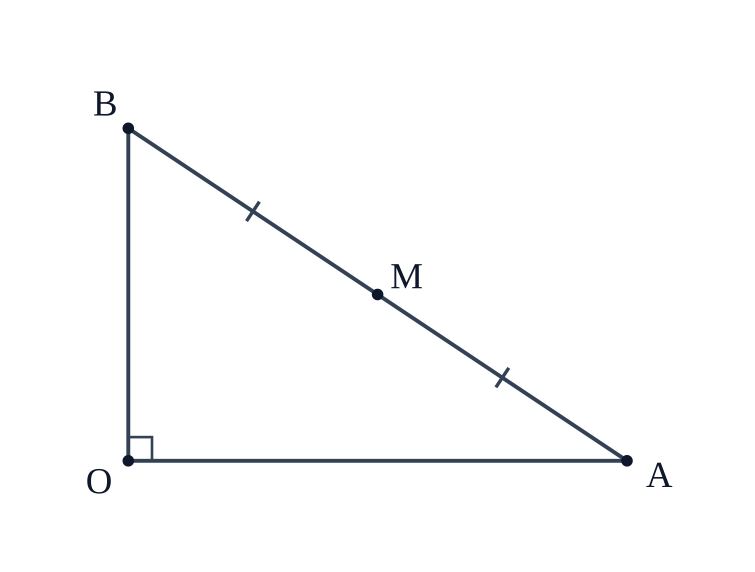
    If the coordinates of the middle point of the portion of a line intercepted between the coordinate axes is (3,2)\displaystyle (3, 2), then the equation of the line will be
    (A)
    2x+3y=12\displaystyle 2 x+3 y=12
    (B)
    3x+2y=12\displaystyle 3 x+2 y=12
    (C)
    4x−3y=6\displaystyle 4 x-3 y=6
    (D)
    5x−2y=10\displaystyle 5 x-2 y=10

    Matches the book, not yet reviewed

    This working reaches the answer NCERT prints. It has not yet been read through by hand.

    NCERT’s answer
    A
    (A) \(\displaystyle 2x+3y=12\)Let the intercepts be \(\displaystyle A(a,0)\) and \(\displaystyle B(0,b)\); their midpoint is \(\displaystyle (3,2)\). \[\left(\frac a2,\ \frac b2\right)=(3,2) \] \[a=6,\quad b=4 \] NCERT_Solution_Class11_Maths_Exemplar_Ch10_Ex10-3_Q33 \[\frac x6+\frac y4=1 \] \[2x+3y=12 \]
  4. Exercise 34

    Equation of the line passing through (1,2)\displaystyle (1,2) and parallel to the line y=3x−1\displaystyle y=3 x-1 is
    (A)
    y+2=x+1\displaystyle y+2=x+1
    (B)
    y+2=3(x+1)\displaystyle y+2=3(x+1)
    (C)
    y−2=3(x−1)\displaystyle y-2=3(x-1)
    (D)
    y−2=x−1\displaystyle y-2=x-1

    Matches the book, not yet reviewed

    This working reaches the answer NCERT prints. It has not yet been read through by hand.

    NCERT’s answer
    C
    (C) \(\displaystyle y-2=3(x-1)\)Parallel lines have equal slopes; \(\displaystyle y=3x-1\) has slope 3. \[m=3 \] Point-slope form through \(\displaystyle (1,2)\): \[y-2=3(x-1) \]
  5. Exercise 35

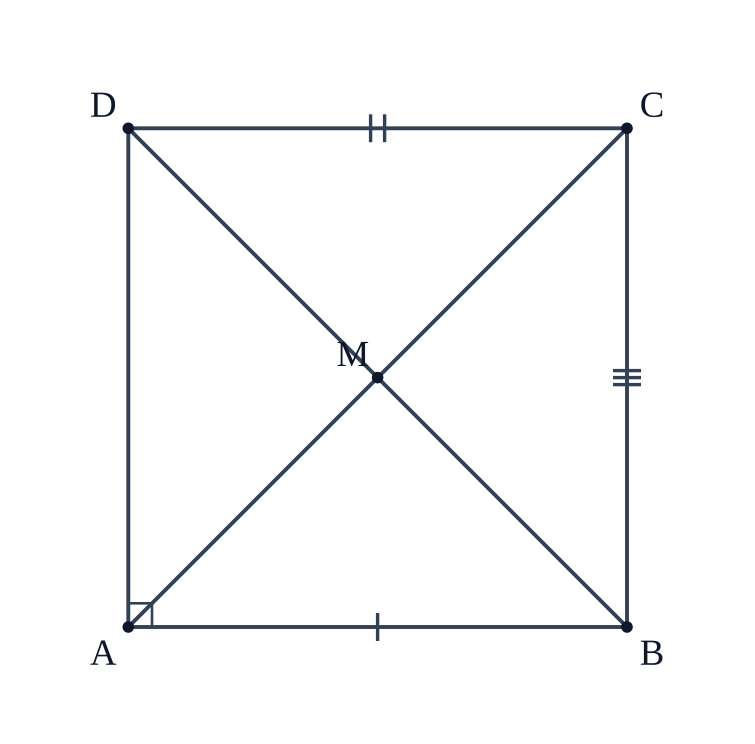
    Equations of diagonals of the square formed by the lines x=0,y=0,x=1\displaystyle x=0, y=0, x=1 and y=1\displaystyle y=1 are
    (A)
    y=x,y+x=1\displaystyle y=x, y+x=1
    (B)
    y=x,x+y=2\displaystyle y=x, \quad x+y=2
    (C)
    2y=x,y+x=13\displaystyle 2 y=x, y+x=\frac{1}{3}
    (D)
    y=2x,y+2x=1\displaystyle y=2 x, \quad y+2 x=1

    Matches the book, not yet reviewed

    This working reaches the answer NCERT prints. It has not yet been read through by hand.

    NCERT’s answer
    A
    (A) \(\displaystyle y=x,\ x+y=1\)The vertices are \(\displaystyle A(0,0)\), \(\displaystyle B(1,0)\), \(\displaystyle C(1,1)\), \(\displaystyle D(0,1)\). NCERT_Solution_Class11_Maths_Exemplar_Ch10_Ex10-3_Q35 \[AC:\ \frac{y-0}{x-0}=\frac{1-0}{1-0}\ \Rightarrow\ y=x \] \[BD:\ \frac{y-0}{x-1}=\frac{1-0}{0-1}\ \Rightarrow\ x+y=1 \]
  6. Exercise 36

    For specifying a straight line, how many geometrical parameters should be known?
    (A)
    1\displaystyle 1 (B) 2\displaystyle 2 (C) 4\displaystyle 4 (D) 3\displaystyle 3

    Matches the book, not yet reviewed

    This working reaches the answer NCERT prints. It has not yet been read through by hand.

    NCERT’s answer
    B
    (B) $\displaystyle 2$Every non-vertical line has the form \[y=mx+c \] and is fixed once the two numbers \(\displaystyle m\) and \(\displaystyle c\) are known.
  7. Exercise 37

    The point (4,1)\displaystyle (4,1) undergoes the following two successive transformations :
    (i)
    Reflection about the line y=x\displaystyle y=x
    (ii)
    Translation through a distance 2\displaystyle 2 units along the positive x\displaystyle x-axis
    Then the final coordinates of the point are
    (A)
    (4,3)\displaystyle (4,3)
    (B)
    (3,4)\displaystyle (3,4)
    (C)
    (1,4)\displaystyle (1,4)
    (D)
    (72,72)\displaystyle \left(\frac{7}{2}, \frac{7}{2}\right)

    Matches the book, not yet reviewed

    This working reaches the answer NCERT prints. It has not yet been read through by hand.

    NCERT’s answer
    B
    (B) \(\displaystyle (3,4)\)Reflection about \(\displaystyle y=x\) swaps the coordinates: \[(4,1)\to(1,4) \] Translation by $\displaystyle 2$ along the positive \(\displaystyle x\)-axis adds $\displaystyle 2$ to \(\displaystyle x\): \[(1,4)\to(1+2,\ 4)=(3,4) \]
  8. Exercise 38

    A point equidistant from the lines 4x+3y+10=0,5x−12y+26=0\displaystyle 4 x+3 y+10=0,5 x-12 y+26=0 and 7x+24y−50=0\displaystyle 7 x+24 y-50=0 is
    (A)
    (1,−1)\displaystyle (1,-1)
    (B)
    (1,1)\displaystyle (1,1)
    (C)
    (0,0)\displaystyle (0,0)
    (D)
    (0,1)\displaystyle (0,1)

    Matches the book, not yet reviewed

    This working reaches the answer NCERT prints. It has not yet been read through by hand.

    NCERT’s answer
    C
    (C) \(\displaystyle (0,0)\)Distance from the origin to \(\displaystyle ax+by+c=0\) is \(\displaystyle \dfrac{|c|}{\sqrt{a^2+b^2}}\). \[4x+3y+10=0:\quad \frac{10}{\sqrt{4^2+3^2}}=\frac{10}{5}=2 \] \[5x-12y+26=0:\quad \frac{26}{\sqrt{5^2+12^2}}=\frac{26}{13}=2 \] \[7x+24y-50=0:\quad \frac{50}{\sqrt{7^2+24^2}}=\frac{50}{25}=2 \]
  9. Exercise 39

    A line passes through (2,2)\displaystyle (2,2) and is perpendicular to the line 3x+y=3\displaystyle 3 x+y=3. Its y\displaystyle y-intercept is
    (A)
    13\displaystyle \frac{1}{3}
    (B)
    23\displaystyle \frac{2}{3}
    (C)
    1\displaystyle 1 (D) 43\displaystyle \frac{4}{3}

    Matches the book, not yet reviewed

    This working reaches the answer NCERT prints. It has not yet been read through by hand.

    NCERT’s answer
    D
    (D) \(\displaystyle \dfrac43\)The line \(\displaystyle 3x+y=3\) has slope \(\displaystyle -3\), so the perpendicular has slope \[m=-\frac{1}{-3}=\frac13 \] Through \(\displaystyle (2,2)\): \[y-2=\frac13(x-2) \] At \(\displaystyle x=0\): \[y=2-\frac23=\frac43 \]
  10. Exercise 40

    The ratio in which the line 3x+4y+2=0\displaystyle 3 x+4 y+2=0 divides the distance between the lines 3x+4y+5=0\displaystyle 3 x+4 y+5=0 and 3x+4y−5=0\displaystyle 3 x+4 y-5=0 is
    (A)
    1\displaystyle 1 : 2\displaystyle 2
    (B)
    3:7\displaystyle 3: 7
    (C)
    2\displaystyle 2 : 3\displaystyle 3
    (D)
    2\displaystyle 2 : 5\displaystyle 5

    Matches the book, not yet reviewed

    This working reaches the answer NCERT prints. It has not yet been read through by hand.

    NCERT’s answer
    B
    (B) \(\displaystyle 3:7\)All three lines are parallel, so use \(\displaystyle d=\dfrac{|c_1-c_2|}{\sqrt{a^2+b^2}}\) with \(\displaystyle \sqrt{3^2+4^2}=5\). \[d_1=\frac{|5-2|}{5}=\frac35 \] \[d_2=\frac{|2-(-5)|}{5}=\frac75 \] \[d_1:d_2=3:7 \]