SolveIt is under development
SolveItNCERT · CBSE · NEET

NCERT Exemplar · Class 11 Mathematics Straight Lines

59 questions · 59 still being checked

EXERCISE 10.3 11–20 (part 2 of 6)

  1. Exercise 11

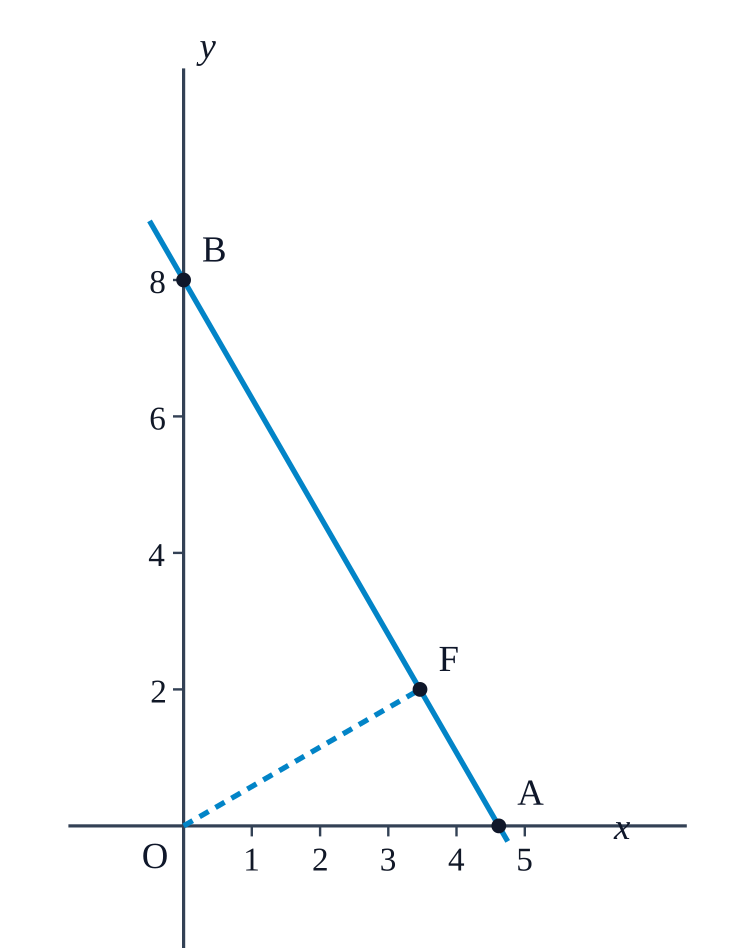
    Find the equation of a straight line on which length of perpendicular from the origin is four units and the line makes an angle of 120\displaystyle 120° with the positive direction of x\displaystyle x-axis. [Hint: Use normal form, here ω=30∘\displaystyle \omega=30^{\circ}.]

    Matches the book, not yet reviewed

    This working reaches the answer NCERT prints. It has not yet been read through by hand.

    NCERT’s answer
    \(\displaystyle \sqrt{3} x+y=8\)
    The perpendicular from the origin makes \(\displaystyle \omega=120^\circ-90^\circ=30^\circ\) with the \(\displaystyle x\)-axis. Normal form with \(\displaystyle p=4\): \[x\cos\omega+y\sin\omega=p \] \[x\cos30^\circ+y\sin30^\circ=4 \] \[\frac{\sqrt3}{2}x+\frac12 y=4 \] \[\sqrt3\,x+y-8=0 \] Check: \[\text{slope}=-\sqrt3=\tan120^\circ \] NCERT_Solution_Class11_Maths_Exemplar_Ch10_Ex10-3_Q11 Answer: \(\displaystyle \sqrt3\,x+y-8=0\) (with \(\displaystyle \omega=210^\circ\), the mirror line \(\displaystyle \sqrt3\,x+y+8=0\) also fits)
  2. Exercise 12

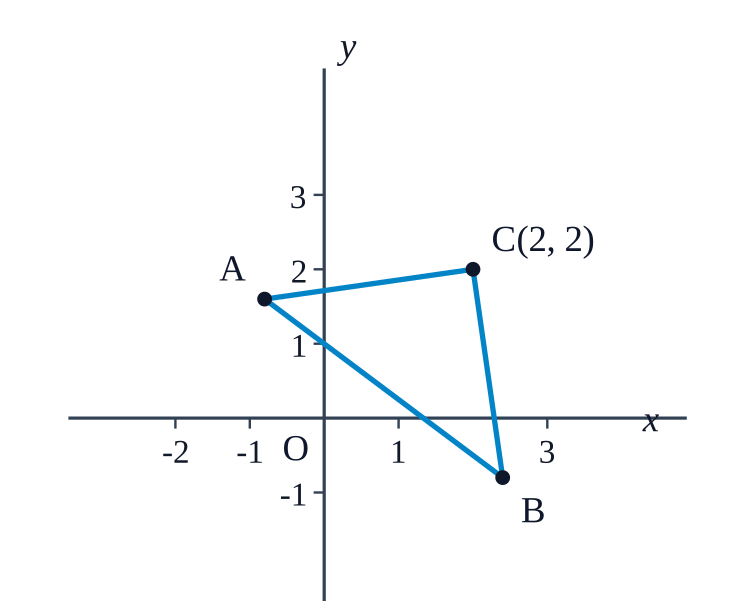
    Find the equation of one of the sides of an isosceles right angled triangle whose hypotenuse is given by 3x+4y=4\displaystyle 3 x+4 y=4 and the opposite vertex of the hypotenuse is (2,2)\displaystyle (2, 2).

    Check this one against your book

    NCERT’s printed answer for this exercise does not match its own question. This working follows the question as printed.

    Hypotenuse slope \(\displaystyle m=-\tfrac34\). Each leg makes \(\displaystyle 45^\circ\) with it; let a leg have slope \(\displaystyle m'\): \[\tan45^\circ=\left|\frac{m'-m}{1+mm'}\right| \Rightarrow \frac{m'+\frac34}{1-\frac34m'}=\pm1 \] \[m'+\tfrac34=1-\tfrac34m'\Rightarrow m'=\tfrac17 \] \[m'+\tfrac34=-1+\tfrac34m'\Rightarrow m'=-7 \] Through \(\displaystyle (2,2)\): \[y-2=\tfrac17(x-2)\Rightarrow x-7y+12=0 \] \[y-2=-7(x-2)\Rightarrow 7x+y-16=0 \] Check: \[\tfrac17\cdot(-7)=-1 \] NCERT_Solution_Class11_Maths_Exemplar_Ch10_Ex10-3_Q12 Answer: \(\displaystyle x-7y+12=0\) or \(\displaystyle 7x+y-16=0\)
  3. Exercise 13

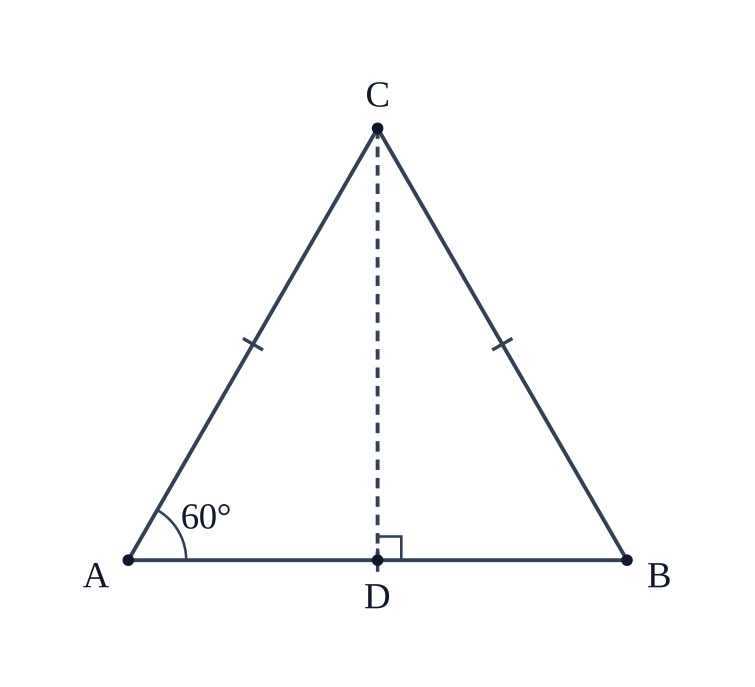
    If the equation of the base of an equilateral triangle is x+y=2\displaystyle x+y=2 and the vertex is (2,−1)\displaystyle (2,-1), then find the length of the side of the triangle. [Hint: Find length of perpendicular (p) from (2,−1)\displaystyle (2, -1) to the line and use p=lsin⁡60∘\displaystyle \mathrm{p}=l \sin 60^{\circ}, where l\displaystyle l is the length of side of the triangle].

    Matches the book, not yet reviewed

    This working reaches the answer NCERT prints. It has not yet been read through by hand.

    NCERT’s answer
    \(\displaystyle \sqrt{\frac{2}{3}}\)
    Perpendicular from the vertex \(\displaystyle (2,-1)\) to the base \(\displaystyle x+y-2=0\): \[p=\frac{|2-1-2|}{\sqrt{1^2+1^2}}=\frac{1}{\sqrt2} \] NCERT_Solution_Class11_Maths_Exemplar_Ch10_Ex10-3_Q13 Altitude of an equilateral triangle of side \(\displaystyle l\): \[p=l\sin60^\circ=\frac{\sqrt3}{2}\,l \] \[l=\frac{2p}{\sqrt3}=\frac{2}{\sqrt6}=\frac{\sqrt6}{3} \] Answer: \(\displaystyle \dfrac{\sqrt6}{3}\)
  4. Exercise 14

    A variable line passes through a fixed point P. The algebraic sum of the perpendiculars drawn from the points (2,0)\displaystyle (2, 0), (0,2)\displaystyle (0, 2) and (1,1)\displaystyle (1,1) on the line is zero. Find the coordinates of the point P. [Hint: Let the slope of the line be m\displaystyle m. Then the equation of the line passing through the fixed point P(x1,y1)\displaystyle \mathrm{P}\left(x_1, y_1\right) is y−y1=m(x−x1)\displaystyle y-y_1=m\left(x-x_1\right). Taking the algebraic sum of perpendicular distances equal to zero, we get y−1=m(x−1)\displaystyle y-1=m(x-1). Thus (x1,y1)\displaystyle \left(x_1, y_1\right) is (1,1)\displaystyle (1, 1).]

    Matches the book, not yet reviewed

    This working reaches the answer NCERT prints. It has not yet been read through by hand.

    NCERT’s answer
    \(\displaystyle (1,1)\)
    Let the variable line be \(\displaystyle ax+by+c=0\). Signed distance of \(\displaystyle (x_0,y_0)\) from it: \[d=\frac{ax_0+by_0+c}{\sqrt{a^2+b^2}} \] Sum of the three signed distances is zero: \[(2a+c)+(2b+c)+(a+b+c)=0 \] \[3(a+b+c)=0 \] \[a\cdot1+b\cdot1+c=0 \] So the line passes through \(\displaystyle (1,1)\). It also passes through \(\displaystyle P\) in every position while its direction varies, so \(\displaystyle P\) must be \(\displaystyle (1,1)\). Answer: \(\displaystyle P=(1,1)\)
  5. Exercise 15

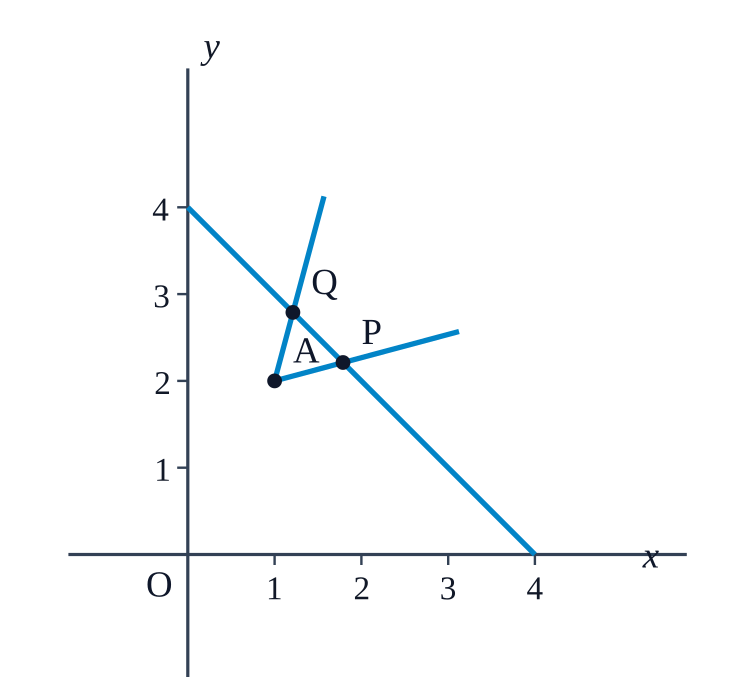
    In what direction should a line be drawn through the point (1,2)\displaystyle (1,2) so that its point of intersection with the line x+y=4\displaystyle x+y=4 is at a distance 63\displaystyle \frac{\sqrt{6}}{3} from the given point.

    Matches the book, not yet reviewed

    This working reaches the answer NCERT prints. It has not yet been read through by hand.

    NCERT’s answer
    \(\displaystyle 15^{\circ}\) or \(\displaystyle 75^{\circ}\)
    Let the line through \(\displaystyle A(1,2)\) make angle \(\displaystyle \theta\) with the \(\displaystyle x\)-axis, meeting \(\displaystyle x+y=4\) at \(\displaystyle P\) with \(\displaystyle AP=r=\tfrac{\sqrt6}{3}\): \[P=(1+r\cos\theta,\ 2+r\sin\theta) \] \[(1+r\cos\theta)+(2+r\sin\theta)=4 \] \[\cos\theta+\sin\theta=\frac1r=\frac{\sqrt6}{2} \] \[\sqrt2\,\sin(\theta+45^\circ)=\frac{\sqrt6}{2}\Rightarrow\sin(\theta+45^\circ)=\frac{\sqrt3}{2} \] \[\theta+45^\circ=60^\circ\ \text{or}\ 120^\circ \] NCERT_Solution_Class11_Maths_Exemplar_Ch10_Ex10-3_Q15 Answer: \(\displaystyle \theta=15^\circ\) or \(\displaystyle 75^\circ\) with the positive \(\displaystyle x\)-axis (slopes \(\displaystyle 2-\sqrt3\), \(\displaystyle 2+\sqrt3\))
  6. Exercise 16

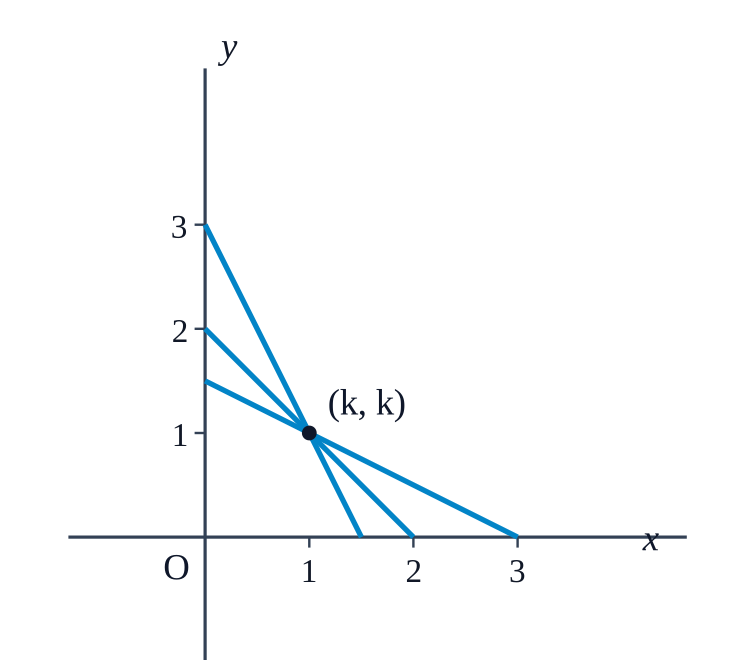
    A straight line moves so that the sum of the reciprocals of its intercepts made on axes is constant. Show that the line passes through a fixed point. [Hint: xa+yb=1\displaystyle \frac{x}{a}+\frac{y}{b}=1 where 1a+1b=\displaystyle \frac{1}{a}+\frac{1}{b}= constant =1k\displaystyle =\frac{1}{k} (say). This implies that ka+kb=1\displaystyle \frac{k}{a}+\frac{k}{b}=1 \quad line passes through the fixed point (k,k)\displaystyle (k, k).]

    Not cross-checked

    NCERT prints no numerical answer for this exercise, so this working has not been cross-checked against the book.

    Let the line be \(\displaystyle \dfrac{x}{a}+\dfrac{y}{b}=1\) with \[\frac1a+\frac1b=\frac1k\quad(k\ \text{constant}) \] Multiply by \(\displaystyle k\): \[\frac{k}{a}+\frac{k}{b}=1 \] So \(\displaystyle x=k,\ y=k\) satisfies \(\displaystyle \dfrac{x}{a}+\dfrac{y}{b}=1\) for every \(\displaystyle a,b\). NCERT_Solution_Class11_Maths_Exemplar_Ch10_Ex10-3_Q16 Answer: the line always passes through the fixed point \(\displaystyle (k,k)\)
  7. Exercise 17

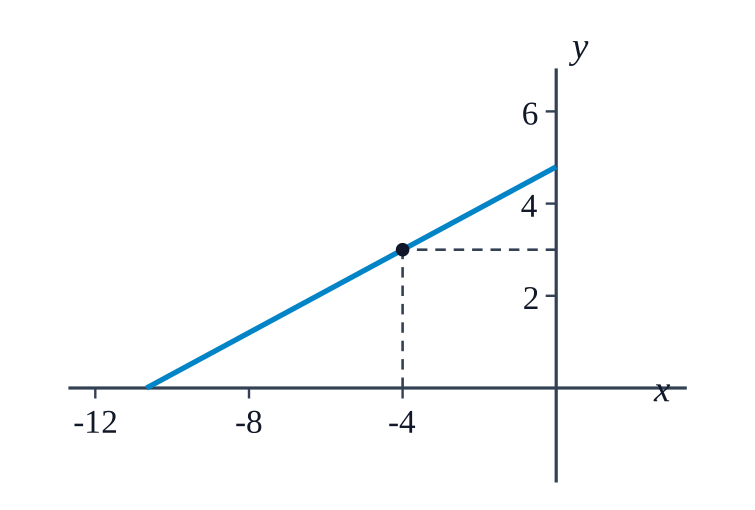
    Find the equation of the line which passes through the point (−4,3)\displaystyle (-4,3) and the portion of the line intercepted between the axes is divided internally in the ratio 5\displaystyle 5 : 3\displaystyle 3 by this point.

    Matches the book, not yet reviewed

    This working reaches the answer NCERT prints. It has not yet been read through by hand.

    NCERT’s answer
    \(\displaystyle 9 x-20 y+96=0\)
    Let the line meet the axes at \(\displaystyle A(a,0)\) and \(\displaystyle B(0,b)\); \(\displaystyle P(-4,3)\) divides \(\displaystyle AB\) internally in the ratio \(\displaystyle 5:3\), taken from \(\displaystyle A\).\[P=\left(\frac{5\cdot 0+3a}{8},\ \frac{5b+3\cdot 0}{8}\right) \]\[\frac{3a}{8}=-4 \Rightarrow a=-\frac{32}{3} \]\[\frac{5b}{8}=3 \Rightarrow b=\frac{24}{5} \]\[\frac{x}{-32/3}+\frac{y}{24/5}=1 \]\[-9x+20y=96 \]NCERT_Solution_Class11_Maths_Exemplar_Ch10_Ex10-3_Q17Answer: \(\displaystyle 9x-20y+96=0\)
  8. Exercise 18

    Find the equations of the lines through the point of intersection of the lines x−y+1=0\displaystyle x-y+1=0 and 2x−3y+5=0\displaystyle 2 x-3 y+5=0 and whose distance from the point (3,2)\displaystyle (3,2) is 75\displaystyle \frac{7}{5}.

    Matches the book, not yet reviewed

    This working reaches the answer NCERT prints. It has not yet been read through by hand.

    NCERT’s answer
    \(\displaystyle 3 x-4 y+6=0\) and \(\displaystyle 4 x-3 y+1=0\)
    Point of intersection of the given lines:\[x-y+1=0,\quad 2x-3y+5=0 \Rightarrow (x,y)=(2,3) \]Line through \(\displaystyle (2,3)\) with slope \(\displaystyle m\):\[mx-y+3-2m=0 \]Distance from \(\displaystyle (3,2)\):\[\frac{|3m-2+3-2m|}{\sqrt{m^2+1}}=\frac75 \]\[25(m+1)^2=49(m^2+1) \]\[12m^2-25m+12=0 \]\[m=\frac{25\pm 7}{24}=\frac43,\ \frac34 \]The vertical line \(\displaystyle x=2\) is at distance \(\displaystyle 1\ne\frac75\) from \(\displaystyle (3,2)\), so it is rejected.\[y-3=\tfrac43(x-2) \Rightarrow 4x-3y+1=0 \]\[y-3=\tfrac34(x-2) \Rightarrow 3x-4y+6=0 \]NCERT_Solution_Class11_Maths_Exemplar_Ch10_Ex10-3_Q18Answer: \(\displaystyle 4x-3y+1=0\) and \(\displaystyle 3x-4y+6=0\)
  9. Exercise 19

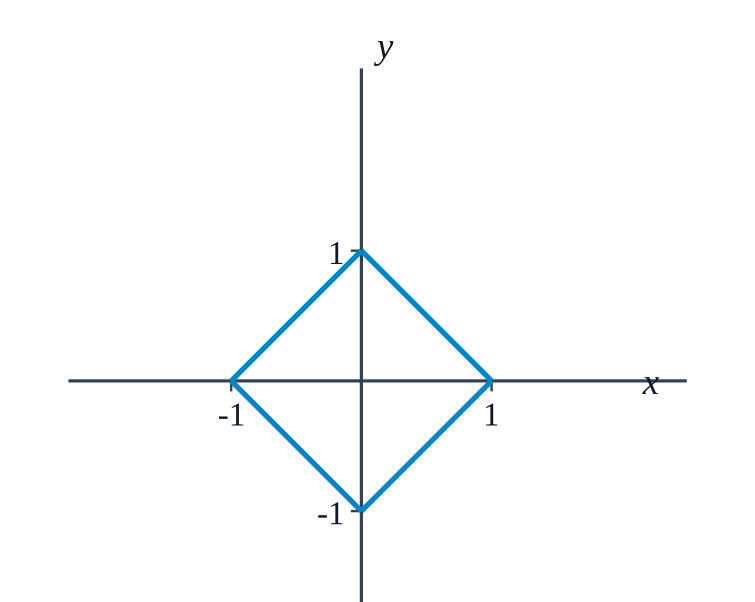
    If the sum of the distances of a moving point in a plane from the axes is 1\displaystyle 1, then find the locus of the point. [Hint: Given that ∣x∣+∣y∣=1\displaystyle |x|+|y|=1, which gives four sides of a square.]

    Not cross-checked

    NCERT prints no numerical answer for this exercise, so this working has not been cross-checked against the book.

    The distances of \(\displaystyle P(x,y)\) from the axes are \(\displaystyle |y|\) and \(\displaystyle |x|\).\[|x|+|y|=1 \]\[x+y=1 \quad (x\ge 0,\ y\ge 0) \]\[-x+y=1 \quad (x\le 0,\ y\ge 0) \]\[-x-y=1 \quad (x\le 0,\ y\le 0) \]\[x-y=1 \quad (x\ge 0,\ y\le 0) \]The four segments meet at \(\displaystyle (\pm1,0)\) and \(\displaystyle (0,\pm1)\).NCERT_Solution_Class11_Maths_Exemplar_Ch10_Ex10-3_Q19Answer: \(\displaystyle |x|+|y|=1\), the square with vertices \(\displaystyle (\pm1,0),(0,\pm1)\).
  10. Exercise 20

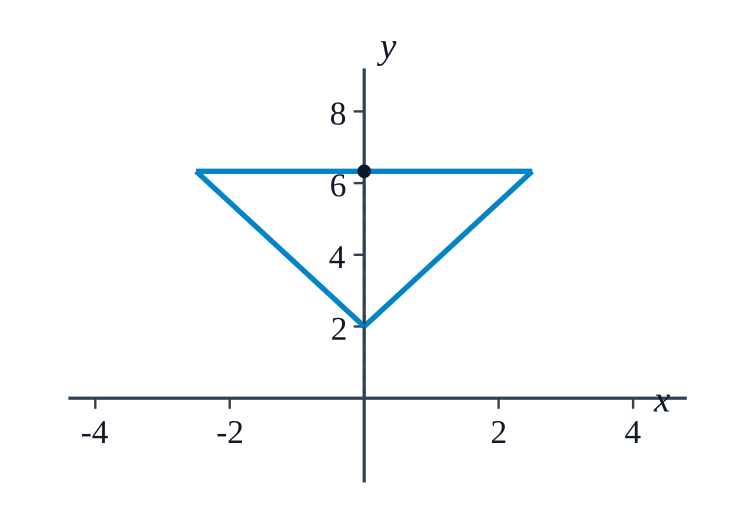
    P1,P2\displaystyle \mathrm{P}_1, \mathrm{P}_2 are points on either of the two lines y−3∣x∣=2\displaystyle y-\sqrt{3}|x|=2 at a distance of 5\displaystyle 5 units from their point of intersection. Find the coordinates of the foot of perpendiculars drawn from P1,P2\displaystyle \mathrm{P}_1, \mathrm{P}_2 on the bisector of the angle between the given lines. [Hint: Lines are y=3x+2\displaystyle y=\sqrt{3} x+2 and y=−3x+2\displaystyle y=-\sqrt{3} x+2 according as x≥0\displaystyle x \geq 0 or x<0\displaystyle x<0. y\displaystyle y-axis is the bisector of the angles between the lines. P1,P2\displaystyle \mathrm{P}_1, \mathrm{P}_2 are the points on these lines at a distance of 5\displaystyle 5 units from the point of intersection of these lines which have a point on y\displaystyle y-axis as common foot of perpendiculars from these points. The y\displaystyle y-coordinate of the foot of the perpendicular is given by 2+5cos⁡30∘\displaystyle 2+5 \cos 30^{\circ}.]

    Matches the book, not yet reviewed

    This working reaches the answer NCERT prints. It has not yet been read through by hand.

    NCERT’s answer
    \(\displaystyle \left(0,2+\frac{5 \sqrt{3}}{2}\right)\)
    The curve is made of\[y=\sqrt3\,x+2\ (x\ge0),\qquad y=-\sqrt3\,x+2\ (x<0) \]They meet at \(\displaystyle (0,2)\) with inclinations \(\displaystyle 60^\circ\) and \(\displaystyle 120^\circ\), so the \(\displaystyle y\)-axis bisects the angle between them.Points at distance \(\displaystyle 5\) from \(\displaystyle (0,2)\) along the two lines:\[P_1=\left(5\cos60^\circ,\ 2+5\sin60^\circ\right)=\left(\tfrac52,\ 2+\tfrac{5\sqrt3}{2}\right) \]\[P_2=\left(-\tfrac52,\ 2+\tfrac{5\sqrt3}{2}\right) \]Perpendiculars to the \(\displaystyle y\)-axis are horizontal, so both feet have \(\displaystyle x=0\) and the ordinate of \(\displaystyle P_1,P_2\):\[y=2+5\cos30^\circ=2+\frac{5\sqrt3}{2} \]NCERT_Solution_Class11_Maths_Exemplar_Ch10_Ex10-3_Q20Answer: \(\displaystyle \left(0,\ 2+\dfrac{5\sqrt3}{2}\right)\), the same foot for \(\displaystyle P_1\) and \(\displaystyle P_2\).