SolveIt is under development
SolveItNCERT · CBSE · NEET

NCERT Exemplar · Class 11 Mathematics Straight Lines

59 questions · 59 still being checked

EXERCISE 10.3 1–10 (part 1 of 6)

  1. Exercise 1

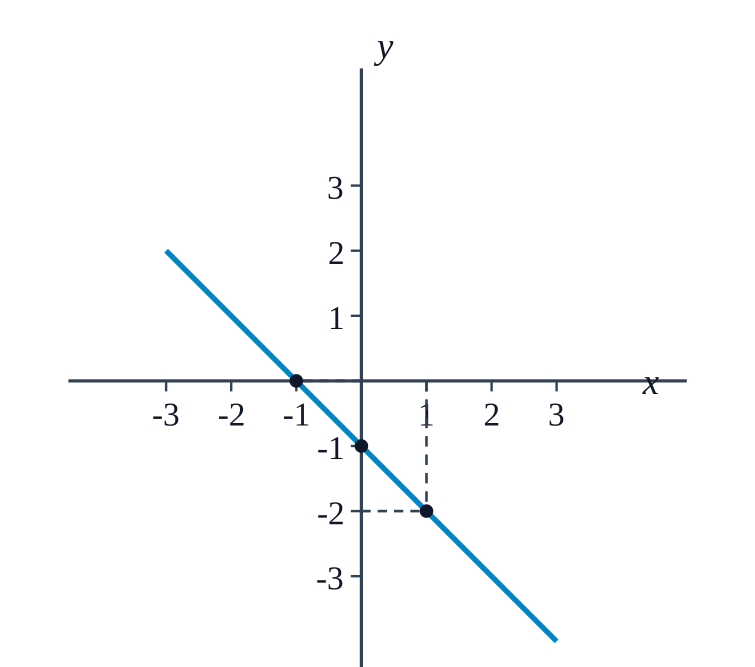
    Find the equation of the straight line which passes through the point (1,−2)\displaystyle (1, -2) and cuts off equal intercepts from axes.

    Matches the book, not yet reviewed

    This working reaches the answer NCERT prints. It has not yet been read through by hand.

    NCERT’s answer
    \(\displaystyle x+y+1=0\)
    Equal non-zero intercepts \(\displaystyle a\): \[\frac{x}{a}+\frac{y}{a}=1 \Rightarrow x+y=a \] The line passes through \(\displaystyle (1,-2)\): \[a=1+(-2)=-1 \] \[x+y+1=0 \]NCERT_Solution_Class11_Maths_Exemplar_Ch10_Ex10-3_Q1The line \(\displaystyle 2x+y=0\) through the origin cuts off no intercepts, so it is not counted.Answer: \(\displaystyle x+y+1=0\)
  2. Exercise 2

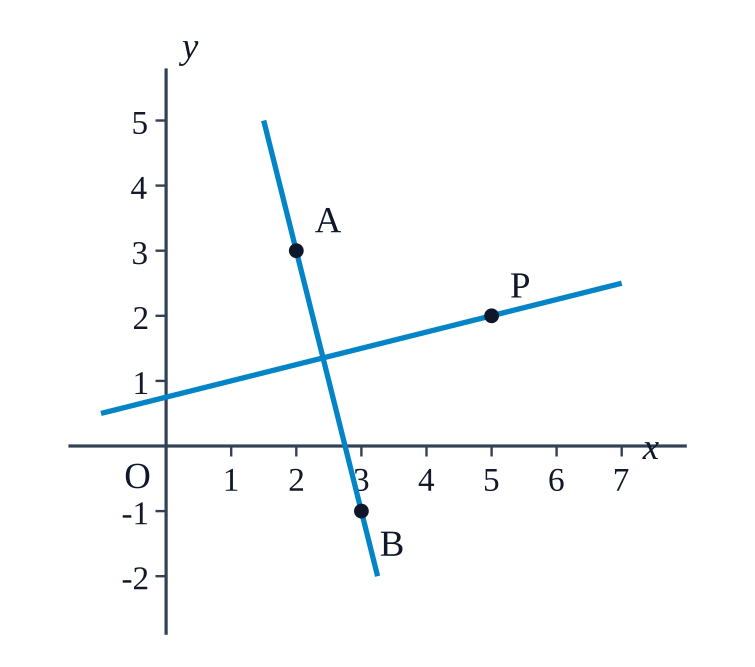
    Find the equation of the line passing through the point (5,2)\displaystyle (5,2) and perpendicular to the line joining the points (2,3)\displaystyle (2,3) and (3,−1)\displaystyle (3,-1).

    Matches the book, not yet reviewed

    This working reaches the answer NCERT prints. It has not yet been read through by hand.

    NCERT’s answer
    \(\displaystyle x-4 y+3=0\)
    \[m_{AB}=\frac{-1-3}{3-2}=-4 \] Perpendicular slope: \[m=-\frac{1}{m_{AB}}=\frac14 \] Through \(\displaystyle P(5,2)\): \[y-2=\frac14(x-5) \] \[4y-8=x-5 \] \[x-4y+3=0 \]NCERT_Solution_Class11_Maths_Exemplar_Ch10_Ex10-3_Q2Answer: \(\displaystyle x-4y+3=0\)
  3. Exercise 3

    Find the angle between the lines y=(2−3)(x+5)\displaystyle y=(2-\sqrt{3})(x+5) and y=(2+3)(x−7)\displaystyle y=(2+\sqrt{3})(x-7).

    Matches the book, not yet reviewed

    This working reaches the answer NCERT prints. It has not yet been read through by hand.

    NCERT’s answer
    \(\displaystyle 60^{\circ}\) or \(\displaystyle 120^{\circ}\)
    \[m_1=2-\sqrt3,\qquad m_2=2+\sqrt3 \] \[m_1m_2=4-3=1,\qquad m_2-m_1=2\sqrt3 \] Acute angle between the lines: \[\tan\theta=\left|\frac{m_2-m_1}{1+m_1m_2}\right|=\frac{2\sqrt3}{2}=\sqrt3 \] \[\theta=60^\circ \] The other angle between the lines is the supplement: \[180^\circ-60^\circ=120^\circ \]Answer: \(\displaystyle 60^\circ\) or \(\displaystyle 120^\circ\)
  4. Exercise 4

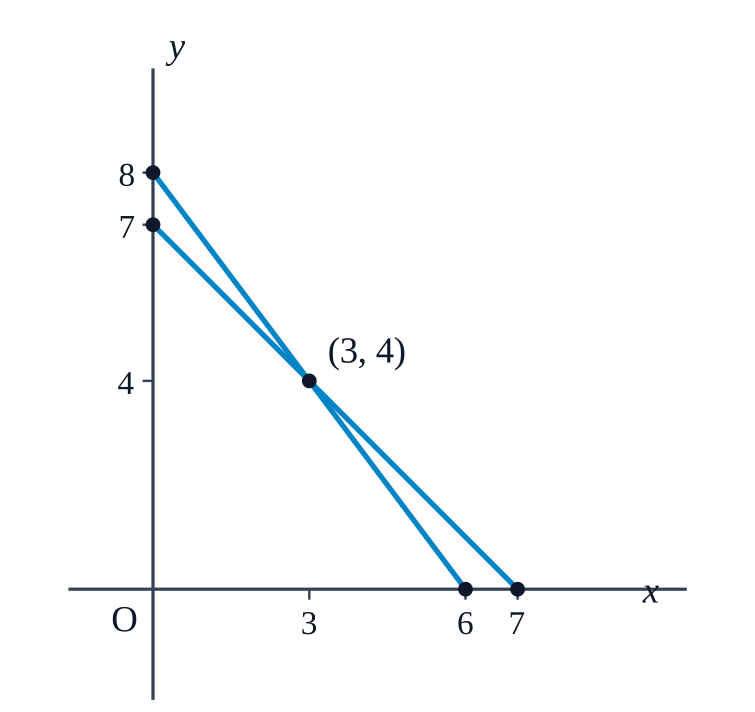
    Find the equation of the lines which passes through the point (3,4)\displaystyle (3,4) and cuts off intercepts from the coordinate axes such that their sum is 14.

    Matches the book, not yet reviewed

    This working reaches the answer NCERT prints. It has not yet been read through by hand.

    NCERT’s answer
    \(\displaystyle x+y=7\) or \(\displaystyle \frac{x}{6}+\frac{y}{8}=1\)
    Intercepts \(\displaystyle a\) and \(\displaystyle b\), with \(\displaystyle a+b=14\): \[\frac{x}{a}+\frac{y}{14-a}=1 \] The line passes through \(\displaystyle (3,4)\): \[\frac{3}{a}+\frac{4}{14-a}=1 \] \[3(14-a)+4a=a(14-a) \] \[a^2-13a+42=0 \] \[(a-6)(a-7)=0 \Rightarrow a=6\ \text{or}\ 7 \] \[a=6,\ b=8:\quad \frac{x}{6}+\frac{y}{8}=1 \Rightarrow 4x+3y=24 \] \[a=7,\ b=7:\quad \frac{x}{7}+\frac{y}{7}=1 \Rightarrow x+y=7 \]NCERT_Solution_Class11_Maths_Exemplar_Ch10_Ex10-3_Q4Answer: \(\displaystyle 4x+3y-24=0\) and \(\displaystyle x+y-7=0\)
  5. Exercise 5

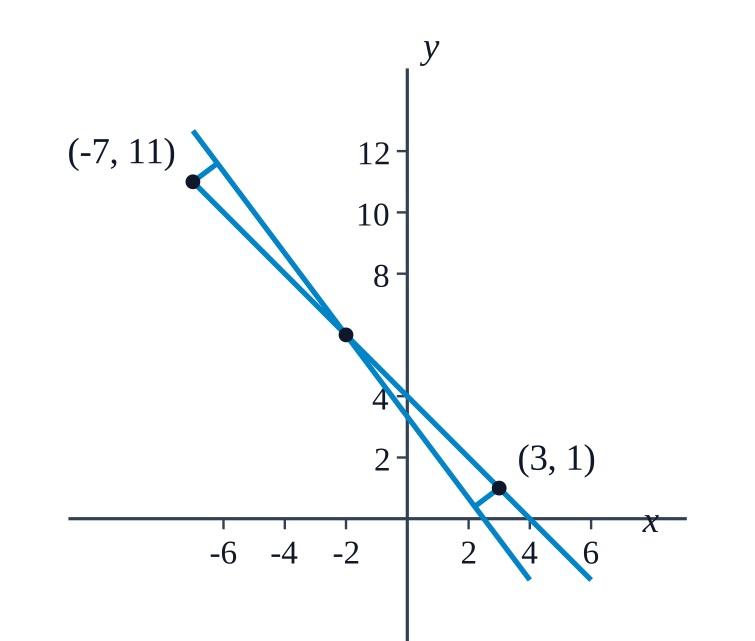
    Find the points on the line x+y=4\displaystyle x+y=4 which lie at a unit distance from the line 4x+3y=10\displaystyle 4 x+3 y=10.

    Matches the book, not yet reviewed

    This working reaches the answer NCERT prints. It has not yet been read through by hand.

    NCERT’s answer
    \(\displaystyle (3,1),(-7,11)\)
    A point on \(\displaystyle x+y=4\) is \(\displaystyle (t,\,4-t)\). Its distance from \(\displaystyle 4x+3y-10=0\) is \(\displaystyle 1\): \[\frac{|4t+3(4-t)-10|}{\sqrt{4^2+3^2}}=1 \] \[\frac{|t+2|}{5}=1 \Rightarrow t+2=\pm5 \] \[t=3\ \text{or}\ t=-7 \]NCERT_Solution_Class11_Maths_Exemplar_Ch10_Ex10-3_Q5Answer: \(\displaystyle (3,1)\) and \(\displaystyle (-7,11)\)
  6. Exercise 6

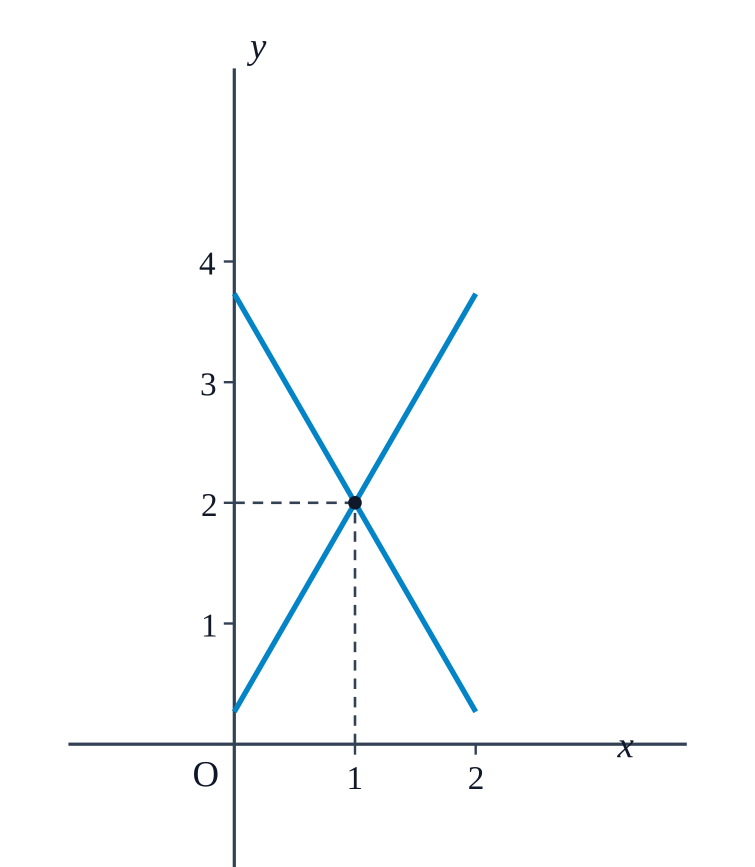
    Show that the tangent of an angle between the lines xa+yb=1\displaystyle \frac{x}{a}+\frac{y}{b}=1 and xa−yb=1\displaystyle \frac{x}{a}-\frac{y}{b}=1 is 2aba2−b2\displaystyle \frac{2 a b}{a^2-b^2}.

    Not cross-checked

    NCERT prints no numerical answer for this exercise, so this working has not been cross-checked against the book.

    \[\frac{x}{a}+\frac{y}{b}=1 \Rightarrow y=-\frac{b}{a}x+b,\qquad m_1=-\frac{b}{a} \] \[\frac{x}{a}-\frac{y}{b}=1 \Rightarrow y=\frac{b}{a}x-b,\qquad m_2=\frac{b}{a} \] Angle from the first line to the second: \[\tan\theta=\frac{m_2-m_1}{1+m_1m_2}=\frac{2b/a}{1-b^2/a^2} \] \[\tan\theta=\frac{2b}{a}\cdot\frac{a^2}{a^2-b^2}=\frac{2ab}{a^2-b^2} \]Answer: \(\displaystyle \tan\theta=\dfrac{2ab}{a^2-b^2}\)
  7. Exercise 7

    Find the equation of lines passing through (1,2)\displaystyle (1,2) and making angle 30\displaystyle 30° with y\displaystyle y-axis.

    Check this one against your book

    NCERT’s printed answer for this exercise does not match its own question. This working follows the question as printed.

    A line at \(\displaystyle 30^\circ\) to the \(\displaystyle y\)-axis is inclined at \(\displaystyle 60^\circ\) or \(\displaystyle 120^\circ\) to the \(\displaystyle x\)-axis: \[m=\tan60^\circ=\sqrt3\quad\text{or}\quad m=\tan120^\circ=-\sqrt3 \] Through \(\displaystyle (1,2)\): \[y-2=\sqrt3(x-1) \Rightarrow \sqrt3x-y+2-\sqrt3=0 \] \[y-2=-\sqrt3(x-1) \Rightarrow \sqrt3x+y-2-\sqrt3=0 \]NCERT_Solution_Class11_Maths_Exemplar_Ch10_Ex10-3_Q7Answer: \(\displaystyle \sqrt3x-y+2-\sqrt3=0\) and \(\displaystyle \sqrt3x+y-2-\sqrt3=0\)
  8. Exercise 8

    Find the equation of the line passing through the point of intersection of 2x+y=5\displaystyle 2 x+y=5 and x+3y+8=0\displaystyle x+3 y+8=0 and parallel to the line 3x+4y=7\displaystyle 3 x+4 y=7.

    Matches the book, not yet reviewed

    This working reaches the answer NCERT prints. It has not yet been read through by hand.

    NCERT’s answer
    \(\displaystyle 3 x+4 y+3=0\)
    Point of intersection: \[2x+y=5 \Rightarrow y=5-2x \] \[x+3(5-2x)+8=0 \Rightarrow -5x+23=0 \] \[x=\frac{23}{5},\qquad y=-\frac{21}{5} \] A line parallel to \(\displaystyle 3x+4y=7\) has the form \(\displaystyle 3x+4y=k\): \[k=3\cdot\frac{23}{5}+4\left(-\frac{21}{5}\right)=\frac{69-84}{5}=-3 \] \[3x+4y+3=0 \]Answer: \(\displaystyle 3x+4y+3=0\)
  9. Exercise 9

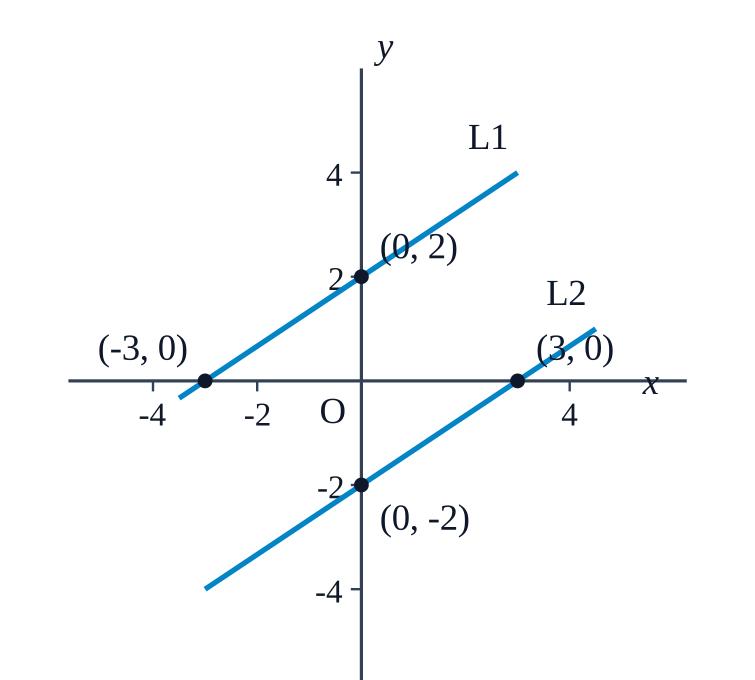
    For what values of a\displaystyle a and b\displaystyle b the intercepts cut off on the coordinate axes by the line ax+by+8=0\displaystyle a x+b y+8=0 are equal in length but opposite in signs to those cut off by the line 2x−3y+6=0\displaystyle 2 x-3 y+6=0 on the axes.

    Matches the book, not yet reviewed

    This working reaches the answer NCERT prints. It has not yet been read through by hand.

    NCERT’s answer
    \(\displaystyle a=\frac{-8}{3}, b=4\)
    Intercepts of \(\displaystyle 2x-3y+6=0\) (put \(\displaystyle y=0\), then \(\displaystyle x=0\)): \[x=-3,\qquad y=2 \] The required line has intercepts \(\displaystyle 3\) and \(\displaystyle -2\). For \(\displaystyle ax+by+8=0\): \[x\text{-intercept}=-\frac{8}{a}=3 \Rightarrow a=-\frac{8}{3} \] \[y\text{-intercept}=-\frac{8}{b}=-2 \Rightarrow b=4 \] Check: \[-\tfrac{8}{3}x+4y+8=0 \iff 2x-3y-6=0 \] NCERT_Solution_Class11_Maths_Exemplar_Ch10_Ex10-3_Q9 Answer: \(\displaystyle a=-\dfrac{8}{3},\ b=4\)
  10. Exercise 10

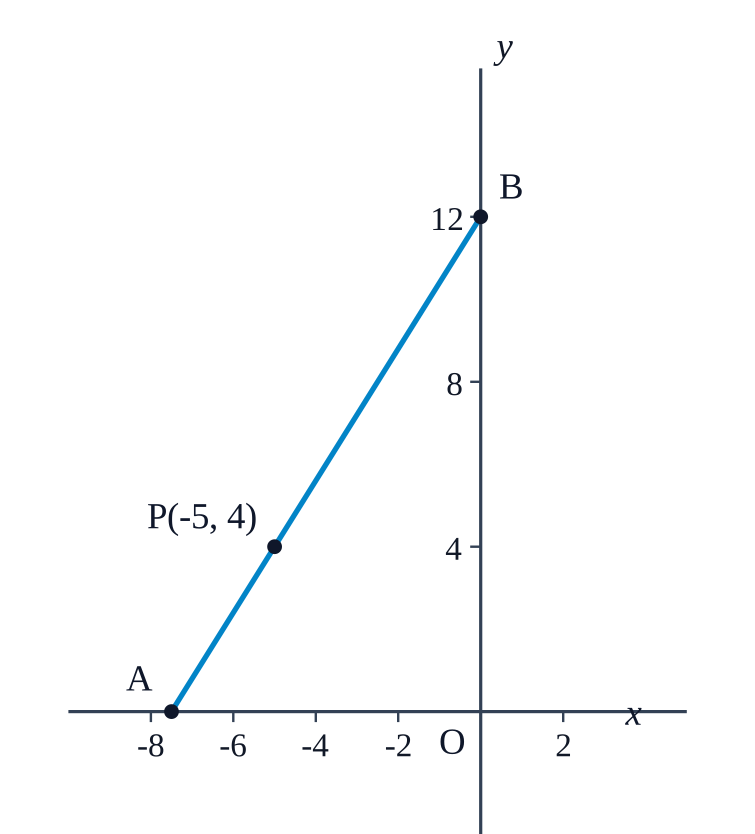
    If the intercept of a line between the coordinate axes is divided by the point (−5,4)\displaystyle (-5, 4) in the ratio 1:2\displaystyle 1: 2, then find the equation of the line.

    Matches the book, not yet reviewed

    This working reaches the answer NCERT prints. It has not yet been read through by hand.

    NCERT’s answer
    \(\displaystyle 8 x-5 y+60=0\)
    Let the line meet the axes at \(\displaystyle A(a,0)\) and \(\displaystyle B(0,b)\). \(\displaystyle P(-5,4)\) divides \(\displaystyle AB\) in the ratio \(\displaystyle 1:2\): \[-5=\frac{1\cdot 0+2\cdot a}{1+2}\Rightarrow a=-\frac{15}{2} \] \[4=\frac{1\cdot b+2\cdot 0}{1+2}\Rightarrow b=12 \] \[\frac{x}{-15/2}+\frac{y}{12}=1 \] \[-8x+5y=60 \] NCERT_Solution_Class11_Maths_Exemplar_Ch10_Ex10-3_Q10 Answer: \(\displaystyle 8x-5y+60=0\) (if the ratio \(\displaystyle 1:2\) is counted from the \(\displaystyle y\)-axis end instead, \(\displaystyle a=-15,\ b=6\) and the line is \(\displaystyle 2x-5y+30=0\))