SolveIt is under development
SolveItNCERT · CBSE · NEET

NCERT Exemplar · Class 11 Mathematics Straight Lines

59 questions · 59 still being checked

EXERCISE 10.3 51–59 (part 6 of 6)

  1. State whether the statements in Exercises $\displaystyle 48$ to $\displaystyle 56$ are true or false. Justify.

    Exercise 51

    The straight line 5x+4y=0\displaystyle 5 x+4 y=0 passes through the point of intersection of the straight lines x+2y−10=0\displaystyle x+2 y-10=0 and 2x+y+5=0\displaystyle 2 x+y+5=0.

    Matches the book, not yet reviewed

    This working reaches the answer NCERT prints. It has not yet been read through by hand.

    NCERT’s answer
    True
    True. Find the point where the two lines meet and test it in \(\displaystyle 5x+4y=0\).\[x + 2y = 10, \qquad 2x + y = -5 \]\[2(x+2y) - (2x+y) = 20 + 5 \Rightarrow 3y = 25 \]\[y = \frac{25}{3}, \qquad x = 10 - 2y = -\frac{20}{3} \]\[5x + 4y = -\frac{100}{3} + \frac{100}{3} = 0 \]
  2. Exercise 52

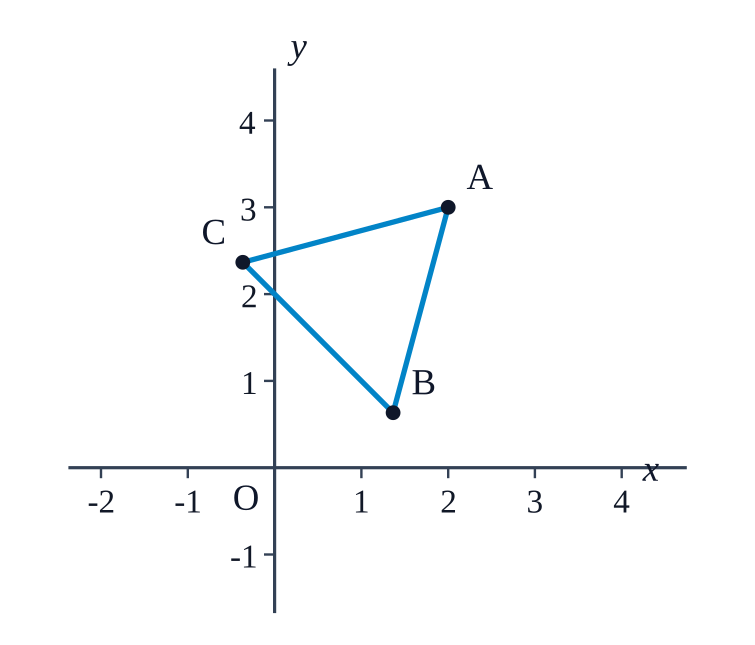
    The vertex of an equilateral triangle is (2,3)\displaystyle (2,3) and the equation of the opposite side is x+y=2\displaystyle x+y=2. Then the other two sides are y−3=(2±3)(x−2)\displaystyle y-3=(2 \pm \sqrt{3})(x-2).

    Matches the book, not yet reviewed

    This working reaches the answer NCERT prints. It has not yet been read through by hand.

    NCERT’s answer
    True
    True. Each of the other sides makes \(\displaystyle 60^\circ\) with \(\displaystyle x+y=2\), whose slope is \(\displaystyle -1\).NCERT_Solution_Class11_Maths_Exemplar_Ch10_Ex10-3_Q52\[\left|\frac{m-(-1)}{1+(-1)m}\right| = \tan 60^\circ \]\[\frac{m+1}{1-m} = \pm\sqrt3 \]\[m = \frac{\sqrt3-1}{\sqrt3+1} = 2-\sqrt3 \quad\text{or}\quad m = \frac{\sqrt3+1}{\sqrt3-1} = 2+\sqrt3 \]Through \(\displaystyle (2,3)\):\[y - 3 = (2\pm\sqrt3)(x-2) \]
  3. Exercise 53

    The equation of the line joining the point (3,5)\displaystyle (3,5) to the point of intersection of the lines 4x+y−1=0\displaystyle 4 x+y-1=0 and 7x−3y−35=0\displaystyle 7 x-3 y-35=0 is equidistant from the points (0,0)\displaystyle (0,0) and (8,34)\displaystyle (8,34).

    Matches the book, not yet reviewed

    This working reaches the answer NCERT prints. It has not yet been read through by hand.

    NCERT’s answer
    True
    True. The line through \(\displaystyle (3,5)\) and the meeting point of the two lines is at equal distances from \(\displaystyle (0,0)\) and \(\displaystyle (8,34)\).\[3(4x+y-1) + (7x-3y-35) = 0 \Rightarrow 19x = 38 \]\[x = 2, \qquad y = 1 - 4x = -7 \]\[m = \frac{5-(-7)}{3-2} = 12 \]\[y - 5 = 12(x-3) \Rightarrow 12x - y - 31 = 0 \]\[d_{(0,0)} = \frac{|-31|}{\sqrt{12^2+1}} = \frac{31}{\sqrt{145}} \]\[d_{(8,34)} = \frac{|96-34-31|}{\sqrt{145}} = \frac{31}{\sqrt{145}} \]
  4. Exercise 54

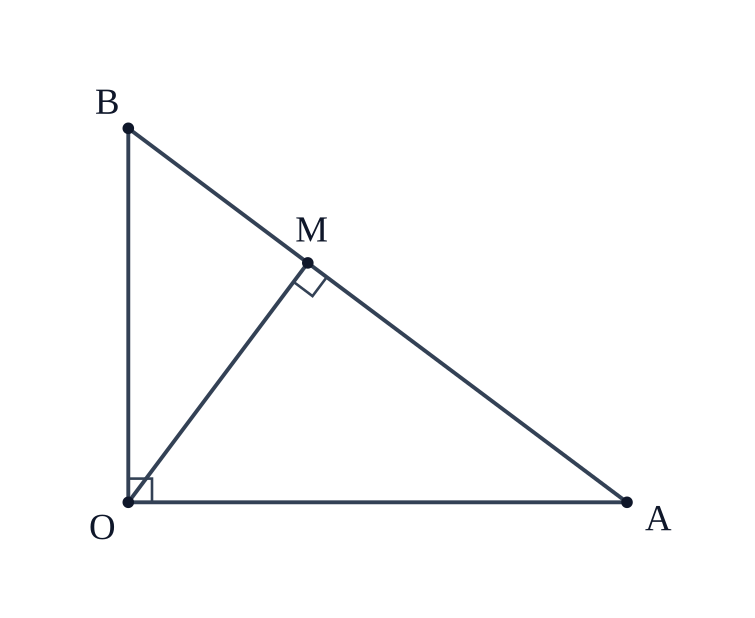
    The line xa+yb=1\displaystyle \frac{x}{a}+\frac{y}{b}=1 moves in such a way that 1a2+1b2=1c2\displaystyle \frac{1}{a^2}+\frac{1}{b^2}=\frac{1}{c^2}, where c\displaystyle c is a constant. The locus of the foot of the perpendicular from the origin on the given line is x2+y2=c2\displaystyle x^2+y^2=c^2.

    Matches the book, not yet reviewed

    This working reaches the answer NCERT prints. It has not yet been read through by hand.

    NCERT’s answer
    True
    True. Let \(\displaystyle M(h,k)\) be the foot of the perpendicular from \(\displaystyle O\). Then \(\displaystyle OM\) is the distance of \(\displaystyle O\) from \(\displaystyle \frac{x}{a}+\frac{y}{b}-1=0\).NCERT_Solution_Class11_Maths_Exemplar_Ch10_Ex10-3_Q54\[OM = \frac{|-1|}{\sqrt{\dfrac{1}{a^2}+\dfrac{1}{b^2}}} = \frac{1}{\sqrt{1/c^2}} = c \]\[h^2 + k^2 = OM^2 = c^2 \]So \(\displaystyle M\) lies on \(\displaystyle x^2+y^2=c^2\).
  5. Exercise 55

    The lines ax+2y+1=0,bx+3y+1=0\displaystyle a x+2 y+1=0, b x+3 y+1=0 and cx+4y+1=0\displaystyle c x+4 y+1=0 are concurrent if a,b,c\displaystyle a, b, c are in G.P.

    Matches the book, not yet reviewed

    This working reaches the answer NCERT prints. It has not yet been read through by hand.

    NCERT’s answer
    False
    False. The lines are concurrent when \(\displaystyle a, b, c\) are in A.P., not G.P.\[\begin{vmatrix} a & 2 & 1 \\ b & 3 & 1 \\ c & 4 & 1 \end{vmatrix} = a(3-4) - 2(b-c) + (4b-3c) = 2b - a - c \]\[2b = a + c \quad \text{(A.P.)} \]Counter-example: \(\displaystyle a, b, c = 1, 2, 4\) are in G.P. but \(\displaystyle 2b = 4 \ne 5 = a + c\). The first two lines meet at \(\displaystyle (1,-1)\):\[4(1) + 4(-1) + 1 = 1 \ne 0 \]
  6. Exercise 56

    Line joining the points (3,−4)\displaystyle (3,-4) and (−2,6)\displaystyle (-2,6) is perpendicular to the line joining the points (−3,6)\displaystyle (-3, 6) and (9,−18)\displaystyle (9, -18).

    Matches the book, not yet reviewed

    This working reaches the answer NCERT prints. It has not yet been read through by hand.

    NCERT’s answer
    False
    False. Both slopes equal \(\displaystyle -2\), so the lines are parallel.\[m_1 = \frac{6-(-4)}{-2-3} = -2 \]\[m_2 = \frac{-18-6}{9-(-3)} = -2 \]\[m_1 m_2 = 4 \ne -1 \]
  7. Match the questions given under Column \(\displaystyle \mathrm{C}_1\) with their appropriate answers given under the Column \(\displaystyle \mathrm{C}_2\) in Exercises $\displaystyle 57$ to 59.

    Exercise 57

    Column C1\displaystyle \mathbf{C}_{\mathbf{1}}Column C2\displaystyle \mathbf{C}_{\mathbf{2}}
    (a) The coordinates of the points P and Q on the line x+5y=13\displaystyle x+5 y=13 which are at a distance of 2\displaystyle 2 units from the line 12x−5y+26=0\displaystyle 12 x-5 y+26=0 are(i) (3,1)\displaystyle (3, 1), (−7,11)\displaystyle (-7, 11)
    (b) The coordinates of the point on the line x+y=4\displaystyle x+y=4, which are at a unit distance from the line 4x+3y−10=0\displaystyle 4 x+3 y-10=0 are(ii) (−13,113),(43,73)\displaystyle \left(-\frac{1}{3}, \frac{11}{3}\right),\left(\frac{4}{3}, \frac{7}{3}\right)
    (c) The coordinates of the point on the line joining A(−2,5)\displaystyle \mathrm{A}(-2,5) and B(3,1)\displaystyle \mathrm{B}(3,1) such that AP=PQ=QB\displaystyle \mathrm{AP}=\mathrm{PQ}=\mathrm{QB} are(iii) (1,125),(−3,165)\displaystyle \left(1, \frac{12}{5}\right),\left(-3, \frac{16}{5}\right)

    Matches the book, not yet reviewed

    This working reaches the answer NCERT prints. It has not yet been read through by hand.

    NCERT’s answer
    (a)
    \(\displaystyle \leftrightarrow\) (iii)
    (b)
    \(\displaystyle \leftrightarrow\) (i) and
    (c)
    \(\displaystyle \leftrightarrow\) (ii)
    (a)-(iii), (b)-(i), (c)-(ii)
    (a)
    Distance from \(\displaystyle 12x-5y+26=0\) is $\displaystyle 2$, with \(\displaystyle x=13-5y\):
    \[\frac{|12x-5y+26|}{13}=2 \]
    \[|182-65y|=26 \Rightarrow y=\tfrac{12}{5},\ \tfrac{16}{5} \]
    \[(x,y)=\left(1,\tfrac{12}{5}\right),\ \left(-3,\tfrac{16}{5}\right) \]
    (b)
    Distance from \(\displaystyle 4x+3y-10=0\) is $\displaystyle 1$, with \(\displaystyle y=4-x\):
    \[\frac{|4x+3y-10|}{5}=1 \]
    \[|x+2|=5 \Rightarrow x=3,\ -7 \]
    \[(3,1),\ (-7,11) \]
    (c)
    P and Q trisect AB (section formula):
    \[P=\left(\frac{2(-2)+3}{3},\ \frac{2(5)+1}{3}\right)=\left(-\frac13,\ \frac{11}{3}\right) \]
    \[Q=\left(\frac{-2+2(3)}{3},\ \frac{5+2(1)}{3}\right)=\left(\frac43,\ \frac73\right) \]
    Answer: (a)-(iii), (b)-(i), (c)-(ii)
  8. Exercise 58

    The value of the λ\displaystyle \lambda, if the lines (2x+3y+4)+λ(6x−y+12)=0\displaystyle (2 x+3 y+4)+\lambda(6 x-y+12)=0 are
    Column C1\displaystyle \mathbf{C}_{\mathbf{1}}Column C2\displaystyle \mathbf{C}_{\mathbf{2}}
    (a) parallel to y\displaystyle y-axis is(i) λ=−34\displaystyle \lambda=-\frac{3}{4}
    (b) perpendicular to 7x+y−4=0\displaystyle 7 x+y-4=0 is(ii) λ=−13\displaystyle \lambda=-\frac{1}{3}
    (c) passes through (1,2)\displaystyle (1,2) is(iii) λ=−1741\displaystyle \lambda=-\frac{17}{41}
    (d) parallel to x\displaystyle x axis is(iv) λ=3\displaystyle \lambda=3

    Matches the book, not yet reviewed

    This working reaches the answer NCERT prints. It has not yet been read through by hand.

    NCERT’s answer
    (a)
    \(\displaystyle \leftrightarrow\) (iv)
    (b)
    \(\displaystyle \leftrightarrow\) (iii)
    (c)
    \(\displaystyle \leftrightarrow\) (i),
    (d)
    \(\displaystyle \leftrightarrow\) (ii)
    (a)-(iv), (b)-(iii), (c)-(i), (d)-(ii)
    The family is
    \[(2+6\lambda)x+(3-\lambda)y+(4+12\lambda)=0 \]
    (a)
    Parallel to the \(\displaystyle y\)-axis: coefficient of \(\displaystyle y\) is zero.
    \[3-\lambda=0 \Rightarrow \lambda=3 \]
    (b)
    Perpendicular to \(\displaystyle 7x+y-4=0\) (slope \(\displaystyle -7\)): slope must be \(\displaystyle \tfrac17\).
    \[-\frac{2+6\lambda}{3-\lambda}=\frac17 \]
    \[-14-42\lambda=3-\lambda \Rightarrow \lambda=-\frac{17}{41} \]
    (c)
    Passes through \(\displaystyle (1,2)\):
    \[(2+6\lambda)+2(3-\lambda)+(4+12\lambda)=0 \]
    \[12+16\lambda=0 \Rightarrow \lambda=-\frac34 \]
    (d)
    Parallel to the \(\displaystyle x\)-axis: coefficient of \(\displaystyle x\) is zero.
    \[2+6\lambda=0 \Rightarrow \lambda=-\frac13 \]
    Answer: (a)-(iv), (b)-(iii), (c)-(i), (d)-(ii)
  9. Exercise 59

    The equation of the line through the intersection of the lines 2x−3y=0\displaystyle 2 x-3 y=0 and 4x−5y=2\displaystyle 4 x-5 y=2 and
    Column C1\displaystyle \mathbf{C}_{\mathbf{1}}Column C2\displaystyle \mathbf{C}_{\mathbf{2}}
    (a) through the point (2,1)\displaystyle (2,1) is(i) 2x−y=4\displaystyle 2 x-y=4
    (b) perpendicular to the line x+2y+1=0\displaystyle x+2 y+1=0 is(ii) x+y−5=0\displaystyle x+y-5=0
    (c) parallel to the line 3x−4y+5=0\displaystyle 3 x-4 y+5=0 is(iii) x−y−1=0\displaystyle x-y-1=0
    (d) equally inclined to the axes is(iv) 3x−4y−1=0\displaystyle 3 x-4 y-1=0

    Matches the book, not yet reviewed

    This working reaches the answer NCERT prints. It has not yet been read through by hand.

    NCERT’s answer
    (a)
    \(\displaystyle \leftrightarrow\) (iii)
    (b)
    \(\displaystyle \leftrightarrow\) (i)
    (c)
    \(\displaystyle \leftrightarrow\) (iv),
    (d)
    \(\displaystyle \leftrightarrow\) (ii)
    (a)-(iii), (b)-(i), (c)-(iv), (d)-(ii)
    Intersection of the given lines:
    \[x=\tfrac32 y,\quad 6y-5y=2 \Rightarrow y=2,\ x=3 \]
    \[(3,2) \](a) Through \(\displaystyle (3,2)\) and \(\displaystyle (2,1)\):
    \[m=\frac{2-1}{3-2}=1 \]
    \[y-1=x-2 \Rightarrow x-y-1=0 \]
    (b)
    Perpendicular to \(\displaystyle x+2y+1=0\) (slope \(\displaystyle -\tfrac12\)), so \(\displaystyle m=2\):
    \[y-2=2(x-3) \Rightarrow 2x-y=4 \]
    (c)
    Parallel to \(\displaystyle 3x-4y+5=0\): take \(\displaystyle 3x-4y+k=0\).
    \[3(3)-4(2)+k=0 \Rightarrow k=-1 \]
    \[3x-4y-1=0 \]
    (d)
    Equally inclined to the axes: \(\displaystyle m=\pm1\). \(\displaystyle m=1\) is already (a), so \(\displaystyle m=-1\):
    \[y-2=-(x-3) \Rightarrow x+y-5=0 \]
    Answer: (a)-(iii), (b)-(i), (c)-(iv), (d)-(ii)