SolveIt is under development
SolveItNCERT · CBSE · NEET

NCERT Exemplar · Class 11 Mathematics Straight Lines

59 questions · 59 still being checked

EXERCISE 10.3 41–50 (part 5 of 6)

  1. Choose the correct answer from the given four options in Exercises $\displaystyle 22$ to $\displaystyle 41$

    Exercise 41

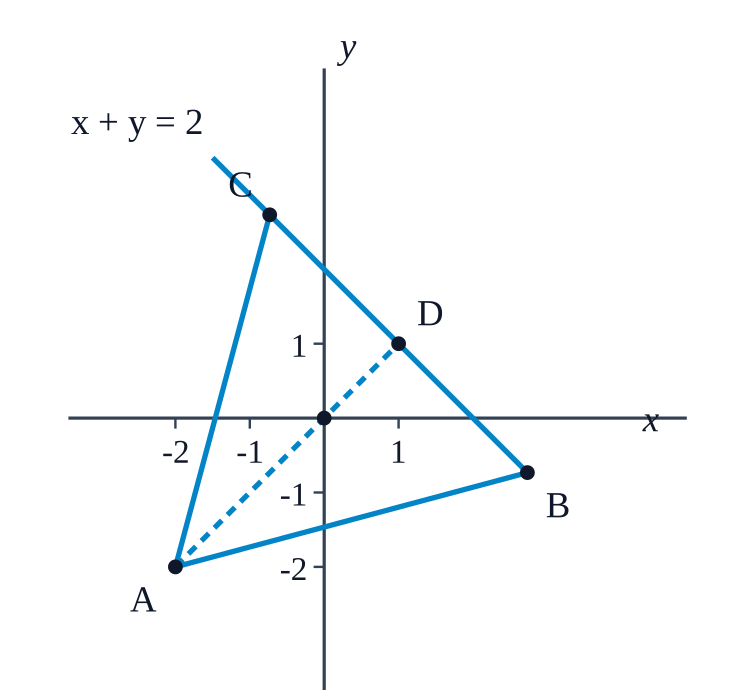
    One vertex of the equilateral triangle with centroid at the origin and one side as x+y−2=0\displaystyle x+y-2=0 is
    (A)
    (−1,−1)\displaystyle (-1, -1)
    (B)
    (2,2)\displaystyle (2,2)
    (C)
    (−2,−2)\displaystyle (-2, -2)
    (D)
    (2,−2)\displaystyle (2,-2)
    [Hint: Let ABC be the equilateral triangle with vertex A(h,k)\displaystyle \mathrm{A}(h, k) and let D(α,β)\displaystyle \mathrm{D}(\alpha, \beta) be the point on BC. Then 2α+h3=0=2β+k3\displaystyle \frac{2 \alpha+h}{3}=0=\frac{2 \beta+k}{3}. Also α+β−2=0\displaystyle \alpha+\beta-2=0 and (k−0h−0)×(−1)=−1\displaystyle \left(\frac{k-0}{h-0}\right) \times(-1)=-1].

    Check this one against your book

    NCERT’s printed answer for this exercise does not match its own question. This working follows the question as printed.

    (C) \(\displaystyle (-2,-2)\)The centroid is also the incentre and circumcentre, so \(\displaystyle R=2r\).\[r=\frac{|0+0-2|}{\sqrt2}=\sqrt2,\qquad R=2\sqrt2 \]The opposite vertex lies on \(\displaystyle y=x\), on the side of the origin away from the given line:\[\sqrt{h^2+h^2}=2\sqrt2,\ h<0 \Rightarrow h=-2 \]NCERT_Solution_Class11_Maths_Exemplar_Ch10_Ex10-3_Q41
  2. Fill in the blank in Exercises $\displaystyle 42$ to 47.

    Exercise 42

    If a,b,c\displaystyle a, b, c are in A.P., then the straight lines ax+by+c=0\displaystyle a x+b y+c=0 will always pass through ____\displaystyle \_\_\_\_.

    Matches the book, not yet reviewed

    This working reaches the answer NCERT prints. It has not yet been read through by hand.

    NCERT’s answer
    \(\displaystyle (1,-2)\)
    \(\displaystyle (1,-2)\)\[a,\ b,\ c \text{ in A.P.} \Rightarrow 2b=a+c \]\[a\cdot 1+b\cdot(-2)+c=a-2b+c=0 \]So \(\displaystyle x=1,\ y=-2\) satisfies \(\displaystyle ax+by+c=0\) for every such \(\displaystyle a,b,c\).
  3. Exercise 43

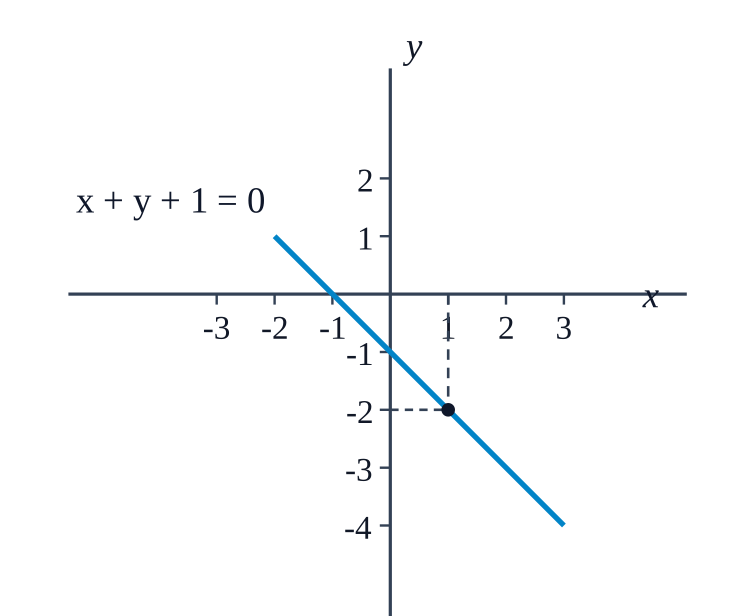
    The line which cuts off equal intercept from the axes and pass through the point (1,−2)\displaystyle (1, -2) is ____\displaystyle \_\_\_\_.

    Matches the book, not yet reviewed

    This working reaches the answer NCERT prints. It has not yet been read through by hand.

    NCERT’s answer
    \(\displaystyle x+y+1=0\)
    \(\displaystyle x+y+1=0\)\[\frac{x}{a}+\frac{y}{a}=1 \Rightarrow x+y=a \]\[(1,-2):\quad 1-2=a \Rightarrow a=-1 \]\[x+y=-1 \]NCERT_Solution_Class11_Maths_Exemplar_Ch10_Ex10-3_Q43
  4. Exercise 44

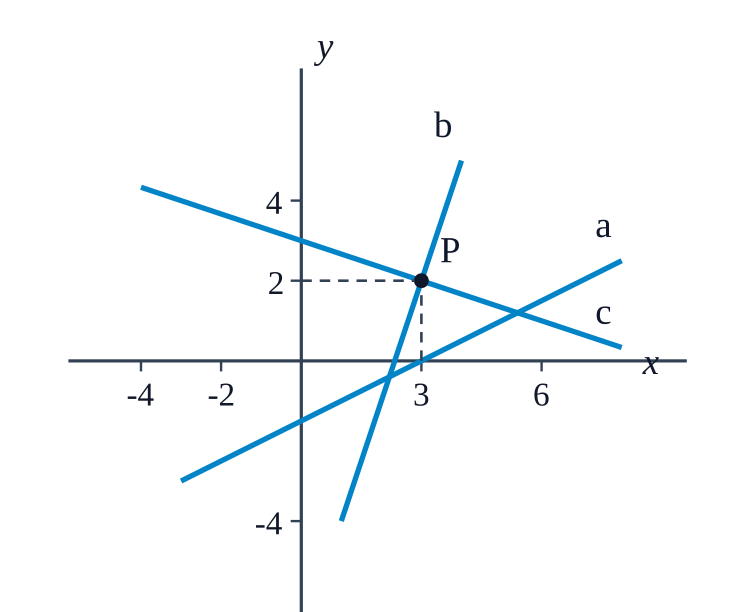
    Equations of the lines through the point (3,2)\displaystyle (3,2) and making an angle of 45∘\displaystyle 45^{\circ} with the line x−2y=3\displaystyle x-2 y=3 are ____\displaystyle \_\_\_\_.

    Matches the book, not yet reviewed

    This working reaches the answer NCERT prints. It has not yet been read through by hand.

    NCERT’s answer
    \(\displaystyle 3 x-y-7=0, x+3 y-9=0\)
    \(\displaystyle 3x-y-7=0\) and \(\displaystyle x+3y-9=0\)Given line \(\displaystyle x-2y=3\) has slope \(\displaystyle \tfrac12\).\[\tan45^\circ=\left|\frac{m-\frac12}{1+\frac m2}\right|=1 \]\[m-\tfrac12=\pm\left(1+\tfrac m2\right) \Rightarrow m=3 \ \text{or}\ m=-\tfrac13 \]\[y-2=3(x-3) \Rightarrow 3x-y-7=0 \]\[y-2=-\tfrac13(x-3) \Rightarrow x+3y-9=0 \]NCERT_Solution_Class11_Maths_Exemplar_Ch10_Ex10-3_Q44
  5. Exercise 45

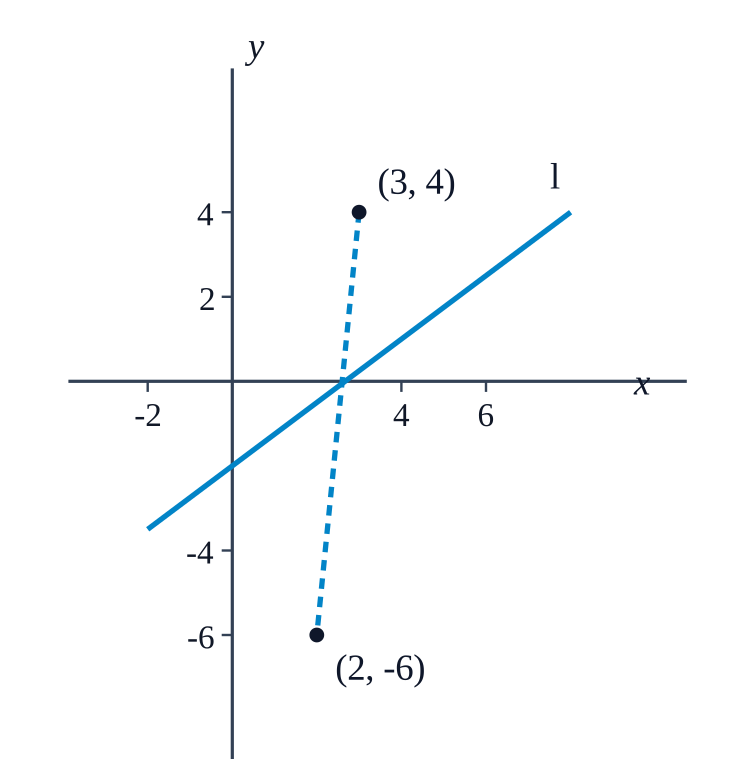
    The points (3,4)\displaystyle (3,4) and (2,−6)\displaystyle (2,-6) are situated on the ____\displaystyle \_\_\_\_ of the line 3x−4y−8=0\displaystyle 3 x-4 y-8=0.

    Matches the book, not yet reviewed

    This working reaches the answer NCERT prints. It has not yet been read through by hand.

    NCERT’s answer
    opposite sides
    opposite sides\[f(x,y)=3x-4y-8 \]\[f(3,4)=9-16-8=-15<0 \]\[f(2,-6)=6+24-8=22>0 \]The signs differ, so the points lie on opposite sides of the line.NCERT_Solution_Class11_Maths_Exemplar_Ch10_Ex10-3_Q45
  6. Exercise 46

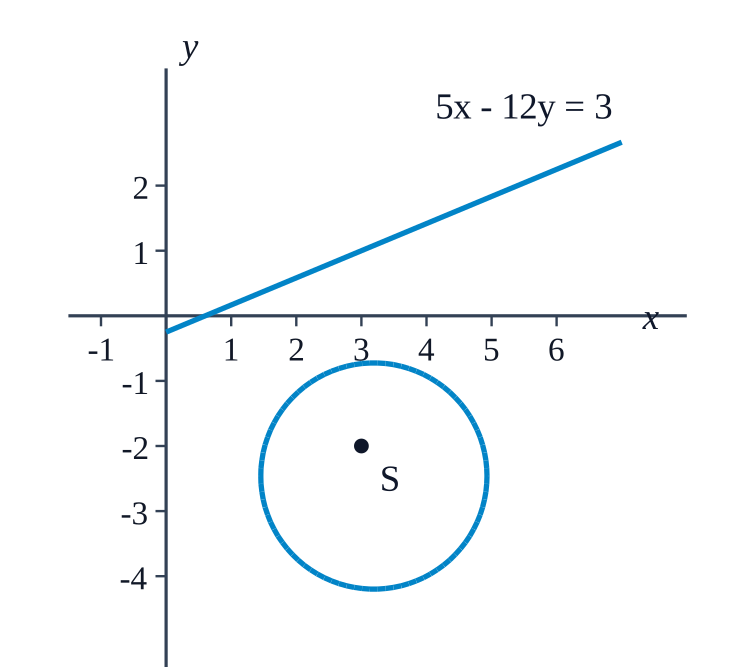
    A point moves so that square of its distance from the point (3,−2)\displaystyle (3, -2) is numerically equal to its distance from the line 5x−12y=3\displaystyle 5 x-12 y=3. The equation of its locus is ____\displaystyle \_\_\_\_.

    Check this one against your book

    NCERT’s printed answer for this exercise does not match its own question. This working follows the question as printed.

    \(\displaystyle 13x^2+13y^2-83x+64y+172=0\)For a point \(\displaystyle (x,y)\) of the locus:\[(x-3)^2+(y+2)^2=\frac{|5x-12y-3|}{13} \]\[13\left[(x-3)^2+(y+2)^2\right]=\pm(5x-12y-3) \]The sign \(\displaystyle -\) gives \(\displaystyle 13x^2+13y^2-73x+40y+166=0\), with \(\displaystyle r^2=-\tfrac{1703}{676}<0\): no real points. The sign \(\displaystyle +\) gives\[13x^2+13y^2-83x+64y+172=0,\qquad r^2=\frac{2041}{676}>0 \]NCERT_Solution_Class11_Maths_Exemplar_Ch10_Ex10-3_Q46
  7. Exercise 47

    Locus of the mid-points of the portion of the line xsin⁡θ+ycos⁡θ=p\displaystyle x \sin \theta+y \cos \theta=p intercepted between the axes is ____\displaystyle \_\_\_\_.

    Matches the book, not yet reviewed

    This working reaches the answer NCERT prints. It has not yet been read through by hand.

    NCERT’s answer
    \(\displaystyle 4 x^2 y^2=p^2\left(x^2+y^2\right)\)
    \(\displaystyle 4x^2y^2=p^2(x^2+y^2)\), that is \(\displaystyle \dfrac1{x^2}+\dfrac1{y^2}=\dfrac4{p^2}\)\[A\left(\frac{p}{\sin\theta},0\right),\qquad B\left(0,\frac{p}{\cos\theta}\right) \]Mid-point \(\displaystyle (h,k)\) of \(\displaystyle AB\):\[h=\frac{p}{2\sin\theta},\qquad k=\frac{p}{2\cos\theta} \]\[\sin\theta=\frac{p}{2h},\qquad \cos\theta=\frac{p}{2k} \]\[\sin^2\theta+\cos^2\theta=1 \Rightarrow \frac{p^2}{4h^2}+\frac{p^2}{4k^2}=1 \]\[p^2(h^2+k^2)=4h^2k^2 \]NCERT_Solution_Class11_Maths_Exemplar_Ch10_Ex10-3_Q47
  8. State whether the statements in Exercises $\displaystyle 48$ to $\displaystyle 56$ are true or false. Justify.

    Exercise 48

    If the vertices of a triangle have integral coordinates, then the triangle can not be equilateral.

    Matches the book, not yet reviewed

    This working reaches the answer NCERT prints. It has not yet been read through by hand.

    NCERT’s answer
    True
    True. For integral vertices the squared side is a positive integer:\[a^2=(x_2-x_1)^2+(y_2-y_1)^2 \]An equilateral triangle would have an irrational area:\[\Delta=\frac{\sqrt3}{4}\,a^2 \]but the coordinate formula gives a rational one:\[\Delta=\tfrac12\left|x_1(y_2-y_3)+x_2(y_3-y_1)+x_3(y_1-y_2)\right| \]Contradiction.
  9. Exercise 49

    The points A(−2,1),B(0,5),C(−1,2)\displaystyle \mathrm{A}(-2,1), \mathrm{B}(0,5), \mathrm{C}(-1,2) are collinear.

    Matches the book, not yet reviewed

    This working reaches the answer NCERT prints. It has not yet been read through by hand.

    NCERT’s answer
    False
    False. The slopes of \(\displaystyle AB\) and \(\displaystyle AC\) differ, so the points are not collinear.\[m_{AB} = \frac{5-1}{0-(-2)} = 2 \]\[m_{AC} = \frac{2-1}{-1-(-2)} = 1 \]\[m_{AB} \ne m_{AC} \]
  10. Exercise 50

    Equation of the line passing through the point (acos⁡3θ,asin⁡3θ)\displaystyle \left(a \cos ^3 \theta, a \sin ^3 \theta\right) and perpendicular to the line xsec⁡θ+ycosec⁡θ=a\displaystyle x \sec \theta+y \operatorname{cosec} \theta=a is xcos⁡θ−ysin⁡θ=asin⁡2θ\displaystyle x \cos \theta-y \sin \theta=a \sin 2 \theta.

    Matches the book, not yet reviewed

    This working reaches the answer NCERT prints. It has not yet been read through by hand.

    NCERT’s answer
    False
    False. The perpendicular through the point has right side \(\displaystyle a\cos 2\theta\), not \(\displaystyle a\sin 2\theta\).Slope of the given line:\[m = -\frac{\sec\theta}{\operatorname{cosec}\theta} = -\tan\theta \]Slope of the perpendicular:\[m' = \cot\theta = \frac{\cos\theta}{\sin\theta} \]Line through \(\displaystyle (a\cos^3\theta,\ a\sin^3\theta)\):\[y - a\sin^3\theta = \frac{\cos\theta}{\sin\theta}\,(x - a\cos^3\theta) \]\[x\cos\theta - y\sin\theta = a(\cos^4\theta - \sin^4\theta) \]\[= a(\cos^2\theta - \sin^2\theta)(\cos^2\theta + \sin^2\theta) = a\cos 2\theta \]