✓ Board-verified
Physics · 2026 · 5 marks
CBSE 2026 · Region 3 · Set 1 · Q31
(a) (i) In the figure, OA and OB show the variation of electric potential V at a point due to two point charges Q_1 and Q_2 with 1/r respectively.…
(i)
In the figure, OA and OB show the variation of electric potential V at a point due to two point charges $\displaystyle \mathrm{Q}_{1}$ and $\displaystyle \mathrm{Q}_{2}$ with $\displaystyle \frac{1}{\mathrm{r}}$ respectively. Here r represents the distance of the point from the two point charges.
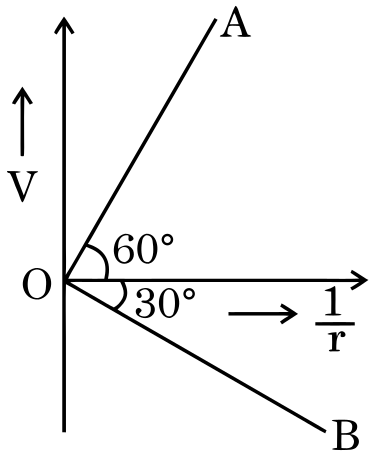
(I)
Identify the nature of the two charges $\displaystyle \mathrm{Q}_{1}$ and $\displaystyle \mathrm{Q}_{2}$.
(II)
What is the value of $\displaystyle \left(\frac{\mathrm{Q}_{1}}{\mathrm{Q}_{2}}\right)$ ? Justify your answer.
(ii)
Two point charges - $\displaystyle 2 \mu \mathrm{C}$ and $\displaystyle 5 \mu \mathrm{C}$ are placed at (-$\displaystyle 30$ cm, $\displaystyle 0$) and ($\displaystyle 30$ cm, $\displaystyle 0$) respectively in an external electric field $\displaystyle \overrightarrow{\mathrm{E}}=\frac{\mathrm{A}}{\mathrm{x}^{2}} \hat{\mathrm{i}}$, where $\displaystyle \mathrm{A}=9 \times 10^{5} \mathrm{Nm}^{2} \mathrm{C}^{-1}$. Find the electrostatic potential energy of this configuration.
(i)
Two infinitely long straight wires having linear charge densities $\displaystyle -\lambda$ and $\displaystyle 3 \lambda$ are held vertically parallel to each other, distance r apart in free space. Find the nature and magnitude of the force/length exerted by one wire on the other.
(ii)
A small hollow conducting sphere of radius $\displaystyle \mathrm{r}_{1}$ is given a charge Q . It is surrounded by a concentric conducting spherical shell of inner radius $\displaystyle \mathrm{r}_{2}$ and outer radius $\displaystyle \mathrm{r}_{3}$, having charge - 3q. If a point charge 2q were kept at the centre, find :
(I)
the electric flux through a concentric spherical Gaussian surface of radius x for ($\displaystyle 1$) $\displaystyle \mathrm{x}<\mathrm{r}_{1}$, and
(2)
$\displaystyle \mathrm{r}_{1}<\mathrm{x}<\mathrm{r}_{2}$.
(II)
electric field at a point distant x from the centre for
(1)
$\displaystyle \mathrm{x}>\mathrm{r}_{3}$, and ($\displaystyle 2$) $\displaystyle \mathrm{r}_{1}<\mathrm{x}<\mathrm{r}_{2}$.
(III)
surface charge density on the inner surface of
(1)
sphere, and ($\displaystyle 2$) shell.
Marking-scheme solution
(i)
(I)
$\displaystyle \mathrm{Q}_{1}$ – Positive
$\displaystyle \mathrm{Q}_{2}$ – Negative
(II)
$\displaystyle \dfrac{Q_{1}}{Q_{2}}=\dfrac{\text{Slope of A}}{\text{Slope of B}}=\dfrac{\tan 60^{\circ}}{\tan 30^{\circ}}=\dfrac{3}{1}$
(ii)
$\displaystyle \mathrm{V}(\mathrm{r})=-\int \mathrm{E}\, \mathrm{dx}=-\int \dfrac{A}{x^{2}}\, \mathrm{dx}=\dfrac{A}{x}$
$\displaystyle \mathrm{U}=q_{1} \mathrm{~V}\left(x_{1}\right)+q_{2} \mathrm{~V}\left(x_{2}\right)+\dfrac{q_{1} q_{2}}{4 \pi \epsilon_{0} x_{12}}=q_{1} \dfrac{A}{x_{1}}+q_{2} \dfrac{A}{x_{2}}+\dfrac{q_{1} q_{2}}{4 \pi \epsilon_{0} x_{12}}$
$\displaystyle =\dfrac{-2 \times 10^{-6} \times 9 \times 10^{5}}{30 \times 10^{-2}}+\dfrac{5 \times 10^{-6} \times 9 \times 10^{5}}{30 \times 10^{-2}}-\dfrac{5 \times 2 \times 10^{-12} \times 9 \times 10^{9}}{60 \times 10^{-2}}$
$\displaystyle =(-6+15-0.15) \mathrm{~J}$
$\displaystyle =8.85 \mathrm{~J}$
(i)
Nature of force: Attractive
$\displaystyle d q=\lambda d l$
Electric field on wire $\displaystyle 2$ due to wire $\displaystyle 1$: $\displaystyle \mathrm{E}=\dfrac{-\lambda}{2 \pi \varepsilon_{0} \mathrm{r}}$
Force on wire $\displaystyle 2=\mathrm{qE}$
$\displaystyle \dfrac{\text{Force}}{\text{length}}=\dfrac{F_{1}}{l}=\dfrac{-\lambda \times 3 \lambda}{2 \pi \varepsilon_{0} \mathrm{r}}=\dfrac{-3 \lambda^{2}}{2 \pi \varepsilon_{0} r}$
Similarly, $\displaystyle \dfrac{F_{2}}{l}=\dfrac{-3 \lambda^{2}}{2 \pi \varepsilon_{0} r}$
(ii)
(I)(1)
$\displaystyle x<r_{1}$: $\displaystyle \phi=\dfrac{2 q}{\varepsilon_{0}}$
($\displaystyle 2$) $\displaystyle r_{1}<x<r_{2}$: $\displaystyle \phi=\dfrac{(Q+2 q)}{\varepsilon_{0}}$
(II)(1)
$\displaystyle x>r_{3}$: $\displaystyle E=\dfrac{k(Q-q)}{x^{2}}$
($\displaystyle 2$) $\displaystyle r_{1}<x<r_{2}$: $\displaystyle E=\dfrac{k(Q+2 q)}{x^{2}}$
(III)(1)
$\displaystyle \sigma=\dfrac{-2 q}{4 \pi r_{1}^{2}}$
($\displaystyle 2$) $\displaystyle \sigma=\dfrac{-(Q+2 q)}{4 \pi r_{2}^{2}}$
All Electrostatic Potential and Capacitance questions2026 question paperNCERT solutions: Electrostatic Potential and CapacitancePractice Electrostatic Potential and Capacitance →
More from Electrostatic Potential and Capacitance
- (i) A parallel plate capacitor with plate area A and plate separation d has a capacitance C_0. A slab of dielectric constant K having area A and…2025
- A point charge q_0 is moving along a circular path of radius a, with a point charge -Q at the centre of the circle. The kinetic energy of q_0 is2023
- The effective capacitance of the network between points A and B shown in the figure is:2025
- Two metal spheres of radii r_1 and r_2(>r_1) having charges q_1 and q_2 respectively kept in air, are brought in contact. Which of the following…2026
- (i) Explain the following statements giving reason: (I) An equipotential surface through a point is normal to the electric field at that point. (II)…2026
- A parallel plate capacitor has plate area A and plate separation d. Half of the space between the plates is filled with a material of dielectric…2025
- A thin spherical conducting shell of radius R has a charge q. A point charge Q is placed at the centre of the shell. Find (i) the charge density on…2024
- A parallel plate capacitor has two parallel plates which are separated by an insulating medium like air, mica, etc. When the plates are connected to…2025
CBSE Class 12 Physics past-paper question from the 2026 board exam, with the answer as CBSE’s own marking scheme gives it. Where our answers come from.