✓ Board-verified
Physics · 2026 · 5 marks
CBSE 2026 · Region 2 · Set 1 · Q32
(a) Derive an expression for the capacitance of a parallel plate capacitor of plate area A and plate separation d with air present between the…
(a)
Derive an expression for the capacitance of a parallel plate capacitor of plate area A and plate separation d with air present between the plates.
(b)
Two air-filled capacitors of capacitances $\displaystyle \mathrm{C}_{1}$ and $\displaystyle \mathrm{C}_{2}$ are connected in parallel with a dc battery. After the capacitors are fully charged, a slab of dielectric constant K is inserted between the plates of each capacitor. How will the (i) charge on each capacitor and (ii) energy stored in the capacitor affected after the slab is introduced.
(a)
An electric field $\displaystyle \overrightarrow{\mathrm{E}}$ is established across the ends of a cylindrical conductor of length L and area of cross-section A. Discuss how electrons attain an average velocity, independent of time. Hence, obtain a relation between current in the conductor and this 'average velocity' of electrons.
(b)(i)
This 'average velocity' is found be few mm/s for currents in range of a few amperes. How then is current established almost the instant a circuit is closed ?
(ii)
Two copper wires having their radii in the ratio of $\displaystyle 3$ : $\displaystyle 2$ are connected in series across a battery. Find the ratio of the drift velocities of the electrons in the wires.
Marking-scheme solution
(a)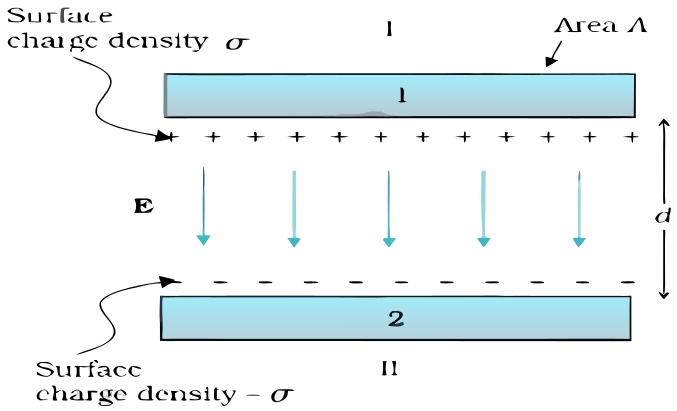
Electric field between the plates $\displaystyle E=\dfrac{\sigma}{\varepsilon_{0}}=\dfrac{q}{A \varepsilon_{0}}$
Potential difference $\displaystyle V=E d=\dfrac{q d}{A \varepsilon_{0}}$
Capacitance $\displaystyle \mathrm{C}=\dfrac{q}{V}=\dfrac{A \varepsilon_{0}}{d}$
(i)
In a parallel combination the potential difference is the same across the capacitors. On insertion of the dielectric slab the capacitance of each capacitor becomes K (dielectric constant) times, i.e. $\displaystyle \mathrm{C}^{\prime}=K \mathrm{C}$. Hence the final charge on each capacitor becomes K times: $\displaystyle q^{\prime}=\mathrm{C}^{\prime} V=K \mathrm{C} V=K q$, so $\displaystyle q_{1}^{\prime}=K \mathrm{C}_{1} V=K q_{1}$ and $\displaystyle q_{2}^{\prime}=K \mathrm{C}_{2} V=K q_{2}$.
(ii)
Energy stored by a capacitor $\displaystyle U=\dfrac{1}{2} \mathrm{C} V^{2}$. As the capacitance becomes K times, the energy stored by each capacitor also increases by a factor K, i.e. $\displaystyle U^{\prime}=K U$, so $\displaystyle U_{1}^{\prime}=\dfrac{1}{2} K \mathrm{C}_{1} V^{2}=K U_{1}$ and $\displaystyle U_{2}^{\prime}=\dfrac{1}{2} K \mathrm{C}_{2} V^{2}=K U_{2}$.
$\displaystyle \vec{v}_{d}=\dfrac{-e \vec{E} \tau}{m}$, where $\displaystyle \tau$ is the average time between two successive collisions, which is constant. The distance covered by electrons between two successive collisions is almost the same, hence $\displaystyle S=\dfrac{1}{2} a t^{2}$ where $\displaystyle a$ = constant and $\displaystyle s$ = almost constant, so $\displaystyle t$ is constant.
Alternatively: At any instant some of the electrons would have spent time more than $\displaystyle \tau$ and some less than $\displaystyle \tau$. Thus averaging over all the times we get a constant time. This way we get an average velocity independent of time.
Let $\displaystyle n$ be the number of free electrons per unit volume in the conductor of length $\displaystyle L$ and cross-sectional area $\displaystyle A$. Total charge crossing area $\displaystyle A$ in time $\displaystyle \Delta t$ is $\displaystyle q=-n e A\left|\vec{v}_{d}\right| \Delta t$
The negative sign indicates that the direction of flow of electrons is opposite to the direction of the electric field. By definition, electric current is opposite to the flow of electrons, so $\displaystyle I \Delta t=n e A\left|\vec{v}_{d}\right| \Delta t$
$\displaystyle I=n e A\left|\vec{v}_{d}\right|$
(b)(i)
The electric field is established throughout the circuit almost instantly, causing at every point a local electron drift. As a result the current is established instantaneously.
(ii)
$\displaystyle v_{\mathrm{d}}=\dfrac{\mathrm{I}}{n e \pi \mathrm{r}^{2}}$
$\displaystyle \dfrac{v_{d 1}}{v_{d 2}}=\left(\dfrac{\mathrm{r}_{2}}{\mathrm{r}_{1}}\right)^{2}=\dfrac{4}{9}$
All Electrostatic Potential and Capacitance questions2026 question paperNCERT solutions: Electrostatic Potential and CapacitancePractice Electrostatic Potential and Capacitance →
More from Electrostatic Potential and Capacitance
- (i) A parallel plate capacitor with plate area A and plate separation d has a capacitance C_0. A slab of dielectric constant K having area A and…2025
- (i) In the figure, OA and OB show the variation of electric potential V at a point due to two point charges Q_1 and Q_2 with 1/r respectively. Here r…2026
- A point charge q_0 is moving along a circular path of radius a, with a point charge -Q at the centre of the circle. The kinetic energy of q_0 is2023
- The effective capacitance of the network between points A and B shown in the figure is:2025
- Two metal spheres of radii r_1 and r_2(>r_1) having charges q_1 and q_2 respectively kept in air, are brought in contact. Which of the following…2026
- (i) Explain the following statements giving reason: (I) An equipotential surface through a point is normal to the electric field at that point. (II)…2026
- A parallel plate capacitor has plate area A and plate separation d. Half of the space between the plates is filled with a material of dielectric…2025
- A thin spherical conducting shell of radius R has a charge q. A point charge Q is placed at the centre of the shell. Find (i) the charge density on…2024
CBSE Class 12 Physics past-paper question from the 2026 board exam, with the answer as CBSE’s own marking scheme gives it. Where our answers come from.