✓ Board-verified
Physics · 2026 · 5 marks
CBSE 2026 · Region 4 · Set 1 · Q33
(a) (i) Explain the following statements giving reason: (I) An equipotential surface through a point is normal to the electric field at that point.…
(i)
Explain the following statements giving reason :
(I)
An equipotential surface through a point is normal to the electric field at that point.
(II)
When a dielectric is placed in an external electric field, the electric field inside the dielectric is less than that outside it.
(III)
The potential difference between the plates of a charged parallel plate capacitor decreases when its plates are brought closer.
(ii)
Obtain an expression for the work done to dissociate the system of three charges q, - 4q and 2q placed at the vertices A, B and C respectively of an equilateral triangle of side 'a'.
(i)
Answer the following giving reason :
(I)
The electron drift speed is estimated to be only a few mm/s for currents in the range of a few amperes. How, then, is the current established almost the instant a circuit is closed ?
(II)
A low voltage supply from which one needs high currents must have very low internal resistance. Why ?
(III)
The assertion that V = IR is a statement of Ohm's law is not true. Why ?
(ii)
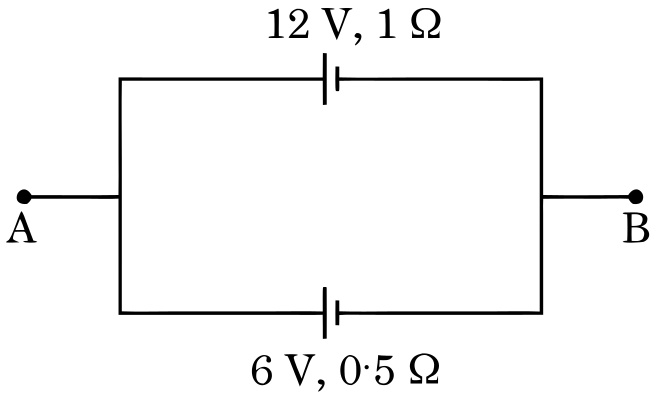
Two cells of emfs $\displaystyle 12$ V and $\displaystyle 6$ V are connected in parallel as shown in the figure. Their internal resistances are $\displaystyle 1 \Omega$ and $\displaystyle 0.5 \Omega$ respectively. Calculate the emf and internal resistance of the equivalent cell between points A and B.
Marking-scheme solution
(a)(i)
Reason for:
(I)
Electric field perpendicular to the equipotential surface at a point. $\displaystyle 1$
(II)
Reduction of electric field inside the dielectric. $\displaystyle 1$
(III)
Potential difference decreases when the plates of a capacitor are brought closer. $\displaystyle 1$
(ii)
Obtaining expression for the work done.
(i)
(I)
If the field were not normal to the equipotential surface, it would have non-zero component along the surface. To move a unit test charge against the direction of the component of the field, work would be done. This is in contradiction to the definition of equipotential surface.
Alternatively
$\displaystyle \oint \overrightarrow{\mathrm{E}} \cdot \overrightarrow{\mathrm{dl}}=\mathrm{V}_{\mathrm{A}}-\mathrm{V}_{\mathrm{B}} ; \mathrm{V}_{\mathrm{A}}=\mathrm{V}_{\mathrm{B}}$ for equipotential surface
$\displaystyle \oint \overrightarrow{\mathrm{E}} \cdot \overrightarrow{\mathrm{dl}}=0 \Rightarrow \cos \theta=0$ as $\displaystyle \mathrm{E} \neq 0 \& \mathrm{dl} \neq 0$ and $\displaystyle \theta=90^{0}$
(II)
When a dielectric is placed in an external electric field, due to polarization of its molecules, an electric field is induced in a direction opposite to the external field, hence net electric field inside is reduced.
Alternatively
\[\varepsilon=\varepsilon_{0}-\varepsilon_{\mathrm{P}}
\]
(III)
Potential difference (V) $\displaystyle =\frac{\mathrm{Q}}{\mathrm{C}}$
\[\begin{aligned}
& \mathrm{V}=\frac{\mathrm{Qd}}{\mathrm{~A} \varepsilon_{0}} \\
& \mathrm{~V} \propto \mathrm{~d}
\end{aligned}
\]
All Electrostatic Potential and Capacitance questions2026 question paperNCERT solutions: Electrostatic Potential and CapacitancePractice Electrostatic Potential and Capacitance →
More from Electrostatic Potential and Capacitance
- (i) A parallel plate capacitor with plate area A and plate separation d has a capacitance C_0. A slab of dielectric constant K having area A and…2025
- (i) In the figure, OA and OB show the variation of electric potential V at a point due to two point charges Q_1 and Q_2 with 1/r respectively. Here r…2026
- A point charge q_0 is moving along a circular path of radius a, with a point charge -Q at the centre of the circle. The kinetic energy of q_0 is2023
- The effective capacitance of the network between points A and B shown in the figure is:2025
- Two metal spheres of radii r_1 and r_2(>r_1) having charges q_1 and q_2 respectively kept in air, are brought in contact. Which of the following…2026
- A parallel plate capacitor has plate area A and plate separation d. Half of the space between the plates is filled with a material of dielectric…2025
- A thin spherical conducting shell of radius R has a charge q. A point charge Q is placed at the centre of the shell. Find (i) the charge density on…2024
- A parallel plate capacitor has two parallel plates which are separated by an insulating medium like air, mica, etc. When the plates are connected to…2025
CBSE Class 12 Physics past-paper question from the 2026 board exam, with the answer as CBSE’s own marking scheme gives it. Where our answers come from.