✓ Board-verified
Physics · 2025 · 4 marks
CBSE 2025 · Region 2 · Set 2 · Q30
A parallel plate capacitor has two parallel plates which are separated by an insulating medium like air, mica, etc. When the plates are connected to…
A parallel plate capacitor has two parallel plates which are separated by an insulating medium like air, mica, etc. When the plates are connected to the terminals of a battery, they get equal and opposite charges and an electric field is set up in between them. This electric field between the two plates depends upon the potential difference applied, the separation of the plates and nature of the medium between the plates.
(i)
The electric field between the plates of a parallel plate capacitor is E . Now the separation between the plates is doubled and simultaneously the applied potential difference between the plates is reduced to half of its initial value. The new value of the electric field between the plates will be :
(A)
E
(B) $\displaystyle 2$ E
(C)
$\displaystyle \frac{\mathrm{E}}{4}$
(D)
$\displaystyle \frac{\mathrm{E}}{2}$
(ii)
A constant electric field is to be maintained between the two plates of a capacitor whose separation d changes with time. Which of the graphs correctly depict the potential difference ( $\displaystyle V$ ) to be applied between the plates as a function of separation between the plates (d) to maintain the constant electric field?
(A)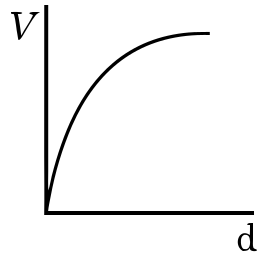
(B)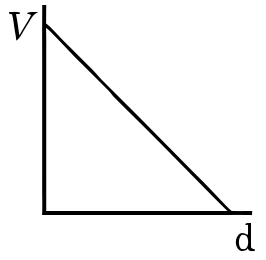
(C)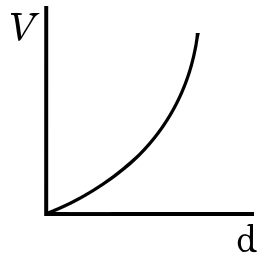
(D)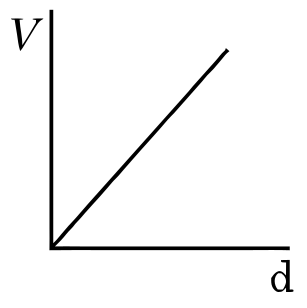
(iii)
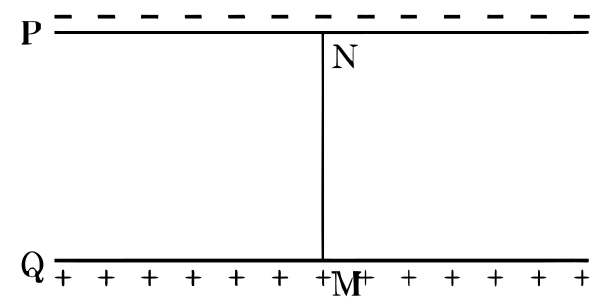
In the above figure $\displaystyle \mathrm{P}, \mathrm{Q}$ are the two parallel plates of a capacitor. Plate Q is at positive potential with respect to plate P. MN is an imaginary line drawn perpendicular to the plates. Which of the graphs shows correctly the variations of the magnitude of electric field strength E along the line MN?
(A)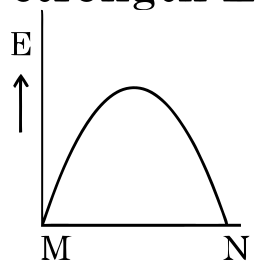
(B)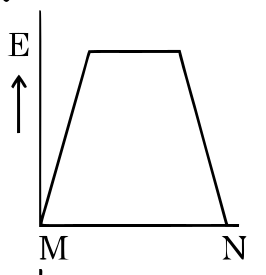
(C)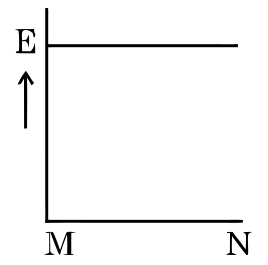
(D)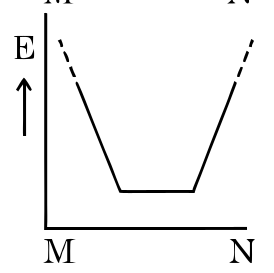
Three parallel plates are placed above each other with equal displacement $\displaystyle \vec{\mathrm{d}}$ between neighbouring plates. The electric field between the first pair of the plates is $\displaystyle \overrightarrow{\mathrm{E}}_{1}$ and the electric field between the second pair of the plates is $\displaystyle \overrightarrow{\mathrm{E}}_{2}$. The potential difference between the third and the first plate is-
(A)
$\displaystyle \left(\overrightarrow{\mathrm{E}}_{1}+\overrightarrow{\mathrm{E}}_{2}\right) \cdot \overrightarrow{\mathrm{d}}$
(B)
$\displaystyle \left(\vec{\mathrm{E}}_{1}-\vec{\mathrm{E}}_{2}\right) \cdot \vec{\mathrm{d}}$
(C)
$\displaystyle \left(\vec{\mathrm{E}}_{2}-\vec{\mathrm{E}}_{1}\right) \cdot \vec{\mathrm{d}}$
(D)
$\displaystyle \frac{\mathrm{d}\left(\mathrm{E}_{1}+\mathrm{E}_{2}\right)}{2}$
A material of dielectric constant K is filled in a parallel plate capacitor of capacitance C. The new value of its capacitance becomes
(A)
C
(B) $\displaystyle \frac{\mathrm{C}}{\mathrm{K}}$
(C)
CK
(D)
$\displaystyle \mathrm{C}\left(1+\frac{1}{\mathrm{~K}}\right)$
Marking-scheme solution
(i)(C)
$\displaystyle \frac{E}{4}$
(ii)(D)
(iii)(C)
(iv)
(A)
$\displaystyle \left(E_{1}+E_{2}\right) \cdot d$
OR
(C)
CK
All Electrostatic Potential and Capacitance questions2025 question paperNCERT solutions: Electrostatic Potential and CapacitancePractice Electrostatic Potential and Capacitance →
More from Electrostatic Potential and Capacitance
- (i) A parallel plate capacitor with plate area A and plate separation d has a capacitance C_0. A slab of dielectric constant K having area A and…2025
- (i) In the figure, OA and OB show the variation of electric potential V at a point due to two point charges Q_1 and Q_2 with 1/r respectively. Here r…2026
- A point charge q_0 is moving along a circular path of radius a, with a point charge -Q at the centre of the circle. The kinetic energy of q_0 is2023
- The effective capacitance of the network between points A and B shown in the figure is:2025
- Two metal spheres of radii r_1 and r_2(>r_1) having charges q_1 and q_2 respectively kept in air, are brought in contact. Which of the following…2026
- (i) Explain the following statements giving reason: (I) An equipotential surface through a point is normal to the electric field at that point. (II)…2026
- A parallel plate capacitor has plate area A and plate separation d. Half of the space between the plates is filled with a material of dielectric…2025
- A thin spherical conducting shell of radius R has a charge q. A point charge Q is placed at the centre of the shell. Find (i) the charge density on…2024
CBSE Class 12 Physics past-paper question from the 2025 board exam, with the answer as CBSE’s own marking scheme gives it. Where our answers come from.