SolveItClass 9 · NCERT

NCERT Solutions · Class 9 Social Science The Price Puzzle: What Drives the Market

24 questions · 24 still being checked

Think About It 9.1–9.3 (part 5 of 6)

  1. Exercise 9.1

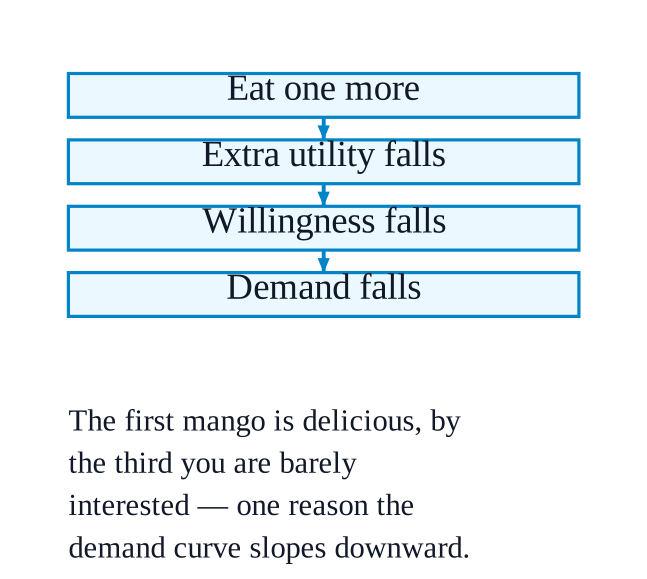
    What happens when you consume the first mango? It tastes delicious, right? The second one is good? The third one and so on? You are barely interested in eating mangoes by this point. Why do you think this happens? This is because the additional utility or usefulness derived from a product declines as more of it is consumed. This is known as the diminishing marginal utility principle in economics. As the utility derived from a successive quantity of products falls, the willingness to pay for the products also decreases, so demand falls.

    The book prints no answer for this

    NCERT publishes no answers for this textbook, so there is nothing in the book to check this working against. It has also not yet been read through by hand.

    Because the extra satisfaction from each additional mango keeps falling — the diminishing marginal utility principle.
    NCERT_Solution_Class9_SocialScience_Ch9_TAI_Q9-1
    The first mango gives the most utility, the second a little less, and by the fourth or fifth you are barely interested.
    As that extra utility falls, your willingness to pay falls with it — you would take another mango only if it were cheaper.
    That is why demand falls as you consume more, and one reason the demand curve slopes downward.
  2. Exercise 9.2

    Can you think of another real-life example (other than hotels) where prices change frequently? Explain why the prices keep changing. Our choices today affect future resources. For example, high demand for fast fashion, overfishing and overuse of groundwater can harm future supply. So, should we focus only on short-term gains, or also think about long-term sustainability? How could this affect the market equilibrium?

    The book prints no answer for this

    NCERT publishes no answers for this textbook, so there is nothing in the book to check this working against. It has also not yet been read through by hand.

    What the task asksNCERT_Solution_Class9_SocialScience_Ch9_TAI_Q9-2
    Name your own example of prices that change often and explain it with demand and supply, then give your own view on short-term gain versus long-term sustainability.
    Worked example: airline seats
    The chapter opens with the puzzle of the same flight seat costing ₹$\displaystyle 3,000$ one day and ₹$\displaystyle 9,000$ another.
    The price climbs as seats run out, as the date of travel comes closer, and during holidays, festivals and exam breaks when many people want to fly at once — demand is high against a fixed number of seats.
    It drops when a flight is filling slowly or when another airline cuts its fare, because an empty seat earns nothing once the plane takes off.
    Other examples that work the same way: onions and tomatoes across the year, cab fares in the rain, hotel rooms on New Year's Eve, gold, movie tickets on an opening weekend.
    Worked example: short term versus long term
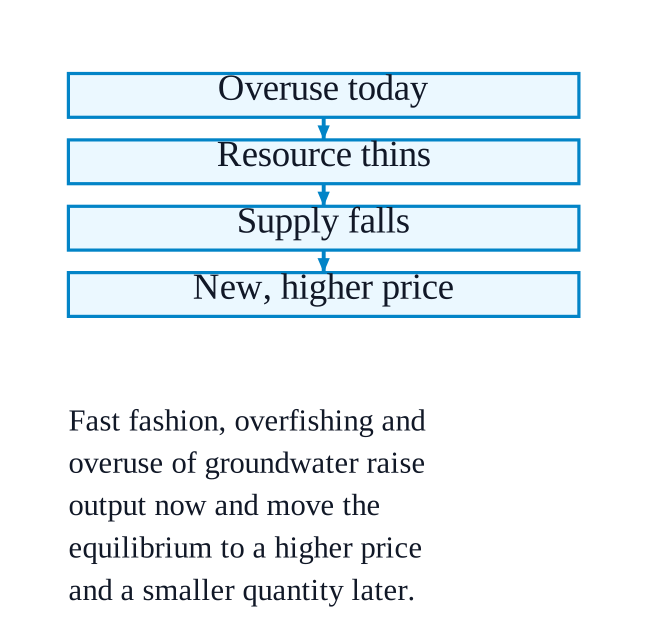
    Fast fashion, overfishing and overuse of groundwater all raise output and profit today by drawing down a resource that took years to build.
    When the resource thins, future supply falls: less is offered at every price.
    With supply smaller and demand unchanged, the market settles at a new equilibrium with a higher price and a smaller quantity — the good becomes both scarcer and costlier, and the people hurt most are those least able to pay.
    So a market that thinks only of short-term gain does not stay cheap; it prices itself out later. Planning for sustainability keeps supply steady and keeps the equilibrium price stable.
    What a good answer must contain
    One named example, with at least two reasons its price moves, each tied to demand or to supply.
    A stated view on sustainability with a reason, not just an opinion.
    The equilibrium link: falling supply means a higher price and a smaller quantity traded.
  3. Exercise 9.3

    Have you ever seen or heard of the government fixing prices or wages (for example, bus fares, medicines, or minimum wages)? Share an example and why you think it was done.

    The book prints no answer for this

    NCERT publishes no answers for this textbook, so there is nothing in the book to check this working against. It has also not yet been read through by hand.

    What the task asksNCERT_Solution_Class9_SocialScience_Ch9_TAI_Q9-3
    Share one instance you have seen or heard of where the government fixed a price or a wage, and say why you think it was done.
    Worked example, from the chapter
    During COVID-$\displaystyle 19$ the demand for sanitisers surged, there were stockouts and sharp price rises, and some shopkeepers began hoarding and black-marketing.
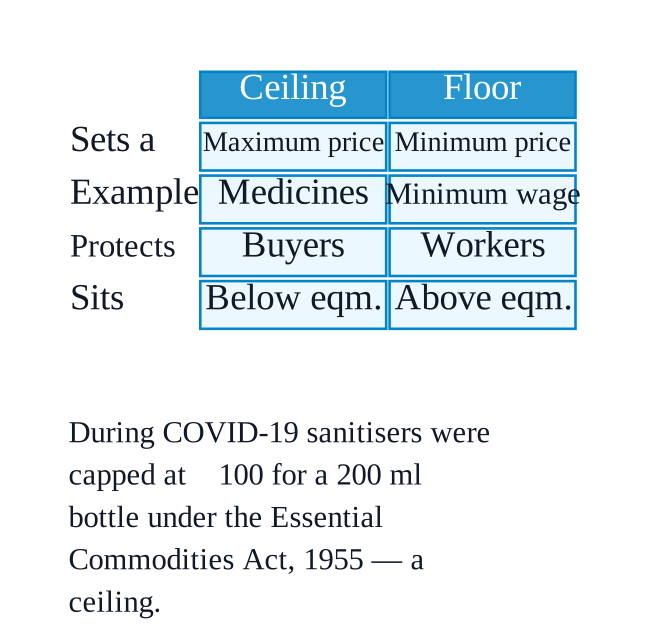
    The government declared sanitisers essential commodities under the Essential Commodities Act, $\displaystyle 1955$, and capped the maximum retail price at ₹$\displaystyle 100$ for a $\displaystyle 200$ ml bottle.
    Why: to stop people being overcharged for something they needed for their safety, at a moment when they had no choice but to buy.
    What followed matters too: many companies started production, and sanitisers soon became widely available at fair prices. A price cap works best when supply is rising alongside it.
    Two more from the chapter
    A price ceiling on essential medicines, so that a sick person is not charged whatever the seller likes.
    A minimum wage — a price floor — so that workers earn enough for their hard work. Bus fares are another kind you may have noticed being fixed.
    What a good answer must contain
    One real instance, with where you saw or heard of it.
    Whether it was a maximum price (ceiling) or a minimum price or wage (floor).
    Who it was meant to protect — buyers from overcharging, or sellers and workers from being paid too little.