SolveItClass 9 · NCERT

NCERT Solutions · Class 9 Social Science The Price Puzzle: What Drives the Market

24 questions · 24 still being checked

The Big Questions 9.1–9.4 (part 1 of 6)

  1. Exercise 9.1

    What are the factors that influence the demand for and supply of goods and services in a market?

    The book prints no answer for this

    NCERT publishes no answers for this textbook, so there is nothing in the book to check this working against. It has also not yet been read through by hand.

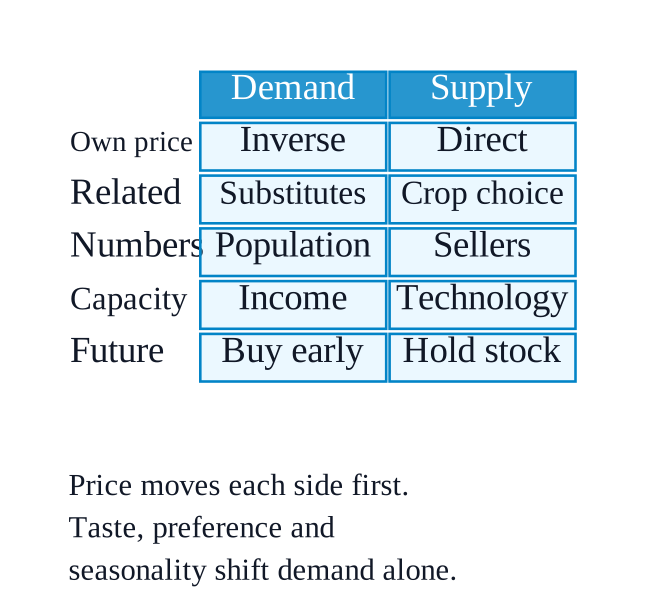
    Demand and supply are each driven by price first, and then by a list of non-price factors.
    NCERT_Solution_Class9_SocialScience_Ch9_BQ_Q9-1What influences demand
    Price — the Law of Demand: when price rises, quantity demanded falls; when price falls, quantity demanded rises.
    Price of related goods — a costlier substitute pushes buyers across (coffee dearer, so tea's demand rises); a costlier complement drags the partner good down (costlier movie tickets, so less popcorn sold).
    Income, and taste and preference — a rise in income lets people buy more or buy better quality; but Srivalli will not swap mangoes for oranges however cheap oranges are.
    Population, seasonality and future price expectations — the size and composition of the population shape what is wanted; sweaters sell in winter and sweets at festivals; and people postpone buying durables before Diwali because they expect discounts.
    What influences supply
    Price — the Law of Supply: a higher price raises profit, so producers make more and new firms enter the market.
    Price of related goods, number of sellers, technology and future expectations — a farmer plants chickpeas if wheat pays less; more sellers means more supply; drip irrigation and cold storage raise output; and a wholesaler who expects a price rise holds stock back to sell later.
  2. Exercise 9.2

    How are prices of goods and services determined through demand and supply interactions?

    The book prints no answer for this

    NCERT publishes no answers for this textbook, so there is nothing in the book to check this working against. It has also not yet been read through by hand.

    Prices are settled by the interaction of demand and supply, not by any single buyer or seller.
    NCERT_Solution_Class9_SocialScience_Ch9_BQ_Q9-2
    The market demand curve slopes downward (buyers take more as price falls) and the market supply curve slopes upward (sellers offer more as price rises).
    Where the two curves cut each other is the equilibrium price — in the chapter's Table $\displaystyle 9.3$ that is ₹$\displaystyle 100$, with $\displaystyle 12$ kg bought and sold.
    If the price is too low there is excess demand — at ₹$\displaystyle 40$ the chapter's table shows $\displaystyle 38$ kg wanted against only $\displaystyle 6$ kg offered, and buyers competing for it push the price up.
    If the price is too high there is excess supply — at ₹$\displaystyle 150$, $\displaystyle 43$ kg is offered against only $\displaystyle 8$ kg wanted, and sellers cut the price to clear stock.
    So a price that is not the equilibrium price creates the very pressure that moves it back.
  3. Exercise 9.3

    What is market equilibrium, and does it exist in the real world?

    The book prints no answer for this

    NCERT publishes no answers for this textbook, so there is nothing in the book to check this working against. It has also not yet been read through by hand.

    Market equilibrium is the price at which quantity demanded equals quantity supplied — no shortage and no surplus, so the market is 'cleared'.
    NCERT_Solution_Class9_SocialScience_Ch9_BQ_Q9-3
    At that price there is no pressure for the price to change; it stays stable unless something outside the market changes.
    On a graph it is the single point where the demand curve and the supply curve intersect — point E, at ₹$\displaystyle 100$ and $\displaystyle 12$ kg in the chapter's example.
    In the real world it is never a resting point. Technology, wages, interest rates, wars, political events, pandemics, weather and natural disasters keep moving demand and supply.
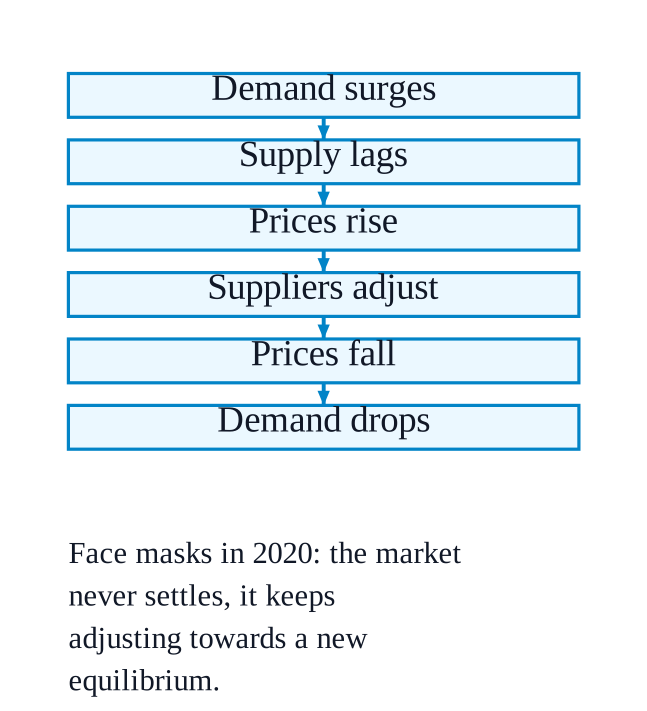
    So the market is always adjusting towards a new equilibrium, never fully settling at the old one — the chapter's example is face masks during the COVID-$\displaystyle 19$ pandemic in $\displaystyle 2020$: demand surged, supply could not catch up, prices rose sharply, then fell again as suppliers adjusted.
  4. Exercise 9.4

    How and why does the government intervene in the market?

    The book prints no answer for this

    NCERT publishes no answers for this textbook, so there is nothing in the book to check this working against. It has also not yet been read through by hand.

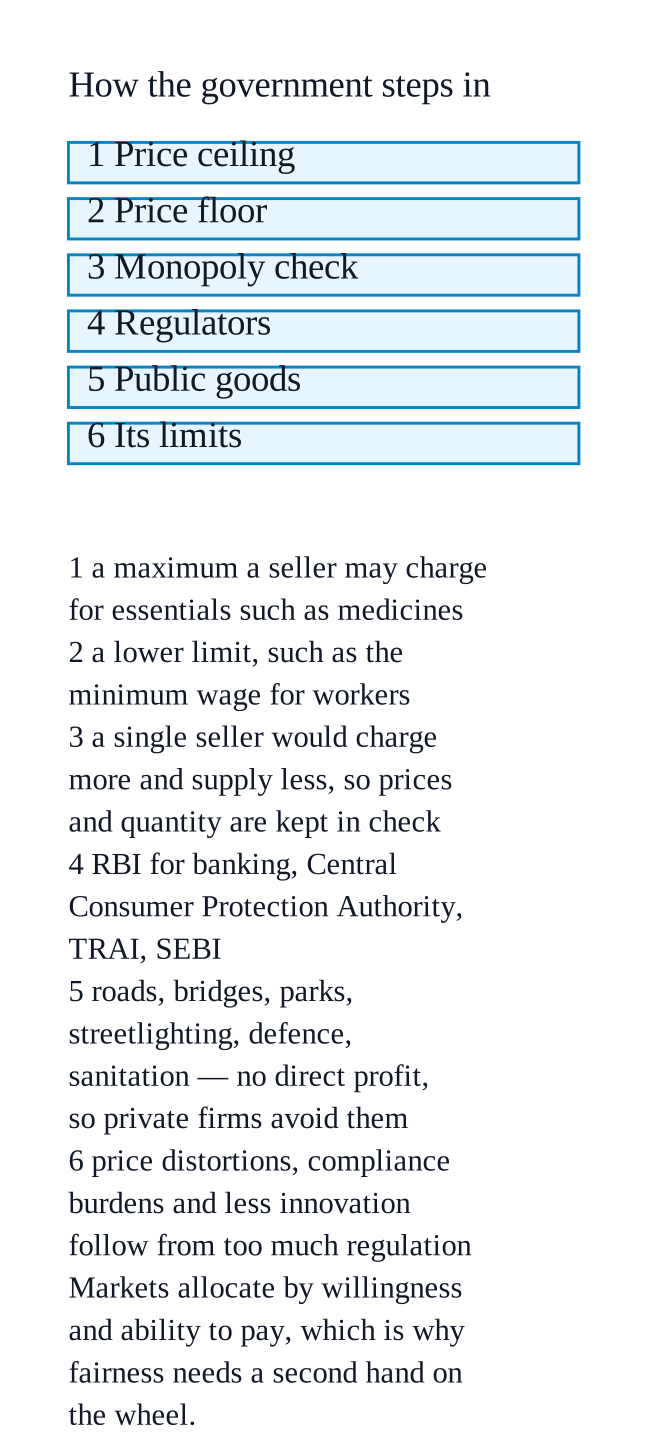
    The government intervenes because markets allocate goods by willingness and ability to pay, which is not always fair — if essential medicines become very expensive, they stop being accessible to everyone.
    NCERT_Solution_Class9_SocialScience_Ch9_BQ_Q9-4
    It regulates unfair practices: a price ceiling sets the maximum a seller may charge for essentials, a price floor such as the minimum wage sets a lower limit, and a monopoly that would charge more and supply less is kept in check.
    Regulators do the watching — the RBI for banking, the Central Consumer Protection Authority for consumer rights and unfair trade practices, TRAI for telecom and SEBI for the securities market — so the market stays transparent.
    It provides public goods — roads, bridges, parks, streetlighting, national defence, sanitation and drainage — which private firms avoid because they earn no direct profit and every family hopes someone else will pay.
    But it must intervene carefully: too much regulation brings price distortions, compliance burdens and less innovation.