Exercise 9.1
In the chapter ‘Democracy’, you have read that a democratic government is accountable to the people and is expected to act in their interest. → According to you, how should a democratic government decide when and how much it should intervene in markets to protect people’s welfare? → Whose voices should a democratic government consider while making such decisions—consumers, producers, workers, or others? Why?
The book prints no answer for this
NCERT publishes no answers for this textbook, so there is nothing in the book to check this working against. It has also not yet been read through by hand.
What the task asks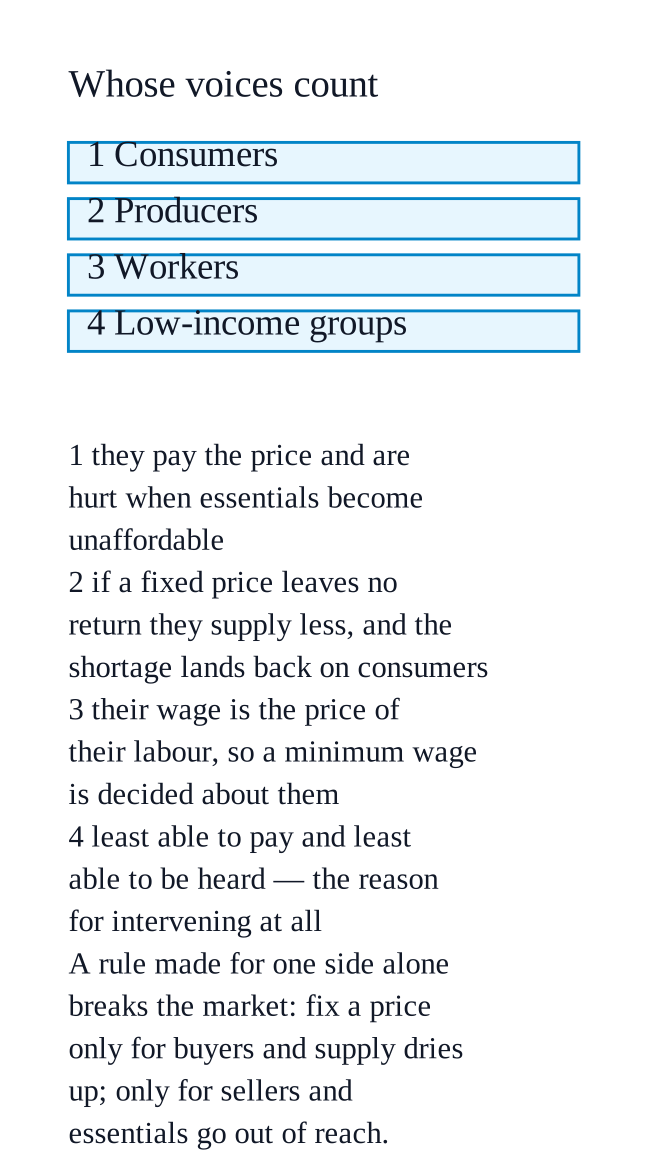
Give your own view on when and how much a democratic government should step into markets, and say whose voices it should listen to.
Worked example: when and how much
Step in when the market gives an unfair or failed outcome — essentials priced beyond reach, hoarding and black-marketing, a monopoly charging what it likes and supplying less, or a public good that nobody will pay for.
Step in as lightly and for as short a time as the problem needs. The sanitiser price cap answered an emergency; the chapter asks whether such controls should last forever, and its own list of costs suggests not.
Weigh the three costs the chapter names before acting: price distortions that kill the seller's incentive, compliance burdens that crush small businesses, and less innovation when returns are capped.
Prefer the lightest tool that works — information and regulators such as the RBI, TRAI, SEBI and the Central Consumer Protection Authority first; fixing prices last.
Be answerable for it. A democratic government is accountable to the people, so it should say publicly why a control was imposed and review whether it is still needed.
Worked example: whose voices
Consumers, because they pay the price and are the ones hurt when essentials become unaffordable.
Producers and sellers, because if a fixed price leaves them no return they simply supply less, and the shortage lands back on consumers.
Workers, because their wage is the price of their labour and a minimum wage decision is made about them.
Vulnerable and low-income groups, who have the least ability to pay and the least ability to be heard, and whose welfare is the reason for intervening at all.
Reason: a rule made for one side alone breaks the market. A price fixed only for buyers dries up supply; a price fixed only for sellers puts essentials out of reach.
What a good answer must contain
A clear test for when to intervene, not just "whenever people suffer".
One chapter example on each side — a case where intervention helped, and a cost of over-intervening.
At least two named groups, each with a reason why their view matters.