SolveItClass 9 · NCERT

NCERT Solutions · Class 9 Social Science Early Humans and Beginning of Civilisation

35 questions · 35 still being checked

Let's Explore 4.1–4.7 (part 3 of 6)

  1. Exercise 4.1

    You have studied about the Harappan script in your previous grades. Observe this seal carefully and discuss why the script has not yet been deciphered. Also, find out what efforts have been made to decipher it. You can use your textbook, consult your teacher, or refer to online sources.NCERT_Question_Class9_SocialScience_Ch4_LE_Q4-1

    The book prints no answer for this

    NCERT publishes no answers for this textbook, so there is nothing in the book to check this working against. It has also not yet been read through by hand.

    What the task asksNCERT_Solution_Class9_SocialScience_Ch4_LE_Q4-1
    Look closely at the seal in Fig. $\displaystyle 4.1$, discuss why its script is still unread, and then find out what attempts have been made to read it.
    What the chapter actually gives you
    The Harappans used a pictographic script, also called Sindhu lipi, found on objects such as seals and pottery.
    It has not yet been deciphered, so we still do not understand it — unlike cuneiform and hieroglyphs, which flourished at the same time and have been read.
    The chapter gives no reason for this, and describes no decipherment attempt.
    Worked example of the discussion (reasoning, not chapter fact)
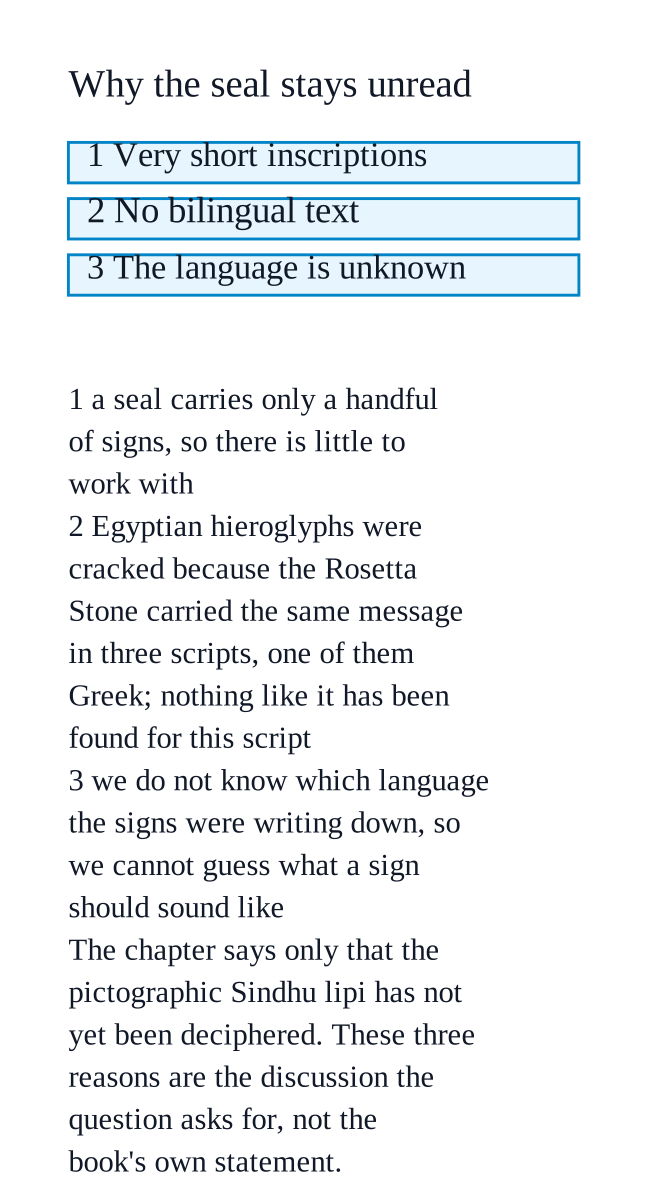
    The inscriptions are very short — a seal carries only a handful of signs, so there is little to work with.
    There is no bilingual text for it. Egyptian hieroglyphs were cracked because the Rosetta Stone carried the same message in three scripts, one of them Greek, which people could still read. Nothing like that has been found for the Harappan script.
    We do not know which language the signs were writing down, so we cannot guess what a sign should sound like.
    What a good answer must contain
    One observation made from the seal itself — for example, the row of signs above the animal.
    At least two reasons why decipherment is hard.
    For the research part: the name of the scholar or project you found, and where you found it (textbook, teacher, or a named website). Say it is a claim, not a settled result — the chapter is clear that the script remains undeciphered.
  2. Exercise 4.2

    Let us observe the images given above and answer the following questions. → Do you notice any changes in the shape or features of the skulls across different ancestors? → Can you observe a gradual straightening of the face?

    The book prints no answer for this

    NCERT publishes no answers for this textbook, so there is nothing in the book to check this working against. It has also not yet been read through by hand.

    Do you notice any changes in the shape or features of the skulls?NCERT_Solution_Class9_SocialScience_Ch4_LE_Q4-2
    Yes. Fig. $\displaystyle 4.6$ is captioned as showing the evolutionary sequence from Homo habilis to Homo sapiens, so the skulls are arranged to be compared.
    The clearest change to look for is the braincase — it grows larger and rounder as you move from Homo habilis to Homo sapiens.
    The heavy ridge of bone above the eyes becomes smaller, and the jaw becomes lighter.
    Can you observe a gradual straightening of the face?
    Yes. In the earlier skulls the jaws and mouth jut forward; in the modern skull they sit almost vertically below the forehead, so the face looks flat and upright.
    The change is gradual, not sudden — that is the point of putting the four skulls in a row.
    Why it matters
    A bigger braincase fits what the chapter says about behaviour: all our ancestors were tool makers, but it was Homo sapiens that developed complex technologies.
  3. Exercise 4.3

    Can you find out which countries constitute West Asia in present times?

    The book prints no answer for this

    NCERT publishes no answers for this textbook, so there is nothing in the book to check this working against. It has also not yet been read through by hand.

    What the task asksNCERT_Solution_Class9_SocialScience_Ch4_LE_Q4-3
    Use a current atlas or political map to list the countries that make up West Asia today.
    What the chapter names, and it names only these
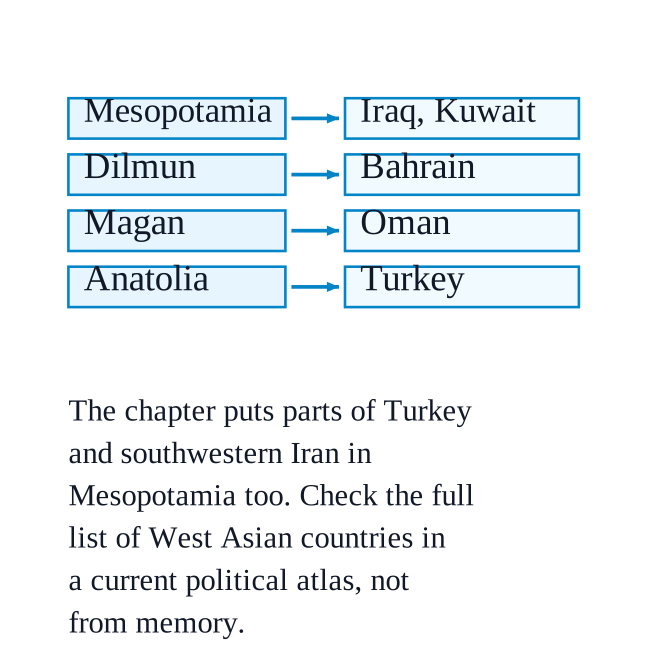
    Mesopotamia today covers mainly Iraq and Kuwait, with some parts of Turkey and southwestern Iran.
    Dilmun is today's Bahrain, and Magan is today's Oman peninsula, both on the Persian Gulf.
    Anatolia, home of the Hittites, is modern-day Turkey.
    Worked example of the shape of an answer
    "Mesopotamia lay mostly in what is now Iraq and Kuwait. Around it, on the Persian Gulf, lie Bahrain and Oman. Turkey is to the north-west and Iran to the east."
    What a good answer must contain
    A full list checked against a current political atlas, not written from memory — borders and country names change.
    The physical landmarks that define the region: the Euphrates and Tigris, the Zagros and Taurus foothills, the Mediterranean, the Red Sea, the Persian Gulf and the Caspian Sea.
    A note of which countries the chapter itself mentions, so the reader can see what came from the book and what you added.
  4. Exercise 4.4

    Do you find any similarities between the temples in India and those of the Sumerian civilisation as centres of socio-cultural and economic activity?

    The book prints no answer for this

    NCERT publishes no answers for this textbook, so there is nothing in the book to check this working against. It has also not yet been read through by hand.

    What the task asksNCERT_Solution_Class9_SocialScience_Ch4_LE_Q4-4
    Compare the Sumerian temple with temples you know in India, looking at them as centres of social, cultural and economic life — not only as places of worship.
    The Sumerian side, from the chapter
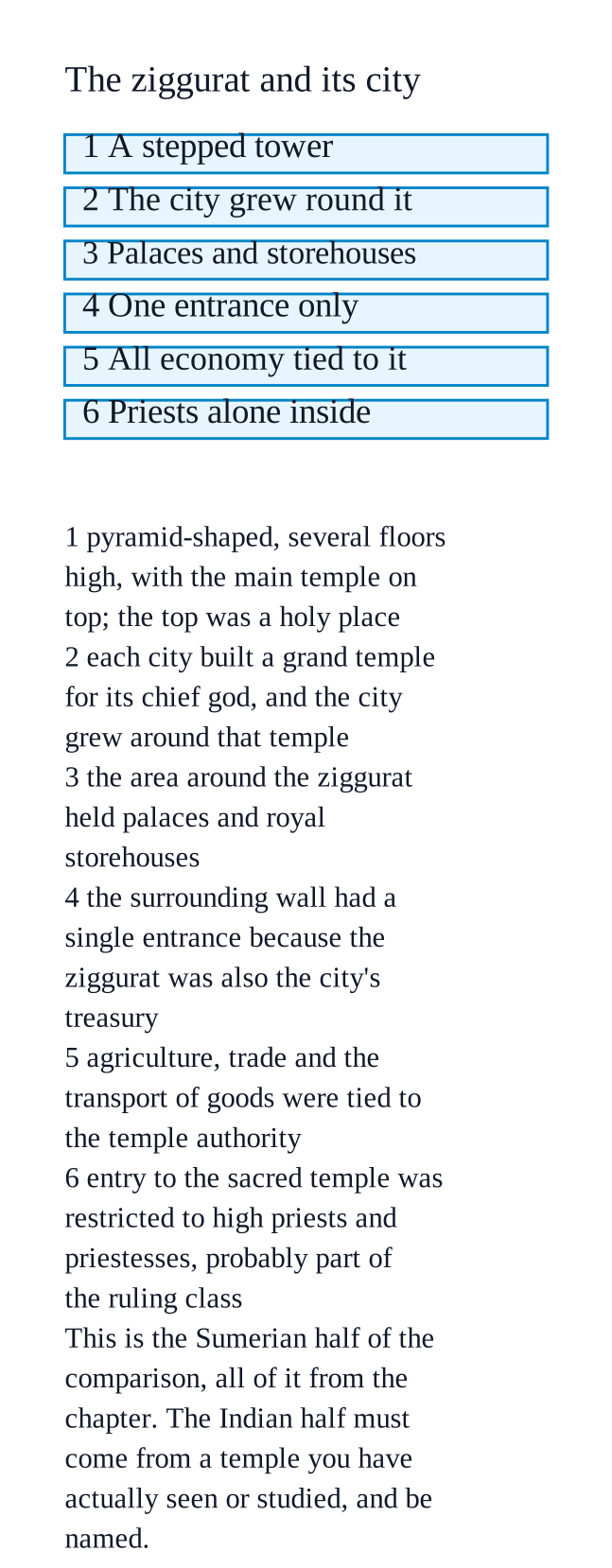
    Each city built a grand temple, the ziggurat, for its chief god, and the city grew around this main temple.
    All economic activities — agriculture, trade and the transport of goods — were tied to the temple authority.
    The ziggurat was a stepped, pyramid-shaped tower with the main temple on top; palaces and royal storehouses stood around it, and the surrounding wall had only one entrance because it also served as the city's treasury.
    Entry to the sacred temple was restricted to high priests and priestesses, who were probably part of the ruling class — a clear sign of social hierarchy.
    Worked example of a comparison a student could make
    "A large temple in my town also stands at the centre of the settlement, and the streets grew around it. Its festivals bring the whole neighbourhood together, it employs craftspeople, musicians and cooks, and it owns land. Its innermost shrine can be entered only by priests. So both are more than places of worship — both are centres of social and economic life."
    A difference worth naming: the Sumerian temple was also the city's treasury and administration, and the chapter does not say that of any Indian temple.
    What a good answer must contain
    At least two similarities and one difference.
    A named Indian temple — your own town's, or one you have studied — not a vague 'temples in India'.
    A clear line between what came from this chapter (the Sumerian half) and what came from your own knowledge or observation (the Indian half).
  5. Exercise 4.5

    The Epic of Gilgamesh, written during the Mesopotamian civilisation, is one of the earliest stories written. Try and find out more such stories and share them in class.

    The book prints no answer for this

    NCERT publishes no answers for this textbook, so there is nothing in the book to check this working against. It has also not yet been read through by hand.

    What the task asksNCERT_Solution_Class9_SocialScience_Ch4_LE_Q4-5
    Find other very early written stories, like the Epic of Gilgamesh, and share them with the class.
    Where the chapter already points you
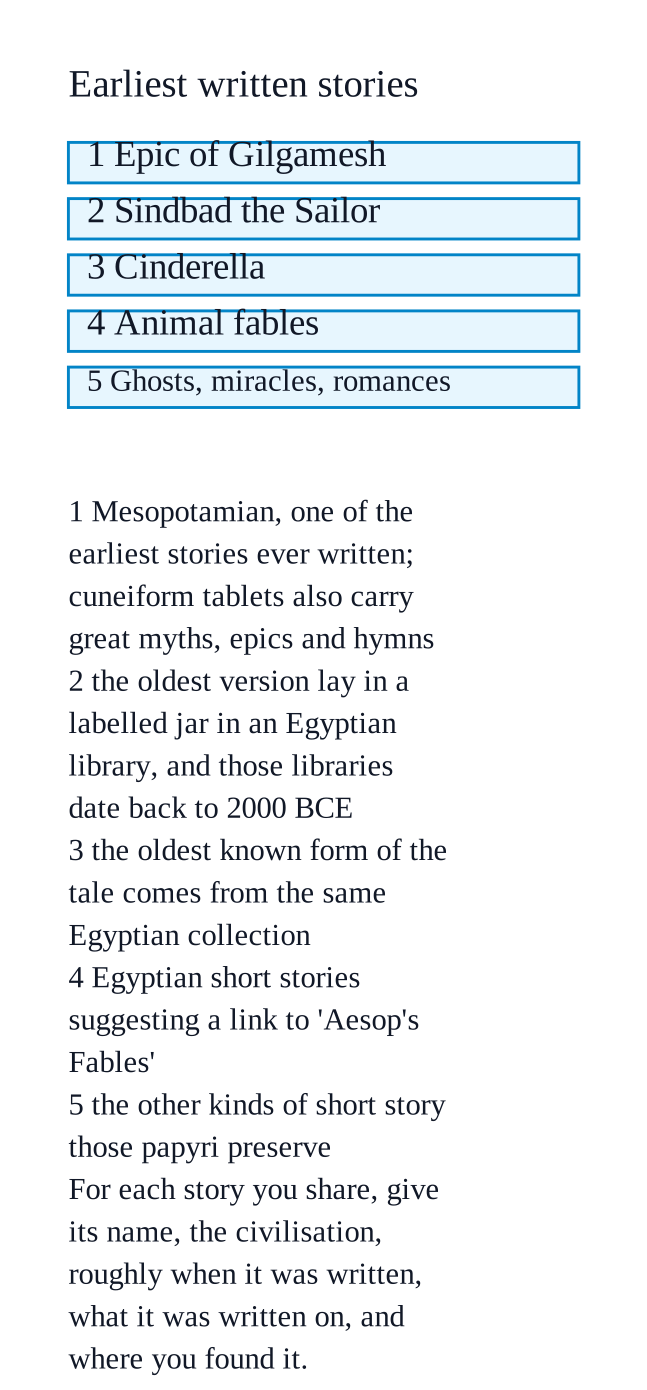
    Egyptian libraries dating back to $\displaystyle 2000$ BCE stored papyrus scrolls in labelled jars on shelves. One such jar contained the oldest version of the story of 'Sindbad the Sailor'.
    The same collection of short stories includes animal fables suggesting a link to 'Aesop's Fables', tales of ghosts, miracles and romances, and even the oldest known form of 'Cinderella'.
    Under the Akkadians, the chapter says, creative literature evolved — and cuneiform tablets carry Mesopotamia's great myths, epics and hymns.
    Worked example of a share-out
    "The oldest known 'Cinderella' story comes from an Egyptian papyrus. Like the Epic of Gilgamesh it was written down thousands of years ago on a material that survived, and like Gilgamesh it was copied and changed as it travelled. It shows that people have been telling the same kinds of stories for a very long time."
    What a good answer must contain
    The story's name, the civilisation it comes from, and roughly when it was written.
    What it was written on — clay tablet, papyrus, bone — because that is why it survived.
    Where you found it, so the class can check.
  6. Exercise 4.6

    Look at the social hierarchy pyramid in the image. What were the social classes of early Egypt? What were the different kinds of occupations? What could have been a typical daily routine of the people from each class?

    The book prints no answer for this

    NCERT publishes no answers for this textbook, so there is nothing in the book to check this working against. It has also not yet been read through by hand.

    The social classes of early Egypt (Fig. $\displaystyle 4.32$, top to bottom)NCERT_Solution_Class9_SocialScience_Ch4_LE_Q4-6
    Pharaoh — the ruler, alone at the top.
    Government officials, nobles and priests.
    Free landholders, artisans and merchants.
    Serfs and slaves — the base of the pyramid.
    The kinds of occupations the chapter names
    Ruling: the pharaoh, whose reign was itself celebrated with festivals — the Sed festival marked a king's 30th year on the throne.
    Administering: an administrative class, which the chapter says grew because digging ditches and constructing dams required collective effort, and which was probably the earliest form of local government in Egypt.
    Religion: priests, who served the gods and led the festival at which each god's statue was paraded, accompanied by music played on instruments such as the sistrum.
    Farming: free landholders, who dug ditches to divert Nile water into their fields and stored water in reservoirs for later use.
    Craft and trade: artisans, who made the daily items shown in Fig. $\displaystyle 4.33$, and merchants. Records were kept on papyrus, made by cutting the inner trunk of the papyrus plant into strips, criss-crossing, pressing, drying and polishing them into sheets, and stored as scrolls in labelled jars in libraries.
    Labour: serfs and slaves.
    A day for each class — every routine below is imagined, and built only from work and leisure the chapter mentions1. The pharaoh
    Hears his officials on the state of the Nile, because the flood decides the year's harvest and everything else waits on it.
    Orders and approves the ditches, dams and reservoirs that no single family could build alone.
    Appears at a god's festival as the statue is carried in procession — and, in the thirtieth year of his reign, at his own Sed festival.
    Gives time to the tomb being made ready for him, since he believes his ka, a spiritual double, lives on after death only if the body is preserved by mummification.
    2. Government officials, nobles and priests
    An official counts the days since the last Nile flood — the chapter says the Egyptian calendar was worked out from exactly this counting.
    He inspects the ditches and reservoirs and arranges the collective labour that keeps them clear, the work out of which local government grew.
    A priest tends his god's temple and prepares the statue, the music and the procession for the coming festival.
    At a death, the priests carry out mummification — the internal organs removed except the heart, the body dried with natron, then oiled, wrapped in linen strips, placed in a coffin and buried with rituals.
    The evening may go in music, dancing or a board game.
    3. Free landholders, artisans and merchants
    The farmer's day follows the calendar's three seasons — Inundation (autumn), Peret, growing (winter) and shemu, harvest (summer) — so he is mending ditches, sowing or reaping, depending on where in the year he stands.
    He opens the ditch that brings Nile water into his field and checks the reservoir holding water for later use.
    The artisan spends the day on the sort of things shown in Fig. $\displaystyle 4.33$ — ornaments, dress and household items — for the households above him; the merchant carries such goods to buyers.
    A woman of this class may own property and run a business of her own, a right the chapter says Egyptian women generally had.
    Free time goes on swimming or canoeing in the river, board games, or music and dancing; at festival time the family stands in the street as the god's statue is paraded past.
    4. Serfs and slaves
    The heavy, repeated work: digging out and clearing the irrigation ditches, and raising the dams before the flood arrives.
    Labour in other people's fields at sowing and at harvest.
    Very probably the hauling and carrying behind the great tombs, such as the step pyramid at Saqqara — the chapter does not say who did this work, so treat this line as reasoning, not as fact.
    The least free time of the four tiers; a public festival in the street is the leisure open to them. (Also reasoning — the chapter describes the festivals but does not say who attended.)
    What a good answer must contain
    All four tiers named in the book's own order, top to bottom.
    At least one occupation for each tier.
    One routine for every tier — four in all, not a single routine.
    Routines built only from what the chapter mentions — farming, ditch and dam work, crafts, trade, temple duties and mummification, swimming, canoeing, board games, music, dancing and festivals — with a clear line saying they are imagined.
  7. Exercise 4.7

    The Chinese script is logographic, with characters representing entire words or morphemes (smallest meaningful units of language), rather than sounds. Person Tree Explore more examples of Chinese characters that resemble the objects or ideas they represent. Note down at least two such characters and explain how their shapes are connected to their meanings.NCERT_Question_Class9_SocialScience_Ch4_LE_Q4-7

    The book prints no answer for this

    NCERT publishes no answers for this textbook, so there is nothing in the book to check this working against. It has also not yet been read through by hand.

    Two more characters whose shape shows their meaning The book already prints Person and Tree, so the task wants characters beyond those two. These are worked examples — you may use them or replace them with finds of your own.山 — shān, 'mountain'
    Three upright strokes rising from one base: a tall middle peak with a lower peak on either side, which is the outline of a mountain range seen from a distance.
    日 — rì, 'sun'
    A closed frame with a single stroke across the middle: the round sun with a mark at its centre, squared off because the characters are written in straight brush strokes.
    Three further examples, if you want a longer list
    月 — yuè, 'moon': a tall, narrow frame — the crescent moon rather than a full disc, which is what tells it apart from 日, the sun.
    雨 — yǔ, 'rain': a line for the sky with a cover below it and four short dots inside — the drops falling.
    田 — tián, 'field': a square cut by one upright and one crosswise stroke into four smaller plots, like a field divided by its paths and water channels.
    How to explain the link, part by part
    Name the character, give its meaning, then say which stroke stands for which part of the object — that is the pattern the book's own Person and Tree examples follow.
    Say why this is possible at all: the script is logographic, so a character stands for a whole word or morpheme (the smallest meaningful unit of language) and not for a sound, and can therefore be built from a picture of the thing instead of from its pronunciation.
    What a good answer must contain
    At least two characters other than the Person and Tree already printed in the book.
    Each one copied out carefully by hand — a wrong stroke makes it a different word.
    Its meaning in English.
    One sentence linking the shape to the meaning, part by part.
    Where you found it — a dictionary, your teacher, or a website — and a check of every character before you write it down.