SolveItClass 9 · NCERT

NCERT Solutions · Class 9 Social Science Early Humans and Beginning of Civilisation

35 questions · 35 still being checked

Think About It 4.1–4.8 (part 5 of 6)

  1. Exercise 4.1

    Why do you think early humans left Africa to migrate to other regions?

    The book prints no answer for this

    NCERT publishes no answers for this textbook, so there is nothing in the book to check this working against. It has also not yet been read through by hand.

    Most likely they moved in search of food and better living conditions as the climate and environment changed around them.
    The chapter says humans had to survive changing climatic and environmental conditions during the Quaternary Period, and developed tools and techniques to use natural resources — moving to a better place is one such response.
    Homo erectus was upright (bipedal) and carried stone tools such as handaxes and cleavers, so it could hunt, butcher and survive in unfamiliar land. Being able to move made moving worthwhile.
    Groups would follow the animals they hunted and the plants they gathered, and spread into empty grasslands and river valleys next door.
    The move was extremely slow — the chapter dates the dispersal of Homo erectus to between $\displaystyle 2$ and $\displaystyle 0.5$ million years ago, and a second major wave with early Homo sapiens to around $\displaystyle 125,000$ years ago. Nobody set out to leave Africa; each generation shifted a little.
  2. Exercise 4.2

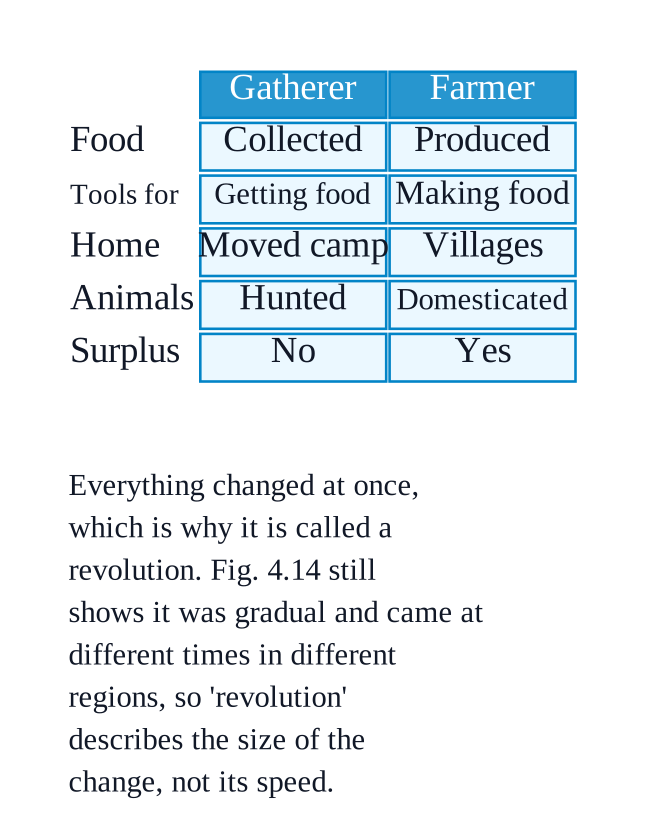
    Why do you think the shift to farming during the Neolithic period is called a revolution rather than a simple change? Discuss with your classmates.

    The book prints no answer for this

    NCERT publishes no answers for this textbook, so there is nothing in the book to check this working against. It has also not yet been read through by hand.

    It is called a revolution because it changed everything about how people lived, not just what they ate.
    NCERT_Solution_Class9_SocialScience_Ch4_TAI_Q4-2
    People stopped only collecting food and began producing it — domesticating selected plants and animals, bringing them under human control, and breeding new varieties.
    The purpose of tools changed. Hunter-gatherers made tools to get food; Neolithic farmers made tools to produce and process it, and added earthenware pottery in many shapes and sizes.
    People stopped moving. The first village settlements appeared — at Mehrgarh, sun-dried brick houses and granaries — and these laid the foundation for the urban revolution.
    It made surplus food possible, and surplus is exactly what the chapter says led to the emergence of civilisation.
    One caution for the discussion: it was still gradual, and Fig. $\displaystyle 4.14$ shows it did not happen everywhere at the same time. 'Revolution' describes the size of the change, not its speed.
  3. Exercise 4.3

    Observe the chart (Fig. 4.14\displaystyle 4.14) and identify the animals that were domesticated. Also try and identify the types of human habitats and objects that were used. Are any of these still used in present times?NCERT_Question_Class9_SocialScience_Ch4_TAI_Q4-3

    The book prints no answer for this

    NCERT publishes no answers for this textbook, so there is nothing in the book to check this working against. It has also not yet been read through by hand.

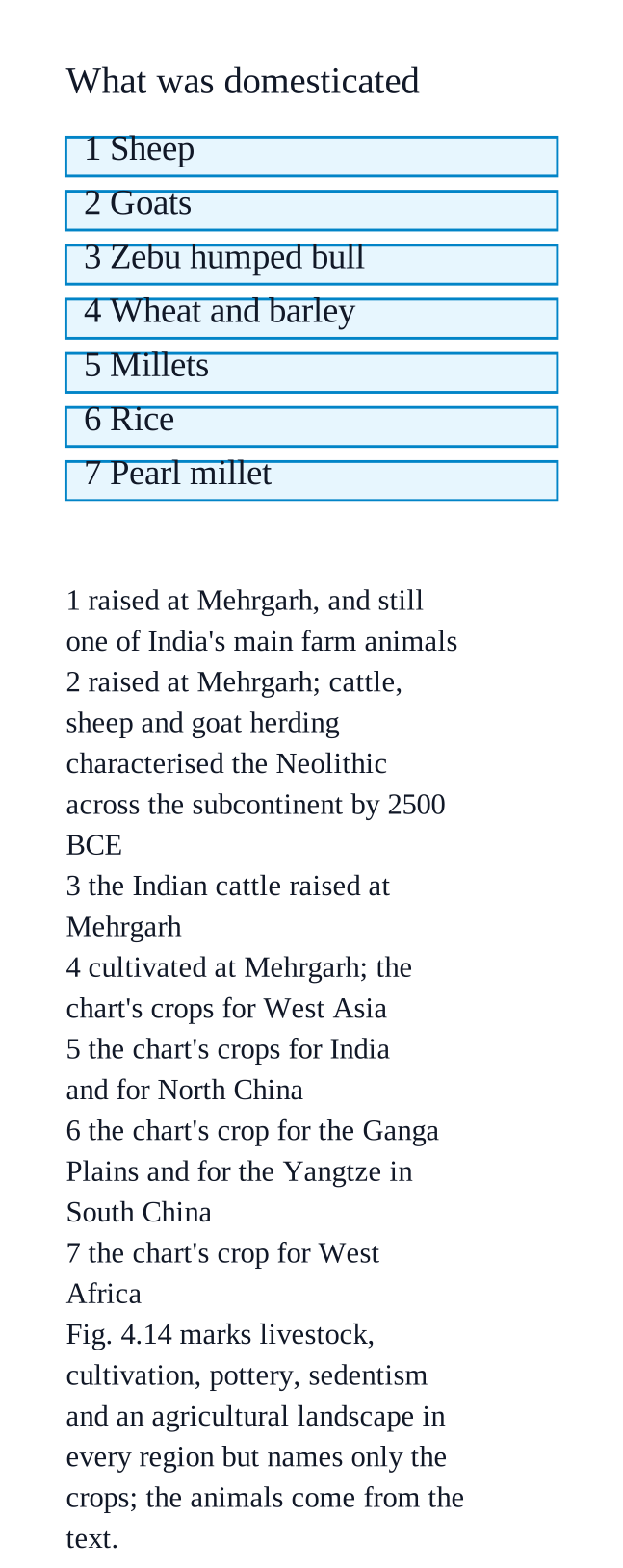
    Animals that were domesticatedNCERT_Solution_Class9_SocialScience_Ch4_TAI_Q4-3
    Fig. $\displaystyle 4.14$ marks livestock in every region, but does not name the animals — the chapter names them in the text.
    At Mehrgarh the people raised sheep, goats and Indian cattle — the zebu humped bull in particular.
    By $\displaystyle 2500$ BCE, cattle, sheep and goat herding characterised the Neolithic way of life across most of the Indian subcontinent.
    Types of human habitats
    The chart marks sedentism — settling in one place — in every region. The chapter calls these the first village settlements.
    At Mehrgarh these were handmade sun-dried brick houses with granaries.
    The earlier habitats named in the chapter are caves, rock shelters and open camps, used in the Palaeolithic and Mesolithic.
    Objects that were used
    Pottery, marked in every region on the chart — earthenware in a variety of shapes and sizes.
    Polished stone tools made for producing and processing food.
    Ornaments of semi-precious stones such as lapis lazuli and carnelian, and of shell.
    Are any of these still used today?
    Yes. Sheep, goats and cattle are still India's main farm animals, and the crops on the chart — wheat, barley, millets and rice — are still our main crops.
    Pottery is still made and used, and the village is still the commonest form of settlement.
    The chapter's own example: the ploughed field at Kalibangan, with furrows crossing in two directions for double cropping, matches the Rabi and Kharif cropping practised even today.
  4. Exercise 4.4

    Harappans had their own standard systems of weight and measurement. This is evident from the meticulously planned settlements and efficient interregional trade practices of the Harappans. They followed a binary multiple (1\displaystyle 1, 2\displaystyle 2, 4\displaystyle 4, 8\displaystyle 8, 16\displaystyle 16, etc.) system for weighing smaller units and used multiples of ten for larger denominations. Such cubical stone weights have been reported from several sites. Can you imagine how long-distance trade would have been affected had the Harappans not followed a standard system of weights?NCERT_Question_Class9_SocialScience_Ch4_TAI_Q4-4

    The book prints no answer for this

    NCERT publishes no answers for this textbook, so there is nothing in the book to check this working against. It has also not yet been read through by hand.

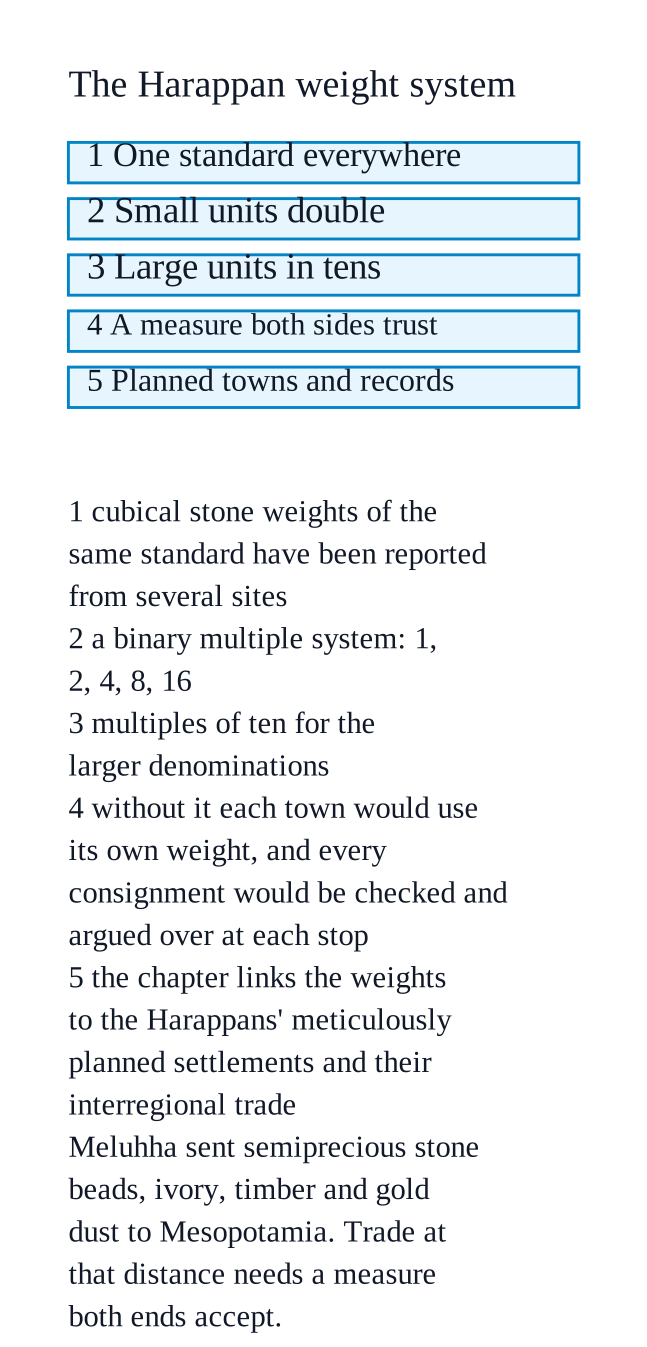
    Without a standard system of weights, long-distance trade would have been slow, unfair and full of disputes — and probably much smaller.
    NCERT_Solution_Class9_SocialScience_Ch4_TAI_Q4-4
    Every town would have used its own weight, so a trader could never be sure that what he received matched what he had paid for.
    Every consignment would have to be checked and argued over at each stop, which makes trade over long distances expensive and risky.
    The Harappans traded very far: cuneiform tablets record Meluhha sending semiprecious stone beads, ivory, timber and gold dust to Mesopotamia. Trade at that distance needs a measure that both sides trust.
    Their system was built to be easy to use — binary multiples ($\displaystyle 1$, $\displaystyle 2$, $\displaystyle 4$, $\displaystyle 8$, $\displaystyle 16$) for smaller units and multiples of ten for larger denominations — and cubical stone weights have been found at several sites, showing the same standard was used across the civilisation.
    Standard weights also made planning and record-keeping possible, which is why the chapter links them to the Harappans' meticulously planned settlements.
  5. Exercise 4.5

    Why were rivers important in the growth of early civilisations?

    The book prints no answer for this

    NCERT publishes no answers for this textbook, so there is nothing in the book to check this working against. It has also not yet been read through by hand.

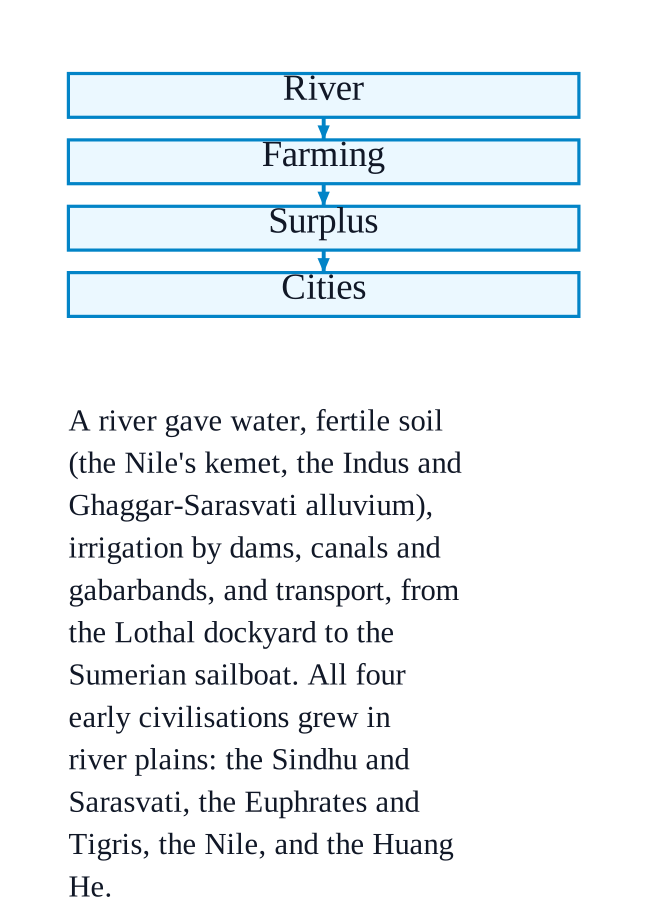
    Rivers gave early civilisations three things at once — water, fertile soil and transport — which is why all four grew in river plains.
    NCERT_Solution_Class9_SocialScience_Ch4_TAI_Q4-5
    Fertile land. The Nile's yearly summer flood left rich black mud, kemet, excellent for growing crops. The alluvial plains of the Indus and Ghaggar-Sarasvatī became far more productive once copper tools arrived.
    Irrigation. The Sumerians were the first to build dams and canals; Egyptian farmers dug ditches to divert Nile water and stored it in reservoirs; the Early Harappans built check dams called gabarbands, and the Harappans built the great tank system at Dholavira.
    Transport and trade. Goods moved by water — the Harappans built a huge dockyard at Lothal entirely of burnt bricks, and the Sumerians invented the sailboat.
    Surplus and cities. River farming produced enough food to support craftspeople, traders and rulers, so towns and urban centres could grow.
    The four early civilisations show the pattern exactly: the Harappan on the Sindhu and Sarasvatī, the Mesopotamian on the Euphrates and Tigris, the Egyptian on the Nile, and the Chinese in the Huang He basin.
  6. Exercise 4.6

    Why do you think there is a scale with a heart on one side and a feather on the other (fig. 4.29\displaystyle 4.29)? What can this papyrus tell us about early Egyptian beliefs?

    The book prints no answer for this

    NCERT publishes no answers for this textbook, so there is nothing in the book to check this working against. It has also not yet been read through by hand.

    The scale is almost certainly showing the heart of a dead person being weighed — a test the Egyptians believed a person faced after death.
    NCERT_Solution_Class9_SocialScience_Ch4_TAI_Q4-6
    The chapter's strongest clue is mummification: every internal organ was removed except the heart. The Egyptians deliberately left the heart in the body, so they treated it as the part that mattered most.
    The chapter also says the Egyptians believed each person had a ka, a spiritual double, that lived on after death if the body was preserved. They expected life to continue, so a judgement at the moment of death makes sense.
    A feather is extremely light. Setting a heart against a feather suggests the heart had to be light — that is, free of wrongdoing — for the person to pass.
    What this papyrus tells us about Egyptian beliefs
    Egyptians believed in an afterlife, and prepared for it very carefully — hence mummification, mastabas and pyramids.
    They believed how you had lived was weighed, not just how you were buried.
    Their beliefs were written down and illustrated on papyrus, which is why we can still see them.
  7. Exercise 4.7

    Observe the images given above. What do they tell you about Egyptian fashion? ◈ Which social classes do you think used these items? ◈ What clues in the images help you to make this guess? Try to explain your reasoning based on the materials, designs, or accessories shown in the pictures.

    The book prints no answer for this

    NCERT publishes no answers for this textbook, so there is nothing in the book to check this working against. It has also not yet been read through by hand.

    What the task asksNCERT_Solution_Class9_SocialScience_Ch4_TAI_Q4-7
    Look at the daily items in Fig. $\displaystyle 4.33$, work out what they say about Egyptian fashion, decide which social classes used them, and say what in the picture led you to that conclusion.
    Start honestly
    The chapter's text describes none of these objects. Fig. $\displaystyle 4.33$ is captioned only 'Daily items used by the Egyptians'. So every statement in your answer must come from what you can actually see in the picture, not from the printed text.
    Worked example of the reasoning shape
    "This item is made of gold and coloured stone, and the workmanship is very fine. Precious materials had to be brought from far away, and fine work takes a trained craftsperson a long time. So it most likely belonged to the pharaoh, or to nobles and priests — the top two tiers of Fig. $\displaystyle 4.32$ — rather than to serfs and slaves."
    "This item is made of simple clay or plain linen, with little decoration. It could have been used by artisans, merchants or ordinary working people."
    What a good answer must contain
    For each item: the material, the workmanship or design, and the class you infer from those two.
    An explicit link back to the social pyramid in Fig. $\displaystyle 4.32$ — the question is really asking you to connect objects to that hierarchy.
    One chapter fact worth using: Egyptian women could own property and run businesses, so fine goods were not the preserve of men.
    A sentence saying which parts are certain (what you can see) and which are guesses (who owned it).
  8. Exercise 4.8

    What could have been the other reasons for building the Great Wall of China? Explore and share your findings on the Great Wall through a model or presentation.

    The book prints no answer for this

    NCERT publishes no answers for this textbook, so there is nothing in the book to check this working against. It has also not yet been read through by hand.

    What the task asksNCERT_Solution_Class9_SocialScience_Ch4_TAI_Q4-8
    Think beyond defence for why the Great Wall was built, then present what you find as a model or a presentation.
    The one reason the chapter gives
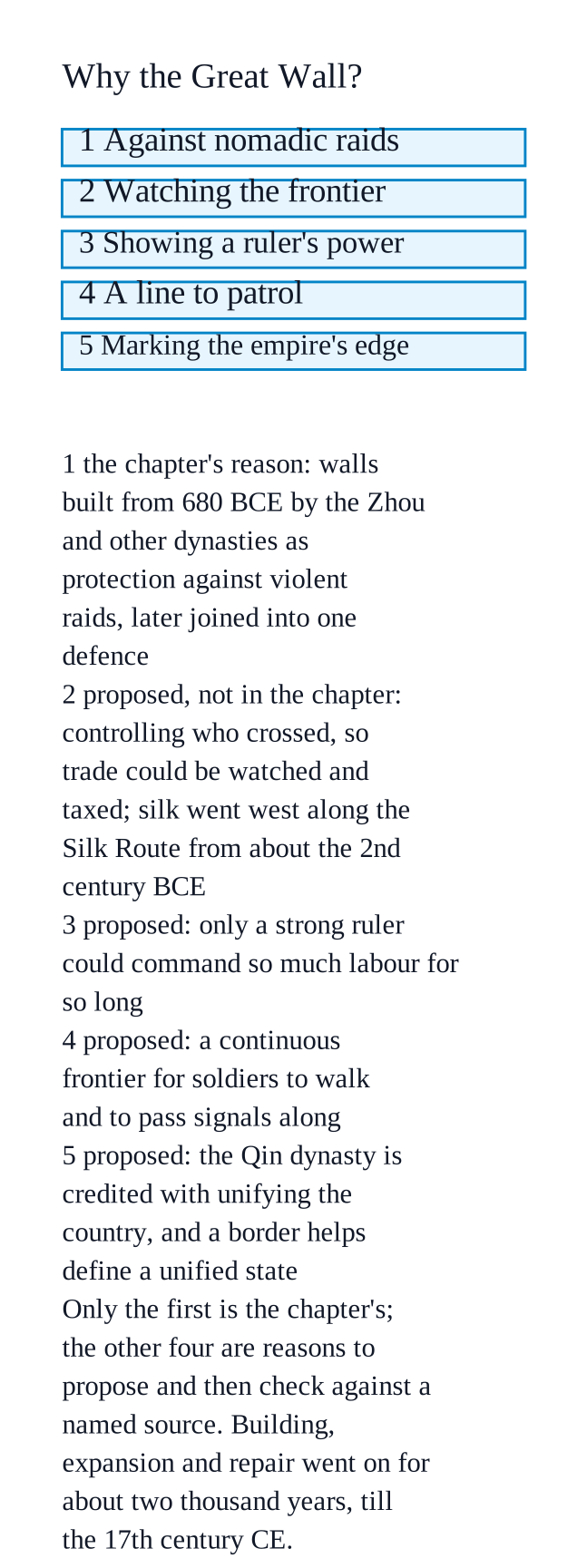
    Several walls were built from $\displaystyle 680$ BCE onwards by the Zhou and other dynasties as protection against the violent raids of nomadic tribes.
    These separate walls were later joined together into one effective defence.
    Building, expansion and repair went on for about two thousand years, continuing till the 17th century CE.
    Worked example of other reasons a student might propose
    These are not in the chapter and must be checked: controlling who crossed the frontier, so that trade could be watched and taxed — the chapter does say the Silk Route carried Chinese silk westwards from about the 2nd century BCE.
    Showing the power of a ruler who could command so much labour for so long.
    Giving soldiers a continuous line along the frontier to patrol and to pass signals along.
    Marking where the empire ended — the Qin dynasty is credited with unifying the country, and a border helps define a unified state.
    What a good answer must contain
    The chapter's defence reason first, then one or two additional reasons with the source named for each.
    For the model or presentation: a labelled section of wall with watchtowers and a gate; the dates $\displaystyle 680$ BCE to the 17th century CE; and one line explaining why it had to be rebuilt so many times.