SolveItClass 9 · NCERT

NCERT Solutions · Class 9 Social Science Early Humans and Beginning of Civilisation

35 questions · 35 still being checked

The Big Questions 4.1–4.4 (part 1 of 6)

  1. Exercise 4.1

    How did humans live on Earth before the beginning of civilisation?

    The book prints no answer for this

    NCERT publishes no answers for this textbook, so there is nothing in the book to check this working against. It has also not yet been read through by hand.

    Before civilisation, humans lived as hunter-gatherers — moving in small groups, living off wild food, and making their own stone tools.
    NCERT_Solution_Class9_SocialScience_Ch4_BQ_Q4-1
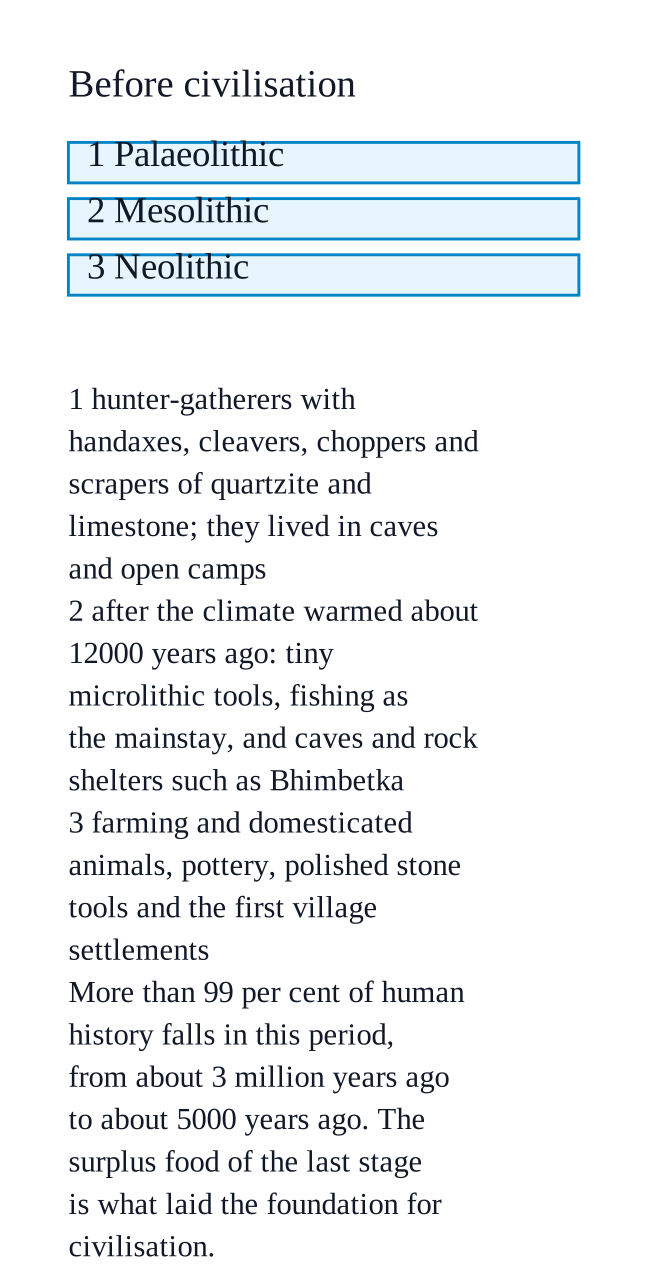
    This stretch covers more than $\displaystyle 99$ per cent of human history, from about $\displaystyle 3$ million years ago to about $\displaystyle 5000$ years ago.
    Palaeolithic people hunted and gathered with handaxes, cleavers, choppers and scrapers of quartzite and limestone — chopping meat, digging out tubers, scraping skin and cleaving bones for marrow. They lived in caves or open camps.
    Mesolithic people, after the climate warmed about $\displaystyle 12000$ years ago, used tiny microlithic tools, made fishing their mainstay, and often occupied caves and rock shelters such as Bhimbetka in Madhya Pradesh.
    Neolithic people began to farm and domesticate animals, made pottery and polished stone tools, and built the first village settlements. The surplus food they produced is what laid the foundation for civilisation.
  2. Exercise 4.2

    How did humans communicate before writing was invented?

    The book prints no answer for this

    NCERT publishes no answers for this textbook, so there is nothing in the book to check this working against. It has also not yet been read through by hand.

    Before writing, humans communicated by symbolic communication — pictures, marks, ornaments and body decoration rather than script.
    NCERT_Solution_Class9_SocialScience_Ch4_BQ_Q4-2
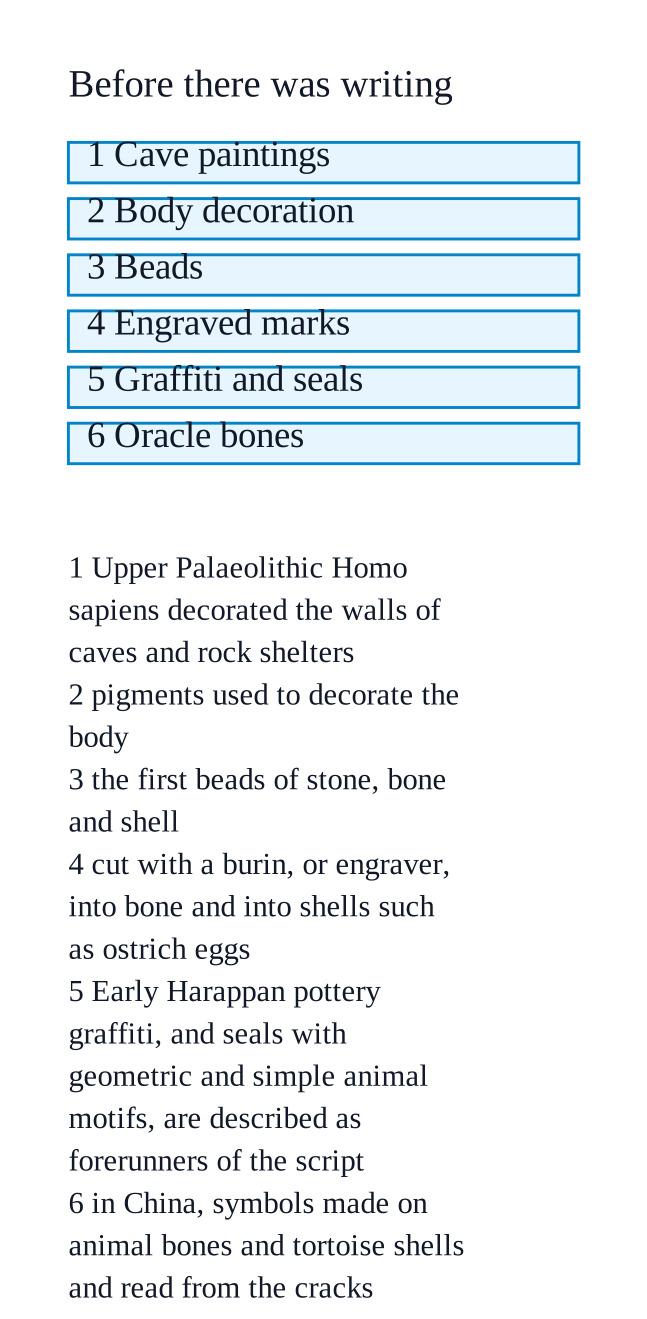
    Upper Palaeolithic Homo sapiens decorated the walls of caves and rock shelters with paintings, and used pigments to decorate their bodies.
    They were the first to make beads of stone, bone and shell — objects that say something about the person wearing them.
    A burin, or engraver, was used to cut symbolic marks into bone and into shells such as ostrich eggs.
    Marks on objects slowly turned into script: graffiti on pottery and seals with geometric and simple animal motifs at Early Harappan sites like Harappa, Rehman Dheri and Kunal are described as forerunners of the Harappan script, and in China symbols on oracle bones were read for meaning.
  3. Exercise 4.3

    How is archaeology helpful in understanding our past?

    The book prints no answer for this

    NCERT publishes no answers for this textbook, so there is nothing in the book to check this working against. It has also not yet been read through by hand.

    Archaeology is the only route to the more than $\displaystyle 99$ per cent of human history that left no writing behind.
    NCERT_Solution_Class9_SocialScience_Ch4_BQ_Q4-3
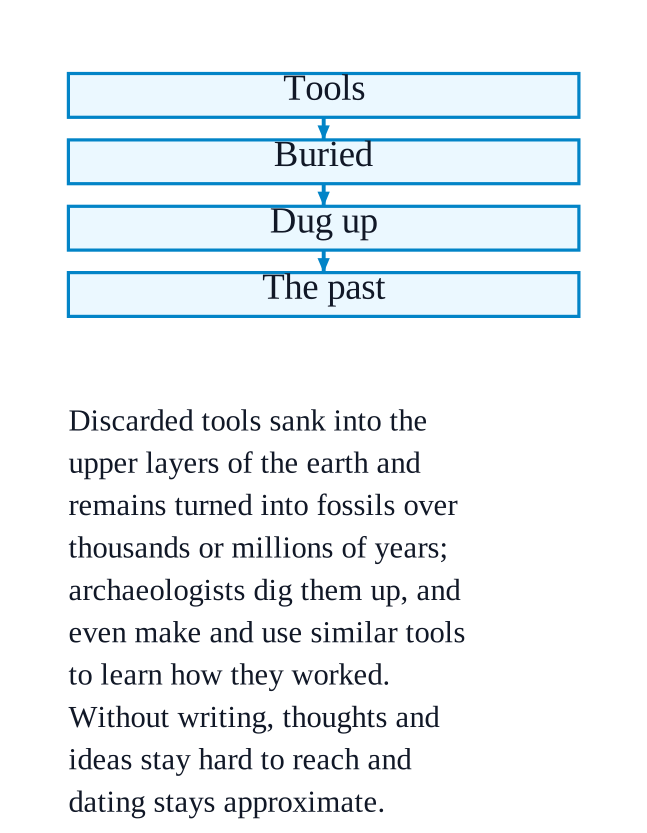
    Archaeologists excavate early human sites and recover the clues our ancestors left — tools, bones and other objects.
    Discarded tools got buried in the upper layers of the earth, and remains of ancestors turned into fossils over thousands or millions of years. Both are the major sources of evidence.
    From such finds we know Homo habilis lived at the Olduvai Gorge in Tanzania and Kenya, and that Homo erectus carried handaxes and cleavers out of Africa into Europe and Asia.
    Archaeologists also make and use similar tools themselves, to learn how early humans created these objects and depended on them daily.
    The chapter also states its limits: without written documents it is hard to understand people's thoughts and ideas, and the dating of events stays approximate.
  4. Exercise 4.4

    How did early civilisations interact with each other?

    The book prints no answer for this

    NCERT publishes no answers for this textbook, so there is nothing in the book to check this working against. It has also not yet been read through by hand.

    Early civilisations interacted mainly through trade, and the strongest link was between Mesopotamia and the Sindhu-Sarasvatī civilisation.
    NCERT_Solution_Class9_SocialScience_Ch4_BQ_Q4-4
    Cuneiform tablets of the Akkadian king Sargon record trade with Dilmun, Magan and Meluhha — today's Bahrain, the Oman peninsula, and the Sindhu-Sarasvatī civilisation.
    The goods traded with the Harappans were semiprecious stone beads, ivory, timber, gold dust and probably copper.
    Geography decided who met whom: Mesopotamia and the Indus and Ghaggar-Sarasvatī valleys lie close together, so contact was strong, while Egypt and China have little tangible evidence of direct contact with the Sindhu-Sarasvatī civilisation.
    Ideas and materials moved too — cuneiform was used across Mesopotamian city-states that spoke different languages, jade reached China from outside China, and much later Chinese silk gave its name to the Silk Route.