SolveItClass 9 · NCERT

NCERT Solutions · Class 9 Social Science Early Humans and Beginning of Civilisation

35 questions · 35 still being checked

Questions and activities 4.1–4.13 (part 6 of 6)

  1. Exercise 4.1

    Do you think life became easier or more challenging after humans started farming? Give two reasons for your answer.

    The book prints no answer for this

    NCERT publishes no answers for this textbook, so there is nothing in the book to check this working against. It has also not yet been read through by hand.

    Life became easier in some ways and harder in others. Either side can be argued — pick one and defend it with two reasons. Here is the evidence for both.
    NCERT_Solution_Class9_SocialScience_Ch4_QA_Q4-1Two reasons it became EASIER
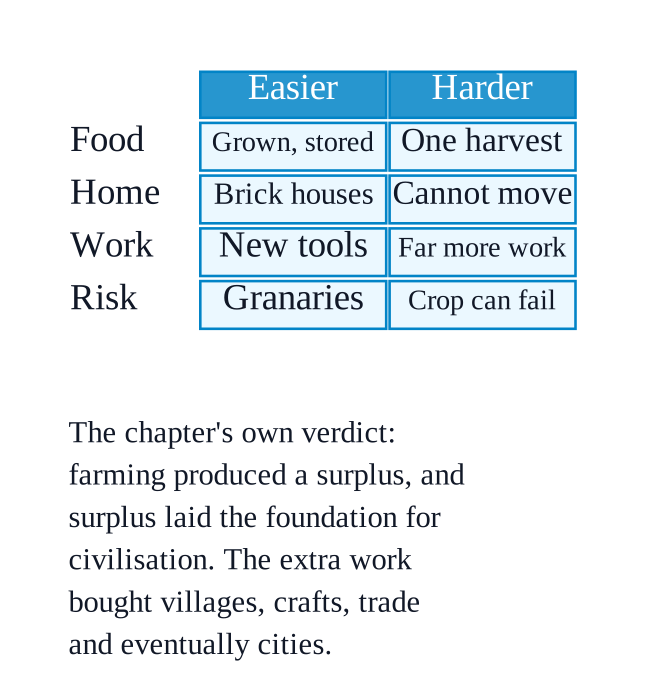
    Food became more certain. Instead of finding food, people produced it — bringing chosen plants and animals under human control and breeding new varieties. A farmer is not at the mercy of a single day's hunt.
    People could settle down. The first village settlements appeared. At Mehrgarh people lived in sun-dried brick houses with granaries to store grain, made pottery, and had ornaments of lapis lazuli, carnelian and shell — a more comfortable and more secure life than moving camp.
    Two reasons it became MORE CHALLENGING
    Farming is far more work. Fields must be cleared, sown, watered and harvested; animals must be tended every day of the year; and grain must be processed before it can be eaten. Neolithic farmers had to invent a whole new set of tools just for producing and processing food.
    A settled village can fail where it stands. Once you depend on one patch of land you are exposed to flood, drought and exhausted soil. The chapter names environmental degradation and pressure on agricultural lands among the things that weakened Babylonia — a farming society cannot simply walk away.
    How to close your answer
    The chapter's own verdict is that farming produced a surplus, and surplus laid the foundation for civilisation. So the extra work bought something: villages, crafts, trade and eventually cities.
  2. Exercise 4.2

    The environment offers human societies both opportunities as well as challenges. Explain with reference to early farming communities and river-valley civilisations.

    The book prints no answer for this

    NCERT publishes no answers for this textbook, so there is nothing in the book to check this working against. It has also not yet been read through by hand.

    The environment gave early societies rich resources and, at the same time, problems that forced them to invent — and both show clearly in early farming communities and river-valley civilisations.
    NCERT_Solution_Class9_SocialScience_Ch4_QA_Q4-2Opportunities
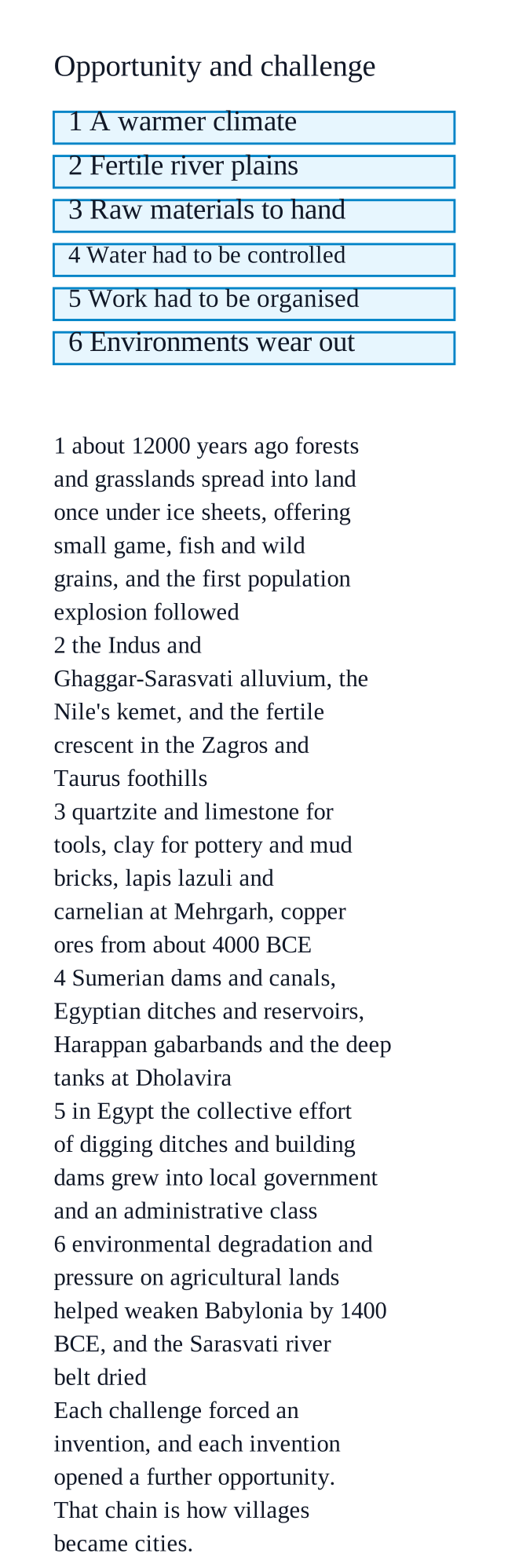
    A warmer climate opened new land. About $\displaystyle 12000$ years ago forests and grasslands spread into areas that had been under ice sheets, offering small game, fish and edible wild grains — and the world saw its first-ever population explosion.
    Fertile river plains. The alluvial plains of the Indus and Ghaggar-Sarasvatī became highly productive once copper tools arrived; the Nile's flood left rich black mud, kemet; the foothills of the Zagros and Taurus were so productive they are called the fertile crescent.
    Raw materials to hand. Quartzite and limestone for tools; clay for pottery and mud bricks; semi-precious stones such as lapis lazuli and carnelian at Mehrgarh; copper ores from about $\displaystyle 4000$ BCE.
    Regular, predictable seasons. The Egyptians could count the days between Nile floods and build a calendar from it; the crossed furrows at Kalibangan show two crops a year were already possible.
    Challenges
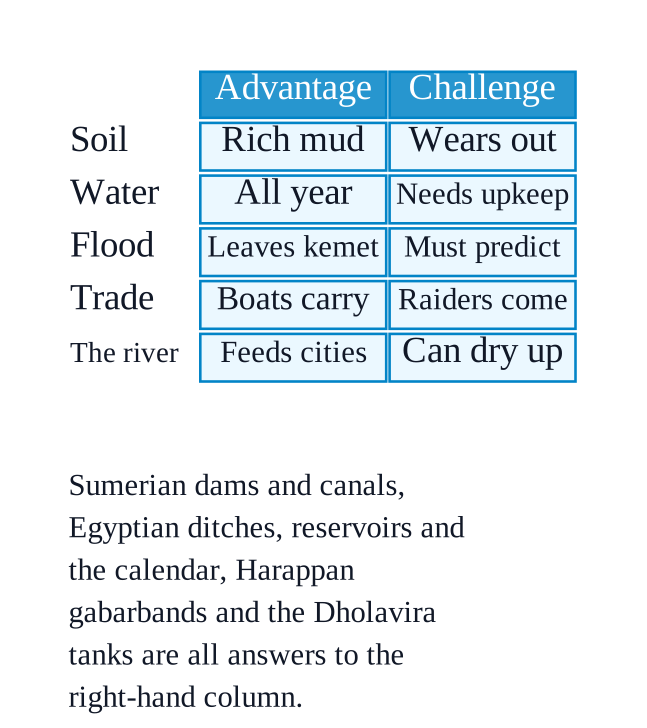
    Water had to be controlled. The Sumerians built the first dams and canals; the Egyptians dug ditches and reservoirs; the Early Harappans built gabarband check dams, and the Harappans built the deep tank system at Dholavira.
    Work had to be organised. In Egypt, digging ditches and building dams needed collective effort, and out of that grew local government and an administrative class.
    Environments wear out. By the end of $\displaystyle 1400$ BCE, environmental degradation and pressure on agricultural lands — along with attacks and internal problems — had weakened Babylonian control.
    Rivers can fail. The chapter refers to sites in the dried river belt of Sarasvati, such as Bhirrana and Kunal.
    Nothing happened everywhere at once. Fig. $\displaystyle 4.14$ shows the transition to farming came at different times in different regions — each environment set its own pace.
    Conclusion
    Societies answered environmental challenges with technology — tools, irrigation, pottery, metallurgy, calendars and writing — and each answer opened a further opportunity. That chain is how villages became cities.
  3. Exercise 4.3

    Why do historians divide early human history into different ages such as Stone Age, Bronze Age, and Iron Age? What does this classification tell us about human progress?

    The book prints no answer for this

    NCERT publishes no answers for this textbook, so there is nothing in the book to check this working against. It has also not yet been read through by hand.

    Historians divide early human history by technology, because for almost all of that time tools are the only evidence there is.
    NCERT_Solution_Class9_SocialScience_Ch4_QA_Q4-3
    The chapter says the divisions are based on technological progress — the development and use of tools, the beginning of agriculture, and changes in human lifestyle and settlement patterns.
    There is no writing for this period, so events cannot be dated by kings or coronations. What survives is what people made, and material objects can be compared across regions and across thousands of years.
    What the classification tells us about human progress
    Palaeolithic (Old Stone Age): a hunting-gathering life with simple stone tools.
    Mesolithic: tiny microlithic tools — a transitional phase between hunting-gathering and agriculture.
    Neolithic (New Stone Age): the shift from hunting-gathering to agriculture and settled life, with domestication of animals and polished stone tools.
    Chalcolithic: copper used alongside stone — the beginning of metallurgy, the extraction and shaping of metal.
    Bronze Age: bronze metallurgy (copper mixed with tin), and with it the expansion of trade, towns and early civilisations.
    Iron Age: widespread iron smelting, stronger tools and weapons, and more advanced societies.
    Read together, the sequence shows one chain: better tools → more food → more people → larger, more organised settlements. The ability to produce surplus food and goods is what the chapter says laid the foundation for civilisation.
    One caution to include
    The ages are not the same dates everywhere. Copper tools reached Mesopotamia around $\displaystyle 4500$ BCE and Mehrgarh by about $\displaystyle 4000$ BCE; iron became popular in China by $\displaystyle 600$ BCE. The labels describe stages a society passes through, not a world timetable.
  4. Exercise 4.4

    Imagine you are a Neolithic farmer. Describe one day of your life. What challenges would you face that a hunter-gatherer would not?

    The book prints no answer for this

    NCERT publishes no answers for this textbook, so there is nothing in the book to check this working against. It has also not yet been read through by hand.

    What the task asksNCERT_Solution_Class9_SocialScience_Ch4_QA_Q4-4
    Write a first-person account of one day as a Neolithic farmer, then set out the difficulties that come with farming and that a hunter-gatherer would never face.
    Worked example — one day at Mehrgarh, about $\displaystyle 7000$ BCE
    I wake in our sun-dried brick house and go first to the granary. Last year's wheat and barley must last until the harvest, so my mother measures out what we may use.
    Early morning: out to the field with a polished stone tool to break the soil and pull weeds. The field is close to the Bolan river, because everything depends on water.
    Mid-morning: my brother takes the sheep and goats out to graze and waters the zebu cattle. They cannot be left alone.
    Midday: grinding grain, and shaping pottery to store it in.
    Afternoon: my sister drills beads of carnelian and lapis lazuli; traders will want them, and we need what they bring.
    Evening: repair a broken tool. We eat grain and milk — food we produced, not food we happened to find that day.
    Challenges a hunter-gatherer would not face
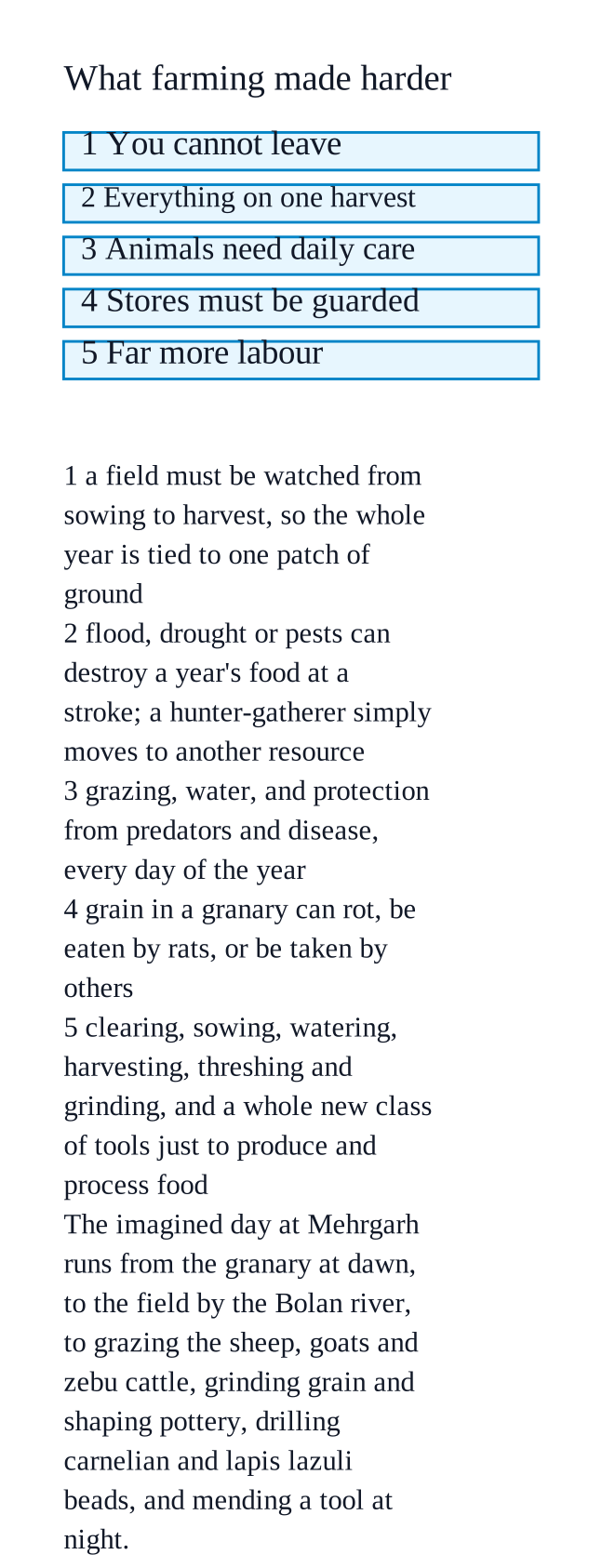
    You cannot leave. A field must be watched from sowing to harvest, so the whole year is tied to one patch of ground.
    Everything rides on one harvest. Flood, drought or pests can destroy a year's food at a stroke. A hunter-gatherer simply moves to another resource.
    Animals need daily care — grazing, water, protection from predators and from disease.
    Stores must be guarded. Grain in a granary can rot, be eaten by rats, or be taken by others. Hunter-gatherers carried little worth stealing.
    Far more labour. Clearing, sowing, watering, harvesting, threshing and grinding — the chapter notes that Neolithic farmers had to make a whole new class of tools just for producing and processing food.
    What a good answer must contain
    First person, one clear day from morning to night.
    At least three named Neolithic things — brick house, granary, pottery, polished stone tool, sheep, goats, zebu cattle, wheat, barley.
    At least two challenges that follow specifically from being settled and farming.
  5. Exercise 4.5

    Imagine that the Harappan script gets deciphered tomorrow. What new types of information do you think historians might learn?

    The book prints no answer for this

    NCERT publishes no answers for this textbook, so there is nothing in the book to check this working against. It has also not yet been read through by hand.

    If the Harappan script were deciphered, the Harappans would move out of prehistory and into history — and we would gain exactly the kinds of information the chapter says only writing can give.
    NCERT_Solution_Class9_SocialScience_Ch4_QA_Q4-5
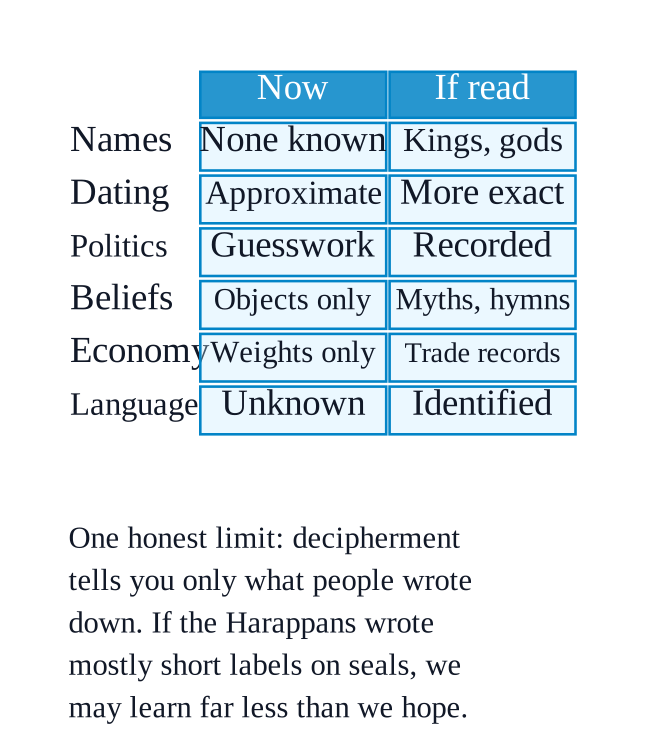
    Names. Rulers, officials, gods, cities and ordinary people. At present we do not know what the Harappans called themselves, their kings or their towns.
    Events and accurate dates. The chapter's table says written documents mention specific dates for events such as coronations and wars, so dating would become relatively accurate instead of only approximate.
    Social, political and cultural life. Who governed, how they governed, and how society was divided — questions the drains and the street plans cannot answer.
    Beliefs, stories and learning. Cuneiform gave us Mesopotamia's myths, epics, hymns, 'law codes' and educational treatises. A readable Harappan script could do the same for the Sindhu-Sarasvatī civilisation.
    The everyday economy. Mesopotamian tablets record the work of potters, seal cutters, shipbuilders, carpenters and farm workers. Harappan seals, pottery graffiti and weights might turn out to be records of the same kind — of crafts, ownership and trade.
    The other side of a known story. Sargon's tablets record Mesopotamian trade with Meluhha. We would finally have the Harappan account of that trade, in Harappan words.
    The language itself — which language the Harappans spoke, which at present nobody can say.
    One honest limit
    Decipherment tells you what people wrote down. If the Harappans wrote mostly short labels on seals, we may learn far less than we hope.
  6. Exercise 4.6

    Prepare a table with three columns—Palaeolithic, Mesolithic, and Neolithic—and fill in their distinctive features: tools, settlements, art, and subsistence.

    The book prints no answer for this

    NCERT publishes no answers for this textbook, so there is nothing in the book to check this working against. It has also not yet been read through by hand.

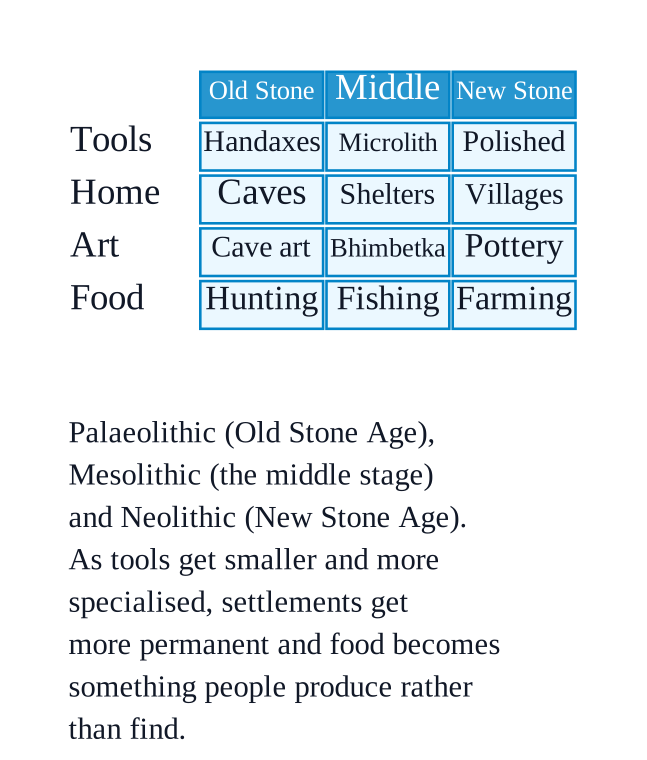
    The three Stone Age stages differ in their tools, settlements, art and subsistence — here is the table filled in.
    NCERT_Solution_Class9_SocialScience_Ch4_QA_Q4-6Palaeolithic (Old Stone Age)
    Tools: large stone tools — handaxes, cleavers, choppers and scrapers of quartzite and limestone; later smaller scrapers, borers and points, then parallel-sided blades and microblades of glassy rock, the bow and arrow, and the burin (engraver).
    Settlements: caves and open camps; people moved with the food supply.
    Art: cave and rock-shelter paintings; pigments used on the body; the first beads of stone, bone and shell; symbolic engraving on bone and ostrich eggshell.
    Subsistence: hunting and gathering — chopping meat, digging out tubers, scraping skin, cleaving bones for marrow; later, small game.
    Mesolithic
    Tools: microlithic (tiny stone) tools, often fixed into a handle; bone points.
    Settlements: caves and rock shelters frequently occupied; temporary settlements near rivers and lakes.
    Art: art activity flourished — the World Heritage Site of Bhimbetka in Madhya Pradesh has hundreds of painted rock shelters.
    Subsistence: fishing was the mainstay, with aquatic food both marine and freshwater, plus small game and edible wild grains.
    Neolithic (New Stone Age)
    Tools: polished stone tools made for producing and processing food, and earthenware pottery in many shapes and sizes.
    Settlements: the first permanent village settlements — at Mehrgarh, handmade sun-dried brick houses and granaries.
    Art: pottery with regional shapes and painted designs; ornaments of semi-precious stones such as lapis lazuli and carnelian, and of shell; the chapter's summary also names weaving.
    Subsistence: farming and herding — wheat and barley at Mehrgarh, millets and rice elsewhere, and cattle, sheep and goats.
    Two things worth adding under the table
    The three stages are a sequence of capability, not a set of world dates — the shift to farming happened at different times in different regions (Fig. $\displaystyle 4.14$).
    The pattern to notice: as tools get smaller and more specialised, settlements get more permanent and food becomes something people produce rather than find.
  7. Exercise 4.7

    “Bronze Age civilisations developed independently but shared common features.” Examine this statement with reference to the civilisations given in the chapter.

    The book prints no answer for this

    NCERT publishes no answers for this textbook, so there is nothing in the book to check this working against. It has also not yet been read through by hand.

    The statement is correct, and the chapter says both halves of it directly.
    NCERT_Solution_Class9_SocialScience_Ch4_QA_Q4-7They developed independently
    The chapter's closing section states that the major Bronze Age civilisations emerged independently in the fertile river plains and developed social and administrative systems independently.
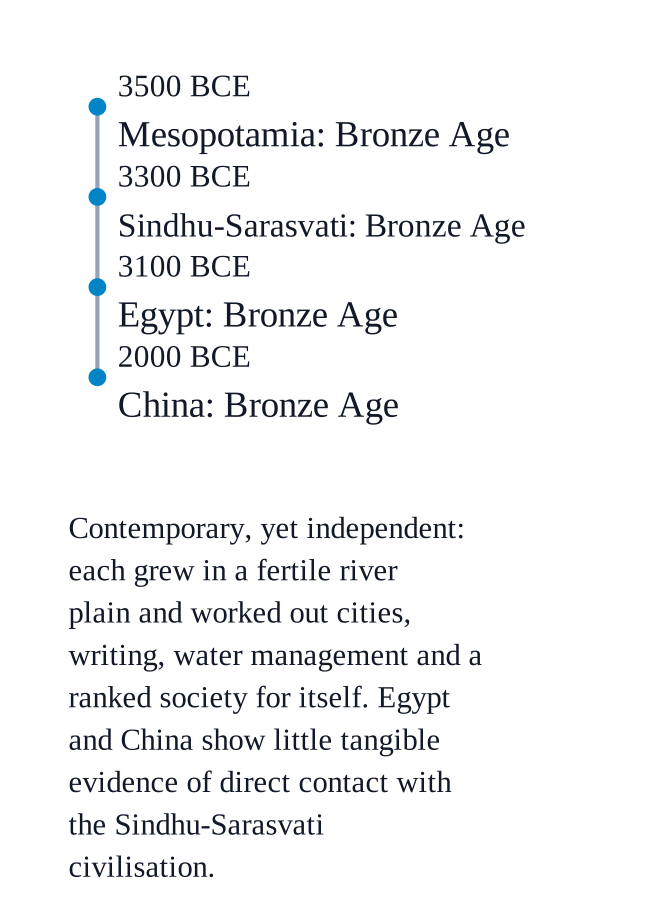
    Two of the four barely met the others: Egypt and China have little tangible evidence of direct contact with the Sindhu-Sarasvatī civilisation.
    Yet they shared these common features
    A great river. The Sindhu and Sarasvatī; the Euphrates and Tigris; the Nile; the Huang He.
    Bronze metallurgy. The chapter's timelines put the Bronze Age at about $\displaystyle 3500$ BCE in Mesopotamia, $\displaystyle 3300$ BCE for the Sindhu-Sarasvatī region, $\displaystyle 3100$ BCE in Egypt, and about $\displaystyle 2000$ BCE in China.
    Cities. In each, higher agricultural productivity and new resources produced urban centres.
    Writing. Cuneiform in Sumer from about $\displaystyle 3200$ BCE, hieroglyphs in Egypt, the pictographic Sindhu lipi, and in China oracle-bone symbols and a logographic script.
    Water management. Sumerian dams and canals; Egyptian ditches and reservoirs; Harappan gabarbands, the Dholavira tanks and the Lothal dockyard.
    A ranked society. High priests and priestesses as part of Mesopotamia's ruling class; the Egyptian pyramid from pharaoh down to serfs and slaves; a highly stratified Chinese society by $\displaystyle 1500$ BCE with rulers, nobles and aristocrats above farmers and labourers.
    Trade, administration and record-keeping, including the Harappans' standard weights and measures.
    Where they differed
    Mesopotamia and the Indus and Ghaggar-Sarasvatī valleys lie close together, so their contact and trade were strong — Sargon's tablets name Meluhha, Magan and Dilmun. Egypt and China grew up apart from them.
    Each kept things of its own: Egyptian pyramids and mummification; Chinese jade objects and oracle bones; Sumerian ziggurats; Harappan planned cities and cubical stone weights.
    Conclusion
    Similar environments set similar problems, and similar problems produced similar solutions. That is why four civilisations that mostly never met still look so alike — and why the chapter can say our cultural ethos has roots in all of them.
  8. Exercise 4.8

    Although rivers provided many benefits, they also created challenges for early societies. Discuss both the advantages and disadvantages of settling near rivers.

    The book prints no answer for this

    NCERT publishes no answers for this textbook, so there is nothing in the book to check this working against. It has also not yet been read through by hand.

    Rivers were the reason early civilisations could exist at all — but living beside one meant constant work and constant risk.
    NCERT_Solution_Class9_SocialScience_Ch4_QA_Q4-8Advantages of settling near rivers
    Water all year for people, animals and crops.
    Fertile soil. The Nile's yearly flood left rich black mud, kemet, excellent for growing crops; the alluvial plains of the Indus and Ghaggar-Sarasvatī raised productivity sharply once copper tools arrived.
    Irrigation was possible. Sumerian dams and canals, Egyptian ditches and reservoirs, Harappan gabarbands and the deep interconnected tanks at Dholavira.
    Transport and trade. Goods moved by water; the Harappans built the huge burnt-brick dockyard at Lothal, and the Sumerians invented the sailboat.
    Raw materials on the banks — clay for mud bricks, burnt bricks and pottery.
    Surplus food, which supported craftspeople, merchants and rulers, and so made towns and cities possible.
    Disadvantages and challenges
    A flood is only useful if you can predict it. The Egyptians had to count the days between Nile floods and build a whole calendar just to live with the river.
    Endless maintenance. Dams, canals, ditches and tanks must be built and repaired; in Egypt this needed collective effort, which is why an administrative class grew up.
    Rivers move and dry up. The chapter refers to sites in the dried river belt of Sarasvati, such as Bhirrana and Kunal — when a river fails, the settlement fails with it.
    The land wears out. Environmental degradation and pressure on agricultural lands are named among the causes that weakened Babylonia by the end of $\displaystyle 1400$ BCE.
    Wealth attracts attack. Rich river settlements were worth raiding — Sumerian cities built defensive walls, Early Harappan settlements built a perimeter wall, and China eventually joined its walls into the Great Wall against nomadic raids.
    Conclusion
    Rivers did not simply feed early societies; they set them a permanent task. The dams, canals, calendars and administrations that we call civilisation are largely the answer to that task.
  9. Exercise 4.9

    With the help of your teacher, find out more about the Code of Hammurabi. Why was it important? Do you think it was fair to all sections of society? Give reasons for your answer.

    The book prints no answer for this

    NCERT publishes no answers for this textbook, so there is nothing in the book to check this working against. It has also not yet been read through by hand.

    What the task asks
    Research the Code of Hammurabi with your teacher, explain why it mattered, and then judge whether it was fair to all sections of society — with reasons.
    What the chapter gives you
    Hammurabi came to power in $\displaystyle 1792$ BCE and turned the small city-state of Babylonia into a large empire by conquering neighbouring regions.
    His most significant contribution was the compilation of rules and regulations for civil and social conduct, applied throughout his empire and known as the Code of Hammurabi.
    It served as a foundational model for many future legal systems.
    A stone stele shows Hammurabi receiving the law from Shamash, the Babylonian god of justice, with the law codes inscribed in cuneiform below the relief.
    Why it was important — points you can defend from the chapter
    One law for a whole empire, instead of a different custom in every city.
    It was written down, in cuneiform, and set up in public on stone — so it could be known, and not simply changed at a ruler's whim.
    It shaped later law, being taken as a model by legal systems that came afterwards.
    It shows how rulers claimed authority — by picturing the king receiving the law from a god, not inventing it himself.
    Was it fair? — how to answer this part, not what to answer
    The chapter does not say whether it was fair, and prints none of its rules. This part needs the text of the Code, found with your teacher.
    A good answer will: quote or summarise at least two actual rules; ask whether the same offence carried the same penalty for a noble, a free person and a slave; and ask whether women had the same rights under it as men.
    Then take a position and give reasons. Both "fair for its time" and "unfair" can earn full marks, provided the rules you cite actually support what you say.
    What a good answer must contain
    The chapter facts first, the researched facts second, and a clear line between them.
    The source named for every rule you quote.
  10. Exercise 4.10

    If you had to choose one major innovation from early civilisations that changed the world permanently, what would it be and why?

    The book prints no answer for this

    NCERT publishes no answers for this textbook, so there is nothing in the book to check this working against. It has also not yet been read through by hand.

    What the task asksNCERT_Solution_Class9_SocialScience_Ch4_QA_Q4-10
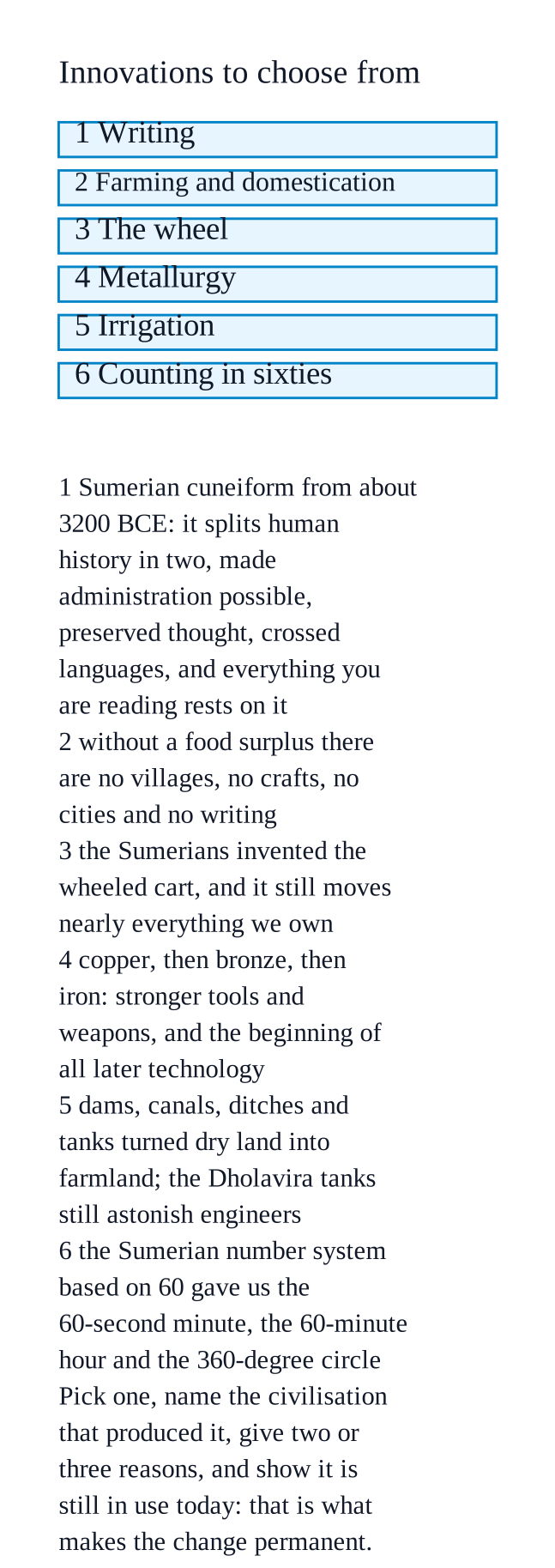
    Choose one innovation from this chapter and argue why it changed the world permanently. Any of the choices below can win full marks; what is marked is the argument.
    Worked example — writing (Sumerian cuneiform, about $\displaystyle 3200$ BCE)
    It splits human history in two. Everything before it — more than $\displaystyle 99$ per cent of our story — is known only from objects. Everything after it can be read.
    It made administration possible: cuneiform tablets kept records of farming and craft activities, of potters, seal cutters, shipbuilders, carpenters and farm workers.
    It preserved thought: Mesopotamia's myths, epics, hymns, 'law codes' and educational treatises survive only because someone wrote them down.
    It crossed languages. By $\displaystyle 3000$ BCE cuneiform was used all over Mesopotamia by city-states that spoke different languages.
    It is still with us. Everything you are reading right now rests on that invention.
    Other strong choices, and the reason each could win
    Farming and domestication — without a food surplus there are no villages, no crafts, no cities and no writing. Everything else in the chapter follows from it.
    The wheel — the Sumerians invented the wheeled cart, and it still moves nearly everything we own.
    Metallurgy — copper, then bronze, then iron: stronger tools and weapons, and the beginning of all later technology.
    Irrigation — dams, canals, ditches and tanks turned dry land into farmland; the Dholavira tanks still astonish engineers.
    The Sumerian number system based on $\displaystyle 60$ — we still keep $\displaystyle 60$ seconds in a minute, $\displaystyle 60$ minutes in an hour and $\displaystyle 360$ degrees in a circle.
    What a good answer must contain
    One innovation, named together with the civilisation that produced it.
    Two or three reasons, not a list of facts.
    One line showing it is still in use today — that is what makes the change 'permanent'.
  11. Exercise 4.11

    Compare the social hierarchy and daily life of people in the Egyptian civilisation with those in Mesopotamia or China. What similarities and differences do you notice?

    The book prints no answer for this

    NCERT publishes no answers for this textbook, so there is nothing in the book to check this working against. It has also not yet been read through by hand.

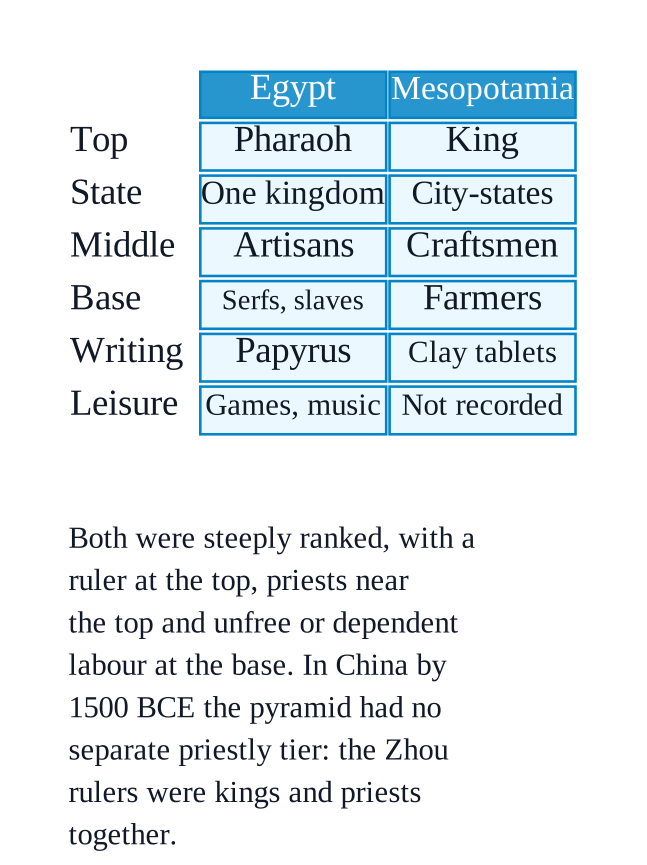
    Both societies were steeply ranked pyramids with a ruler at the top and labourers at the bottom, but Egypt was one kingdom under a pharaoh while Mesopotamia was a set of rival city-states.
    NCERT_Solution_Class9_SocialScience_Ch4_QA_Q4-11Egypt — hierarchy and daily life
    Hierarchy, top to bottom (Fig. $\displaystyle 4.32$): Pharaoh; government officials, nobles and priests; free landholders, artisans and merchants; serfs and slaves.
    Daily life: farming on Nile-watered land, digging ditches and filling reservoirs; crafts and trade; writing on papyrus.
    Leisure: they swam, canoed, played board games, and enjoyed music and dancing.
    Festivals were central — a god's statue was paraded to the sound of the sistrum, and the Sed festival marked a king's 30th year on the throne.
    Women could own property and run businesses, more rights than their Greek or Roman counterparts; Cleopatra was trained from childhood and became queen at eighteen.
    Belief shaped everything: the ka, mummification, mastabas and pyramids.
    Mesopotamia — hierarchy and daily life
    Kings lived in grand palaces; ordinary people lived in small brick houses.
    High priests and priestesses alone could enter the sacred temple and were probably part of the ruling class. Scribes enjoyed a status similar to theirs.
    Life centred on the ziggurat: agriculture, trade and the transport of goods were all tied to the temple authority, and the city grew around it.
    Most people farmed; others worked in metalworking, pottery and textiles, and there were merchants and traders.
    Similarities
    Both were sharply divided, with a ruler at the apex and unfree labour at the base.
    In both, priests stood near the top and religion ran right through economic life — the ziggurat was also the city's treasury; Egyptian festivals honoured gods and pharaoh together.
    In both, most people were farmers, with craftspeople and traders forming a middle group.
    Both used writing and record-keeping, and gave scribes standing.
    Differences
    Egypt had a single ruler, the pharaoh, over one land; Mesopotamia had a succession of city-states — Sumerian, Akkadian, Assyrian, Babylonian — each dominant in turn.
    Egyptian life was shaped by preparing for the afterlife; the chapter records no comparable practice in Mesopotamia.
    The chapter describes Egyptian leisure and festivals in detail but says nothing of the kind about Mesopotamia — a real difference in what our sources preserve, if not in how people lived.
    If you compare with China instead
    By $\displaystyle 1500$ BCE Chinese Bronze Age society was highly stratified — ruling class, nobles and aristocrats above farmers and labourers — again a pyramid, but with no separate priestly tier: the Zhou rulers were themselves both kings and priests.
    Two sharp contrasts with Egypt: Zhou kings were believed to be appointees of heaven who could be dismissed when their people did not prosper, whereas the pharaoh's position was not conditional in that way; and China chose public officials by examination — in archery, horsemanship, calculations, writing and music — a route upward the chapter does not describe for Egypt.
  12. Exercise 4.12

    Activity: Using maps, locate the major rivers and civilisations of Mesopotamia, Egypt, China, and the Sindhu-Sarasvatī Valley. Mark the trade links between them.

    The book prints no answer for this

    NCERT publishes no answers for this textbook, so there is nothing in the book to check this working against. It has also not yet been read through by hand.

    What the task asksNCERT_Solution_Class9_SocialScience_Ch4_QA_Q4-12
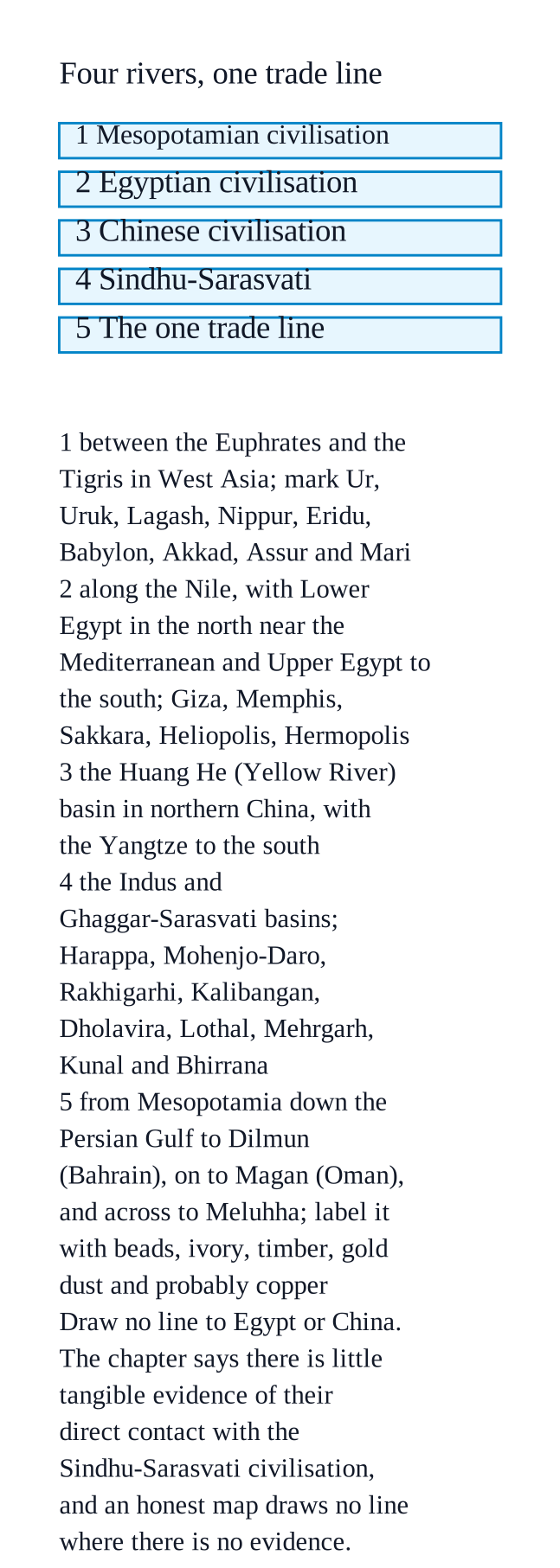
    On an outline map, mark the four civilisations and their rivers, then draw the trade links the chapter records between them.
    Rivers and civilisations to mark
    Mesopotamian civilisation — between the Euphrates and the Tigris in West Asia. Mark Ur, Uruk, Lagash, Nippur, Eridu, Babylon, Akkad, Assur and Mari.
    Egyptian civilisation — along the Nile. Mark Lower Egypt in the north near the Mediterranean and Upper Egypt to the south; add Giza, Memphis, Sakkara, Heliopolis and Hermopolis.
    Chinese civilisation — the Huang He (Yellow River) basin in northern China, with the Yangtze to the south.
    Sindhu-Sarasvatī civilisation — the Indus and Ghaggar-Sarasvatī basins. Mark Harappa, Mohenjo-Daro, Rakhigarhi, Kalibangan, Dholavira, Lothal, Mehrgarh, Kunal and Bhirrana.
    Also shade the fertile crescent — the foothills of the Zagros and Taurus, from the Mediterranean in the west to the Persian Gulf in the east.
    The trade links to draw
    One line from Mesopotamia down the Persian Gulf to Dilmun (Bahrain), on to Magan (the Oman peninsula), and across to Meluhha — the Sindhu-Sarasvatī sites, reaching the sea at Lothal and Dholavira.
    Label that line with the goods the chapter names: semiprecious stone beads, ivory, timber, gold dust and probably copper.
    Beside Egypt and China write: little tangible evidence of direct contact with the Sindhu-Sarasvatī civilisation. An honest map draws no line where there is no evidence — that is itself a finding worth showing.
    What a good map must have
    A title, north arrow, scale and legend.
    The four river systems drawn in blue; the four civilisations shaded in four different colours.
    Every name spelt exactly as the book spells it — Sindhu-Sarasvatī, Ghaggar-Sarasvatī, Huang He, Mohenjo-Daro.
  13. Exercise 4.13

    Activity: Choose one early civilisation (Mesopotamia, Egypt, or China) and prepare a mini-scrapbook or a presentation showing their innovations in tools, writing, art, and architecture. Include pictures, brief descriptions, and explain their significance.

    The book prints no answer for this

    NCERT publishes no answers for this textbook, so there is nothing in the book to check this working against. It has also not yet been read through by hand.

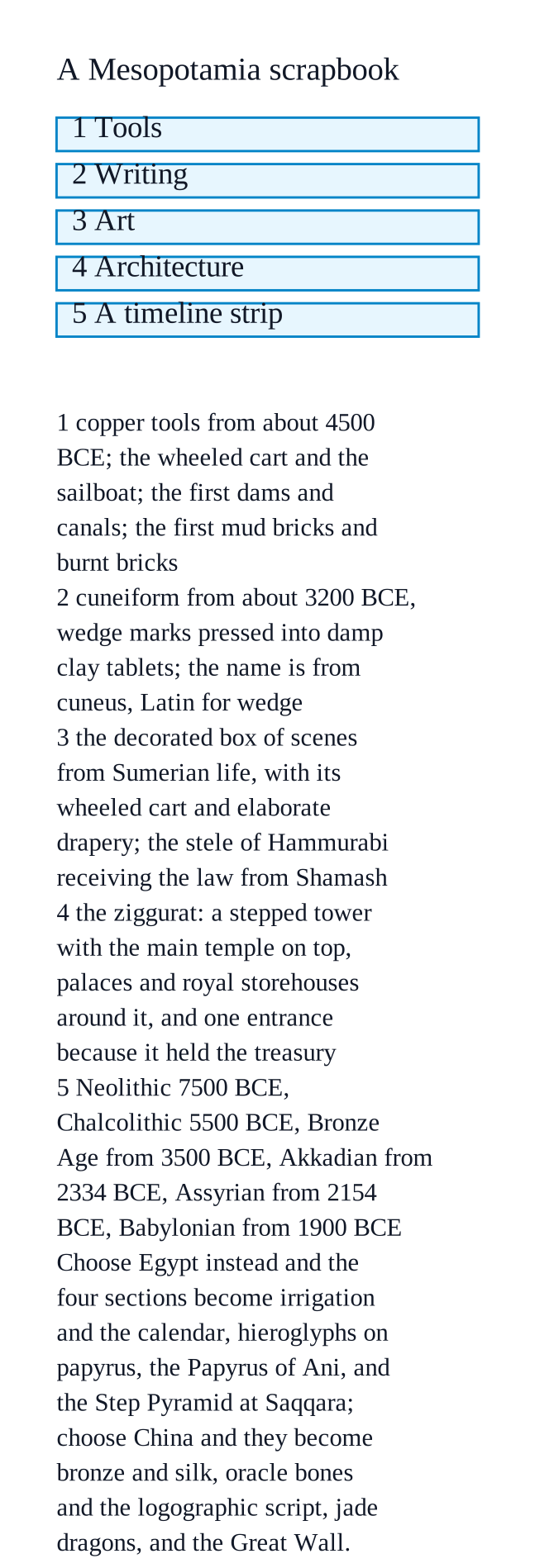
    What the task asksNCERT_Solution_Class9_SocialScience_Ch4_QA_Q4-13
    Pick one of Mesopotamia, Egypt or China, and build a scrapbook or presentation on its innovations in tools, writing, art and architecture — with pictures, brief descriptions, and why each mattered.
    Worked example — Mesopotamia, in four sections
    Tools and technology: copper tools from about $\displaystyle 4500$ BCE; the wheeled cart and the sailboat, both Sumerian inventions; the first dams and canals for irrigation; the first use of mud bricks and burnt bricks in building. Significance: the wheel and the fired brick are still in daily use.
    Writing: cuneiform from about $\displaystyle 3200$ BCE — hundreds of marks pressed into damp clay tablets with a sharp wedge-shaped reed. The name comes from the Latin cuneus, 'wedge'. Significance: the first writing system; used across city-states that spoke different languages; it carried myths, epics, hymns, 'law codes', educational treatises and craft accounts, and stayed in use until the end of the first millennium BCE.
    Art: the decorated box showing scenes of Sumerian life, with its wheeled cart and its elaborate drapery and ornaments; the stone stele showing Hammurabi receiving the law from Shamash, god of justice. Significance: their art recorded rule and everyday life together.
    Architecture: the ziggurat — a stepped, pyramid-shaped tower with the main temple on the top floor, palaces and royal storehouses around it, and a surrounding wall with only one entrance because it also held the city's treasury. Significance: the city grew around it, so the temple was the plan of the city.
    One extra page worth adding: the Sumerian number system based on $\displaystyle 60$, which gave the world the $\displaystyle 60$-second minute, the $\displaystyle 60$-minute hour and the $\displaystyle 360$-degree circle.
    If you choose Egypt instead
    Tools and technology: irrigation ditches and reservoirs; the calendar of three seasons of four months, $\displaystyle 365$ days, based on the rising of Sirius; mummification using natron.
    Writing: hieroglyphs on papyrus, deciphered from the Rosetta Stone by Jean-François Champollion in 1822.
    Art: the Papyrus of Ani; jewellery and daily items.
    Architecture: the mastaba, and the Step Pyramid at Saqqara.
    If you choose China instead
    Tools and technology: bronze metallurgy for weapons, tools and ritual vessels; silk; metal money under the Zhou and later paper currency; civil services chosen by public examination.
    Writing: oracles — symbols on animal bones and tortoise shells, cracked by heat and read from the pattern; the logographic script.
    Art: jade dragons, pendants and figurines; carved marble birds and animals; jade pieces that rang when struck.
    Architecture: the Great Wall, built and rebuilt from $\displaystyle 680$ BCE to the 17th century CE.
    What a good scrapbook must contain
    Four clearly labelled sections, one per theme.
    At least one picture per section, each with a caption saying what it shows and where you got it.
    Two or three lines of significance per item — not only what it was, but why it mattered then and why it still matters.
    A timeline strip. For Mesopotamia: Neolithic $\displaystyle 7500$ BCE, Chalcolithic $\displaystyle 5500$ BCE, Bronze Age from $\displaystyle 3500$ BCE, Akkadian from $\displaystyle 2334$ BCE, Assyrian from $\displaystyle 2154$ BCE, Babylonian from $\displaystyle 1900$ BCE.
    Names spelt exactly as the book spells them.