SolveItClass 9 · NCERT

NCERT Solutions · Class 9 Science Work, Energy, and Simple Machines

28 questions · 20 still being checked

Pause and Ponder 7.9–7.10 (part 14 of 21)

  1. Exercise 7.9

    Explain why roads on hills are built to wind around in gentle slopes rather than going straight up (Fig. 4.26\displaystyle 4.26)?

    Not cross-checked

    NCERT prints no numerical answer for this exercise, so this working has not been cross-checked against the book.

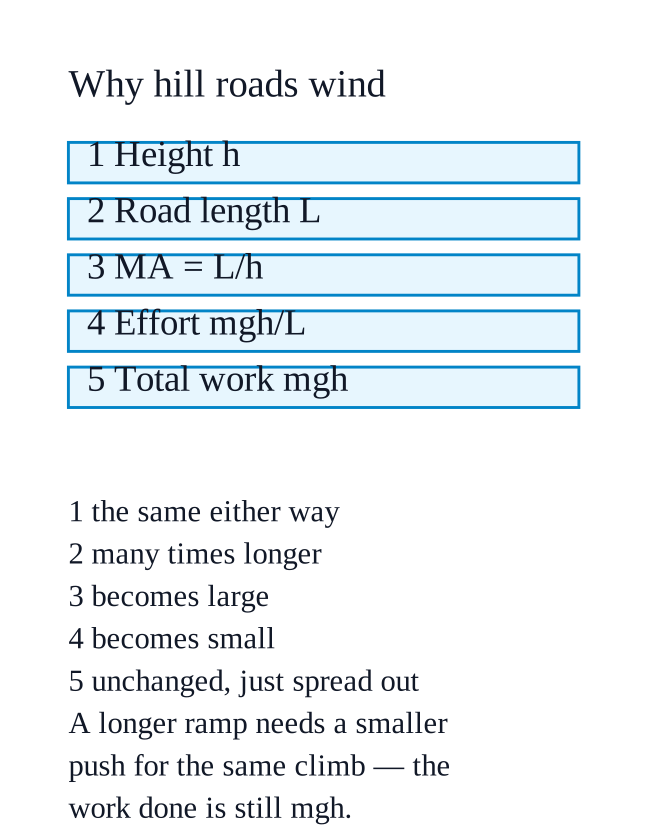
    Because a winding road is a long inclined plane, and a longer ramp needs a smaller force to climb the same hill.
    NCERT_Solution_Class9_Science_Ch7_PP_Q7-9
    The mechanical advantage of an inclined plane is \(\displaystyle \text{MA} = \dfrac{L}{h} \) (Eq. $\displaystyle 7.13$), where \(\displaystyle L \) is the length of the road and \(\displaystyle h \) the height of the hill.
    Winding round and round makes \(\displaystyle L \) many times larger while \(\displaystyle h \) stays fixed, so the MA becomes large.
    The effort needed at any instant is \(\displaystyle F' = \dfrac{mgh}{L} \) — a bigger \(\displaystyle L \) means a much smaller push from the engine, and a gentler slope that vehicles can actually manage.
    The total work is not reduced: it is still \(\displaystyle mgh \). The same work is simply spread over a much longer distance.
  2. Exercise 7.10

    To reach a higher floor, we find climbing an inclined ladder easier in comparison to climbing a vertical ladder (Fig. 7.30\displaystyle 7.30). Explain why.NCERT_Question_Class9_Science_Ch7_PP_Q7-10

    Not cross-checked

    NCERT prints no numerical answer for this exercise, so this working has not been cross-checked against the book.

    Because the inclined ladder works as an inclined plane, and reduces the force you must apply at each step.
    Vertical ladder: you lift your whole weight straight up, so the effort you must supply is the full \(\displaystyle mg \).
    Inclined ladder of length \(\displaystyle L \) reaching the same height \(\displaystyle h \): from \(\displaystyle F' \times L = mgh \), the effort is \(\displaystyle F' = \dfrac{mgh}{L} \).
    Since \(\displaystyle L > h \), we get \(\displaystyle F' < mg \), and \(\displaystyle \text{MA} = \dfrac{L}{h} > 1 \).
    You have to travel a longer distance along the slanted ladder, so the total work is still \(\displaystyle mgh \) — it only feels easier because each step demands less force.