Exercise 11.9
A farmer wants to produce a large number of genetically identical plants quickly. Suggest suitable reproduction methods and explain why they are effective.
Not cross-checked
NCERT prints no numerical answer for this exercise, so this working has not been cross-checked against the book.
Use asexual reproduction — vegetative propagation, and for large numbers in a short time, tissue culture above all; cutting, layering and grafting serve for smaller batches.
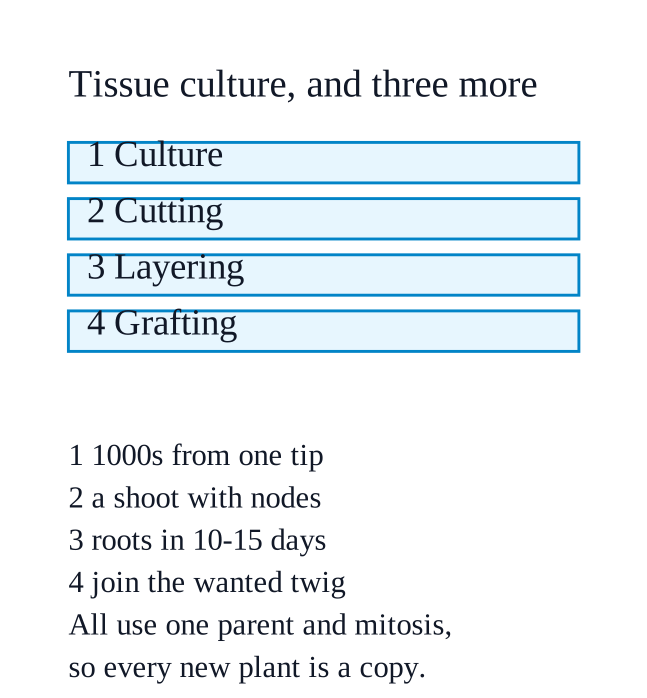
Tissue culture — healthy plantlets are mass-produced from the shoot tip (apical meristem) of a chosen plant. Thousands of identical plants come from one parent quickly, and virus-infected plants are eliminated in the process, which is how banana farming was transformed.
Cutting — a shoot piece bearing nodes is planted about half its length into compost-mixed soil at \(\displaystyle 45\)–\(\displaystyle 60^\circ\) and grows into a whole new plant (sugarcane, money plant).
Layering — the middle of a flexible twig is buried in soil; roots develop from the buried part in about \(\displaystyle 10\)–\(\displaystyle 15\) days, and the rooted twig is then cut away as a new plant (lemon).
Grafting — a stem piece of the desired variety (Plant B) is fitted into a slit on a healthy rooted plant (Plant A) and protected until it heals, so the desired variety is multiplied on a strong root system (rose).
Why these work: each uses one parent and mitosis only, so every new plant is a clone carrying exactly the desirable characters the farmer selected — no mixing, no surprises.
They are also fast, because they skip flowering, pollination, fertilisation, seed formation and germination altogether, and each new plant starts from an already-grown piece of the parent.