Exercise 11.7
Why do vegetatively propagated plants tend to be more vulnerable to diseases than sexually reproduced plants?
Not cross-checked
NCERT prints no numerical answer for this exercise, so this working has not been cross-checked against the book.
Because vegetatively propagated plants are clones — genetically identical, so a disease able to attack one plant can attack every plant in the field.
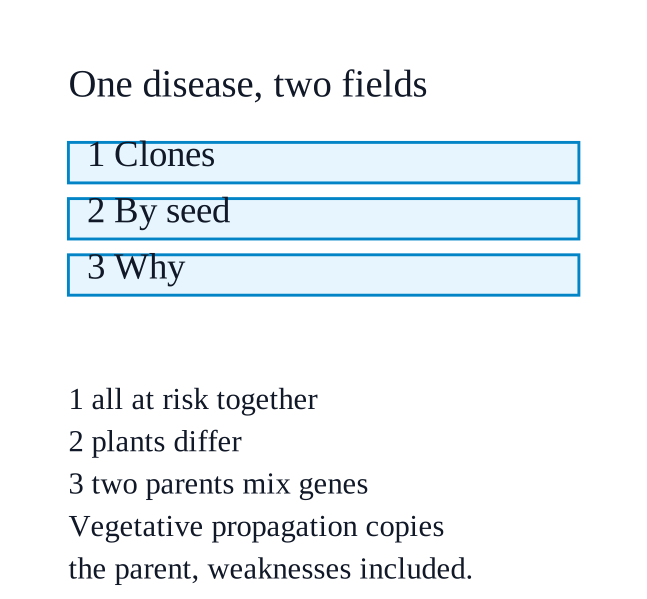
Vegetative propagation uses a single parent and mitosis, so there is no variation among the new plants; not one of them carries a different combination of characters that might resist the pathogen.
Sexually reproduced plants come from the fusion of gametes formed by meiosis, so the chromosomes of two parents are shuffled into new combinations and the seedlings differ from one another.
In such a mixed population, some individuals happen to be resistant and survive an outbreak, and the crop is not wiped out together.
The chapter states the general principle: variation helps some individuals adapt better to changing environments, and is important for the survival of a species.
This is also why tissue-cultured banana plantlets are deliberately raised from healthy shoot tips — an identical crop has to be started virus-free, because it has no built-in variation to fall back on.