Exercise 11.10
Suresh prepares slides with pollen grains in different sugar concentrations (%, %, %, %, %) to study the germination of pollen. (i) What are the different hypotheses which can be tested using this set-up? (ii) What parameters should be kept the same in this set-up?
Not cross-checked
NCERT prints no numerical answer for this exercise, so this working has not been cross-checked against the book.
(i) Hypotheses that this set-up can test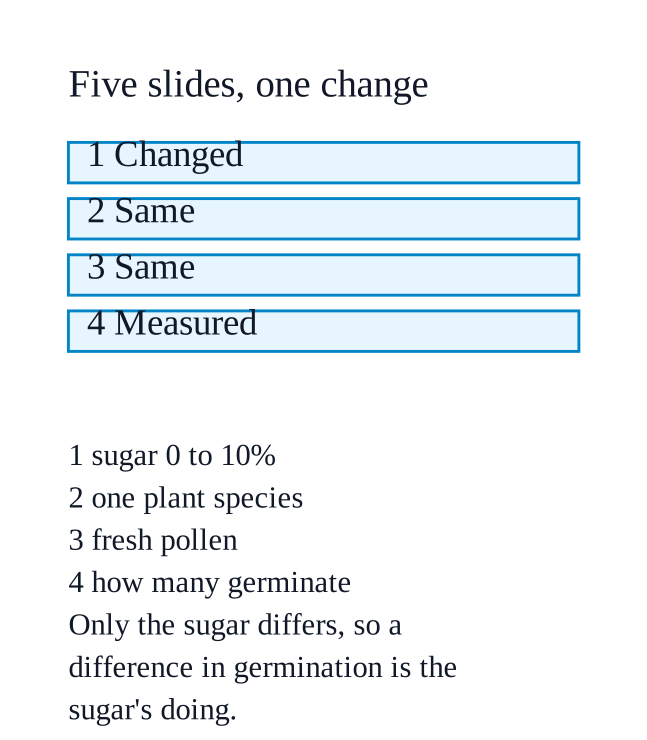
Pollen grains need sugar in the surrounding medium to germinate — they will not germinate in \(\displaystyle 0\%\) sugar, i.e. in plain water.
The percentage of pollen grains that germinate depends on the sugar concentration of the medium.
There is an optimum sugar concentration at which germination is highest, with poorer germination both below it and above it.
The length of the pollen tube grown in a fixed time increases with sugar concentration up to that optimum.
(Any one of these is testable here, because the set-up changes only the sugar concentration and measures what the pollen does.)
(ii) Parameters that must be kept the same on every slide
The same plant species, and pollen collected fresh from flowers of the same age — old pollen from a different plant would germinate differently for reasons that have nothing to do with sugar.
Roughly the same number of pollen grains per slide, in the same size of drop.
All five solutions made from the same water, prepared freshly and in the same way, so that only the sugar concentration differs.
The same temperature, light and humidity — all slides kept together in one place.
The same length of time before observation, since a pollen tube keeps growing.
The same microscope and magnification, the same clean slides and coverslips, and the same rule for deciding when a grain counts as "germinated".
Sugar concentration is the only thing allowed to change — that is what makes the comparison fair.