SolveItClass 9 · NCERT

NCERT Solutions · Class 9 Science Reproduction: How Life Continues

24 questions · 22 still being checked

Revise, Reflect, Refine 11.1–11.13 (part 2 of 2)

  1. Exercise 11.1

    A flower’s anthers are removed before it matures. Later, pollen from another plant of the same species is dusted onto its stigma and seeds are produced. Which process has been ensured here? (i) Self-pollination (iii) Fertilisation

    Not cross-checked

    NCERT prints no numerical answer for this exercise, so this working has not been cross-checked against the book.

    NCERT’s answer
    (iii)
    (iii) Fertilisation.
    NCERT_Solution_Class9_Science_Ch11_RRR_Q11-1
    Removing the anthers before they mature means the flower has no pollen of its own, so (i) self-pollination is ruled out.
    (iv) tissue culture is ruled out too — that is an asexual method using the shoot tip, with no flower, pollen or stigma involved.
    Pollen from another plant of the same species was dusted on the stigma, so cross-pollination was certainly carried out — but pollination on its own does not guarantee seeds.
    The decisive fact is that seeds were produced. Seeds form only after the pollen tube grows down the style and the male gamete fuses with the egg cell in the ovule, and the fertilised ovule then becomes the seed.
    So the process the outcome ensures is fertilisation.
  2. Exercise 11.2

    Arrange the following stages of sexual reproduction in plants in the correct order: (i) Pollen germination on stigma (ii) Fertilisation (iii) Pollination

    Not cross-checked

    NCERT prints no numerical answer for this exercise, so this working has not been cross-checked against the book.

    NCERT’s answer
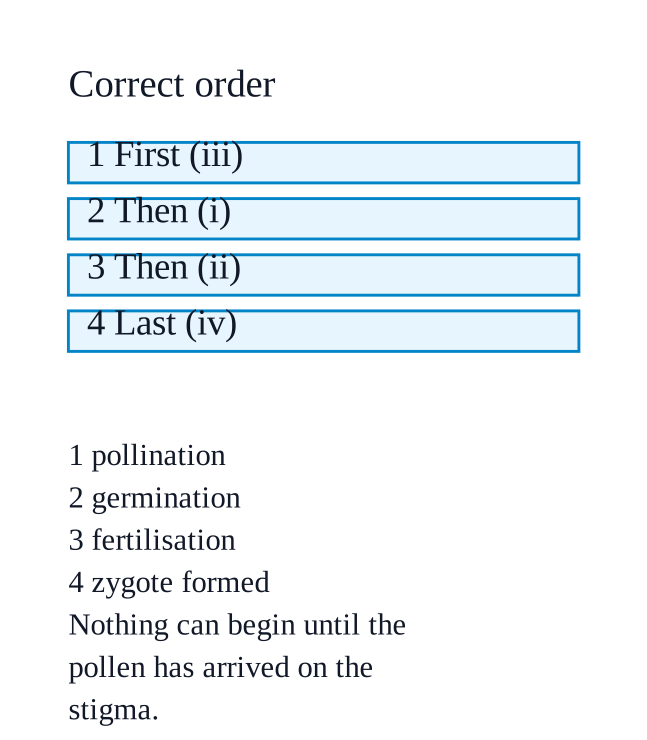
    Correct sequence is (iii), (i), (ii), (iv)
    Correct order: (iii) → (i) → (ii) → (iv).
    NCERT_Solution_Class9_Science_Ch11_RRR_Q11-2
    (iii) Pollination — pollen grains are first transferred from the anther to the stigma; nothing else can begin until the pollen has arrived.
    (i) Pollen germination on stigma — on a compatible stigma the pollen grain germinates and puts out a pollen tube, which grows down through the style into the ovary.
    (ii) Fertilisation — the male gamete travels down that tube to the ovule and fuses with the egg cell.
    (iv) Formation of zygote — the fertilised egg produced by that fusion is the zygote, which later develops into the embryo while the ovule becomes the seed and the ovary the fruit.
  3. Exercise 11.3

    Assertion (A): The zygote formed after fertilisation immediately attaches to the uterus wall. Reason (R): The uterus wall is always prepared to receive the zygote. (i) Both A and R are true, and R is the correct explanation of A. (ii) Both A and R are true, but R is not the correct explanation of A. (iii) A is true, but R is false. (iv) A is false, but R is true.

    Not cross-checked

    NCERT prints no numerical answer for this exercise, so this working has not been cross-checked against the book.

    NCERT’s answer
    (iv)
    (iv) A is false, but R is true.
    NCERT_Solution_Class9_Science_Ch11_RRR_Q11-3
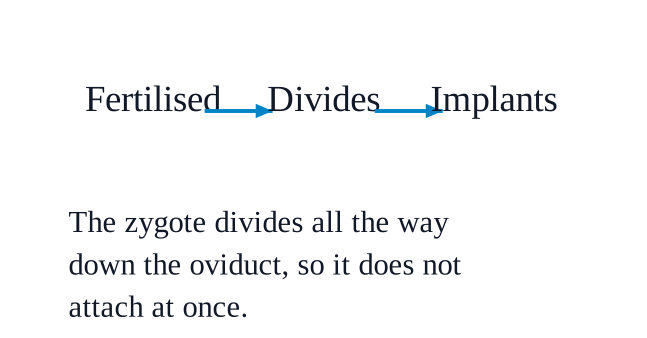
    A is false. The zygote does not attach immediately. It undergoes a series of mitotic divisions while it travels down the oviduct to the uterus, and only then implants into the inner lining — and it is that implantation, not fertilisation, that marks the beginning of pregnancy.
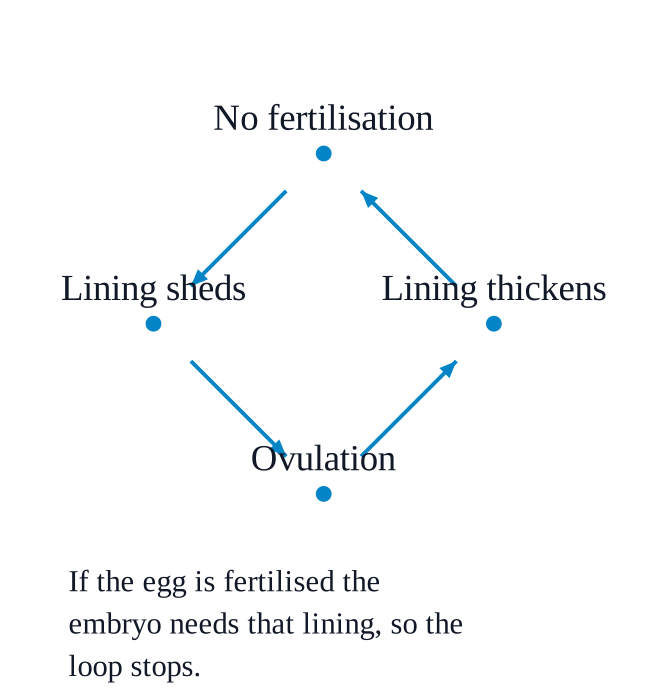
    R is true in the sense meant: the uterus prepares itself in advance, not in response to a zygote. Before ovulation the inner lining becomes thick, and after ovulation it becomes thicker and richer in blood vessels — ready to receive and nourish a zygote should one arrive.
    Once A is judged false, options (i), (ii) and (iii) are all eliminated, because each of them requires A to be true. Only (iv) remains.
  4. Exercise 11.4

    Why does asexual reproduction produce offsprings that are genetically identical to the parent?

    Not cross-checked

    NCERT prints no numerical answer for this exercise, so this working has not been cross-checked against the book.

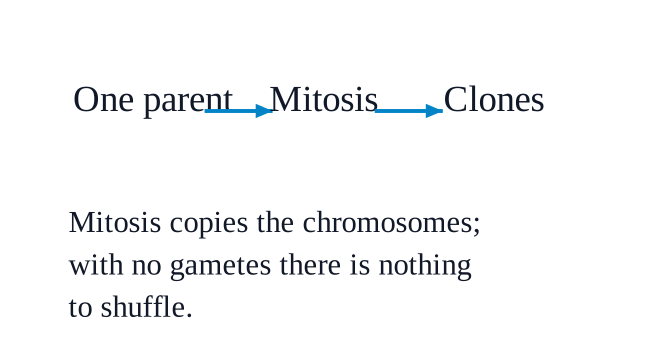
    Because asexual reproduction involves only one parent, and the cells divide by mitosis.
    NCERT_Solution_Class9_Science_Ch11_RRR_Q11-4
    Mitosis produces two daughter cells, each having the same number of chromosomes, identical to the parent cell — the genetic information is copied, not mixed.
    There is no meiosis and no formation of gametes, so no second set of chromosomes is brought in from another individual and no random recombination of characters takes place.
    The offspring are therefore exact genetic copies of the parent and are called clones — as in budding in yeast and hydra, spore formation in moulds, and vegetative propagation in potato, ginger, sugarcane and Bryophyllum.
    This is also why the method is fast and lets an organism build up its population quickly when conditions are favourable.
  5. Exercise 11.5

    Explain why the menstrual cycle stops during pregnancy.

    Not cross-checked

    NCERT prints no numerical answer for this exercise, so this working has not been cross-checked against the book.

    Because during pregnancy the thick uterine lining is needed by the embryo, so it is not shed — and menstruation is the shedding of that lining.
    NCERT_Solution_Class9_Science_Ch11_RRR_Q11-5
    The lining becomes thick and rich in blood vessels in every cycle in order to receive and nourish a developing zygote.
    When the egg is not fertilised, it degenerates within about a day, the lining is no longer needed, and it breaks down and leaves the body with some blood as menstruation.
    When fertilisation does happen, the zygote implants into that very lining and draws its nourishment from it. Shedding the lining would mean losing the embryo.
    So the cycle of ovulation → thickening of the lining → shedding is interrupted, and menstruation resumes only after the pregnancy is over.
  6. Exercise 11.6

    Why are flowers that bloom at night white or light in colour as compared to flowers that bloom during the day?

    Not cross-checked

    NCERT prints no numerical answer for this exercise, so this working has not been cross-checked against the book.

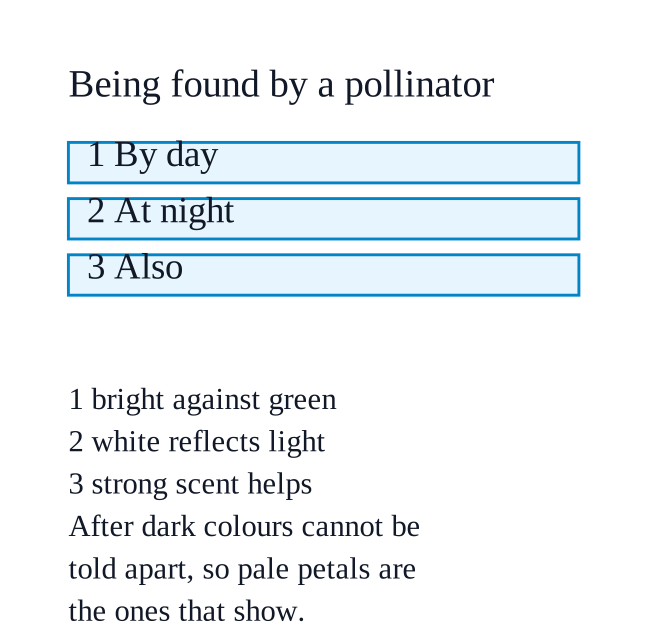
    Because a white or light-coloured flower remains visible in the dark, so the pollinators that are active at night can still find it.
    NCERT_Solution_Class9_Science_Ch11_RRR_Q11-6
    A flower's colour is its advertisement to pollinators: the chapter notes that insect-pollinated flowers are often brightly coloured, produce nectar and give off fragrance to attract them.
    In daylight, strong colours like red, yellow and orange stand out against green leaves, so day-blooming flowers use them.
    After dark there is very little light and colours cannot be told apart; pale and white petals reflect the little light there is and show up against dark foliage, while a red or deep-coloured flower would simply disappear.
    Night-blooming flowers usually back this up with a strong fragrance, which works in complete darkness where sight fails.
    Being found means more visits, more pollen carried from anther to stigma, and so more fruits and seeds — reproductive success.
  7. Exercise 11.7

    Why do vegetatively propagated plants tend to be more vulnerable to diseases than sexually reproduced plants?

    Not cross-checked

    NCERT prints no numerical answer for this exercise, so this working has not been cross-checked against the book.

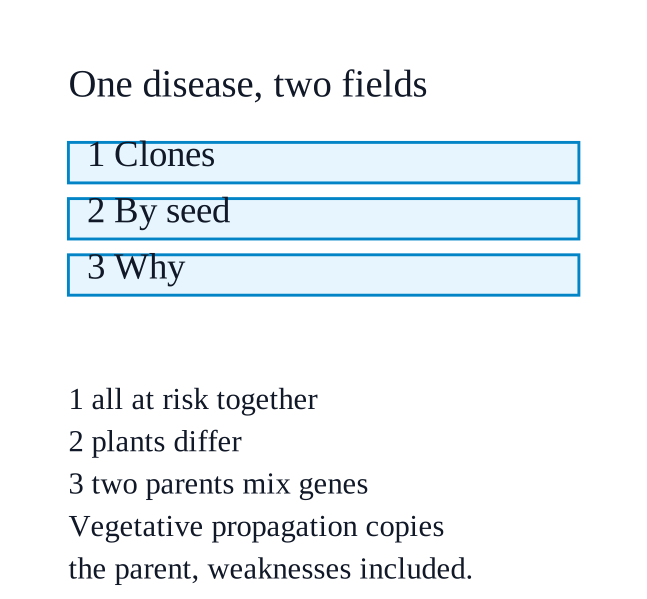
    Because vegetatively propagated plants are clones — genetically identical, so a disease able to attack one plant can attack every plant in the field.
    NCERT_Solution_Class9_Science_Ch11_RRR_Q11-7
    Vegetative propagation uses a single parent and mitosis, so there is no variation among the new plants; not one of them carries a different combination of characters that might resist the pathogen.
    Sexually reproduced plants come from the fusion of gametes formed by meiosis, so the chromosomes of two parents are shuffled into new combinations and the seedlings differ from one another.
    In such a mixed population, some individuals happen to be resistant and survive an outbreak, and the crop is not wiped out together.
    The chapter states the general principle: variation helps some individuals adapt better to changing environments, and is important for the survival of a species.
    This is also why tissue-cultured banana plantlets are deliberately raised from healthy shoot tips — an identical crop has to be started virus-free, because it has no built-in variation to fall back on.
  8. Exercise 11.8

    If all flowers in a type of plant were only capable of self-pollination, how would it affect the genetic diversity over several generations? Explain.

    Not cross-checked

    NCERT prints no numerical answer for this exercise, so this working has not been cross-checked against the book.

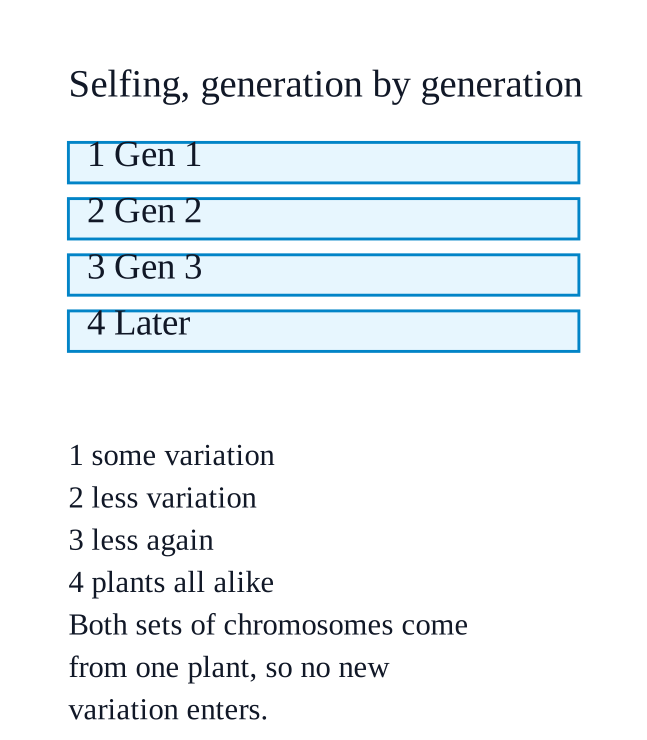
    Genetic diversity would fall steadily generation after generation, and the plants would become more and more alike.
    NCERT_Solution_Class9_Science_Ch11_RRR_Q11-8
    In self-pollination the pollen reaches the stigma of the same flower or another flower of the same plant, so both sets of chromosomes come from a single parent — no new genetic material ever enters the line.
    The only source of variation left is the reshuffling of that one plant's own chromosomes during meiosis. The same limited set of characters is recombined over and over, so genuinely new combinations soon stop appearing.
    Compare this with cross-pollination, where chromosomes from two different plants combine and every seed receives a unique mix — the mechanism the chapter shows with the three bead pairs, where just three pairs already give eight combinations.
    With little variation left, hardly any individual carries a character useful in a changed situation, so a new disease, pest, drought or temperature change could damage the entire population at once.
    Since variation is what lets some individuals adapt and what drives evolution over time, a strictly self-pollinating species would be much less able to survive a changing environment.
  9. Exercise 11.9

    A farmer wants to produce a large number of genetically identical plants quickly. Suggest suitable reproduction methods and explain why they are effective.

    Not cross-checked

    NCERT prints no numerical answer for this exercise, so this working has not been cross-checked against the book.

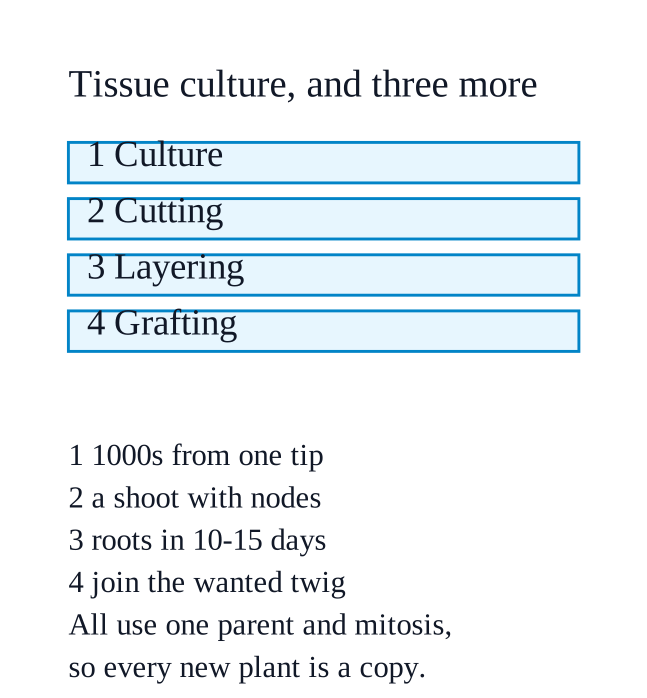
    Use asexual reproduction — vegetative propagation, and for large numbers in a short time, tissue culture above all; cutting, layering and grafting serve for smaller batches.
    NCERT_Solution_Class9_Science_Ch11_RRR_Q11-9
    Tissue culture — healthy plantlets are mass-produced from the shoot tip (apical meristem) of a chosen plant. Thousands of identical plants come from one parent quickly, and virus-infected plants are eliminated in the process, which is how banana farming was transformed.
    Cutting — a shoot piece bearing nodes is planted about half its length into compost-mixed soil at \(\displaystyle 45\)–\(\displaystyle 60^\circ\) and grows into a whole new plant (sugarcane, money plant).
    Layering — the middle of a flexible twig is buried in soil; roots develop from the buried part in about \(\displaystyle 10\)–\(\displaystyle 15\) days, and the rooted twig is then cut away as a new plant (lemon).
    Grafting — a stem piece of the desired variety (Plant B) is fitted into a slit on a healthy rooted plant (Plant A) and protected until it heals, so the desired variety is multiplied on a strong root system (rose).
    Why these work: each uses one parent and mitosis only, so every new plant is a clone carrying exactly the desirable characters the farmer selected — no mixing, no surprises.
    They are also fast, because they skip flowering, pollination, fertilisation, seed formation and germination altogether, and each new plant starts from an already-grown piece of the parent.
  10. Exercise 11.10

    Suresh prepares slides with pollen grains in different sugar concentrations (0\displaystyle 0%, 2.5\displaystyle 2.5%, 5\displaystyle 5%, 7.5\displaystyle 7.5%, 10\displaystyle 10%) to study the germination of pollen. (i) What are the different hypotheses which can be tested using this set-up? (ii) What parameters should be kept the same in this set-up?

    Not cross-checked

    NCERT prints no numerical answer for this exercise, so this working has not been cross-checked against the book.

    (i) Hypotheses that this set-up can testNCERT_Solution_Class9_Science_Ch11_RRR_Q11-10
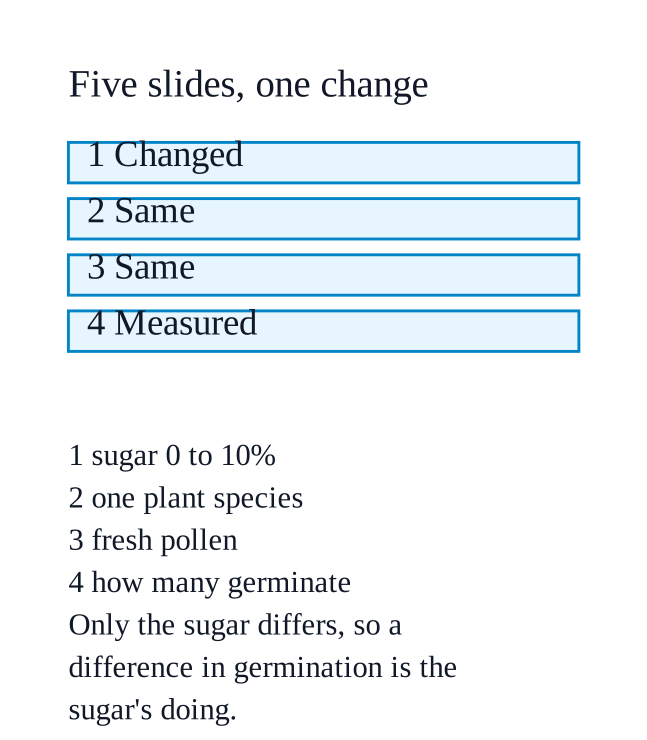
    Pollen grains need sugar in the surrounding medium to germinate — they will not germinate in \(\displaystyle 0\%\) sugar, i.e. in plain water.
    The percentage of pollen grains that germinate depends on the sugar concentration of the medium.
    There is an optimum sugar concentration at which germination is highest, with poorer germination both below it and above it.
    The length of the pollen tube grown in a fixed time increases with sugar concentration up to that optimum.
    (Any one of these is testable here, because the set-up changes only the sugar concentration and measures what the pollen does.)
    (ii) Parameters that must be kept the same on every slide
    The same plant species, and pollen collected fresh from flowers of the same age — old pollen from a different plant would germinate differently for reasons that have nothing to do with sugar.
    Roughly the same number of pollen grains per slide, in the same size of drop.
    All five solutions made from the same water, prepared freshly and in the same way, so that only the sugar concentration differs.
    The same temperature, light and humidity — all slides kept together in one place.
    The same length of time before observation, since a pollen tube keeps growing.
    The same microscope and magnification, the same clean slides and coverslips, and the same rule for deciding when a grain counts as "germinated".
    Sugar concentration is the only thing allowed to change — that is what makes the comparison fair.
  11. Exercise 11.11

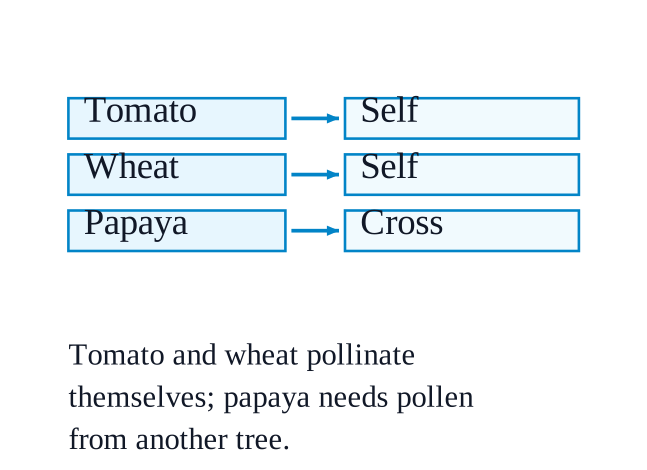
    Look at the picture given below and think in line with the given prompts and find out which type(s) of pollination might have been followed in these flowers — Stamens cover the stigma.

    Not cross-checked

    NCERT prints no numerical answer for this exercise, so this working has not been cross-checked against the book.

    NCERT’s answer
    Tomato—self pollination; wheat—self pollination; papaya—cross pollination
    Tomato — self-pollination. The stamens cover the stigma, so pollen shed by the anthers falls straight onto the stigma of the same flower; the stigma is shielded and pollen from outside can barely reach it.
    NCERT_Solution_Class9_Science_Ch11_RRR_Q11-11
    Wheat — self-pollination. The flower opens only after pollination is over, so the pollen that reached the stigma must have come from the anthers of that same still-closed flower.
    Papaya — cross-pollination. Male and female flowers are often borne on different trees, so pollen has to be carried from a flower on a male tree to the stigma of a flower on a different tree — transfer between two plants, which is cross-pollination by definition.
    Note on wheat: the chapter also lists it among the wind-pollinated cereals, so wind can carry its light pollen to other plants as well. The clue given in this picture — flowers opening after pollination — tells us that in wheat the transfer normally happens inside the unopened flower, so the usual outcome is self-pollination.
  12. Exercise 11.12

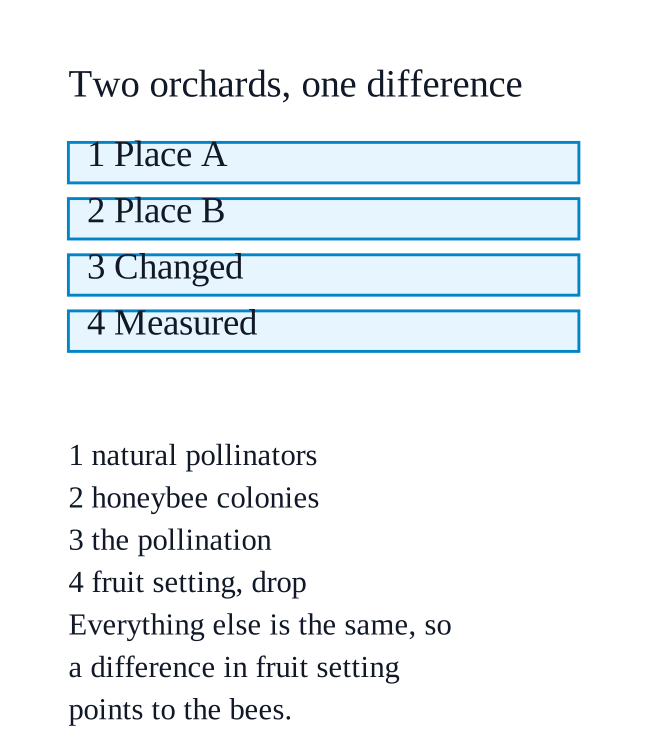
    In the lower Himalayan region of northern India, apples are an important cash crop that contribute significantly to farmer’s livelihoods. The fruit yield in apple cultivation is declining continuously, associated with climate change and a significant decline in the population of natural pollinators. A researcher-farmer group set up two experimental apple orchards at two distinct locations: Places A and B. In apple orchards at Place A, they allowed natural pollinators (iv) Based on your analysis, what do you infer from the data?

    Not cross-checked

    NCERT prints no numerical answer for this exercise, so this working has not been cross-checked against the book.

    (i) Hypotheses behind the investigationNCERT_Solution_Class9_Science_Ch11_RRR_Q11-12
    The falling apple yield is caused by the decline in pollinator numbers, not by the trees themselves.
    Adding managed honeybee colonies (beekeeping) to an orchard increases pollination and so raises fruit setting.
    Better pollination lowers fruit drop, because a well-pollinated flower whose ovules are fertilised develops into a fruit that stays on the branch instead of falling prematurely.
    Mixed farming of apples with beekeeping gives the farmer a higher total return — apples and honey — than depending on natural pollinators alone.
    (ii) Parameters in the experiment
    Independent variable (what the group changed): the pollination treatment — natural pollinators only at Place A, versus honeybee colonies added at Place B.
    Dependent variables (what they measured): per cent fruit setting, defined here as number of fruits ÷ total number of corresponding fruit-bearing branches, and per cent fruit drop.
    Parameters that should be held the same at both places: apple variety, age, number and spacing of trees, soil, irrigation, manure and spray schedule, pruning, and the same season and dates of recording.
    Weakness of the design to note: Places A and B are two distinct locations, so altitude, weather and soil may also differ. Any difference in yield cannot then be attributed to bees alone with full confidence.
    (iii) Comparing the two orchards
    Read both bars for each place off Fig. $\displaystyle 11.24$ — one for fruit setting, one for fruit drop.
    The comparison the design is built to show is Place B (with beekeeping) having the higher per cent fruit setting and the lower per cent fruit drop, and Place A — left to the declining natural pollinators — the lower fruit setting and the higher fruit drop.
    The mechanism: more pollinators → more pollen grains carried to stigmas → more ovules fertilised → more flowers turning into fruits, and fewer young fruits shed before they mature.
    (iv) Inference
    Apple yield in this region is limited by pollination, not by the trees' capacity to bear fruit.
    Introducing honeybees repairs that limitation, so beekeeping alongside the orchard is a practical answer to the decline of natural pollinators — and it yields honey as a second product.
    More broadly, a fruit crop is only as productive as its pollinators, so protecting pollinator populations directly protects the farmer's livelihood.
  13. Exercise 11.13

    A student claims, “In humans, ovulation always happens on day 14\displaystyle 14 of the menstrual cycle”. Critically examine this claim and state whether the claim is correct or not. Give at least two reasons for your answer.

    Not cross-checked

    NCERT prints no numerical answer for this exercise, so this working has not been cross-checked against the book.

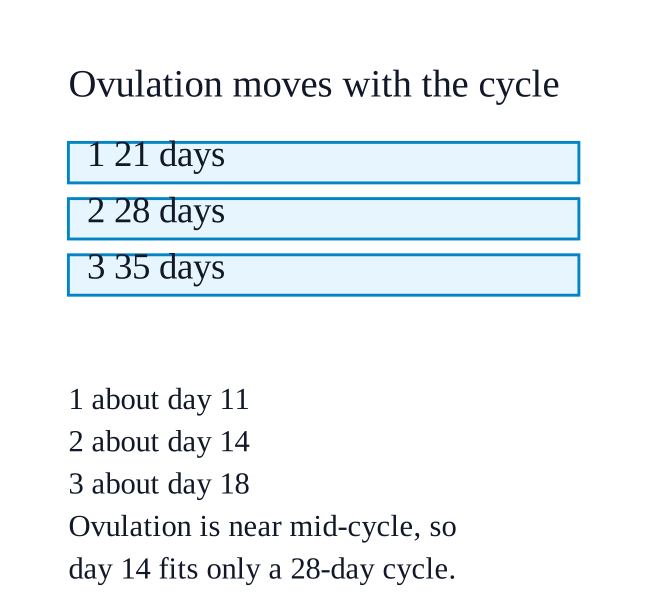
    The claim is not correct. Ovulation happens around day $\displaystyle 14$, and only in a cycle that happens to be about $\displaystyle 28$ days long — "always on day $\displaystyle 14$" is wrong.
    NCERT_Solution_Class9_Science_Ch11_RRR_Q11-13
    Reason $\displaystyle 1$ — cycle length varies. The chapter gives the cycle of ovulation, uterine preparation and menstruation as repeating typically every \(\displaystyle 21\)–\(\displaystyle 35\) days, often around \(\displaystyle 28\). Day \(\displaystyle 14\) is roughly the mid-point of a \(\displaystyle 28\)-day cycle; in a \(\displaystyle 21\)-day or \(\displaystyle 35\)-day cycle the mid-point, and so the day of ovulation, falls elsewhere.
    Reason $\displaystyle 2$ — the book's own wording is approximate. It says ovulation takes place around the 14th day, and describes the stages as ranges: Day $\displaystyle 1$–$\displaystyle 5$ menstruation, Day $\displaystyle 6$–$\displaystyle 14$ the lining gradually rebuilding while the egg matures, Day $\displaystyle 15$–$\displaystyle 28$ the lining thickening further. This is a description of a typical cycle, not a fixed calendar date.
    Reason $\displaystyle 3$ — it varies from person to person and month to month. The same person's cycle need not be the same length every time, and it is especially irregular in the years just after puberty (ages \(\displaystyle 10\)–\(\displaystyle 14\)) and in the years approaching menopause (around age \(\displaystyle 50\)).
    Corrected statement: "In a typical \(\displaystyle 28\)-day menstrual cycle, ovulation usually happens around day \(\displaystyle 14\)."