SolveItClass 9 · NCERT

NCERT Solutions · Class 9 Science Reproduction: How Life Continues

24 questions · 22 still being checked

Pause and Ponder 11.1–11.11 (part 1 of 2)

  1. Exercise 11.1

    In a china-rose (hibiscus or gudhal) plant, a pollen tube grows and continues through the style after pollen lands on the stigma. Which process is about to happen next?

    Not cross-checked

    NCERT prints no numerical answer for this exercise, so this working has not been cross-checked against the book.

    Fertilisation is the process about to happen.
    NCERT_Solution_Class9_Science_Ch11_PP_Q11-1
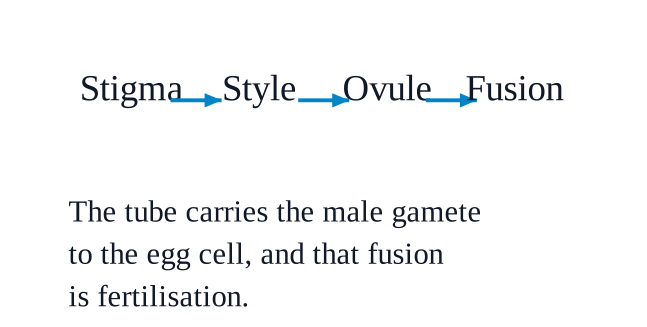
    The pollen tube grows down through the style and carries the male gamete into the ovary, where it reaches an ovule.
    Inside the ovule the male gamete fuses with the egg cell — that fusion of gametes is fertilisation.
    The immediate product is a zygote, which then develops into an embryo; the ovule becomes the seed and the ovary around it enlarges into the fruit.
  2. Exercise 11.2

    Look at the pictures (Fig. 11.16\displaystyle 11.16) of calotropis (madar) seeds and dandelion seeds given below. Can you guess what kind of seed dispersal these seeds are adapted for?NCERT_Question_Class9_Science_Ch11_PP_Q11-2

    Not cross-checked

    NCERT prints no numerical answer for this exercise, so this working has not been cross-checked against the book.

    Both are adapted for seed dispersal by wind.
    Madar (calotropis) seeds carry a tuft of long silky hairs, and dandelion seeds carry a parachute of fine hairs at the top.
    These hairs make the seed very light for its surface area, so even a light breeze lifts it and floats it far from the parent plant.
    The chapter lists wind, water and animals as the agents of seed dispersal; a small, dry, plumed seed with no fleshy pulp and no hooks points to wind, not to water or animals.
    Being carried away matters: the new seedling then germinates where it is not competing with its parent for water, light and nutrients.
  3. Exercise 11.3

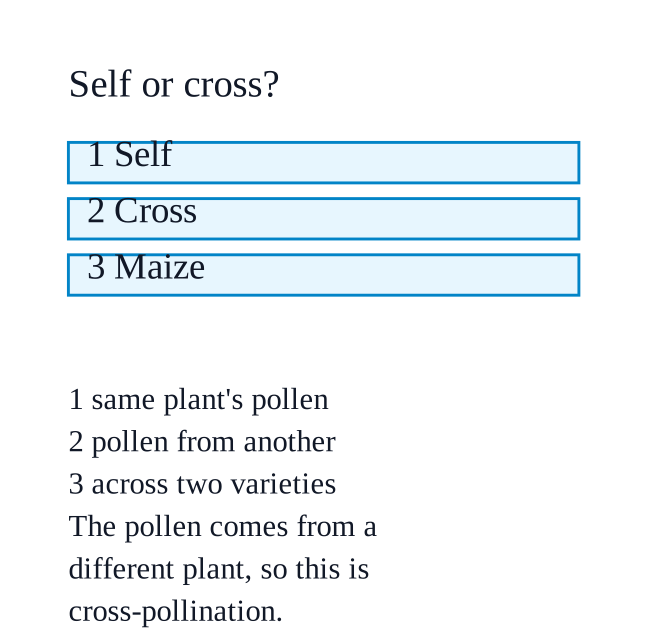
    A farmer plants two varieties of maize side by side, but notices that seeds form only when pollen from one variety reaches the stigma of the other. What type of pollination is this? Bridging Science and Society Sexual reproduction in plants has an applied importance in plant breeding. There are several methods of plant breeding, such as selective breeding, artificial hybridisation, genetically engineered crops, and more. In selective breeding, farmers select plants of desirable characters for reproduction. Process of artificial hybridisation involves removal of the stamens from the flowers, covering it with a bagging to prevent self-pollination, and manual transfer of the pollens with desired characters. Genetic engineering is also applied by inserting the genetic material of desired characters into the DNA of the selected varieties. This leads to the development of new varieties, such as high yielding varieties, disease resistant varieties, and so on. This has revolutionised crop production in agriculture.

    Not cross-checked

    NCERT prints no numerical answer for this exercise, so this working has not been cross-checked against the book.

    This is cross-pollination.
    NCERT_Solution_Class9_Science_Ch11_PP_Q11-3
    The pollen is going from the anther of a flower on one plant to the stigma of a flower on another plant of the same type — the chapter's exact definition of cross-pollination.
    Had the pollen reached the stigma of the same flower, or another flower on the same plant, it would have been self-pollination.
    The farmer's observation — seeds forming only when one variety's pollen reaches the other variety's stigma — shows these two maize varieties depend on pollen from a different plant to set seed.
  4. Exercise 11.4

    Why do animals with external fertilisation generally produce more eggs than animals with internal fertilisation?

    Not cross-checked

    NCERT prints no numerical answer for this exercise, so this working has not been cross-checked against the book.

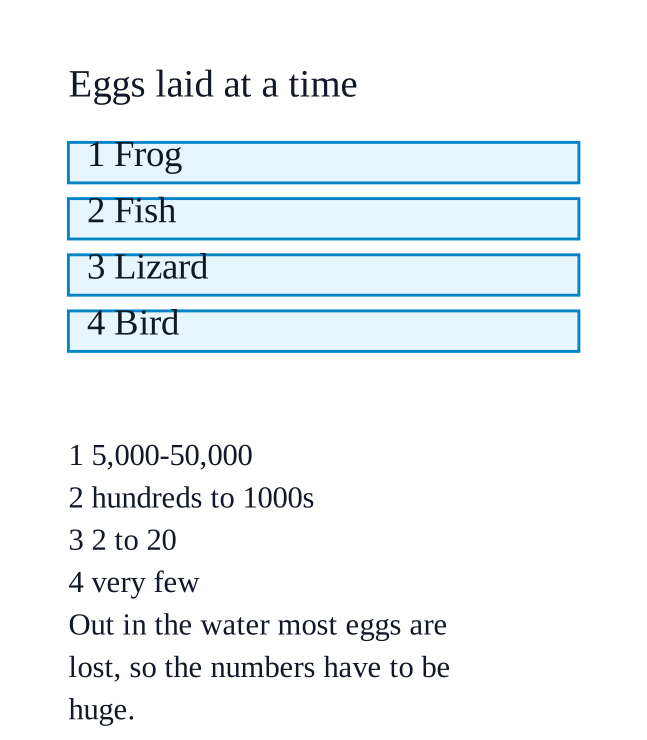
    Because in external fertilisation the gametes are released into open water, so only a tiny fraction of the eggs ever becomes a young one — laying huge numbers is what makes up for the losses.
    NCERT_Solution_Class9_Science_Ch11_PP_Q11-4
    The female sheds her eggs into the water and the male sheds sperm over them; whether a sperm actually meets an egg is left to chance in a moving medium.
    Even the eggs that are fertilised are destroyed by water currents or eaten by other animals, so Table $\displaystyle 11.4$ lists the estimated survival of young in fish and frog as low.
    Numbers compensate: a frog releases \(\displaystyle 5{,}000\)–\(\displaystyle 50{,}000\) eggs at a time and fish hundreds to thousands, so a few survivors are almost certain.
    In internal fertilisation the sperm meets the egg inside the female's body and the fertilised egg or embryo is protected there, so survival is moderate to high — a lizard needs only \(\displaystyle 2\)–\(\displaystyle 20\) eggs and a bird only \(\displaystyle 1\)–\(\displaystyle 15\).
  5. Exercise 11.5

    In animals, which fertilisation method the gametes are more protected? Animal Fish Frog Lizard Bird egg emergence 218\displaystyle 218 Exploration|Grade 9\displaystyle 9

    Not cross-checked

    NCERT prints no numerical answer for this exercise, so this working has not been cross-checked against the book.

    NCERT’s answer
    Internal Fertilisation
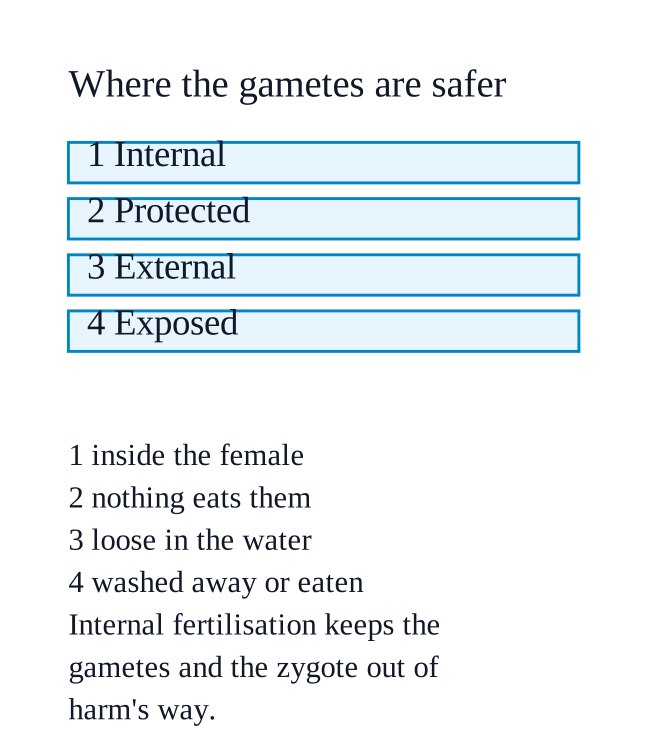
    The gametes are better protected in internal fertilisation.
    NCERT_Solution_Class9_Science_Ch11_PP_Q11-5
    Fertilisation takes place inside the body of the female, so the gametes and the zygote are never exposed to water currents or to animals that eat them.
    In external fertilisation the eggs and sperm are simply released into the water, where many are washed away or eaten.
    This is why reptiles, birds and mammals (internal) show moderate to high survival of young from very few eggs, while fish and frogs (external) show low survival from thousands.
  6. Exercise 11.6

    Ravi suddenly notices that he is growing taller rapidly, his shoulders are broadening, and his voice cracks. What stage of life is he entering?

    Not cross-checked

    NCERT prints no numerical answer for this exercise, so this working has not been cross-checked against the book.

    NCERT’s answer
    Adolescence
    Ravi is entering adolescence — the stage at which puberty brings about sexual maturation.
    A rapid gain in height, broadening shoulders and a cracking voice are the physical changes of this stage in boys.
    They are brought about by the hormone produced by the testes, which also starts and controls the production of sperm.
    Sexual maturity — the body becoming capable of reproduction — comes gradually at this stage, but emotional maturity takes longer to develop.
  7. Exercise 11.7

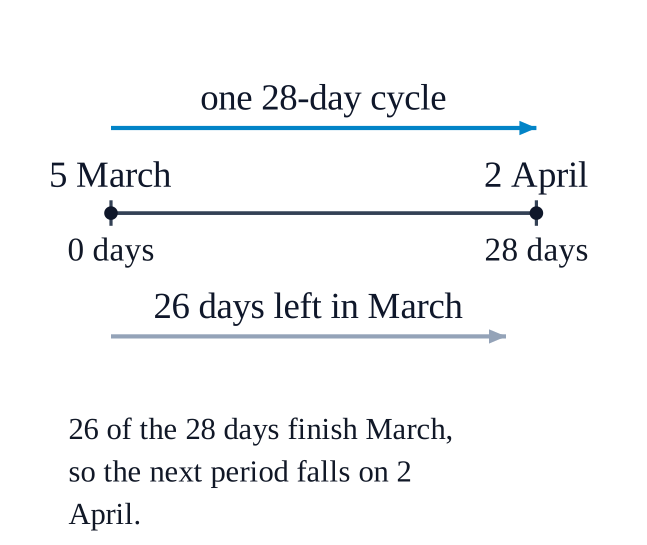
    Rina’s period occurs every 28\displaystyle 28 days. Her last period was on the 5th of March. On which day is she most likely to get her next period?
    NCERT’s answer
    2nd April
    Her next period is most likely on 2nd April.
    NCERT_Solution_Class9_Science_Ch11_PP_Q11-7
    Her cycle length is \(\displaystyle 28\) days and the last period began on $\displaystyle 5$ March, so the next one begins \(\displaystyle 28\) days later: \(\displaystyle 5 + 28 = 33\).
    March has \(\displaystyle 31\) days, so day \(\displaystyle 33\) of March is \(\displaystyle 33 - 31 = 2\) → $\displaystyle 2$ April.
    This is an expected date, not a fixed one: the chapter gives the cycle as repeating typically every \(\displaystyle 21\)–\(\displaystyle 35\) days, so it can shift by a few days.
  8. Exercise 11.8

    A human zygote has just formed. How many chromosomes does it have? 11.5.8\displaystyle 11.5.8 Mother’s health during pregnancy A woman’s health during pregnancy plays a vital role in the baby’s growth and safety. She should eat a balanced diet rich in proteins, vitamins and minerals, attend regular medical check-ups, and follow her doctor’s advice regarding light exercise and rest. Her emotional well-being is also important, and support from family members helps her remain healthy and stress-free. Exploration|Grade 9\displaystyle 9
    NCERT’s answer
    $\displaystyle 46$ Chromosomes
    $\displaystyle 46$ chromosomes — that is \(\displaystyle 23\) pairs.
    NCERT_Solution_Class9_Science_Ch11_PP_Q11-8
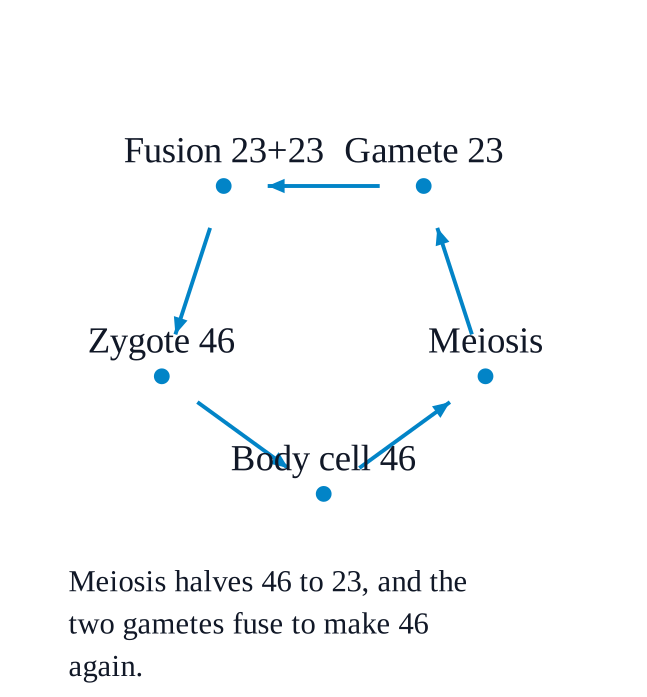
    A human body cell has \(\displaystyle 46\) chromosomes, but gametes are made by meiosis, which halves the number, so each sperm and each egg carries only \(\displaystyle 23\).
    At fertilisation the two haploid gametes fuse: \(\displaystyle 23 + 23 = 46\).
    This is exactly why meiosis is needed — it keeps the chromosome number of the species constant instead of doubling it every generation.
  9. Exercise 11.9

    What protective devices can be used during sexual activity to reduce the spread of STIs?

    Not cross-checked

    NCERT prints no numerical answer for this exercise, so this working has not been cross-checked against the book.

    Condoms are the protective device used to reduce the spread of STIs.
    They act as a barrier, so the infection is not passed from an infected person to an uninfected one during close physical contact.
    The same barrier also stops sperm from reaching the egg, so a condom prevents pregnancy as well.
    This matters because the STIs named in the chapter — gonorrhoea, herpes, syphilis, genital warts and HIV (which can eventually lead to AIDS) — include some that are not curable yet, so prevention is the only reliable protection.
  10. Exercise 11.10

    If a couple uses oral contraceptive pills but not condoms, which risks remain and why?

    Not cross-checked

    NCERT prints no numerical answer for this exercise, so this working has not been cross-checked against the book.

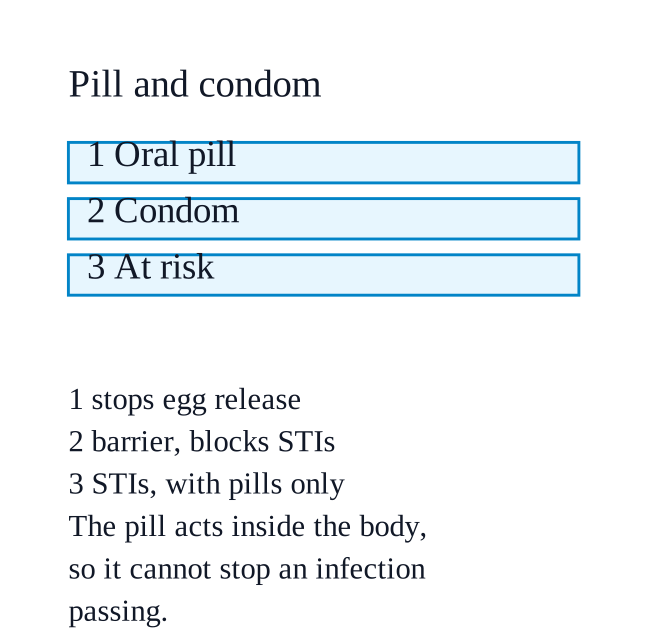
    The risk of Sexually Transmitted Infections stays exactly as it was — oral pills give no protection against them at all.
    NCERT_Solution_Class9_Science_Ch11_PP_Q11-10
    An oral contraceptive works by altering hormones so that the release of the egg is changed; it acts inside the woman's body and puts no barrier between the two partners.
    STIs spread through the close physical contact itself, so gonorrhoea, herpes, syphilis, genital warts and HIV can still pass from an infected person to an uninfected one.
    Only a condom does both jobs — it blocks that transfer and also helps prevent pregnancy.
    A second, smaller point: the chapter notes that pills may have some side effects, so relying on them alone carries that cost too.
  11. Exercise 11.11

    In many animals, the young ones can walk or find food soon after birth but human babies are completely dependent on adults for a long time. What might be some advantages and disadvantages of this for humans as a species? 224\displaystyle 224 Exploration|Grade 9\displaystyle 9

    Not cross-checked

    NCERT prints no numerical answer for this exercise, so this working has not been cross-checked against the book.

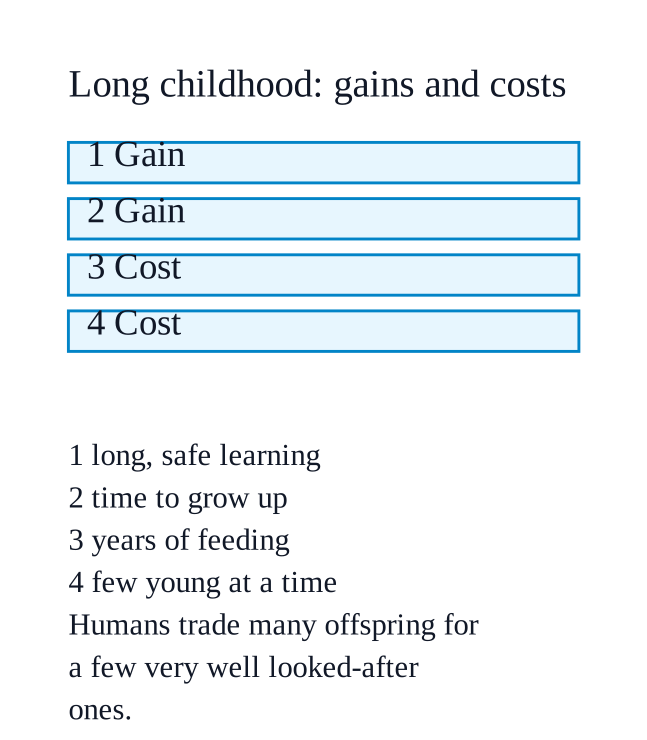
    Advantage — a long dependent childhood is a long period of protected learning: the chapter notes that mammals feed their young on breast milk after birth and that newborns must be kept warm, vaccinated on time and handled gently, and this constant care keeps survival high.
    NCERT_Solution_Class9_Science_Ch11_PP_Q11-11
    Advantage — it gives time for emotional and social maturity, which the chapter says develops much more slowly than sexual maturity; skills like handling feelings, communicating and making thoughtful decisions are learnt from adults over years.
    Advantage — because so much is invested in each child, most children survive, so humans do not need to produce young in huge numbers the way externally fertilising animals do.
    Disadvantage — the cost to the parents is heavy: food, time, shelter and protection for years, so a human family can raise only a few young at a time.
    Disadvantage — a baby that cannot walk or feed itself cannot escape danger or find food on its own, so it is entirely at risk if the adults caring for it are lost.
    Disadvantage — the population therefore grows slowly compared with species whose young are independent at birth.