SolveItClass 9 · NCERT

NCERT Solutions · Class 9 Science Patterns in Life: Diversity and Classification

25 questions · 25 still being checked

Pause and Ponder 12.4–12.5 (part 7 of 14)

  1. Exercise 12.4

    Cell structure — whether the organism is unicellular or multicellular, the cell is eukaryote or prokaryote, presence or absence of cell wall.

    Not cross-checked

    NCERT prints no numerical answer for this exercise, so this working has not been cross-checked against the book.

    This item's stored line is a stray fragment of the §$\displaystyle 12.3.1$ criteria list. The chapter's Pause and Ponder $\displaystyle 4$ (page $\displaystyle 239$) asks: why do taller plants need specialised transport tissues?
    NCERT_Solution_Class9_Science_Ch12_PP_Q12-4
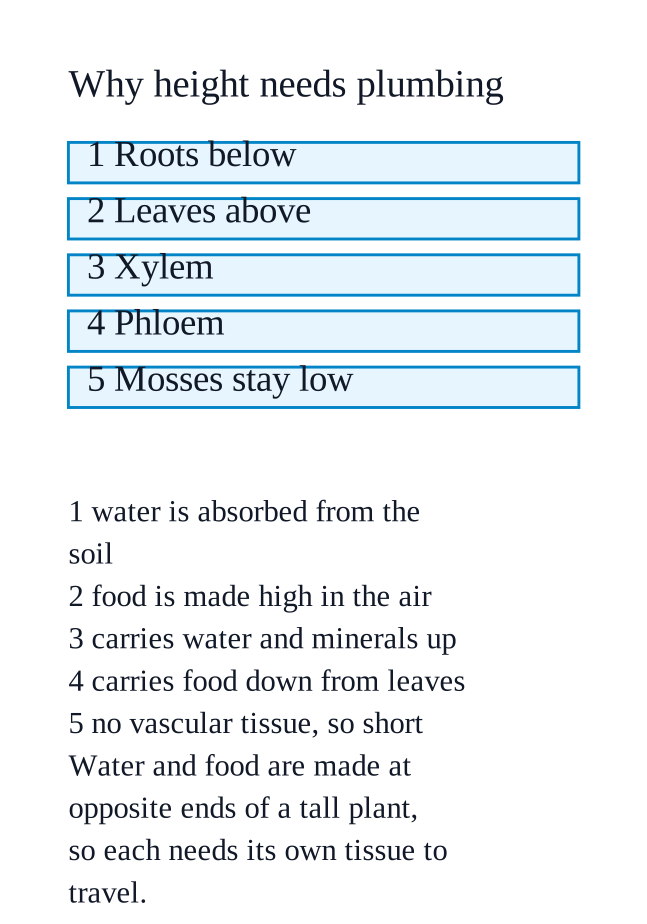
    Because in a tall plant the water and the food are made in different places, far apart. Water is absorbed by roots in the soil; food is made in leaves held high in the air. Something must carry each to the other end.
    Direct exchange with the surroundings only works over short distances. A thallus or a moss mat is thin and low, so water soaks in everywhere — that is why bryophytes lack vascular tissue and stay small, growing as green mats on damp ground.
    Xylem transports water and minerals upward from the roots; phloem transports food from the leaves to the rest of the plant. Pteridophytes were the first group to have both, and it is why ferns can stand well above the soil.
    The tissue also gives mechanical support — a stiff vascular core lets the stem hold a tall body up against gravity, which a moss cannot do.
    Chapter evidence: bryophytes lack vascular tissue and remain moisture-bound mats; pteridophytes have xylem and phloem and are listed as being able to transport food and water to all parts of the plant.
  2. Exercise 12.5

    Ecological role — producer, consumer, or decomposer.

    Not cross-checked

    NCERT prints no numerical answer for this exercise, so this working has not been cross-checked against the book.

    This item's stored line is a stray fragment of the §$\displaystyle 12.3.1$ criteria list. The chapter's Pause and Ponder $\displaystyle 5$ (page $\displaystyle 239$) asks: how do seeds and fruits affect where and how plants can survive?
    NCERT_Solution_Class9_Science_Ch12_PP_Q12-5
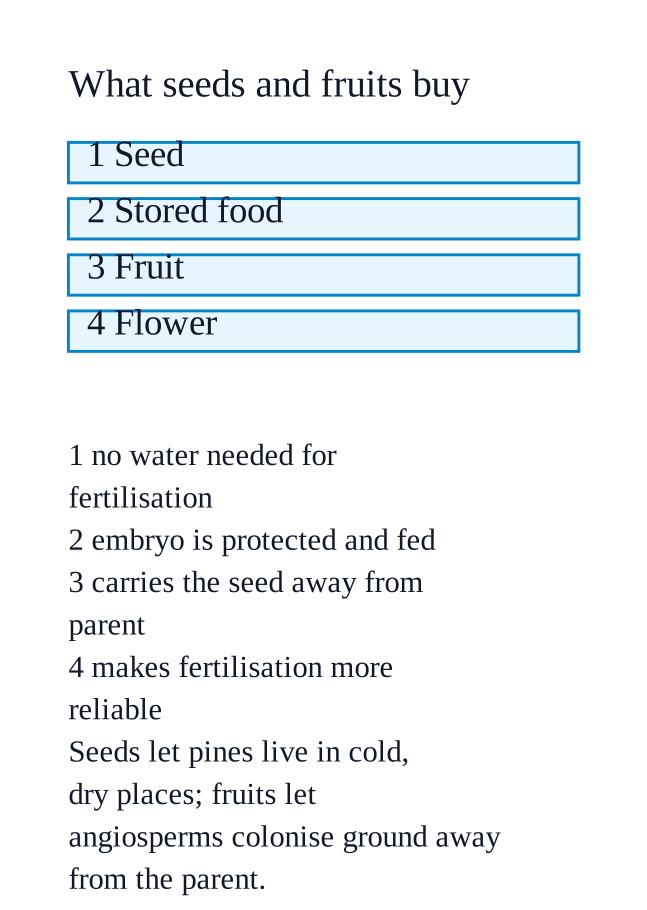
    Seeds cut the plant's last link to water. Gymnosperms do not need aquatic conditions for fertilisation, so pines and cycads can live in cold and dry regions where a fern or a moss could never reproduce.
    A seed protects and feeds the young plant. It shields the developing embryo and carries stored food, so the seedling can start growing when conditions become suitable rather than dying at once.
    Fruits move the seed away from the parent. In angiosperms the seed is enclosed in a fruit, and the fruit is dispersed by insects, birds, other animals, wind or water — the plant colonises new ground instead of crowding its own parent.
    Flowers make the fertilisation itself more reliable, because they attract pollinators rather than leaving pollen transfer to chance.
    Result: these features let angiosperms occupy a wide range of environments, which is why the chapter calls them the most diverse plant group on the Earth.
    The trade-off the chapter lists: gymnosperm seeds are naked on cones and unprotected, and angiosperm reproduction now depends on pollinating agents being present.