Exercise 6.9
A hand cart loaded with vegetables collides with an identical but empty hand cart. During the collision: (i) the loaded cart exerts a force of larger magnitude on the empty cart. (ii) the empty cart exerts a force of larger magnitude on the loaded cart. (iii) neither cart exerts a force on the other. (iv) the loaded cart and the empty cart, both exert an equal magnitude of force on each other.
Not cross-checked
NCERT prints no numerical answer for this exercise, so this working has not been cross-checked against the book.
NCERT’s answer
(iv)
Correct option: (iv) the loaded cart and the empty cart both exert an equal magnitude of force on each other.
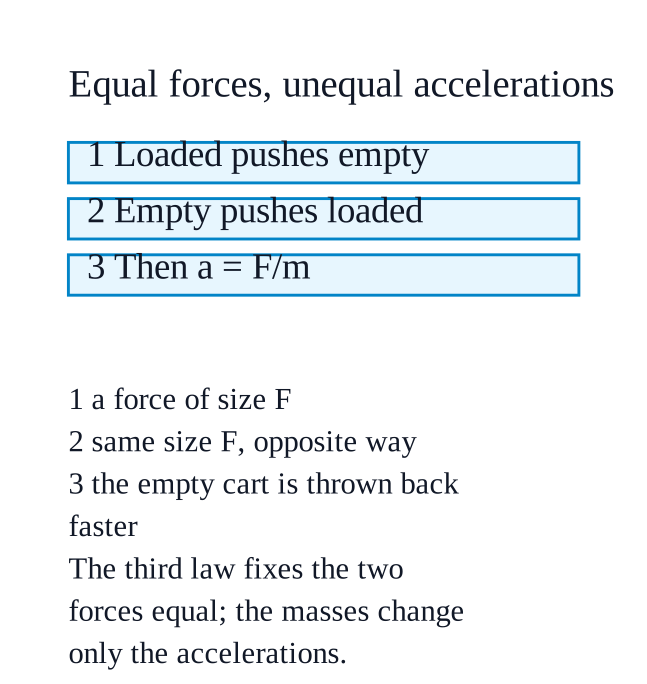
By Newton's third law, whenever one object exerts a force on a second object, the second exerts an equal and opposite force on the first.
This holds no matter how the masses differ — the loading of the cart does not change the size of either force.
What the masses do change is the acceleration: from \(\displaystyle a = \dfrac{F}{m} \), the lighter empty cart is thrown back much faster than the loaded one, even though the forces are equal (the same point as Example $\displaystyle 6.7$ and Example $\displaystyle 6.8$).