Exercise 6.5
When a net force acts on an object, we observe that the object accelerates: (i) opposite to the direction of force, with acceleration proportional to the force acting on the object. (ii) opposite to the direction of force, with acceleration proportional to the mass of the object. (iii) in the direction of force, with acceleration inversely proportional to the force acting on the object. (iv) in the direction of force, with acceleration proportional to the force acting on the object.
Not cross-checked
NCERT prints no numerical answer for this exercise, so this working has not been cross-checked against the book.
NCERT’s answer
(iv)
Correct option: (iv) in the direction of force, with acceleration proportional to the force acting on the object.
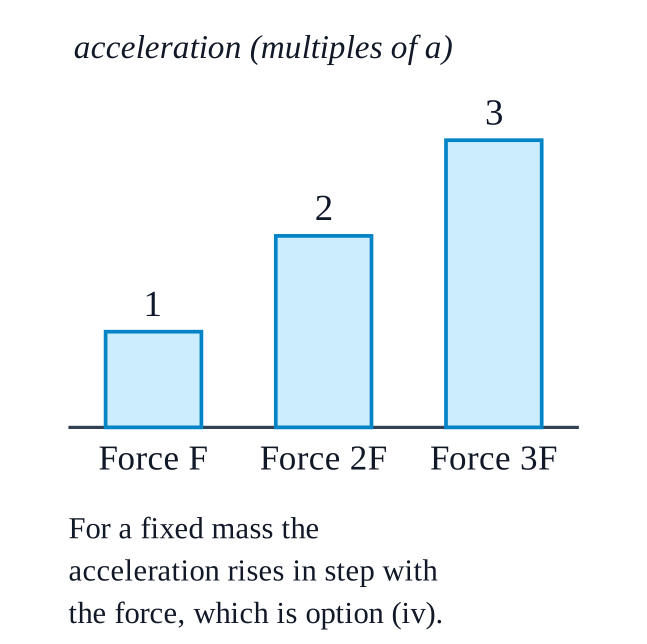
Newton's second law: the object accelerates in the direction of the net force, which rules out (i) and (ii).
The magnitude of the acceleration is proportional to the net force, \(\displaystyle a \propto F \), which rules out (iii)'s "inversely proportional to the force".
It is the mass that appears inversely, \(\displaystyle a = \dfrac{F}{m} \).
