SolveItClass 9 · NCERT

NCERT Solutions · Class 9 Science How Forces Affect Motion

26 questions · 19 still being checked

Revise, Reflect, Refine 6.1–6.2 (part 2 of 18)

  1. Exercise 6.1

    Using a horizontal force F, a table is moved across the floor at a constant velocity. How much is the frictional force exerted by the floor on the table?

    Not cross-checked

    NCERT prints no numerical answer for this exercise, so this working has not been cross-checked against the book.

    NCERT’s answer
    F in the direction opposite to the applied force.
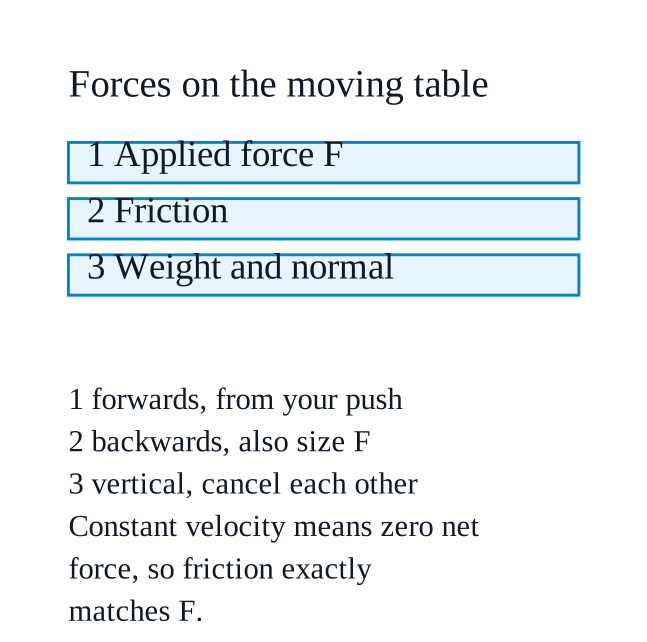
    The frictional force is \(\displaystyle F \), acting in the direction opposite to the applied force.
    NCERT_Solution_Class9_Science_Ch6_RRR_Q6-1
    The table moves at constant velocity, so its acceleration is zero.
    By Newton's first law, zero acceleration means the net force on the table is zero.
    Only two horizontal forces act — the applied force \(\displaystyle F \) forwards and friction backwards — so they must be balanced.
    Hence force of friction \(\displaystyle = F \), directed backwards, opposite to the motion.
    (The weight and the normal force are vertical and balance each other separately.)
  2. Exercise 6.2

    For a ball moving on a smooth frictionless surface, choose the appropriate option that will make the following statements physically correct. (i) If no net force is applied on the ball, the velocity of the ball will remain the same/increase/decrease. (ii) If a net force is applied on the ball in the direction of its motion, the magnitude of the velocity of the ball will remain the same/ increase/decrease. (iii) If a net force is applied on the ball in a direction opposite to the direction of its motion, the magnitude of the velocity of the ball will remain the same/increase/decrease.

    Not cross-checked

    NCERT prints no numerical answer for this exercise, so this working has not been cross-checked against the book.

    NCERT’s answer
    (i)
    same (ii) increase (iii) decrease
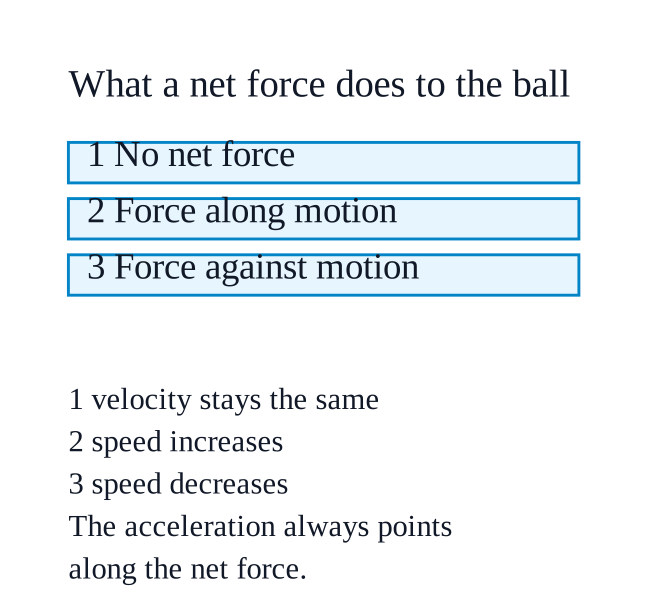
    (i) remain the same. With no net force, Newton's first law says the ball keeps moving with a constant velocity.
    NCERT_Solution_Class9_Science_Ch6_RRR_Q6-2
    (ii) increase. The acceleration is along the net force, i.e. along the motion, so the velocity grows in magnitude.
    (iii) decrease. The acceleration is opposite to the motion, so the velocity falls in magnitude (the ball slows down).