Exercise 6.10
Suppose a spacecraft is moving in a region of space where the gravitational force acting upon it is negligible. Suggest how can it change its velocity. You have learnt about contact and non-contact forces earlier. Is From the Newton’s second law of motion, the initial magnitudes of force = mass of gun While the initial acceleration of bullet force = mass of bullet Even though the pair of forces are equal in magnitude, the
Not cross-checked
NCERT prints no numerical answer for this exercise, so this working has not been cross-checked against the book.
It can change its velocity by firing its engine to expel gas, using Newton's third law.
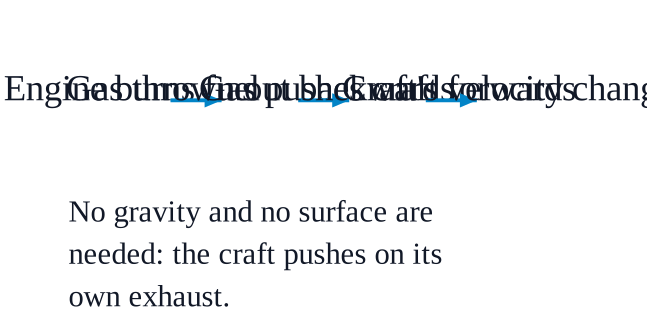
The engine pushes exhaust gas out in one direction with a large force.
The gas simultaneously pushes the spacecraft with an equal force in the opposite direction.
This is an external force on the spacecraft, so by \(\displaystyle F = ma \) it produces an acceleration and the velocity changes.
Firing the gas backwards speeds the craft up; firing it in the direction of motion slows it down — exactly what the Vikram lander of Chandrayaan-$\displaystyle 3$ did to slow for its soft landing near the Moon's south pole.
Note that no gravitational force or contact with any surface is needed: the craft pushes on its own exhaust.