SolveItClass 9 · NCERT

NCERT Solutions · Class 9 Science Exploring Mixtures and their Separation

25 questions · 21 still being checked

Revise, Reflect, Refine 5.1–5.10 (part 2 of 3)

  1. Exercise 5.1

    Which of the following mixtures are correctly classified as homogeneous (Hm) and heterogeneous (Ht)? Choose the correct option. (i) Air — Hm, Milk — Ht, Sugar solution — Hm, Smoke — Hm (ii) Brass — Ht, Fog — Ht, Vinegar — Ht, Muddy water — Hm (iii) Copper sulfate solution — Hm, Salt solution — Hm, Milk — Hm, Bronze — Hm (iv) Muddy water — Ht, Milk — Ht, Blood — Ht, Brass — Hm

    Not cross-checked

    NCERT prints no numerical answer for this exercise, so this working has not been cross-checked against the book.

    NCERT’s answer
    (iv)
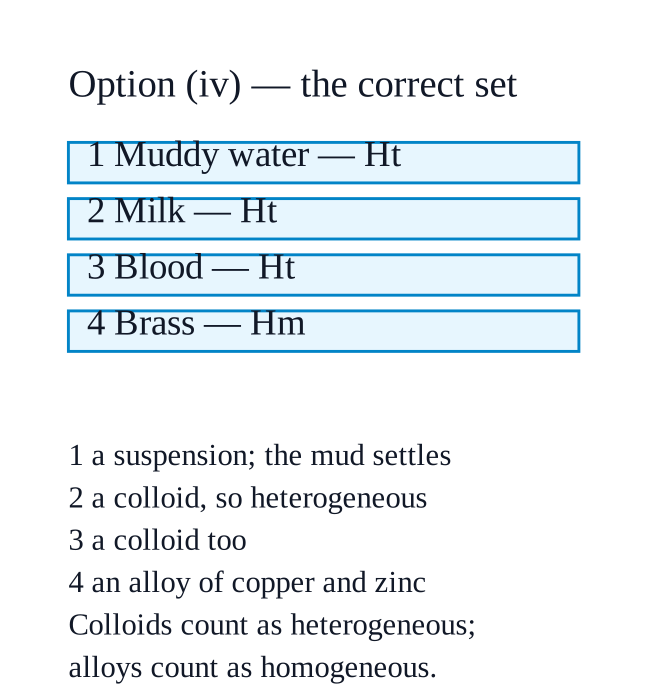
    Option (iv) is the correct classification.
    NCERT_Solution_Class9_Science_Ch5_RRR_Q5-1
    Muddy water — Ht: a suspension, the mud particles are visible and settle.
    Milk — Ht: a colloid, and colloids are heterogeneous mixtures.
    Blood — Ht: also a colloid, whose components can be spun apart by centrifugation.
    Brass — Hm: an alloy of about $\displaystyle 80$% copper and $\displaystyle 20$% zinc, and an alloy is a homogeneous mixture.
    (i) is wrong because smoke, being solid particles suspended in air, is heterogeneous, not Hm.
    (ii) is wrong on three counts: brass is Hm, vinegar (acetic acid in water) is a Hm solution, and muddy water is Ht.
    (iii) is wrong because milk is a colloid and therefore Ht, not Hm.
  2. Exercise 5.2

    Choose the correct options, and explain the reason for the correct and incorrect options. Which among the following mixtures show the Tyndall Effect? A mixture of: (a) air and dust particles (b) copper sulfate and water (c) starch and water (d) acetone and water (i) a and b

    Not cross-checked

    NCERT prints no numerical answer for this exercise, so this working has not been cross-checked against the book.

    NCERT’s answer
    (iii)
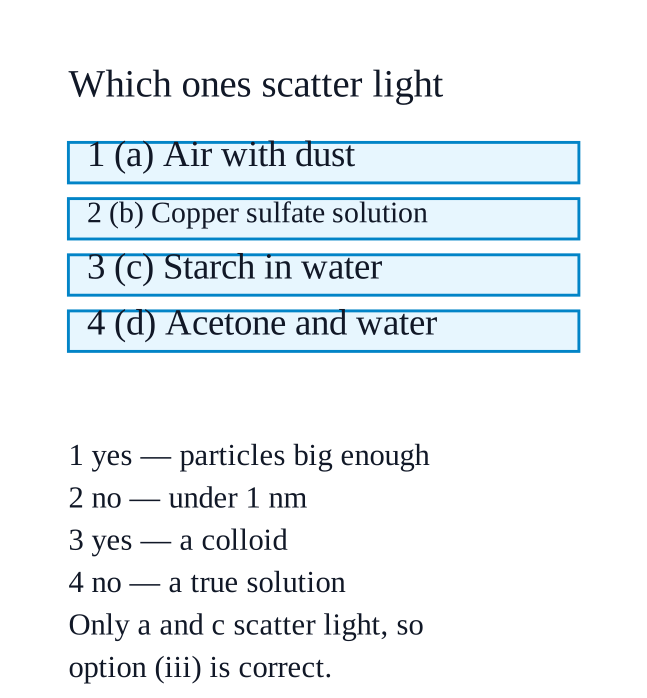
    Option (iii) — a and c.
    NCERT_Solution_Class9_Science_Ch5_RRR_Q5-2
    (a) Air and dust particles — shows the effect. The dust particles are large enough to scatter light, which is why a beam entering a dark room, or a stadium floodlight, becomes visible.
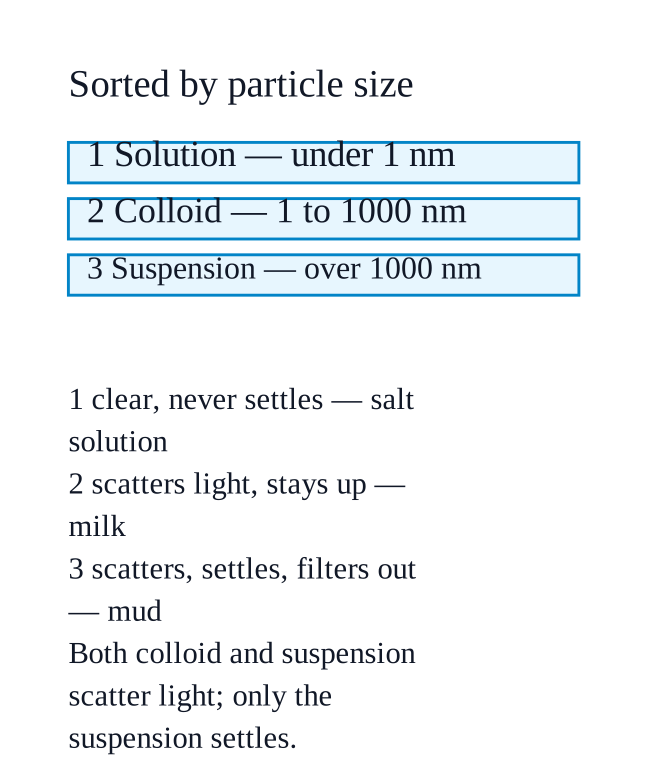
    (c) Starch and water — shows the effect. Starch does not dissolve into particles smaller than $\displaystyle 1$ nm; it forms a colloid with particles in the $\displaystyle 1$–$\displaystyle 1000$ nm range, and colloidal particles scatter light.
    (b) Copper sulfate and water — does not. It is a true solution with solute particles smaller than $\displaystyle 1$ nm, too small to scatter light, exactly like beaker A in Activity $\displaystyle 5.1$ where the laser path was invisible.
    (d) Acetone and water — does not. These are two miscible liquids, so the mixture is a homogeneous solution and the light passes straight through.
    So options (i), (ii) and (iv) all fail because each of them includes a true solution, and scattering happens in colloids and suspensions but not in transparent solutions.
  3. Exercise 5.3

    A mixture can be categorised as a solution, a suspension, or a colloid, each possessing distinct properties. Utilise the words or phrases provided in the box to fill in the Table 5.2. Words and phrases may be used more than once. Words and Phrases Large-sized particles; Particles remain evenly distributed; Small-sized particles (less than 1\displaystyle 1 nm diameter); Moderate-sized particles (1\displaystyle 1 - 1000\displaystyle 1000 nm); Settles down when left undisturbed (more than 1000\displaystyle 1000 nm in diameter); Does not settle down; Scatters light; Separates by filtration; Transparent; Salt solution; Milk; Sand in water; Smoke; Heterogeneous mixture; Cannot be separated by filtration; Mud; Butter; Brass. Complete the Table 5.2. Solution Properties __________________________ __________________________ Examples __________________________ __________________________

    Not cross-checked

    NCERT prints no numerical answer for this exercise, so this working has not been cross-checked against the book.

    Solution
    NCERT_Solution_Class9_Science_Ch5_RRR_Q5-3
    Properties: Small-sized particles (less than $\displaystyle 1$ nm diameter); Particles remain evenly distributed; Does not settle down; Cannot be separated by filtration; Transparent.
    Examples: Salt solution; Brass.
    Suspension
    Properties: Large-sized particles (more than $\displaystyle 1000$ nm in diameter); Heterogeneous mixture; Settles down when left undisturbed; Separates by filtration; Scatters light.
    Examples: Sand in water; Mud.
    Colloid
    Properties: Moderate-sized particles ($\displaystyle 1$ - $\displaystyle 1000$ nm); Heterogeneous mixture; Particles remain evenly distributed; Does not settle down; Cannot be separated by filtration; Scatters light.
    Examples: Milk; Smoke; Butter.
    A colloid and a suspension both scatter light, so the Tyndall effect will not tell them apart; what does is particle size — $\displaystyle 1$ - $\displaystyle 1000$ nm against more than $\displaystyle 1000$ nm — and the two consequences of it: a suspension settles on standing and is held back by filter paper, while a colloid stays evenly dispersed and passes straight through.
  4. Exercise 5.4

    Solve the following problems: (i) A cake recipe uses dry ingredients, namely 75\displaystyle 75 g of sugar for 420\displaystyle 420 g of all-purpose flour and 5\displaystyle 5 g of sodium hydrogencarbonate. Express the concentration of each component in the mixture using an appropriate method. (ii) A brass alloy contains 70\displaystyle 70% copper by mass. Calculate the quantities of copper and zinc present in 120\displaystyle 120 g of brass.
    NCERT’s answer
    (i)
    % m/m; Sugar = $\displaystyle 15$%; All-purpose flour = $\displaystyle 84$%; Sodium hydrogencarbonate = $\displaystyle 1$% (ii) Copper = $\displaystyle 84$ g; Zinc = $\displaystyle 36$ g
    (i) All three ingredients are solids weighed in grams, so the appropriate method is mass by mass percentage (% m/m).
    NCERT_Solution_Class9_Science_Ch5_RRR_Q5-4
    Total mass of the mixture \(\displaystyle = 75\ \text{g} + 420\ \text{g} + 5\ \text{g} = 500\ \text{g} \)
    Sugar: \(\displaystyle \dfrac{75}{500} \times 100 = 15\ \%\ m/m \)
    All-purpose flour: \(\displaystyle \dfrac{420}{500} \times 100 = 84\ \%\ m/m \)
    Sodium hydrogencarbonate: \(\displaystyle \dfrac{5}{500} \times 100 = 1\ \%\ m/m \)
    Check: \(\displaystyle 15 + 84 + 1 = 100\ \% \)
    (ii) Copper = $\displaystyle 84$ g and zinc = $\displaystyle 36$ g.
    Copper: \(\displaystyle \dfrac{70}{100} \times 120\ \text{g} = 84\ \text{g} \)
    Zinc is the rest of the alloy: \(\displaystyle 120\ \text{g} - 84\ \text{g} = 36\ \text{g} \), i.e. $\displaystyle 30$ % m/m.
  5. Exercise 5.5

    The label on a cooking oil pack says one litre (910\displaystyle 910 g). If this oil is mixed with water, will it form a separate layer? If so, which substance will be on top? How will you separate the two layers? Also, draw the diagram of the apparatus used.

    Not cross-checked

    NCERT prints no numerical answer for this exercise, so this working has not been cross-checked against the book.

    Yes, two separate layers form, with the oil on top, and the two are separated using a separating funnel.
    NCERT_Solution_Class9_Science_Ch5_RRR_Q5-5
    Oil and water are immiscible, so they never form a single uniform liquid however much they are shaken.
    One litre of the oil has a mass of $\displaystyle 910$ g while one litre of water has a mass of about $\displaystyle 1000$ g, so the oil is the lighter liquid: \(\displaystyle \text{density of oil} = \dfrac{910\ \text{g}}{1000\ \text{mL}} = 0.91\ \text{g/mL} \) against \(\displaystyle 1\ \text{g/mL} \) for water.
    The less dense liquid floats, so oil is the upper layer and water the lower layer.
    Method: pour the mixture into a separating funnel, close the stopper and let it stand undisturbed until the boundary between the layers is sharp; open the stopcock slowly and run the lower water layer into a beaker; close the stopcock when the water is almost drained; discard the small middle portion that contains both liquids; then open the stopcock again and collect the oil in a separate vessel.
    Diagram to draw: a pear-shaped separating funnel clamped upright in a laboratory stand, a glass stopper at the top, the funnel showing two layers separated by a straight horizontal boundary — the upper one labelled oil and the lower one labelled water — the narrow stem below carrying the stopcock, and a conical flask placed under the stem to receive the liquid that is run off. Every one of those seven parts must be labelled with a leader line.
  6. Exercise 5.6

    Assertion (A): Solutions do not exhibit the Tyndall effect. Reason (R): The particles in solutions are larger than 100\displaystyle 100 nm, so they cannot scatter light. Choose the correct option: (i) Both A and R are true, and R is the correct explanation of A. (ii) Both A and R are true, but R is not the correct explanation of A. (iii) A is true, but R is false. (iv) A is false, but R is true.

    Not cross-checked

    NCERT prints no numerical answer for this exercise, so this working has not been cross-checked against the book.

    NCERT’s answer
    (iii)
    Option (iii) — A is true, but R is false.
    Assertion is true: a solution does not show the Tyndall effect, which is why the laser beam left no visible path through the salt solution in Activity 5.1.
    Reason is false on the number: the particles in a solution are the smallest of all — less than $\displaystyle 1$ nm in diameter, not larger than $\displaystyle 100$ nm. Particles larger than $\displaystyle 1000$ nm are found in suspensions.
    The correct reason is the opposite of the one given: solution particles are too small to scatter light, so the beam passes straight through and the solution looks transparent.
  7. Exercise 5.7

    How would you separate the mixtures given in Table 5.3\displaystyle 5.3? Mention the reason for choosing your method. If a mixture cannot be separated, explain why. Mixture Mud from muddy water Plasma from other components in the blood sample Naphthalene and sand Chalk powder and common salt Common salt and water Oil from water Pigments of the flower

    Not cross-checked

    NCERT prints no numerical answer for this exercise, so this working has not been cross-checked against the book.

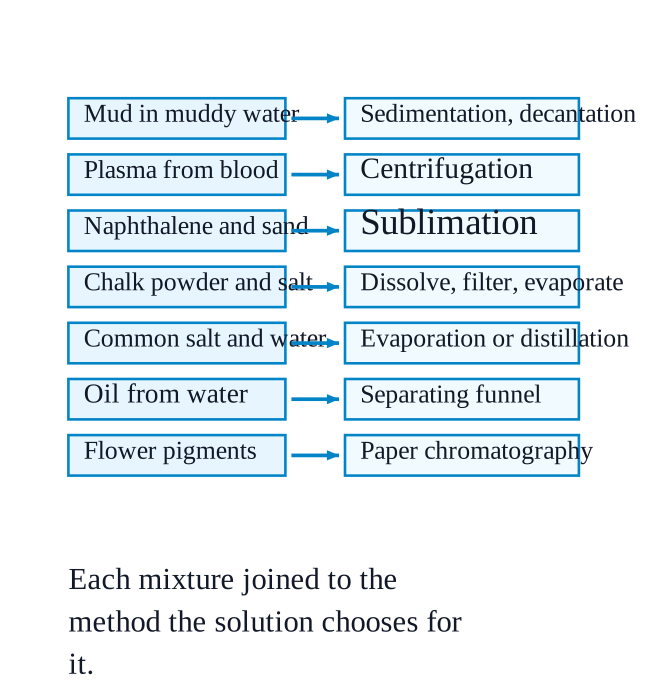
    Mud from muddy water — sedimentation and decantation, with coagulation (alum) and filtration for the fine particles. Mud is a suspension, so the heavy particles settle on standing and the water above can be poured off; the fine particles that keep it cloudy are clumped together by adding powdered alum, and the clumps settle by gravity and are removed by decantation or filtration.
    NCERT_Solution_Class9_Science_Ch5_RRR_Q5-7
    Plasma from the other components of a blood sample — centrifugation. Blood is a colloid, so its particles will not stay on filter paper; spinning the tube at high speed throws the heavier red blood cells, white blood cells and platelets outwards to the bottom and leaves the lighter plasma on top.
    Naphthalene and sand — sublimation. On gentle heating naphthalene passes straight from the solid to the vapour state and deposits as a white solid on the cool inverted funnel, while sand does not sublime and stays in the china dish.
    Chalk powder and common salt — dissolve in water, filter, then evaporate or crystallise the filtrate. Salt is soluble in water and chalk is not, so chalk is left on the filter paper as residue and the salt is recovered from the filtrate.
    Common salt and water — evaporation if only the salt is wanted, distillation if the water is wanted too. Evaporation drives the water off and leaves the salt; in distillation the water vaporises, is condensed and collected, and the salt stays behind in the distillation flask.
    Oil from water — separating funnel. The two liquids are immiscible and differ in density, so they settle into two layers that can be run off one after the other through the stopcock.
    Pigments of the flower — paper chromatography. The colour of a petal is a mixture of pigments that move up the paper at different rates with the solvent, so they separate into distinct coloured spots.
    All seven mixtures in the table can be separated. A mixture that could not be separated by these physical methods is an alloy such as brass, because its metals are mixed uniformly in the solid.
  8. Exercise 5.8

    Two miscible liquids, A and B, are present in a mixture. The boiling point of A is 60\displaystyle 60 °C and the boiling point of B is 90\displaystyle 90 °C. Suggest a method to separate them. Also, draw a labelled diagram of the method suggested.

    Not cross-checked

    NCERT prints no numerical answer for this exercise, so this working has not been cross-checked against the book.

    Separate them by distillation.
    NCERT_Solution_Class9_Science_Ch5_RRR_Q5-8
    The difference in boiling points is \(\displaystyle 90\ ^\circ\text{C} - 60\ ^\circ\text{C} = 30\ ^\circ\text{C} \), which is more than the minimum of about $\displaystyle 25$ °C that distillation needs.
    They are miscible, so they form one homogeneous layer and a separating funnel cannot be used.
    On heating, A (the lower-boiling liquid) vaporises first at $\displaystyle 60$ °C; its vapour passes into the condenser, is cooled by the circulating water and is collected as pure liquid A in the receiver, while B is left behind in the distillation flask.
    Diagram to draw and label: a distillation flask holding the mixture of A and B, standing on a wire gauze over a tripod stand with a burner beneath it; a thermometer fitted through the mouth of the flask with its bulb level with the side tube; the side tube leading into a water condenser clamped to a laboratory stand, with the water inlet at its lower end and the water outlet at its upper end; and a conical flask at the far end of the condenser collecting the distillate (liquid A).
  9. Exercise 5.9

    Compare evaporation, crystallization and distillation. In which situation, would you prefer each of these over the others?

    Not cross-checked

    NCERT prints no numerical answer for this exercise, so this working has not been cross-checked against the book.

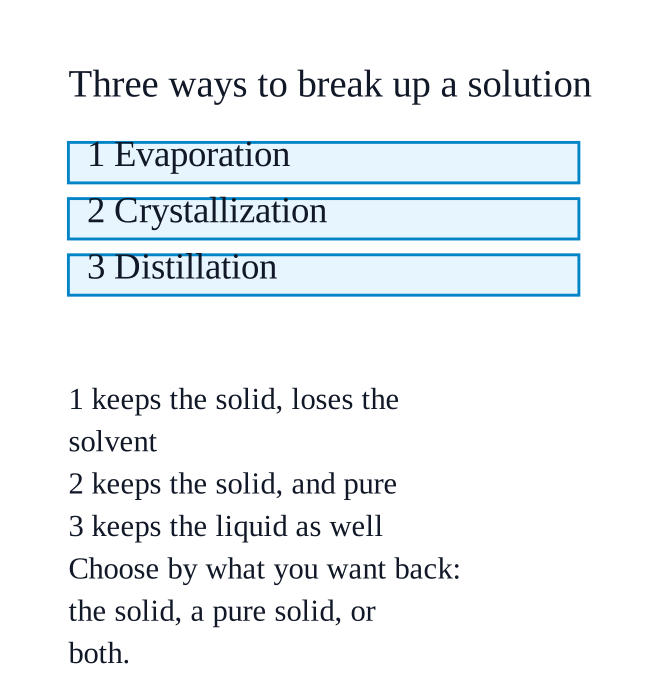
    All three separate a solution, but they differ in what is recovered and how pure it is.
    NCERT_Solution_Class9_Science_Ch5_RRR_Q5-9
    Evaporation — the solution is heated until the solvent escapes as vapour and the dissolved solid is left behind. The solvent is lost, and any soluble impurity stays with the solid. Prefer it when only the solid is wanted, it is stable to heat, and purity does not matter — obtaining common salt from seawater.
    Crystallization — a hot saturated solution is filtered hot and then cooled slowly, so that the excess solute separates as pure crystals while the impurities remain dissolved. Prefer it when the solid must be pure and well-formed, or when it would decompose on strong heating — purifying copper sulfate, or making candy sugar.
    Distillation — the mixture is boiled, the vapour is condensed and collected, so both components are recovered. Prefer it when the liquid is wanted as well as the solid, or when the mixture is two miscible liquids whose boiling points differ by at least about $\displaystyle 25$ °C — separating acetone from water, or getting drinking water back from a salt solution.
    In short: evaporation to keep the solid, crystallization to keep the solid pure, distillation to keep the liquid as well.
  10. Exercise 5.10

    Blood is an example of a colloidal mixture. (i) What would happen if blood behaved like a true suspension inside the body? (ii) In a blood sample, identify the dispersed phase and the dispersion medium.

    Not cross-checked

    NCERT prints no numerical answer for this exercise, so this working has not been cross-checked against the book.

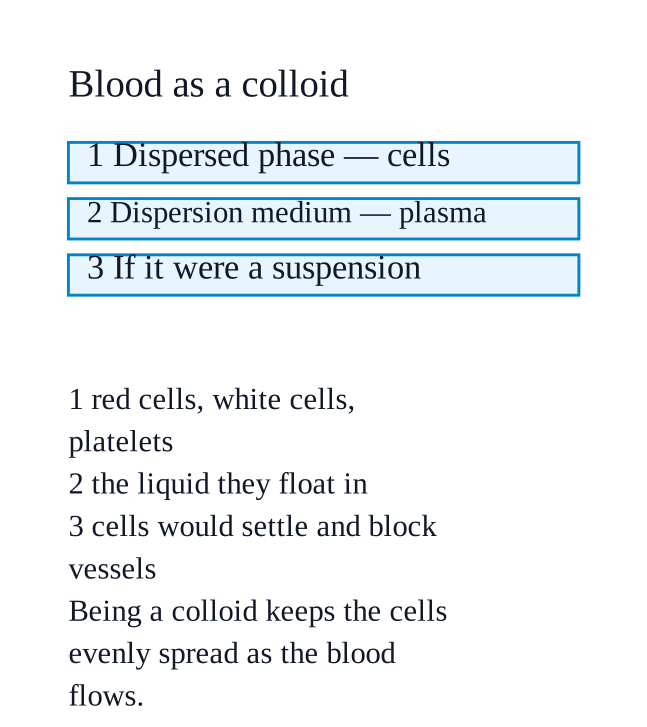
    (i) If blood behaved like a true suspension, its cells would settle out of the plasma instead of staying evenly dispersed.
    NCERT_Solution_Class9_Science_Ch5_RRR_Q5-10
    Suspension particles are large and sink when left undisturbed, so the heavier red blood cells would sediment wherever the blood flowed slowly, and could clump and block the narrow vessels.
    Blood could then no longer do its job of connecting the parts of the body by carrying nutrients, gases and hormones evenly to every tissue.
    The cells would also be big enough to be seen with the naked eye and could be strained out by simple filtration, which is not what happens.
    Being a colloid is what keeps the cells uniformly spread throughout the plasma while the blood circulates.
    (ii) Dispersed phase = the blood cells — red blood cells, white blood cells and platelets. Dispersion medium = the plasma, the liquid in which they are suspended.