SolveItClass 9 · NCERT

NCERT Solutions · Class 9 Science Exploring Mixtures and their Separation

25 questions · 21 still being checked

Pause and Ponder 5.1–5.10 (part 1 of 3)

  1. Exercise 5.1

    A common talcum powder contains 4\displaystyle 4 % m/m zinc oxide, which acts as an antiseptic. How much zinc oxide is present in 300\displaystyle 300 g of the talcum powder?
    NCERT’s answer
    $\displaystyle 12$ g
    $\displaystyle 12$ g of zinc oxide is present in $\displaystyle 300$ g of the talcum powder.
    $\displaystyle 4$ % m/m means $\displaystyle 4$ g of zinc oxide in every $\displaystyle 100$ g of powder.
    \(\displaystyle \text{Mass by mass percentage} = \dfrac{\text{Mass of solute}}{\text{Mass of solution}} \times 100 \)
    \(\displaystyle 4 = \dfrac{\text{Mass of ZnO}}{300\ \text{g}} \times 100 \)
    \(\displaystyle \text{Mass of ZnO} = \dfrac{4 \times 300}{100} = 12\ \text{g} \)
  2. Exercise 5.2

    Your mother gives you a bottle of orange juice concentrate to mix with water and serve it to your visiting friends. She asks you to mix two tablespoons of the concentrate with water in a glass tumbler. If each tablespoon measures 15\displaystyle 15 mL and you make 150\displaystyle 150 mL of juice per person, what is the % v/v of orange juice concentrate in the mixture you prepared?
    NCERT’s answer
    $\displaystyle 20$ % v/v
    The concentrate is $\displaystyle 20$ % v/v in the juice you prepared.
    Volume of concentrate (solute) \(\displaystyle = 2 \times 15\ \text{mL} = 30\ \text{mL} \)
    Volume of juice (solution) \(\displaystyle = 150\ \text{mL} \)
    \(\displaystyle \text{Volume by volume percentage} = \dfrac{\text{Volume of solute}}{\text{Volume of solution}} \times 100 \)
    \(\displaystyle = \dfrac{30\ \text{mL}}{150\ \text{mL}} \times 100 = 20\ \%\ v/v \)
  3. Exercise 5.3

    Vinegar, used as a food preservative and additive, contains 5\displaystyle 5 % v/v acetic acid. Glacial acetic acid is a liquid, i.e., 100\displaystyle 100% acetic acid. If you want to make vinegar from glacial acetic acid, how would you proceed? Grade 8\displaystyle 8 Curiosity Chapter 9\displaystyle 9 76\displaystyle 76 Exploration|Grade 9\displaystyle 9

    Not cross-checked

    NCERT prints no numerical answer for this exercise, so this working has not been cross-checked against the book.

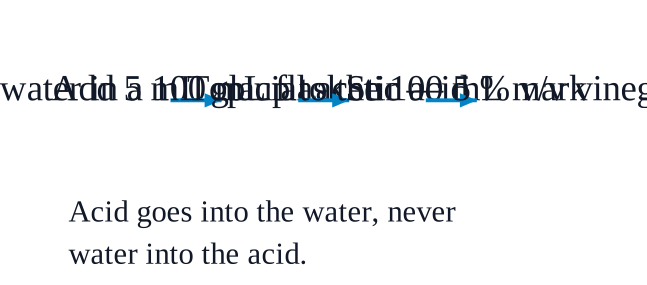
    Dilute the glacial acetic acid $\displaystyle 20$ times with water — $\displaystyle 5$ mL of glacial acetic acid made up to $\displaystyle 100$ mL of solution gives $\displaystyle 5$ % v/v vinegar.
    NCERT_Solution_Class9_Science_Ch5_PP_Q5-3
    Vinegar must be $\displaystyle 5$ % v/v, i.e. \(\displaystyle \dfrac{\text{Volume of acetic acid}}{\text{Volume of solution}} \times 100 = 5 \).
    For $\displaystyle 100$ mL of vinegar: \(\displaystyle \text{Volume of acetic acid} = \dfrac{5 \times 100}{100} = 5\ \text{mL} \)
    For $\displaystyle 1$ litre of vinegar: \(\displaystyle \dfrac{5 \times 1000}{100} = 50\ \text{mL} \) of glacial acetic acid, water added up to the $\displaystyle 1000$ mL mark.
    Steps: take some water in a $\displaystyle 100$ mL measuring flask, add $\displaystyle 5$ mL of glacial acetic acid to it, then add water up to the $\displaystyle 100$ mL mark and stir.
    Safety first: glacial acetic acid is corrosive — measure and add it only under your teacher's supervision, and always add the acid to the water, never water to the acid.
  4. Exercise 5.4

    Filter the hot solution to remove insoluble impurities (Fig. 5.8b). Collect it in a clean beaker and cover it with a watch glass.NCERT_Question_Class9_Science_Ch5_PP_Q5-4

    Not cross-checked

    NCERT prints no numerical answer for this exercise, so this working has not been cross-checked against the book.

    Compound 'B' is likely to deposit more solid.
    The solid that separates on cooling = (solubility at $\displaystyle 80$ °C) − (solubility at $\displaystyle 60$ °C), per $\displaystyle 100$ g of water, so the compound whose curve falls more steeply between those two temperatures throws out more solid.
    Read Fig. $\displaystyle 5.6$ at the two temperatures: the curve of 'B' comes down through a large vertical distance from $\displaystyle 80$ °C to $\displaystyle 60$ °C, while the curve of 'A' is almost flat over the same interval, so the solubility of 'A' hardly changes and very little solid separates from it.
    How steep the curve of 'B' is can be seen from the one step the chapter puts numbers to — the $\displaystyle 60$ °C to $\displaystyle 40$ °C step of Section $\displaystyle 5.3.1$, where its solubility falls from $\displaystyle 287$ g to $\displaystyle 241$ g per $\displaystyle 100$ g of water, i.e. \(\displaystyle 287 - 241 = 46\ \text{g} \) of solid crystallising out of every $\displaystyle 100$ g of water. The $\displaystyle 80$ °C → $\displaystyle 60$ °C step lies higher up on that same steeply rising curve.
    Equal masses of the two hot saturated solutions are compared, so the answer turns only on how far each curve drops over $\displaystyle 80$ °C → $\displaystyle 60$ °C — and in Fig. $\displaystyle 5.6$ that drop is much the larger for 'B'.
  5. Exercise 5.5

    Allow the solution to cool slowly without disturbing it (Fig. 5.8c). It gives enough time to the particles in the solution to come together, resulting in the formation of larger, shiny, well-shaped and blue-coloured crystals.NCERT_Question_Class9_Science_Ch5_PP_Q5-5

    Not cross-checked

    NCERT prints no numerical answer for this exercise, so this working has not been cross-checked against the book.

    Yes — the faster the evaporation, the smaller the crystals; slow evaporation gives larger, better-shaped crystals.
    A crystal is a solid whose particles are arranged in a regular geometric pattern, and building that pattern takes time.
    When evaporation is slow, the particles have enough time to come together in an orderly way, so they grow into large, shiny, well-formed crystals.
    When evaporation is fast (strong heating, or a thin film left on a glass plate), many tiny crystals start forming at once and none can grow, so the salt is a powder of small, poorly-shaped crystals.
    The chapter's own example: panga salt, made by boiling concentrated sea brine, and karkatch salt, made by the slow evaporation of seawater, came out as salt crystals of different sizes.
  6. Exercise 5.6

    Filter the crystals, rinse them with cold water and allow them to dry on a watch glass (Fig. 5.8d).NCERT_Question_Class9_Science_Ch5_PP_Q5-6

    Not cross-checked

    NCERT prints no numerical answer for this exercise, so this working has not been cross-checked against the book.

    (i) True. Evaporation drives the water off and leaves the salt behind; distillation does the same and also recovers the water, since a liquid can be distilled out of a solution containing a dissolved solid, the solid staying in the distillation flask.
    (ii) False. Corrected: Distillation can separate two liquids only when their boiling points differ by at least about $\displaystyle 25$ °C. If the boiling points are the same, both liquids vaporise together and the distillate is still a mixture.
    (iii) False. Corrected: In paper chromatography, the solvent level should be below the sample spot at the beginning of the experiment. If the solvent covered the spot, the ink would simply dissolve away into the liquid instead of being carried up the paper.
    (iv) False. Corrected: Evaporation and crystallization are different processes. In evaporation the solvent is driven off and lost, and any soluble impurity stays behind with the solid; in crystallization a hot saturated solution is cooled slowly so that the pure substance separates as crystals, leaving impurities in the solution.
  7. Exercise 5.7

    Collect the layer of oil separately by opening the stopcock again. You now have two separate liquids. Can you think of any heterogeneous mixtures with a gas as one of the components? Gas particles are free to move in all directions, so they mix easily and uniformly with other gases. Hence, most mixtures of gases are homogeneous, such as a mixture of hydrogen and oxygen, which is used as a rocket fuel. On the other hand, smoke (solid particles suspended in air), fog (tiny liquid water droplets present in air) and dust in the air are some heterogeneous mixtures with gas as one of the components. Most of the solid-solid mixtures are heterogeneous. You can use a property of one of the solids to separate the mixture. You have learnt how to separate iron nails from sawdust using a magnet. Now, let us explore another technique to separate solid-solid mixtures.

    Not cross-checked

    NCERT prints no numerical answer for this exercise, so this working has not been cross-checked against the book.

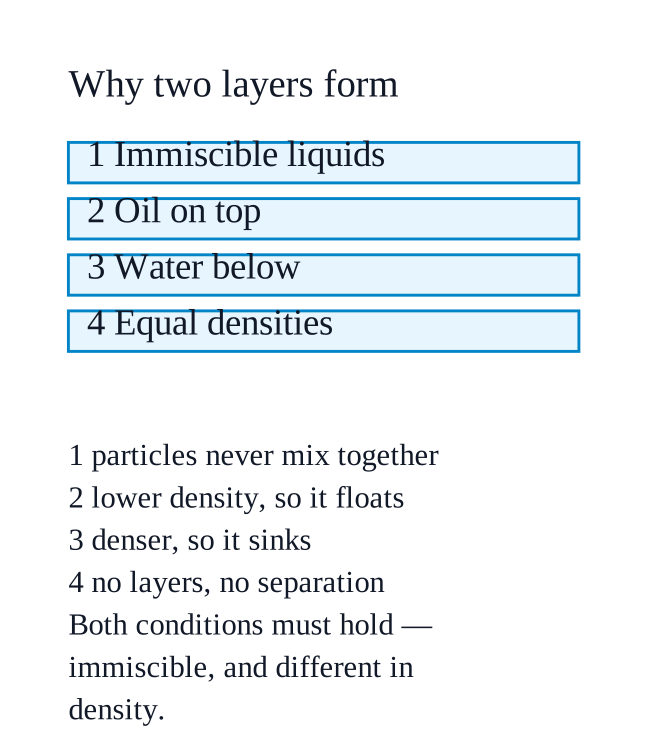
    Because the two liquids do not mix (they are immiscible) and they have different densities.
    NCERT_Solution_Class9_Science_Ch5_PP_Q5-7
    Being immiscible, the particles of one liquid do not spread in between the particles of the other, so the mixture stays heterogeneous however much it is shaken.
    On standing, the liquid of lower density floats to the top and the denser liquid sinks, giving two clearly separated layers with a sharp boundary.
    In Activity $\displaystyle 5.6$ the yellow mustard oil is less dense than water, so oil forms the upper layer and water the lower layer, which can then be run off through the stopcock.
    If the two immiscible liquids had exactly the same density, neither would float on the other and no clean layers would form, so a separating funnel could not separate them.
  8. Exercise 5.8

    Is sublimation different from evaporation? Justify. 84\displaystyle 84 Exploration|Grade 9\displaystyle 9

    Not cross-checked

    NCERT prints no numerical answer for this exercise, so this working has not been cross-checked against the book.

    Yes, sublimation is different from evaporation — the two start from different states of matter.
    NCERT_Solution_Class9_Science_Ch5_PP_Q5-8
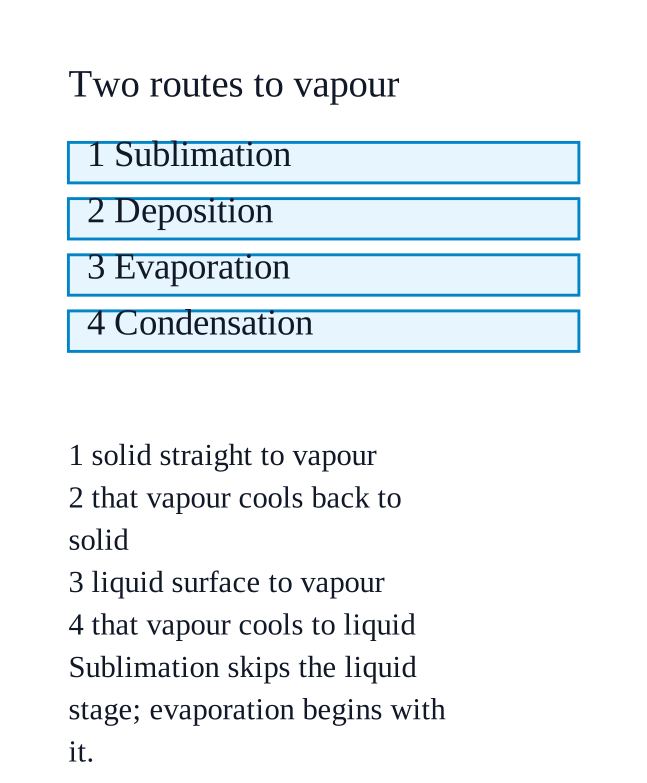
    Sublimation: a solid changes directly into vapour, below its melting point, without ever becoming a liquid — camphor, naphthalene and dry ice (solid carbon dioxide) behave this way.
    Evaporation: a liquid changes into vapour from its surface; there is no solid stage at all.
    The reverse processes differ too: cooled sublimed vapour turns straight back into a solid, which is called deposition, whereas cooled vapour from evaporation condenses into a liquid.
    They are used for different separations: sublimation separates a sublimable solid from a non-sublimable one (camphor from sand), while evaporation separates a dissolved solid from its solvent (salt from salt solution).
  9. Exercise 5.9

    Clouds are made up of tiny water droplets or ice crystals floating in the air. Based on what you know about solutions, suspensions and colloids, what type of mixture do you think clouds are and why?

    Not cross-checked

    NCERT prints no numerical answer for this exercise, so this working has not been cross-checked against the book.

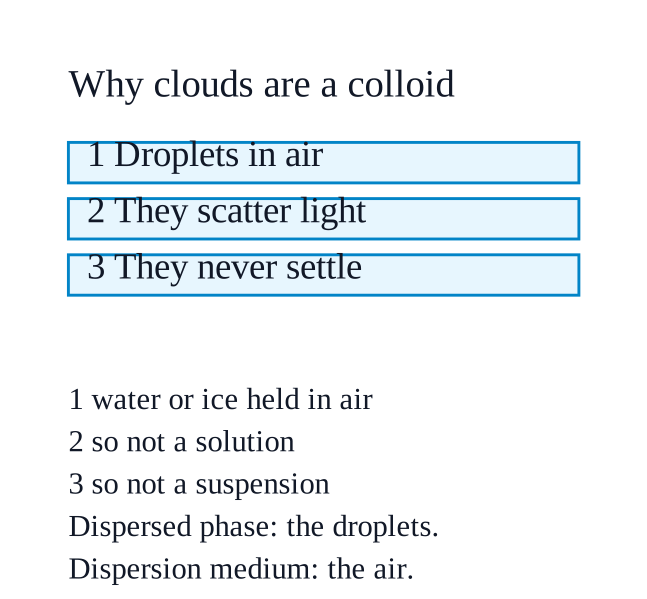
    Clouds are a colloid — tiny water droplets or ice crystals forming the dispersed phase, with air as the dispersion medium.
    NCERT_Solution_Class9_Science_Ch5_PP_Q5-9
    They are not a solution: in a solution the particles are smaller than $\displaystyle 1$ nm and the path of a light beam is not visible, but clouds clearly scatter light, which is why we see them as bright white masses.
    They are not a true suspension either: suspension particles are visible to the naked eye and settle down when left undisturbed, whereas cloud droplets stay evenly dispersed and float in the air for hours.
    Staying uniformly dispersed while still scattering light is exactly the behaviour of a colloid, like smoke (solid particles in air) which the chapter treats the same way.
  10. Exercise 5.10

    Why do cities with a lot of smoke and dust in the air often look hazy? S. No. 1. Nature (homogeneous/heterogeneous) 2. Particle size 3. Visibility 4. Separation by filtration 5. Settling 6. Tyndall effect 88\displaystyle 88 Exploration|Grade 9\displaystyle 9

    Not cross-checked

    NCERT prints no numerical answer for this exercise, so this working has not been cross-checked against the book.

    Because the smoke and dust particles suspended in the air scatter the light passing through them — this is the Tyndall effect.
    NCERT_Solution_Class9_Science_Ch5_PP_Q5-10
    Instead of travelling straight to your eye, sunlight is spread sideways by the particles, so the whole air glows faintly and distant buildings lose their sharpness.
    The chapter's other examples of the same scattering are a fine beam of light entering a dark room through a small hole, and the visible beams of floodlights in a sports stadium.
    Clean air has no such particles, so it scatters far less light and the view stays clear.