Exercise 13.11
How is heat lost from the surface of the Earth? What is its significance?
Not cross-checked
NCERT prints no numerical answer for this exercise, so this working has not been cross-checked against the book.
The Earth's surface loses heat mainly by re-radiating it as infrared radiation into the atmosphere and space.
By day the surface absorbs incoming solar radiation (UV, visible and infrared), warms up, and then radiates that energy back at longer, infrared wavelengths — because all objects radiate heat.
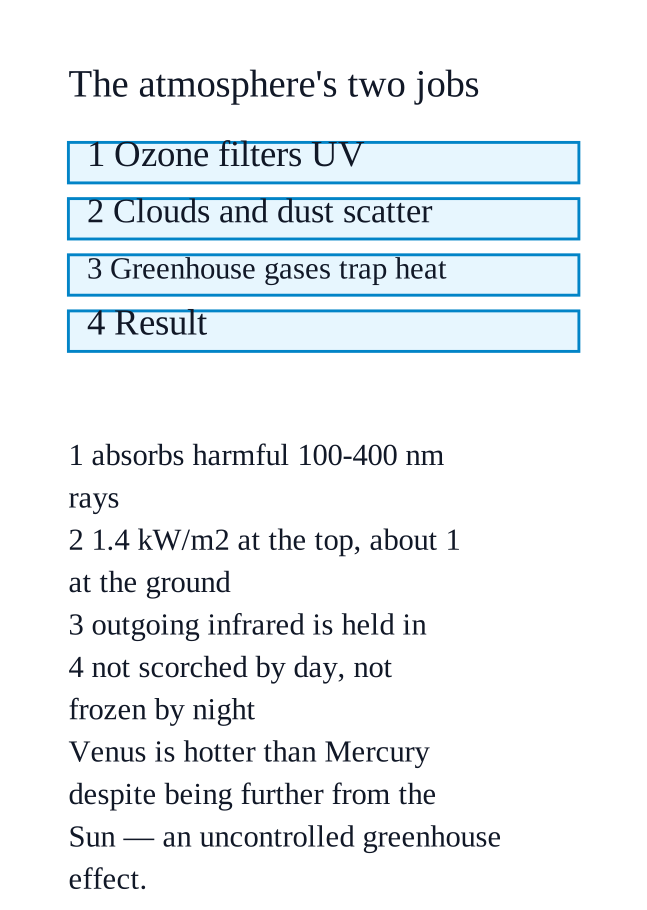
Part of this outgoing infrared is absorbed by the greenhouse gases \(\displaystyle CO_{2} \), \(\displaystyle CH_{4} \) and water vapour and sent back down; the rest escapes into space.
A further part of the incoming radiation never heats the surface at all — it is reflected straight back by the surface (its albedo) and by clouds and the atmosphere.
Significance — energy balance: this outgoing loss balances the energy arriving from the Sun. If heat were not lost, the Earth would go on getting hotter without limit.
Significance — habitable temperature: the partial trapping of the outgoing heat is what keeps the planet warm enough for life; without the atmosphere the Earth would be too cold to live on.
Everyday evidence: a concrete house feels hot at night because the concrete re-radiates the heat it absorbed during the day, while a thick mud-and-wood house stays cool because it re-radiates less.