SolveItClass 9 · NCERT

NCERT Solutions · Class 9 Science Earth as a System: Energy, Matter, and Life

23 questions · 23 still being checked

Pause and Ponder 13.1–13.7 (part 1 of 3)

  1. Exercise 13.1

    Visit the website given below and study the effect of the concentration of greenhouse gas on surface temperature, https://phet.colorado. edu/en/simulations/ greenhouse-effect 258\displaystyle 258 Exploration|Grade 9\displaystyle 9

    Not cross-checked

    NCERT prints no numerical answer for this exercise, so this working has not been cross-checked against the book.

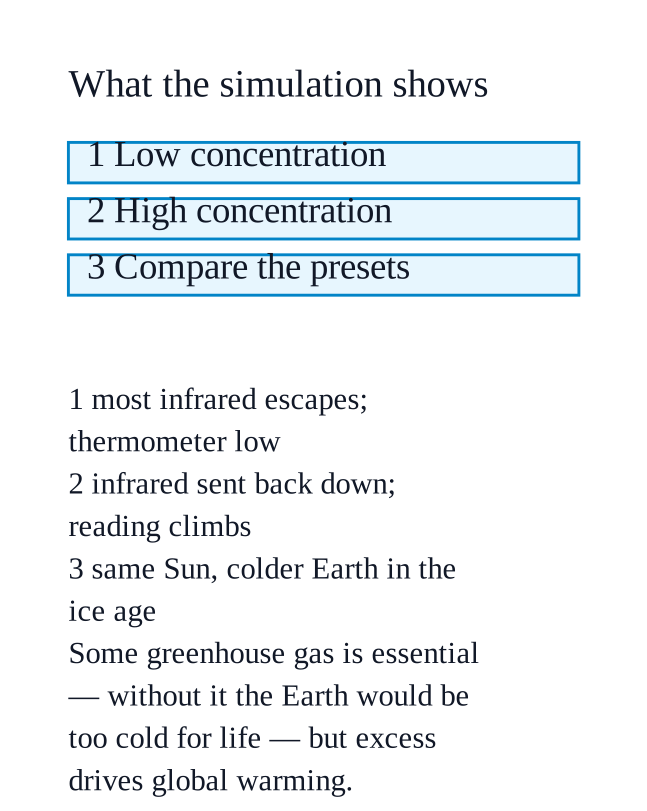
    The simulation shows that surface temperature rises as the greenhouse gas concentration is raised — more gas, warmer surface.
    NCERT_Solution_Class9_Science_Ch13_PP_Q13-1
    Set the concentration slider to a low value: most of the infrared radiated by the ground escapes to space, and the thermometer settles at a low reading.
    Slide the concentration up: more infrared is absorbed by the gas and sent back down, the ground receives extra energy, and the thermometer reading climbs.
    Compare the built-in presets (ice age / pre-industrial / today): the same Sun gives a colder Earth when the greenhouse gas level is lower.
    This is exactly the chapter's mechanism — the surface absorbs sunlight and re-radiates it as infrared, and \(\displaystyle CO_{2} \), \(\displaystyle CH_{4} \) and water vapour trap part of that outgoing heat.
    Take-away: some greenhouse gas is essential (without it the Earth would be too cold for life), but excess drives global warming.
  2. Exercise 13.2

    How does the cool mountain breeze benefit agriculture activity, particularly the crops and soil?

    Not cross-checked

    NCERT prints no numerical answer for this exercise, so this working has not been cross-checked against the book.

    The cool mountain breeze lowers the night temperature in the valley and slows moisture loss, which helps both the crop and the soil.
    NCERT_Solution_Class9_Science_Ch13_PP_Q13-2
    After sunset the mountain slopes lose heat faster than the valley floor; the air above them becomes cool and dense and drains down into the valley as a steady night wind over the fields.
    Cooler nights mean less evaporation from the soil and less transpiration from leaves, so the soil holds its moisture longer and needs less irrigation.
    The cool, moist air favours dew formation, adding a little extra water to the leaves and the topsoil.
    Cool nights relieve the day's heat stress on plants; the large day–night temperature swing this creates is what many hill crops (apple, tea, potato) need for good quality.
    By regulating temperature and moisture conditions in this way, mountain breezes support soil and crop health in hilly regions like Shimla and Dehradun.
  3. Exercise 13.3

    What happens to the warm surface of water from the equator as it travels toward the poles? What impact does this movement have on the area? India’s Scientific Contributions Scientists at the Indian Institute of Tropical Meteorology (IITM), Pune, run advanced computer models that couple the energy flows we discussed in this chapter, between atmosphere, oceans, land and ice to simulate the Indian monsoon. These models use data from satellites, buoys in the Indian Ocean, and even stations in Antarctica to improve seasonal forecasts and to study how global warming may change monsoon rainfall patterns across India.

    Not cross-checked

    NCERT prints no numerical answer for this exercise, so this working has not been cross-checked against the book.

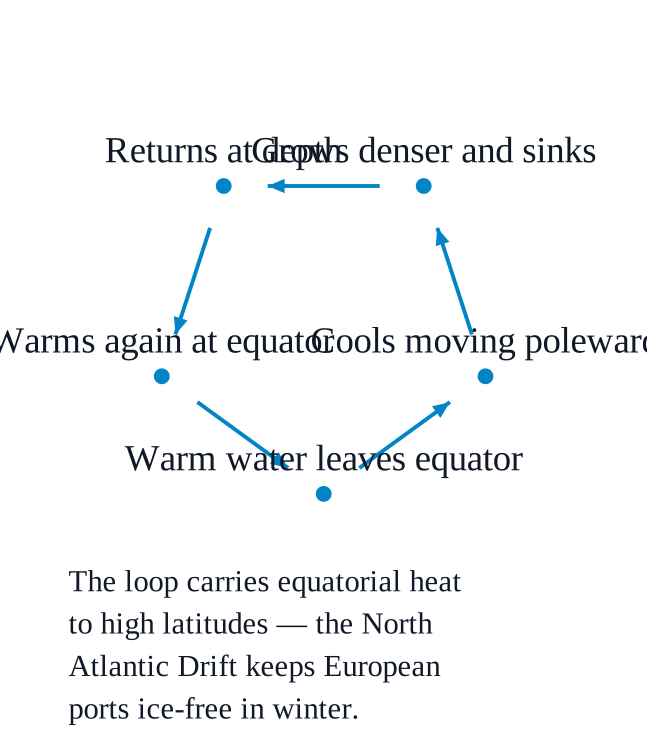
    The warm equatorial surface water cools as it travels poleward, becomes denser and sinks, then flows back towards the equator through the deeper levels of the ocean.
    NCERT_Solution_Class9_Science_Ch13_PP_Q13-3
    The Earth's rotation deflects these moving water masses, so the flow curves into large circular patterns called gyres — clockwise in the Northern Hemisphere, counter clockwise in the Southern Hemisphere.
    Impact on the area it reaches: the current carries heat from the equator towards the poles, so the temperature difference across the planet is reduced and high-latitude coasts are made much milder than their latitude would suggest.
    Example: the North Atlantic Drift, an extension of the Gulf Stream, flows to the north-western coast of Europe and keeps many ports ice-free during winter even at high latitudes.
    This moderating influence also supports human activities such as trade and commerce.
    The same currents transport nutrients along their path, supporting massive marine ecosystems.
  4. Exercise 13.4

    The CO2\displaystyle CO_{2} dissolved in the ocean is disturbed when the global temperature increases. What will happen to marine life?

    Not cross-checked

    NCERT prints no numerical answer for this exercise, so this working has not been cross-checked against the book.

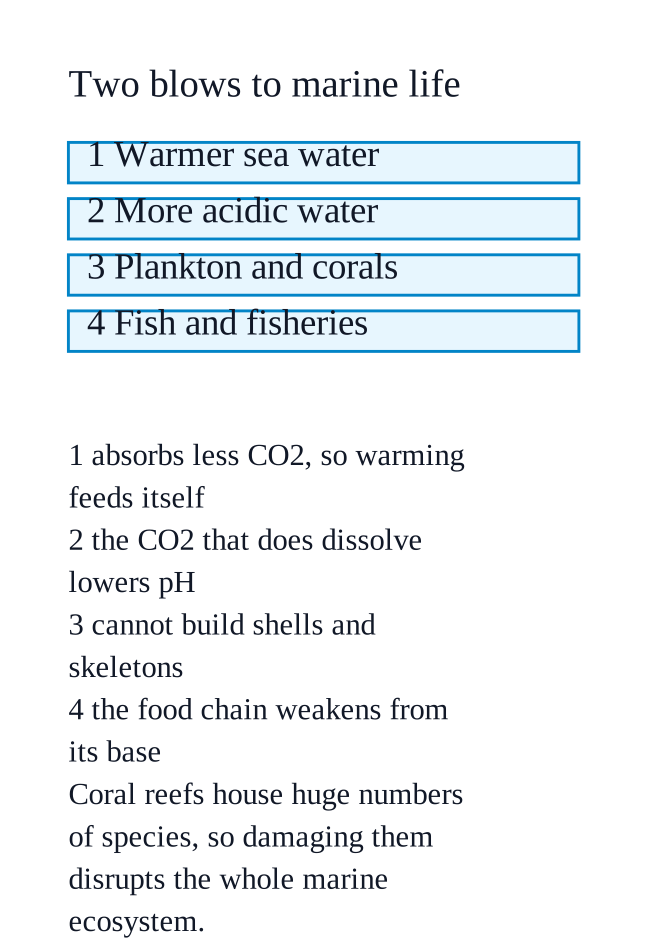
    Marine life is hit from two sides: warm sea water absorbs less \(\displaystyle CO_{2} \), and the \(\displaystyle CO_{2} \) that does dissolve makes the water more acidic.
    NCERT_Solution_Class9_Science_Ch13_PP_Q13-4
    Warmer ocean water reduces the ocean's capacity to act as a carbon sink, so more \(\displaystyle CO_{2} \) stays in the atmosphere and the warming feeds on itself.
    The excess atmospheric \(\displaystyle CO_{2} \) that is absorbed makes sea water more acidic; this threatens tiny plankton and coral reefs, which need carbonate to build shells and skeletons.
    Phytoplankton use the dissolved carbonate and bicarbonate ions for photosynthesis; disturbing this weakens the very base of the marine food chain, so fish and larger animals decline too.
    Coral reefs are habitats for a huge number of species — damaging them destroys those habitats and disrupts the whole marine ecosystem.
    Coastal fisheries, and the people who depend on them, are affected in turn.
  5. Exercise 13.5

    What would happen to plants and animals on Earth if the biogeochemical cycles were disrupted and stopped? Explain by giving a few examples. Burning of fossil fuels and deforestation saturate natural carbon sinks The overuse of fertilisers in agriculture adds excessive

    Not cross-checked

    NCERT prints no numerical answer for this exercise, so this working has not been cross-checked against the book.

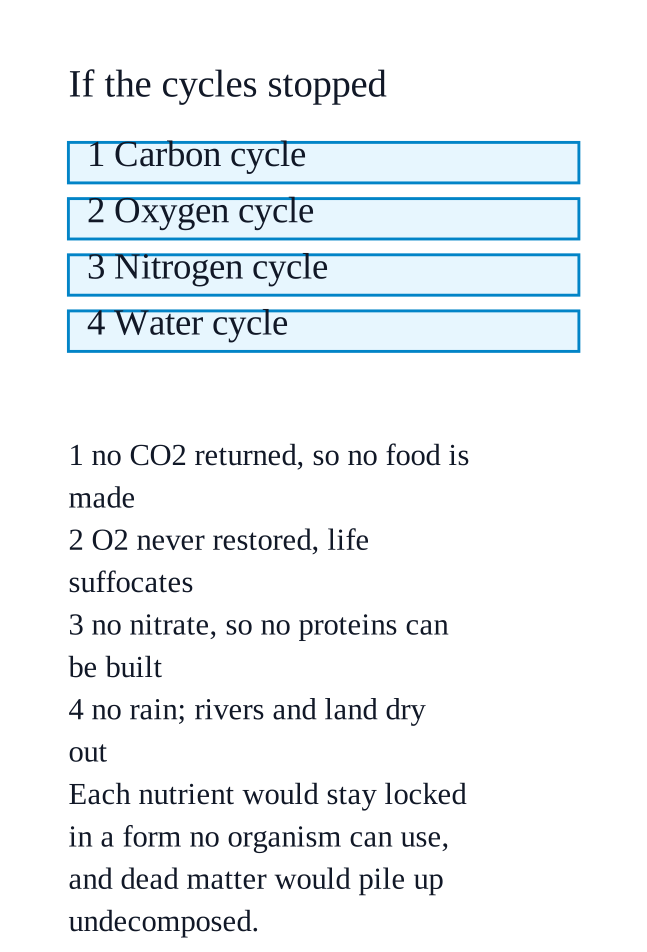
    Life would collapse, because the biogeochemical cycles are what keep returning nutrients to living organisms; if they stopped, each nutrient would be locked in a form no organism could use.
    NCERT_Solution_Class9_Science_Ch13_PP_Q13-5
    Carbon cycle stops — respiration, decomposition and combustion no longer return \(\displaystyle CO_{2} \) to the air, so plants run out of raw material for photosynthesis and no food is made for any organism.
    Oxygen cycle stops — the \(\displaystyle O_{2} \) used up by respiration and combustion is not restored by photosynthesis, so plants and animals eventually suffocate.
    Nitrogen cycle stops — atmospheric \(\displaystyle N_{2} \) is non-reactive and cannot be used directly; with no ammonia or nitrate in the soil, plants cannot build proteins and nucleic acids, and animals that eat them are starved of nitrogen too.
    Water cycle stops — no evaporation, no clouds, no precipitation; rivers, lakes and groundwater are never refilled, and terrestrial life dries out.
    Dead bodies and waste would pile up undecomposed, permanently trapping the nutrients they contain instead of returning them to the soil.
  6. Exercise 13.6

    Discuss how human activities increase the concentration of greenhouse gases in the atmosphere. What would you do as an individual to reduce the emission of greenhouse gas? 266\displaystyle 266 Exploration|Grade 9\displaystyle 9

    Not cross-checked

    NCERT prints no numerical answer for this exercise, so this working has not been cross-checked against the book.

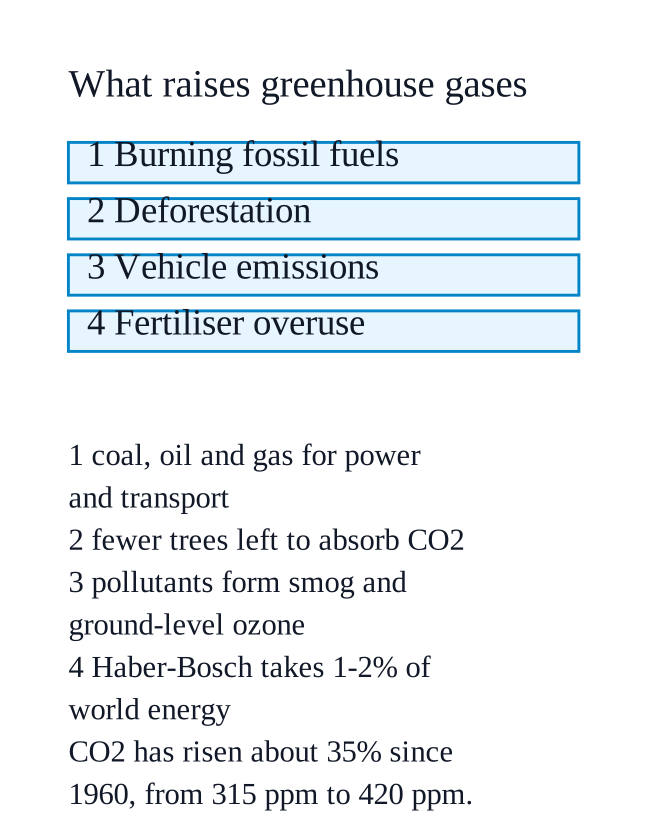
    Human activities raise greenhouse gases chiefly by burning fossil fuels and clearing forests.
    NCERT_Solution_Class9_Science_Ch13_PP_Q13-6
    Burning coal, oil and gas for electricity, heating, cooking, transport and industry releases carbon that took millions of years to bury, returning it as \(\displaystyle CO_{2} \) on a very short time scale.
    Deforestation removes the trees that absorb \(\displaystyle CO_{2} \), and saturates natural carbon sinks like forests and oceans, so more \(\displaystyle CO_{2} \) stays in the air.
    Vehicular emissions add pollutants that react with sunlight to form ground-level smog and ozone.
    Overuse of nitrogen fertilisers, and the energy-intensive Haber–Bosch process behind them (about \(\displaystyle 1-2\% \) of global energy), add further emissions.
    Result: atmospheric \(\displaystyle CO_{2} \) has risen by about \(\displaystyle 35\% \) since $\displaystyle 1960$, from \(\displaystyle 315 \) ppm to \(\displaystyle 420 \) ppm.
    As an individual I would: walk, cycle or use public transport instead of a private vehicle; switch off lights, fans and appliances when not in use and prefer LED lamps; support solar and other renewable energy at home; plant trees and look after them; save water and avoid wasting food; and reduce, reuse and recycle materials — the mindful lifestyle promoted by Mission LiFE.
  7. Exercise 13.7

    (iii)
    13. Cl -; one; two (ii) Nitrogen dioxide (ii) SO2\displaystyle SO_{2} (iv) Cu2\displaystyle Cu_{2}O (ii) K2\displaystyle K_{2}CO3\displaystyle CO_{3} (ii) Ionic

    Not cross-checked

    NCERT prints no numerical answer for this exercise, so this working has not been cross-checked against the book.

    No solution exists for this item — it is not a question.
    The text captured under this number is stray OCR from the book's Answer Key section at the back, where two columns of printed answers were read across as a single line.
    Chapter $\displaystyle 13$ prints exactly six Pause and Ponder questions (numbered $\displaystyle 1$ to $\displaystyle 6$), ending with question $\displaystyle 6$ on human activities and greenhouse gases; there is no question 7.
    The fragments belong elsewhere: "Anion (\(\displaystyle O^{2-} \))", "\(\displaystyle Cl^{-} \); one; two", "Carbon dioxide / Nitrogen dioxide / Sulfur hexafluoride / Phosphorus trichloride", "\(\displaystyle NaHCO_{3} \), \(\displaystyle SO_{2} \), \(\displaystyle FeCl_{3} \), \(\displaystyle Cu_{2}O \)" and "MO; Ionic" are Chapter $\displaystyle 9$ answers.
    "A - Green curve; B - Red curve; C - Blue curve", "$\displaystyle 0.01$ s", "$\displaystyle 0.007$ s", "$\displaystyle 0.04$ m; $\displaystyle 8500$ Hz" and "$\displaystyle 2$:$\displaystyle 9$" are Chapter $\displaystyle 10$ answers.
    Recommended action: delete this entry rather than attempt an answer.