SolveItClass 9 · NCERT

NCERT Solutions · Class 9 Science Cell: The Building Block of Life

24 questions · 24 still being checked

Revise, Reflect, Refine 2.1–2.10 (part 2 of 3)

  1. Exercise 2.1

    Differentiate between the following pairs of terms based on the clues given in parentheses: (i) Cell membrane and cell wall (permeability) (ii) RER and SER (structure) (iii) Chloroplasts and chromoplasts (pigments)

    Not cross-checked

    NCERT prints no numerical answer for this exercise, so this working has not been cross-checked against the book.

    (i) Cell membrane and cell wall — permeabilityNCERT_Solution_Class9_Science_Ch2_RRR_Q2-1
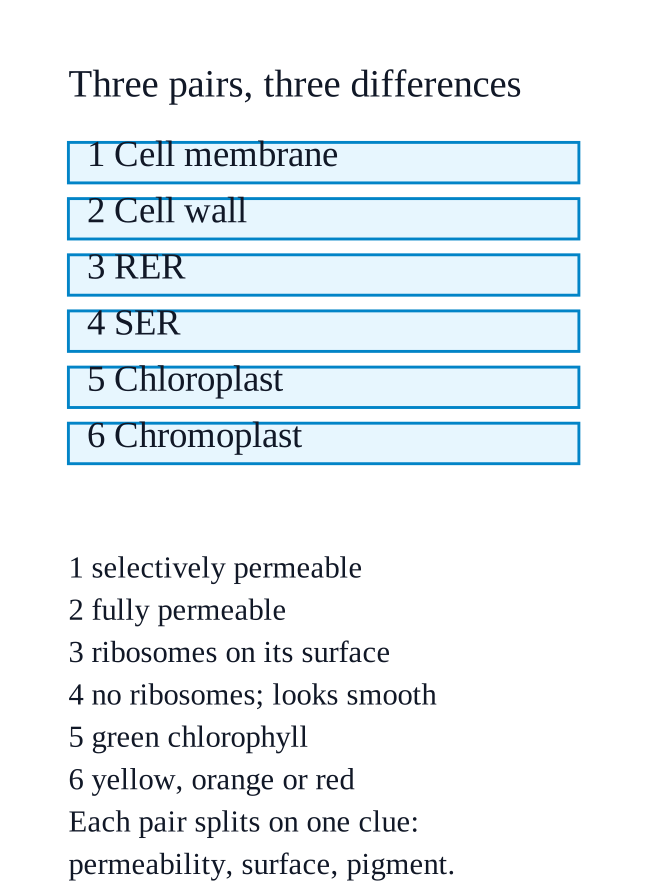
    The cell membrane is selectively permeable: it lets some substances through and blocks others. In Activity $\displaystyle 2.2$ it let water move in and out of the potato cells but held back the salt and sugar molecules.
    The cell wall is permeable: water and dissolved minerals pass straight through it. The two working together are what let a root absorb water and nutrients from the soil.
    (ii) RER and SER — structure
    RER carries ribosomes on its surface, which is what makes it look rough under an electron microscope.
    SER has no ribosomes on its surface, so it looks smooth.
    (iii) Chloroplasts and chromoplasts — pigments
    Chloroplasts contain the green pigment chlorophyll, which absorbs sunlight for photosynthesis.
    Chromoplasts contain pigments other than chlorophyll — yellow, orange or red — which colour flower petals and fruits and so attract pollinators and seed-dispersing animals.
  2. Exercise 2.2

    Two similar animal cells are placed in two different solutions: y Cell X is placed in pure water. y Cell Y is placed in a concentrated salt solution.

    Not cross-checked

    NCERT prints no numerical answer for this exercise, so this working has not been cross-checked against the book.

    NCERT’s answer
    (iii)
    (iii) Water moved into Cell X and moved out of Cell Y through the cell membrane.
    NCERT_Solution_Class9_Science_Ch2_RRR_Q2-2
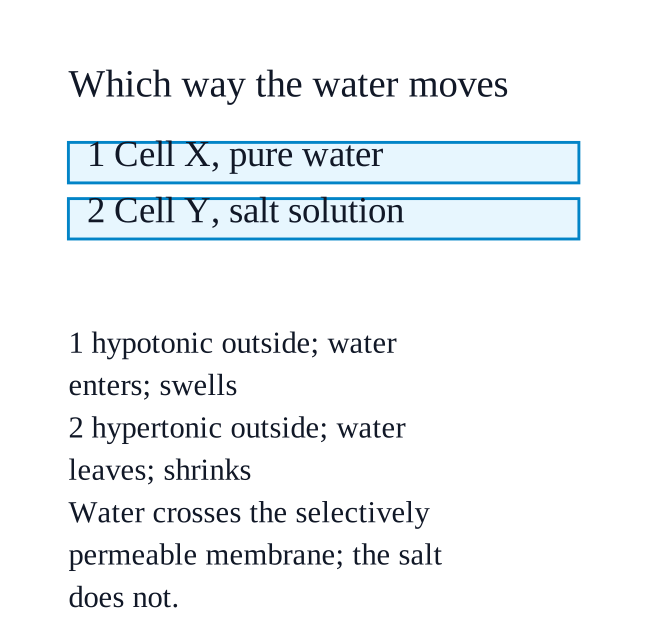
    Cell X is in pure water. Outside there is more water and less solute than inside, so the surroundings are hypotonic; water enters by osmosis and the cell swells.
    Cell Y is in concentrated salt solution. Outside there is less water and more solute, so the surroundings are hypertonic; water leaves by osmosis and the cell shrinks.
    One fact explains both: the cell membrane is selectively permeable — water crosses it, salt does not.
    (i) is wrong — salt molecules do not move into Cell Y. What leaves is water, and that is why it shrinks.
    (ii) is wrong for the same reason: it assumes salt solution entered the cell, so there is nothing for the outgoing water to be "more than".
    (iv) is wrong — osmosis is the diffusion of water across a selectively permeable membrane. Solute movement is not what caused it here, and the solute did not move at all.
  3. Exercise 2.3

    Look at the diagram of a cell in Fig. 2.20. Identify the parts labelled from (a) to (g) and correctly match them with their functions given below: (i) Controlling all the activities of a cell. (ii) Site of cellular respiration. (iii) Storage organelle that also provides rigidity to the cell. (iv) Separates the cell contents from surroundings. (v) Provides structural rigidity to the cell. (vi) Packs and stores materials received from ER. (vii) Helps in manufacturing food.NCERT_Question_Class9_Science_Ch2_RRR_Q2-3

    Not cross-checked

    NCERT prints no numerical answer for this exercise, so this working has not been cross-checked against the book.

    The cell in Fig. $\displaystyle 2.20$ is a plant cell — the functions listed include a cell wall, a large storage vacuole and food manufacture, and an animal cell has none of these.
    (i) Controlling all the activities of a cell — nucleus, the house of coded instructions, holding the chromosomes.
    (ii) Site of cellular respiration — mitochondrion, where glucose is broken down and the energy stored as ATP.
    (iii) Storage organelle that also provides rigidity to the cell — vacuole; the water it stores keeps up the pressure inside the cell, which keeps the cell firm.
    (iv) Separates the cell contents from surroundings — cell membrane.
    (v) Provides structural rigidity to the cell — cell wall.
    (vi) Packs and stores materials received from ER — Golgi apparatus.
    (vii) Helps in manufacturing food — chloroplast, whose chlorophyll absorbs sunlight for photosynthesis.
    Now read the seven labels off Fig. $\displaystyle 2.20$ in your book and write the matching letter beside each part named above.
  4. Exercise 2.4

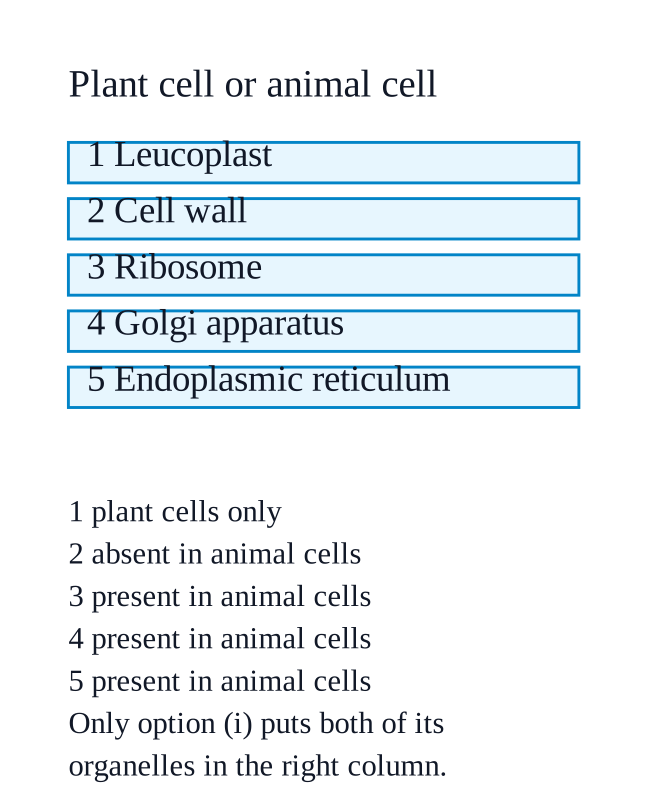
    Which of the following option(s) of the pairs of cell organelles are correctly placed under the given categories? Option (i) (ii) (iii) (iv)

    Not cross-checked

    NCERT prints no numerical answer for this exercise, so this working has not been cross-checked against the book.

    NCERT’s answer
    (i)
    (i) — Leucoplast (present in the plant cells) and Cell wall (absent in the animal cells).
    NCERT_Solution_Class9_Science_Ch2_RRR_Q2-4
    Leucoplast is a colourless plastid that stores starch, oils or proteins, and plastids of every kind occur only in plant cells — so it belongs under "present in the plant cells". ✔
    Cell wall lies outside the cell membrane in plants, fungi and bacteria; animal cells have none, which is why they change shape so easily. ✔
    (ii) fails on Ribosome — ribosomes are present in animal cells, and indeed in every cell including bacteria, so they cannot be listed as absent.
    (iii) fails on Golgi apparatus — it is present in animal cells; Camillo Golgi first saw it in the nerve cells of a barn owl.
    (iv) fails on Endoplasmic reticulum — the ER is present in animal cells too.
    So only option (i) has both cells of the pair in the right column.
  5. Exercise 2.5

    Two students, Renu and Rohit, were having a discussion on the plastids. Renu emphasised that all parts of the plants, even roots, contain plastids. However, Rohit did not agree with the statement and told her that plastids are absent in plant roots since the roots are underground and do not need to perform photosynthesis. Who is correct? Justify your answer.

    Not cross-checked

    NCERT prints no numerical answer for this exercise, so this working has not been cross-checked against the book.

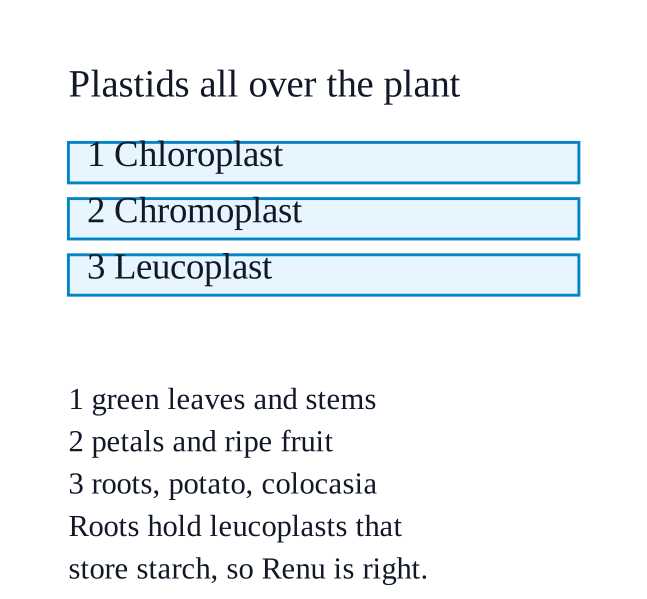
    Renu is correct — plastids are found in all parts of a plant, roots included.
    NCERT_Solution_Class9_Science_Ch2_RRR_Q2-5
    Plastids are not only chloroplasts. The chapter names three kinds: chloroplasts (green, for photosynthesis), chromoplasts (yellow, orange or red, in petals and fruits) and leucoplasts (colourless, for storage).
    Non-green parts carry leucoplasts, which store food material such as starch, oils or proteins. The chapter's own examples are the starch-storing cells of potato and taro (Colocasia) — underground parts that never see sunlight.
    So a root does not photosynthesise, yet it still needs plastids, because storing the food that the leaves send down is itself a plastid's job.
    Rohit's error is treating "plastid" and "chloroplast" as the same word. His reasoning correctly explains why roots have few or no chloroplasts — it does not show that they have no plastids.
  6. Exercise 2.6

    Mitochondria and chloroplasts are two important organelles in a plant cell. Discuss how these two organelles are structurally and functionally similar to each other, and different from each other.

    Not cross-checked

    NCERT prints no numerical answer for this exercise, so this working has not been cross-checked against the book.

    Structurally similarNCERT_Solution_Class9_Science_Ch2_RRR_Q2-6
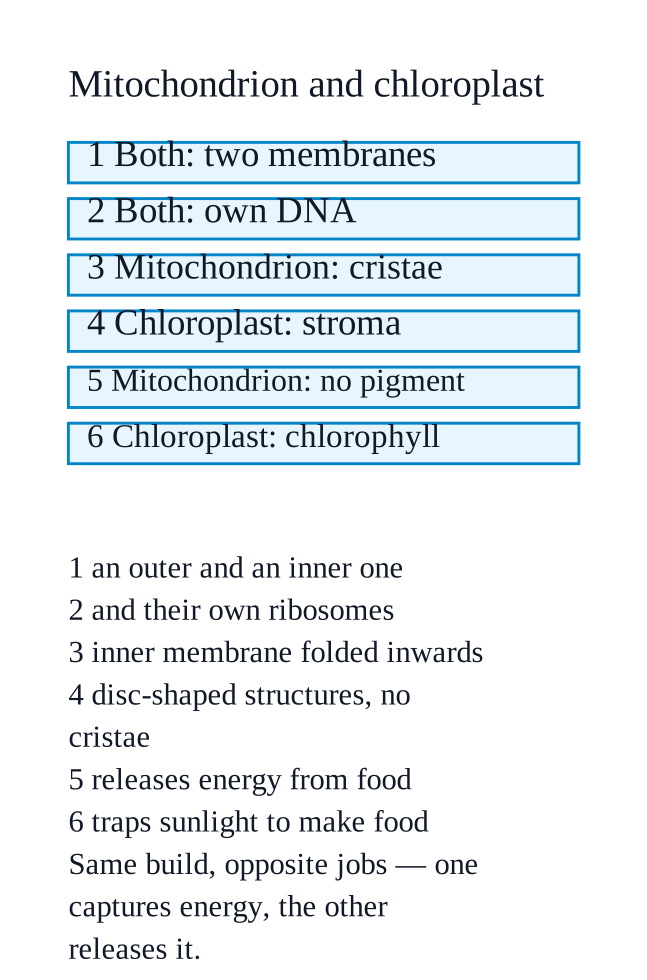
    Both are double-membrane-bound organelles, with an outer and an inner membrane.
    Both carry their own DNA and their own ribosomes, so both can make some of their own proteins.
    Both therefore appear to share an evolutionary history with certain single-celled bacteria.
    Functionally similar
    Both are the plant cell's energy organelles — one captures energy, the other releases it, and between them they run the cell's whole energy budget.
    Structurally different
    In a mitochondrion the inner membrane is folded into cristae, finger-like projections that increase the surface area for the reactions.
    In a chloroplast the inner space holds a semi-fluid stroma containing disc-shaped membrane structures; there are no cristae.
    A chloroplast holds the green pigment chlorophyll; a mitochondrion holds no pigment at all.
    Functionally different
    Mitochondria break glucose down during cellular respiration and store the released energy as ATP, the energy currency of the cell.
    Chloroplasts build glucose up: chlorophyll absorbs sunlight for photosynthesis, and the sugars made are stored in the stroma along with starch granules.
    Mitochondria are present in plant and animal cells alike; chloroplasts are present only in plant cells.
  7. Exercise 2.7

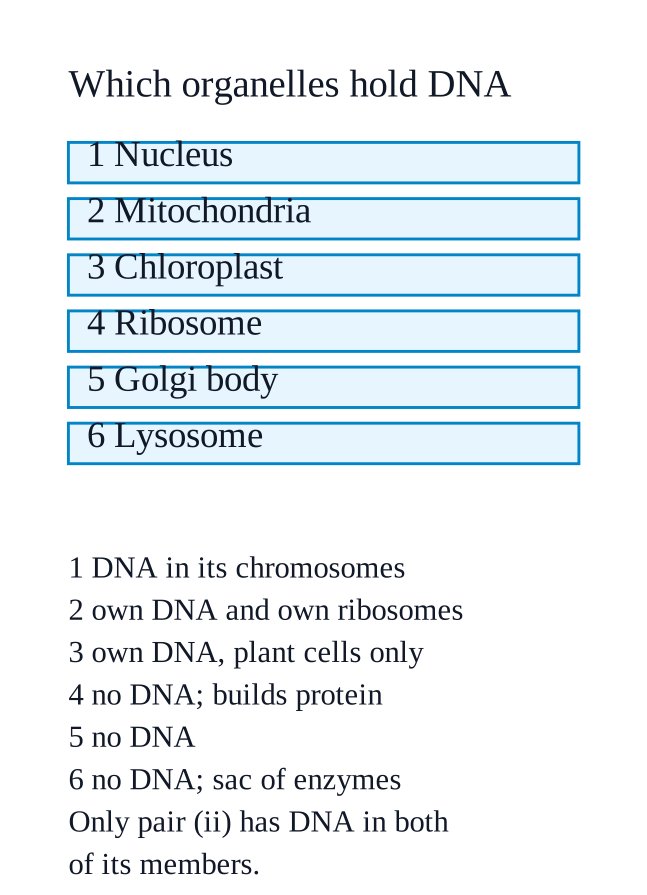
    Which of the following pairs of cell organelles contains DNA? (i) Chloroplasts, Ribosomes (ii) Mitochondria, Nucleus (iii) Golgi bodies, Ribosomes (iv) Nucleus, Lysosomes

    Not cross-checked

    NCERT prints no numerical answer for this exercise, so this working has not been cross-checked against the book.

    NCERT’s answer
    (ii)
    (ii) Mitochondria, Nucleus.
    NCERT_Solution_Class9_Science_Ch2_RRR_Q2-7
    Nucleus — it contains chromosomes, and chromosomes are composed of DNA and specific proteins; the functional segments of that DNA are the genes.
    Mitochondria — they have their own DNA and their own ribosomes, which is exactly why they can make some of their own proteins.
    (i) fails on the ribosome. A chloroplast does contain DNA, but a ribosome does not — it is the site where protein is assembled, not where genetic information is kept. One member of the pair is enough to spoil it.
    (iii) fails on both members: neither Golgi bodies nor ribosomes contain DNA.
    (iv) fails on the lysosome — it is a single membrane-bound sac of digestive enzymes, with no DNA.
  8. Exercise 2.8

    A researcher carried out an experiment in which she took two carrots of similar size. She placed one carrot in plain water and the other carrot in concentrated salt solution (Fig. 2.21\displaystyle 2.21). After 24\displaystyle 24 hours she recorded her observations. (i) What hypothesis does she want to test through this experiment? (ii) What would you suggest for the improvement of this experiment? (iii) Why does the carrot in plain water stay stiff and crunchy, but the carrot in concentrated salt solution become rubbery and limp?NCERT_Question_Class9_Science_Ch2_RRR_Q2-8

    Not cross-checked

    NCERT prints no numerical answer for this exercise, so this working has not been cross-checked against the book.

    (i) The hypothesis being tested
    That water moves into or out of a plant tissue by osmosis, in the direction set by the concentration of the solution around it.
    Stated so it can be tested: a carrot in plain water will take in water and stay firm, while an identical carrot in a concentrated salt solution will lose water and go limp.
    (ii) How to improve the experiment
    Weigh both carrots before and after, as in Activity $\displaystyle 2.2$, so the result is a measured change \(\displaystyle = \text{final weight} - \text{initial weight} \) instead of an impression of how they look.
    Match the carrots properly — same variety, same length and thickness, cut and trimmed at the same time.
    Hold everything but the solution identical: same volume of liquid, same size of beaker, same temperature, same $\displaystyle 24$ hours.
    State the salt concentration used, for example $\displaystyle 20$ per cent, so that someone else can repeat the experiment exactly.
    Use two or three carrots in each beaker rather than one, so a single odd carrot cannot decide the result.
    (iii) Why the two carrots end up different
    Plain water is hypotonic to the cell sap inside the carrot cells, so water enters them by osmosis. The vacuoles fill, the pressure inside each cell rises and the cells press outwards against their cell walls — the carrot stays stiff and crunchy.
    Concentrated salt solution is hypertonic, so water leaves the cells by osmosis. The vacuoles lose water, the cells go slack and the tissue loses its firmness — the carrot turns rubbery and limp.
    It is the same thing that happens to a whole plant short of water: the vacuoles empty, the cells stop being firm, and the plant wilts.
  9. Exercise 2.9

    Indicate the presence or absence of following structures in bacterial and animal cells: Structures in a cell Chromosome Nucleus Mitochondria Golgi complex Chromoplasts

    Not cross-checked

    NCERT prints no numerical answer for this exercise, so this working has not been cross-checked against the book.

    Structure in a cellBacterial cellAnimal cell
    ChromosomePresent (a single circular DNA molecule with proteins, lying in the nucleoid)Present
    NucleusAbsentPresent
    MitochondriaAbsentPresent
    Golgi complexAbsentPresent
    ChromoplastsAbsentAbsent
    A bacterial cell is prokaryotic: no membrane-bound nucleus and no membrane-bound organelles at all. That single fact removes the nucleus, the mitochondria and the Golgi complex together; its cellular activities take place directly in the cytoplasm.
    Chromosome in a bacterium — present. The chapter defines a chromosome as being "composed of DNA and specific proteins", and it describes a prokaryote's genetic material as "a single circular molecule associated with specific proteins". That is DNA plus specific proteins, so the structure itself is there; what the bacterium lacks is the membrane around it. The region holding this single circular chromosome is called the nucleoid, which is why the chromosome row and the nucleus row differ.
    An animal cell is eukaryotic, so the nucleus with its chromosomes, the mitochondria and the Golgi complex are all present. Its chromosomes are visible as rod-shaped bodies only when the cell is about to divide; at other times the same DNA is present as chromatin.
    Chromoplasts are absent from both. Plastids of every kind — chloroplasts, chromoplasts and leucoplasts — occur only in plant cells.
  10. Exercise 2.10

    Carry out the following experiment: Take four peeled potato halves and scoop each one out to make potato cups. One of these potato cups should be made from a boiled potato. Place each of the potato cups in a beaker containing water (Fig. 2.22\displaystyle 2.22). Now, set up the experiment as follows: (a) Keep Cup A empty. (b) Add one teaspoon sugar in Cup B. (c) Add one teaspoon salt in Cup C. (d) Add one teaspoon sugar in the boiled potato in Cup D. Observe the four potato cups at least two hours and answer the following questions: (i) Explain why water gathers in the hollowed portion of Cup B and Cup C. (ii) Why is Cup A necessary for this experiment? (iii) Explain why water does not gather in the hollowed portions of Cups A and D.NCERT_Question_Class9_Science_Ch2_RRR_Q2-10

    Not cross-checked

    NCERT prints no numerical answer for this exercise, so this working has not been cross-checked against the book.

    (i) Why water gathers in Cup B and Cup C
    The sugar in Cup B and the salt in Cup C dissolve in the trace of moisture in the hollow, making the fluid there far more concentrated than the plain water in the beaker.
    The potato between them is living tissue: its cell walls are permeable and its cell membranes are selectively permeable, so water can cross but sugar and salt cannot.
    Water therefore moves by osmosis from the beaker (more water, less solute) through the potato wall into the hollow (less water, more solute), and collects there as a visible pool.
    (ii) Why Cup A is necessary
    Cup A is the control. It is set up in exactly the same way as the others except that nothing is added, so the only difference between A and B or C is the solute.
    Without it you could not rule out the alternatives — that the potato simply leaks, or that water splashed in. Because A stays dry, the sugar and salt must be what causes the pools in B and C.
    (iii) Why no water gathers in Cups A and D
    Cup A — plain water on both sides. There is no concentration difference, so there is no net movement of water in either direction.
    Cup D — the potato was boiled, and boiling kills the cells and destroys their selectively permeable cell membranes. The sugar creates a concentration difference, but there is no longer a living selectively permeable membrane for osmosis to work across, so no water is drawn through.
    Cup D is the second control, and it makes the sharper point of the two: osmosis needs a living membrane, not merely a difference in concentration.