Exercise 2.1
Differentiate between the following pairs of terms based on the clues given in parentheses: (i) Cell membrane and cell wall (permeability) (ii) RER and SER (structure) (iii) Chloroplasts and chromoplasts (pigments)
Not cross-checked
NCERT prints no numerical answer for this exercise, so this working has not been cross-checked against the book.
(i) Cell membrane and cell wall — permeability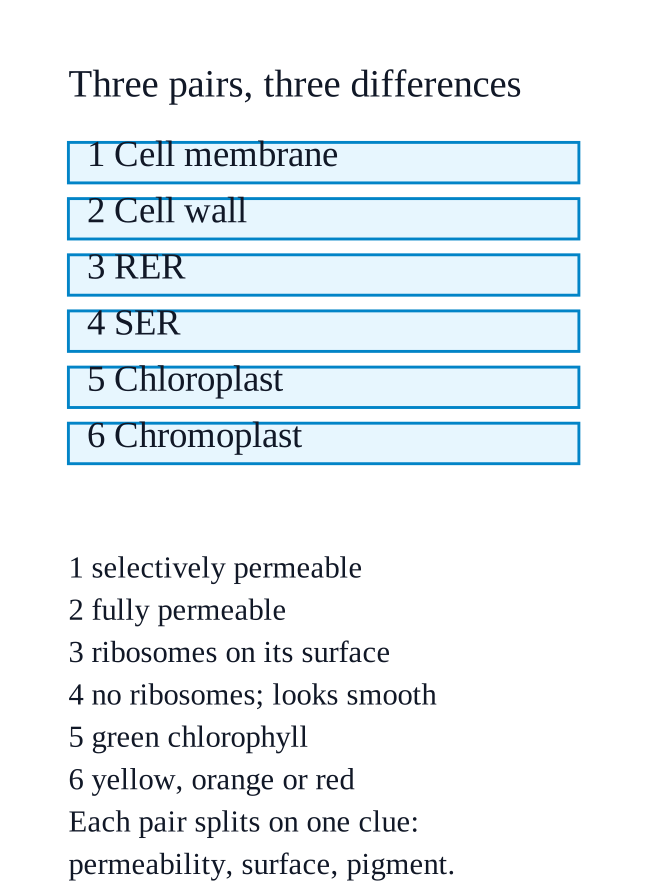
The cell membrane is selectively permeable: it lets some substances through and blocks others. In Activity $\displaystyle 2.2$ it let water move in and out of the potato cells but held back the salt and sugar molecules.
The cell wall is permeable: water and dissolved minerals pass straight through it. The two working together are what let a root absorb water and nutrients from the soil.
(ii) RER and SER — structure
RER carries ribosomes on its surface, which is what makes it look rough under an electron microscope.
SER has no ribosomes on its surface, so it looks smooth.
(iii) Chloroplasts and chromoplasts — pigments
Chloroplasts contain the green pigment chlorophyll, which absorbs sunlight for photosynthesis.
Chromoplasts contain pigments other than chlorophyll — yellow, orange or red — which colour flower petals and fruits and so attract pollinators and seed-dispersing animals.