Exercise 1
Represent graphically a displacement of east of north.
Not cross-checked
This solution has not been cross-checked against the answer printed in NCERT.
NCERT’s answer
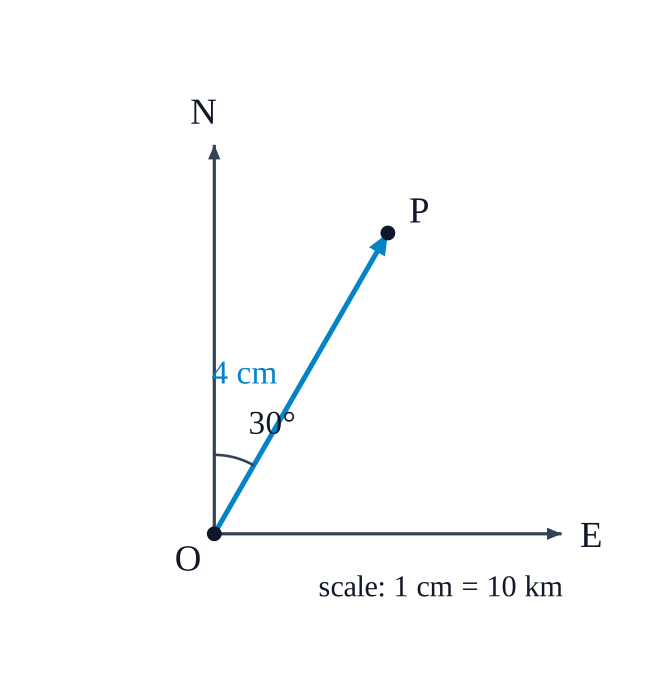
In the adjoining figure, the vector \(\displaystyle \overrightarrow{\mathrm{OP}}\) represents the required displacement. 
 A displacement is represented graphically by a directed line segment: its length, on a stated scale, gives the magnitude, and the direction of the arrow gives the direction of the displacement.Choose a scale first, otherwise "length" is meaningless. Take
\[1\ \mathrm{cm} \equiv 10\ \mathrm{km}, \qquad\text{so}\qquad 40\ \mathrm{km}\ \equiv\ 4\ \mathrm{cm}. \]Now fix the direction. The phrase \(\displaystyle 30^{\circ}\) east of north is measured starting from the north direction and turning through \(\displaystyle 30^{\circ}\) towards the east — it is not \(\displaystyle 30^{\circ}\) measured from the east, and not \(\displaystyle 30^{\circ}\) from the horizontal. This is the step most often got wrong.So, from a starting point O draw the north line ON. Rotate ON through \(\displaystyle 30^{\circ}\) towards OE (east) and along this ray mark P with \(\displaystyle \mathrm{OP}=4\ \mathrm{cm}\), putting the arrow head at P.The vector \(\displaystyle \overrightarrow{\mathrm{OP}}\) so drawn represents the required displacement: \(\displaystyle |\overrightarrow{\mathrm{OP}}|=40\ \mathrm{km}\), directed at \(\displaystyle 30^{\circ}\) east of north (equivalently, making \(\displaystyle 60^{\circ}\) with the east direction).
A displacement is represented graphically by a directed line segment: its length, on a stated scale, gives the magnitude, and the direction of the arrow gives the direction of the displacement.Choose a scale first, otherwise "length" is meaningless. Take
\[1\ \mathrm{cm} \equiv 10\ \mathrm{km}, \qquad\text{so}\qquad 40\ \mathrm{km}\ \equiv\ 4\ \mathrm{cm}. \]Now fix the direction. The phrase \(\displaystyle 30^{\circ}\) east of north is measured starting from the north direction and turning through \(\displaystyle 30^{\circ}\) towards the east — it is not \(\displaystyle 30^{\circ}\) measured from the east, and not \(\displaystyle 30^{\circ}\) from the horizontal. This is the step most often got wrong.So, from a starting point O draw the north line ON. Rotate ON through \(\displaystyle 30^{\circ}\) towards OE (east) and along this ray mark P with \(\displaystyle \mathrm{OP}=4\ \mathrm{cm}\), putting the arrow head at P.The vector \(\displaystyle \overrightarrow{\mathrm{OP}}\) so drawn represents the required displacement: \(\displaystyle |\overrightarrow{\mathrm{OP}}|=40\ \mathrm{km}\), directed at \(\displaystyle 30^{\circ}\) east of north (equivalently, making \(\displaystyle 60^{\circ}\) with the east direction).