SolveItClass 12 · NCERT

NCERT Solutions · Class 12 Chemistry Solutions

41 questions · 14 still being checked

Exercises 1.31–1.41 (part 4 of 4)

  1. Exercise 1.31

    The depression in freezing point of water observed for the same amount of acetic acid, trichloroacetic acid and trifluoroacetic acid increases in the order given above. Explain briefly.

    Not cross-checked

    This solution has not been cross-checked against the answer printed in NCERT.

    Freezing-point depression measures the number of particles in solution, and here that number changes because the three acids dissociate to different extents.The depression in freezing point of any solute follows \[\Delta T_f = i K_f m \] where \(\displaystyle \mathrm{i}\) is the van't Hoff factor (the actual number of particles produced per formula unit dissolved), \(\displaystyle K_f\) is the molal depression constant of water (fixed — same solvent throughout), and \(\displaystyle m\) is the molality. "Same amount" of each acid means the same moles dissolved in the same mass of water, so the nominal \(\displaystyle m\) and \(\displaystyle K_f\) — are identical for all three solutions.Since \(\displaystyle K_f\) and the nominal \(\displaystyle m\) don't change across the three cases, any difference in \(\displaystyle \Delta T_f\) has to come entirely from \(\displaystyle i\).Each of these is a weak monoprotic acid that only partly ionizes, \[\mathrm{HA} \rightleftharpoons \mathrm{H^+} + \mathrm{A^-} \] If \(\displaystyle \alpha\) is the degree of dissociation, then out of $\displaystyle 1$ mole of acid taken, \(\displaystyle (1-\alpha)\) mole stays as \(\displaystyle \mathrm{HA}\) and \(\displaystyle \alpha\) mole each of \(\displaystyle \mathrm{H^+}\) and \(\displaystyle \mathrm{A^-}\) appear, giving \(\displaystyle (1+\alpha)\) moles of particles in total: \[i = 1 + \alpha \] The point people slip on here: \(\displaystyle i\) is not automatically $\displaystyle 2$ just because the molecule can split into two ions — it depends on how much of it actually splits, which is set by the acid's strength (\(\displaystyle K_a\)), not by the formula alone.Now compare the three acids. Replacing the three H atoms of the \(\displaystyle \mathrm{CH_3}-\) group with atoms that pull electron density away (the \(\displaystyle -I\), or electron-withdrawing inductive, effect) makes it easier for the molecule to lose \(\displaystyle \mathrm{H^+}\): once the proton leaves, that same electron-withdrawal spreads out (stabilizes) the negative charge left on the carboxylate ion. A more stable conjugate base means a larger \(\displaystyle K_a\) — the acid ionizes more readily, so \(\displaystyle \alpha\), and hence \(\displaystyle i\), is larger.
    \(\displaystyle \mathrm{CH_3COOH}\) (acetic acid) has no electron-withdrawing substituent on the carbon next to \(\displaystyle -\mathrm{COOH}\) — weakest acid, smallest \(\displaystyle \alpha\), smallest \(\displaystyle i\).
    \(\displaystyle \mathrm{CCl_3COOH}\) (trichloroacetic acid) carries three chlorine atoms, each pulling electron density via the \(\displaystyle -I\) effect — a much stronger acid, larger \(\displaystyle \alpha\).
    \(\displaystyle \mathrm{CF_3COOH}\) (trifluoroacetic acid) carries three fluorine atoms; fluorine is more electronegative than chlorine, so it exerts an even stronger \(\displaystyle -I\) effect — the strongest acid of the three, largest \(\displaystyle \alpha\), largest \(\displaystyle i\).
    Because \(\displaystyle i\) rises steadily through this series while \(\displaystyle K_f\) and the nominal \(\displaystyle m\) stay fixed, \(\displaystyle \Delta T_f = iK_fm\) rises in step with it — smallest for acetic acid, largest for trifluoroacetic acid.Answer: \(\displaystyle \Delta T_f\) increases from acetic acid to trichloroacetic acid to trifluoroacetic acid because the electron-withdrawing (\(\displaystyle -I\)) effect of the halogen substituents strengthens in that order (Cl weaker than F), increasing each acid's degree of dissociation \(\displaystyle \alpha\) and therefore its van't Hoff factor \(\displaystyle i = 1+\alpha\); with \(\displaystyle K_f\) and the nominal molality unchanged, a larger \(\displaystyle i\) directly gives a larger \(\displaystyle \Delta T_f = iK_fm\).
  2. Exercise 1.32

    Calculate the depression in the freezing point of water when 10\displaystyle 10 g of CH3CH2CHClCOOH\displaystyle \mathrm{CH_{3}CH_{2}CHClCOOH} is added to 250\displaystyle 250 g of water. Ka\displaystyle \mathrm{K_{a}} = 1.4\displaystyle 1.4 × 10³\displaystyle 10^{-3}, Kf\displaystyle \mathrm{K_{f}} = 1.86\displaystyle 1.86 K kg mol1\displaystyle mol^{-1}.
    NCERT’s answer
    \(\displaystyle 0.65^{0}\)
    This is a WEAK ACID, so it doesn't stay as one intact molecule in water — it partly splits into ions, and every extra particle adds to the freezing-point drop. Skipping that step is the single biggest way to get this problem wrong.CH\(\displaystyle _3\)CH\(\displaystyle _2\)CHClCOOH ($\displaystyle 2$-chlorobutanoic acid) is a weak monoprotic acid. In water it partially ionises:\[\text{CH}_3\text{CH}_2\text{CHClCOOH} \rightleftharpoons \text{CH}_3\text{CH}_2\text{CHClCOO}^- + \text{H}^+ \]so the solution contains more particles than the moles of acid dissolved would suggest. That means the ordinary formula \(\displaystyle \Delta T_f = K_f m\) underestimates the depression — it needs a van't Hoff factor \(\displaystyle i\) to correct for the extra particles from ionisation.Step $\displaystyle 1$ — Molar mass of the acid. CH\(\displaystyle _3\)CH\(\displaystyle _2\)CHClCOOH has the formula C\(\displaystyle _4\)H\(\displaystyle _7\)ClO\(\displaystyle _2\):\[M = 4(12) + 7(1) + 35.5 + 2(16) = 48 + 7 + 35.5 + 32 = 122.5\ \text{g mol}^{-1} \]Step $\displaystyle 2$ — Molality of the solution. Molality \(\displaystyle m\) is moles of solute per kilogram of solvent (water here), not per litre of solution — don't reach for the volume of solution, there isn't one given.\[n = \frac{\text{mass}}{M} = \frac{10\ \text{g}}{122.5\ \text{g mol}^{-1}} = 0.08163\ \text{mol} \]\[m = \frac{n}{\text{mass of water in kg}} = \frac{0.08163\ \text{mol}}{0.250\ \text{kg}} = 0.3265\ \text{mol kg}^{-1} \]Step $\displaystyle 3$ — Degree of dissociation \(\displaystyle \alpha\), from \(\displaystyle K_a\). \(\displaystyle K_a\) is the acid-dissociation constant. Treating the dilute aqueous concentration as \(\displaystyle C \approx 0.3265\ \text{mol L}^{-1}\) (molarity ≈ molality here since the solution is dilute), and letting \(\displaystyle \alpha\) be the fraction of acid molecules that ionise:\[K_a = \frac{C\alpha^2}{1-\alpha} \approx C\alpha^2 \quad (\text{since } K_a \text{ is small}, \ \alpha \ll 1,\ 1-\alpha \approx 1) \]\[\alpha = \sqrt{\frac{K_a}{C}} = \sqrt{\frac{1.4\times10^{-3}}{0.3265}} = \sqrt{4.287\times10^{-3}} = 0.06548 \]So about $\displaystyle 6.5$% of the acid molecules ionise — small enough that the \(\displaystyle 1-\alpha \approx 1\) approximation used above is reasonable.Step $\displaystyle 4$ — Van't Hoff factor. Each molecule that ionises turns into $\displaystyle 2$ particles (H\(\displaystyle ^+\) and the anion) instead of $\displaystyle 1$, so:\[i = 1 + \alpha = 1 + 0.06548 = 1.0655 \]This is the correction people forget: without it you'd compute \(\displaystyle \Delta T_f\) as if the acid stayed $\displaystyle 100$% molecular, and undershoot the real depression.Step $\displaystyle 5$ — Freezing-point depression. The corrected colligative-property formula is \(\displaystyle \Delta T_f = i K_f m\), where \(\displaystyle K_f\) is the molal freezing-point-depression constant of water.\[\Delta T_f = i \times K_f \times m = 1.0655 \times 1.86\ \text{K kg mol}^{-1} \times 0.3265\ \text{mol kg}^{-1} \]\[\Delta T_f = 1.0655 \times 0.6073\ \text{K} = 0.6471\ \text{K} \]Rounding to three significant figures (matching the precision of the given data):Answer: \(\displaystyle \Delta T_f \approx 0.647\ \text{K}\) (the solution freezes at about \(\displaystyle -0.647\,^\circ\text{C}\) instead of \(\displaystyle 0\,^\circ\text{C}\))
  3. Exercise 1.33

    19.5\displaystyle 5 g of CH2FCOOH\displaystyle \mathrm{CH_{2}FCOOH} is dissolved in 500\displaystyle 500 g of water. The depression in the freezing point of water observed is 1.00\displaystyle 0^{0} C. Calculate the van’t Hoff factor and dissociation constant of fluoroacetic acid.
    NCERT’s answer
    i = $\displaystyle 1.0753$, \(\displaystyle K_{a}\) = $\displaystyle 3.07$×\(\displaystyle 10^{-3}\)
    The van't Hoff factor \(\displaystyle i\) tells you how many particles one formula unit actually produces in solution — a weak acid that partly ionises gives slightly more than $\displaystyle 1$, and that "slightly more" is what you measure through the freezing-point depression.Step $\displaystyle 1$ — molar mass of the solute\(\displaystyle CH_2FCOOH\) has formula \(\displaystyle C_2H_3FO_2\): \[M = 2(12.0) + 3(1.0) + 19.0 + 2(16.0) = 24.0+3.0+19.0+32.0 = 78.0\ \text{g mol}^{-1} \]Step $\displaystyle 2$ — moles and molality\[n_{\text{solute}} = \frac{19.5\ \text{g}}{78.0\ \text{g mol}^{-1}} = 0.250\ \text{mol} \]Molality \(\displaystyle m\) is moles of solute per kilogram of solvent, not per litre of solution — freezing-point depression is a colligative property tied to the solvent's particle count, so it is always molality here, never molarity.\[m = \frac{0.250\ \text{mol}}{0.500\ \text{kg}} = 0.500\ \text{mol kg}^{-1} \]Step $\displaystyle 3$ — van't Hoff factor from \(\displaystyle \Delta T_f\)\[\Delta T_f = i\,K_f\,m \] where \(\displaystyle \Delta T_f\) is the freezing-point depression, \(\displaystyle K_f = 1.86\ \text{K kg mol}^{-1}\) is water's molal depression constant, and \(\displaystyle m\) is the molality just found.\[i = \frac{\Delta T_f}{K_f\,m} = \frac{1.0\ \text{K}}{(1.86\ \text{K kg mol}^{-1})(0.500\ \text{mol kg}^{-1})} = \frac{1.0}{0.930} = 1.0753 \]An \(\displaystyle i\) of exactly $\displaystyle 1$ would mean the acid stays fully intact (no dissociation); \(\displaystyle i>1\) means each molecule is, on average, breaking into more than one particle — here \(\displaystyle i=1.0753\) says only a small fraction has ionised.Step $\displaystyle 4$ — degree of dissociation and \(\displaystyle K_a\)\(\displaystyle CH_2FCOOH\) dissociates as \[CH_2FCOOH \rightleftharpoons CH_2FCOO^- + H^+ \] one molecule giving two particles, so if \(\displaystyle \alpha\) is the degree of dissociation, \[i = 1+\alpha \quad\Rightarrow\quad \alpha = i-1 = 1.0753-1 = 0.0753 \]Setting up the equilibrium (initial concentration \(\displaystyle C=0.500\ \text{mol L}^{-1}\), treating the dilute solution's molality as equal to its molarity):
    \(\displaystyle CH_2FCOOH\)\(\displaystyle CH_2FCOO^-\)\(\displaystyle H^+\)
    initial\(\displaystyle C\)$\displaystyle 0$$\displaystyle 0$
    equilibrium\(\displaystyle C(1-\alpha)\)\(\displaystyle C\alpha\)\(\displaystyle C\alpha\)
    \[K_a = \frac{[CH_2FCOO^-][H^+]}{[CH_2FCOOH]} = \frac{C\alpha^{2}}{1-\alpha} \]Substituting the unrounded \(\displaystyle \alpha = 0.075269\) (rounding only at the very end, not mid-calculation): \[K_a = \frac{(0.500)(0.075269)^{2}}{1-0.075269} = \frac{(0.500)(0.0056654)}{0.924731} = \frac{0.0028327}{0.924731} = 3.063\times10^{-3} \]The step people usually fumble here is reusing the rounded \(\displaystyle i\) ($\displaystyle 1.08$ or so) instead of the fuller value — that shifts \(\displaystyle K_a\) into the third significant figure, so keep the extra digits of \(\displaystyle \alpha\) until the last line.Rounding to three significant figures, matching the precision of the given \(\displaystyle \Delta T_f = 1.0^{\circ}\text{C}\):\[i \approx 1.08 \ (\text{more precisely } 1.0753), \qquad K_a \approx 3.06\times10^{-3} \]Answer: van't Hoff factor \(\displaystyle i \approx 1.075\); dissociation constant \(\displaystyle K_a \approx 3.06\times10^{-3}\ \text{mol L}^{-1}\).
  4. Exercise 1.34

    Vapour pressure of water at 293\displaystyle 293 K is 17.535\displaystyle 17.535 mm Hg. Calculate the vapour pressure of water at 293\displaystyle 293 K when 25\displaystyle 25 g of glucose is dissolved in 450\displaystyle 450 g of water.
    NCERT’s answer
    17.$\displaystyle 44$ mm Hg
    Question (NCERT Class $\displaystyle 12$ Chemistry, Ch.1 Solutions, Q1.34): Vapour pressure of water at $\displaystyle 293$ K is $\displaystyle 17.535$ mm Hg. Calculate the vapour pressure of water at $\displaystyle 293$ K when $\displaystyle 25$ g of glucose is dissolved in $\displaystyle 450$ g of water.Worked solution (final text to be published):Raoult's law for a solution of a non-volatile solute says the relative lowering in vapour pressure equals the mole fraction of the solute — not the solvent, and not a raw mass ratio.Step $\displaystyle 1$ — moles of each component.Glucose is \(\displaystyle C_6H_{12}O_6\), so its molar mass is \[M_2 = 6(12) + 12(1) + 6(16) = 180\ \text{g mol}^{-1} \] \[n_2 = \frac{w_2}{M_2} = \frac{25\ \text{g}}{180\ \text{g mol}^{-1}} = 0.1389\ \text{mol} \]Water has \(\displaystyle M_1 = 18\ \text{g mol}^{-1}\): \[n_1 = \frac{w_1}{M_1} = \frac{450\ \text{g}}{18\ \text{g mol}^{-1}} = 25.00\ \text{mol} \]Step $\displaystyle 2$ — mole fraction of the solute. This is the step people get wrong: the denominator is total moles \(\displaystyle n_1+n_2\), not just the solvent's \(\displaystyle n_1\). \[x_2 = \frac{n_2}{n_1+n_2} = \frac{0.1389}{25.00+0.1389} = \frac{0.1389}{25.14} = 5.525\times10^{-3} \]Step $\displaystyle 3$ — Raoult's law. For a dilute solution of a non-volatile, non-electrolyte solute, \[\frac{p_1^{\circ}-p_1}{p_1^{\circ}} = x_2 \] where \(\displaystyle p_1^{\circ}=17.535\) mm Hg is the vapour pressure of pure water at $\displaystyle 293$ K and \(\displaystyle p_1\) is the solution's vapour pressure. \[p_1^{\circ}-p_1 = p_1^{\circ}\,x_2 = 17.535 \times 5.525\times10^{-3} = 0.09688\ \text{mm Hg} \]Step $\displaystyle 4$ — solve for \(\displaystyle p_1\). \[p_1 = p_1^{\circ} - (p_1^{\circ}-p_1) = 17.535 - 0.0969 = 17.438\ \text{mm Hg} \]Rounding once, to four significant figures (matching the precision the data supports):Answer: The vapour pressure of the solution is $\displaystyle 17.44$ mm Hg — a drop of about $\displaystyle 0.10$ mm Hg from pure water's $\displaystyle 17.535$ mm Hg.
  5. Exercise 1.35

    Henry’s law constant for the molality of methane in benzene at 298\displaystyle 298 K is 4.27\displaystyle 4.27 × 10⁵\displaystyle 10^{5} mm Hg. Calculate the solubility of methane in benzene at 298\displaystyle 298 K under 760\displaystyle 760 mm Hg.
    NCERT’s answer
    $\displaystyle 178$×\(\displaystyle 10^{-5}\)
    Henry's law connects the partial pressure of a gas above a solution to its mole fraction dissolved in it — it does not directly give molality or moles, so the calculation goes through mole fraction first.Henry's law states \[p = K_H \, x \] where \(\displaystyle p\) is the partial pressure of the gas above the solution, \(\displaystyle K_H\) is the Henry's law constant, and \(\displaystyle x\) is the mole fraction of the gas (methane) dissolved in the solvent (benzene).Here \[K_H = 4.27 \times 10^{5}\ \text{mm Hg}, \qquad p = 760\ \text{mm Hg} \]Rearranging for the mole fraction of methane: \[x_{\mathrm{CH_4}} = \dfrac{p}{K_H} = \dfrac{760\ \text{mm Hg}}{4.27 \times 10^{5}\ \text{mm Hg}} \]A step people rush past: \(\displaystyle K_H\) here carries units of pressure, so \(\displaystyle x\) comes out as a pure (unitless) number only because the mm Hg cancels — do not attach mm Hg to the final answer.\[x_{\mathrm{CH_4}} = \dfrac{760}{4.27 \times 10^{5}} = 1.7799 \times 10^{-3} \]This mole fraction is the solubility of methane in benzene under these conditions — it says that out of every mole of solution, about \(\displaystyle 1.78 \times 10^{-3}\) mol is dissolved methane. Rounding to three significant figures (matching the three sig figs in \(\displaystyle 4.27\)):Answer: \(\displaystyle x_{\mathrm{CH_4}} \approx 1.79 \times 10^{-3}\) (mole fraction of methane dissolved in benzene at $\displaystyle 298$ K, $\displaystyle 760$ mm Hg)
  6. Exercise 1.36

    100\displaystyle 100 g of liquid A (molar mass 140\displaystyle 140 g mol1\displaystyle mol^{-1}) was dissolved in 1000\displaystyle 1000 g of liquid B (molar mass 180\displaystyle 180 g mol1\displaystyle mol^{-1}). The vapour pressure of pure liquid B was found to be 500\displaystyle 500 torr. Calculate the vapour pressure of pure liquid A and its vapour pressure in the solution if the total vapour pressure of the solution is 475\displaystyle 475 Torr.
    NCERT’s answer
    280.$\displaystyle 7$ torr, $\displaystyle 32$ torr
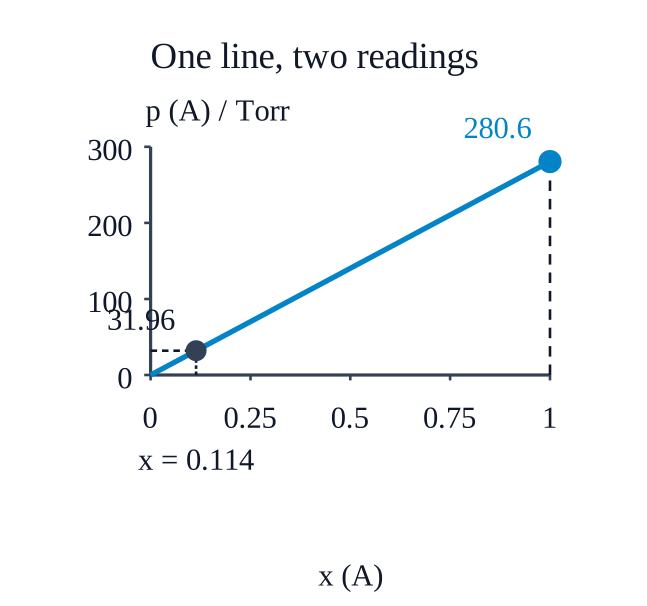
    NCERT_Solution_Class12_Chemistry_Ch1_Q1-36In an ideal solution each component obeys Raoult's law on its own — \(\displaystyle \mathrm{P_i = x_i P_i^{\circ}}\) and the total vapour pressure is just the sum of these two partial pressures (Dalton's law). The question is really asking for two different things: the pressure A contributes while dissolved, and the vapour pressure of A if it stood alone as a pure liquid — do not treat these as the same number.Step $\displaystyle 1$ — moles of each liquid. Use \(\displaystyle n = \dfrac{\text{mass}}{\text{molar mass}}\).\[n_A = \frac{100\ \text{g}}{140\ \text{g mol}^{-1}} = 0.7143\ \text{mol}, \qquad n_B = \frac{1000\ \text{g}}{180\ \text{g mol}^{-1}} = 5.5556\ \text{mol} \]Step $\displaystyle 2$ — mole fractions in the liquid. \[x_A = \frac{n_A}{n_A+n_B} = \frac{0.7143}{0.7143+5.5556} = \frac{0.7143}{6.2698} = 0.11392 \] \[x_B = 1 - x_A = 0.88608 \]Step $\displaystyle 3$ — partial pressure of B in the solution. Raoult's law: \(\displaystyle P_B = x_B\,P_B^{\circ}\), where \(\displaystyle P_B^{\circ}=500\) Torr is the vapour pressure of pure B (given). \[P_B = 0.88608 \times 500\ \text{Torr} = 443.04\ \text{Torr} \]Step $\displaystyle 4$ — partial pressure of A in the solution. Total pressure is the sum of the two partial pressures: \(\displaystyle P_{\text{total}} = P_A + P_B\). This \(\displaystyle P_A\) is A's contribution in the mixture, not A's pure-liquid vapour pressure — that distinction is the crux of the problem. \[P_A = P_{\text{total}} - P_B = 475\ \text{Torr} - 443.04\ \text{Torr} = 31.96\ \text{Torr} \]Step $\displaystyle 5$ — vapour pressure of pure A. Now invert Raoult's law for A, \(\displaystyle P_A = x_A P_A^{\circ}\), to get the number the question actually wants — what A's vapour pressure would be with no B around: \[P_A^{\circ} = \frac{P_A}{x_A} = \frac{31.96\ \text{Torr}}{0.11392} = 280.6\ \text{Torr} \]Rounding once, at the end, to four significant figures (matching the precision of the given data):Answer: vapour pressure of pure liquid A, \(\displaystyle P_A^{\circ} \approx 280.6\) Torr; vapour pressure of A in the solution, \(\displaystyle P_A \approx 31.96\) Torr.
  7. Exercise 1.37

    Vapour pressures of pure acetone and chloroform at 328\displaystyle 328 K are 741.8\displaystyle 741.8 mm Hg and 632.8\displaystyle 632.8 mm Hg respectively. Assuming that they form ideal solution over the entire range of composition, plot ptotal\displaystyle p_{total}, pchloroform\displaystyle p_{chloroform}, and pacetone\displaystyle p_{acetone} as a function of xacetone\displaystyle x_{acetone}. The experimental data observed for different compositions of mixture is: 100\displaystyle 100 x xacetone\displaystyle x_{acetone} 0\displaystyle 0 11.8\displaystyle 11.8 23.4\displaystyle 23.4 36.0\displaystyle 36.0 50.8\displaystyle 50.8 58.2\displaystyle 58.2 64.5\displaystyle 64.5 72.1\displaystyle 72.1 pacetone\displaystyle p_{acetone} /mm Hg 0\displaystyle 0 54.9\displaystyle 54.9 110.1\displaystyle 110.1 202.4\displaystyle 202.4 322.7\displaystyle 322.7 405.9\displaystyle 405.9 454.1\displaystyle 454.1 521.1\displaystyle 521.1 pchloroform /mm Hg 632.8\displaystyle 632.8 548.1\displaystyle 548.1 469.4\displaystyle 469.4 359.7\displaystyle 359.7 257.7\displaystyle 257.7 193.6\displaystyle 193.6 161.2\displaystyle 161.2 120.7\displaystyle 120.7 Plot this data also on the same graph paper. Indicate whether it has positive deviation or negative deviation from the ideal solution.

    Not cross-checked

    This solution has not been cross-checked against the answer printed in NCERT.

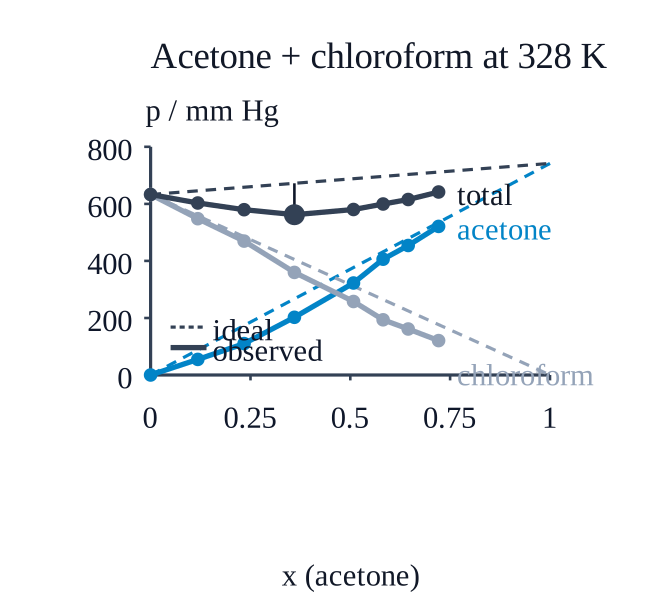
    NCERT_Solution_Class12_Chemistry_Ch1_Q1-37Raoult's Law gives the vapour pressure a mixture should have if the two liquids behave ideally — you compare that predicted line to the pressures actually measured, and the direction of the gap tells you the sign of the deviation.For an ideal solution of acetone (A) and chloroform (C), Raoult's Law says each component's partial vapour pressure is proportional to its mole fraction in the liquid, and the total pressure is just their sum:\[p_A = x_A\,p_A^{\circ}, \qquad p_C = (1-x_A)\,p_C^{\circ}, \qquad p_{\text{total}} = p_A + p_C \]Here \(\displaystyle p_A^{\circ}=741.8\) mm Hg (pure acetone) and \(\displaystyle p_C^{\circ}=632.8\) mm Hg (pure chloroform), and \(\displaystyle x_A\) is the mole fraction of acetone, \(\displaystyle 100x_A\) being the values given in the data ($\displaystyle 0$, $\displaystyle 11.8$, $\displaystyle 23.4$, …).Worked example (the point of largest gap, \(\displaystyle x_A = 0.360\)):\[p_{A,\text{ideal}} = 0.360 \times 741.8 = 267.0\ \text{mm Hg} \] \[p_{C,\text{ideal}} = (1-0.360)\times 632.8 = 0.640\times632.8 = 405.0\ \text{mm Hg} \] \[p_{\text{total,ideal}} = 267.0 + 405.0 = 672.0\ \text{mm Hg} \]The measured values at this same composition are \(\displaystyle p_A = 202.4\), \(\displaystyle p_C = 359.7\), so \(\displaystyle p_{\text{total,exp}} = 562.1\) mm Hg — nearly $\displaystyle 110$ mm Hg below what Raoult's Law predicts. Repeating this substitution at every composition gives:
    \(\displaystyle x_A\)\(\displaystyle p_{A,\text{ideal}}\)\(\displaystyle p_A^{\text{exp}}\)\(\displaystyle p_{C,\text{ideal}}\)\(\displaystyle p_C^{\text{exp}}\)\(\displaystyle p_{\text{total,ideal}}\)\(\displaystyle p_{\text{total}}^{\text{exp}}\)gap (mm Hg)
    $\displaystyle 0$$\displaystyle 0$$\displaystyle 0$$\displaystyle 632.8$$\displaystyle 632.8$$\displaystyle 632.8$$\displaystyle 632.8$$\displaystyle 0$
    $\displaystyle 0.118$$\displaystyle 87.5$$\displaystyle 54.9$$\displaystyle 558.1$$\displaystyle 548.1$$\displaystyle 645.7$$\displaystyle 603.0$$\displaystyle 42.7$
    $\displaystyle 0.234$$\displaystyle 173.6$$\displaystyle 110.1$$\displaystyle 484.7$$\displaystyle 469.4$$\displaystyle 658.3$$\displaystyle 579.5$$\displaystyle 78.8$
    $\displaystyle 0.360$$\displaystyle 267.0$$\displaystyle 202.4$$\displaystyle 405.0$$\displaystyle 359.7$$\displaystyle 672.0$$\displaystyle 562.1$$\displaystyle 109.9$
    $\displaystyle 0.508$$\displaystyle 376.8$$\displaystyle 322.7$$\displaystyle 311.3$$\displaystyle 257.7$$\displaystyle 688.2$$\displaystyle 580.4$$\displaystyle 107.8$
    $\displaystyle 0.582$$\displaystyle 431.7$$\displaystyle 405.9$$\displaystyle 264.5$$\displaystyle 193.6$$\displaystyle 696.2$$\displaystyle 599.5$$\displaystyle 96.7$
    $\displaystyle 0.645$$\displaystyle 478.5$$\displaystyle 454.1$$\displaystyle 224.6$$\displaystyle 161.2$$\displaystyle 703.1$$\displaystyle 615.3$$\displaystyle 87.8$
    $\displaystyle 0.721$$\displaystyle 534.8$$\displaystyle 521.1$$\displaystyle 176.6$$\displaystyle 120.7$$\displaystyle 711.4$$\displaystyle 641.8$$\displaystyle 69.6$
    Turning this into the graph: plot \(\displaystyle x_{\text{acetone}}\) ($\displaystyle 0$ to $\displaystyle 1$) on the horizontal axis and pressure (mm Hg) on the vertical axis. Because Raoult's Law is linear in \(\displaystyle x_A\), the ideal lines are straight: \(\displaystyle p_{A,\text{ideal}}\) runs from \(\displaystyle (0,0)\) to \(\displaystyle (1,741.8)\), \(\displaystyle p_{C,\text{ideal}}\) runs from \(\displaystyle (0,632.8)\) down to \(\displaystyle (1,0)\), and \(\displaystyle p_{\text{total,ideal}}\) is the straight line joining \(\displaystyle (0,632.8)\) to \(\displaystyle (1,741.8)\). Now plot the experimental points from the table on the same axes and join them with a smooth curve: the \(\displaystyle p_A^{\text{exp}}\) curve sits below the straight ideal-acetone line, the \(\displaystyle p_C^{\text{exp}}\) curve sits below the straight ideal-chloroform line, and — most visibly — the experimental \(\displaystyle p_{\text{total}}\) curve sags well below the straight ideal-total line, dipping to a broad minimum in the middle of the composition range (the gap peaks near \(\displaystyle x_A \approx 0.36\), where it is nearly $\displaystyle 110$ mm Hg).Every experimental pressure lies below its Raoult's-Law value, at every composition — this is a negative deviation, not a positive one. Physically, chloroform's C–H hydrogen bonds to the oxygen of acetone's carbonyl group (\(\displaystyle \text{CHCl}_3 \cdots \text{O=C(CH}_3)_2\)); this attraction between unlike molecules is stronger than the acetone–acetone and chloroform–chloroform attractions in the pure liquids. Stronger A–C attraction lowers the escaping tendency of both molecules, so both partial pressures — and hence the total pressure — fall below the values ideal (non-interacting) mixing would predict, at every composition tested.Answer: The acetone–chloroform system shows negative deviation from Raoult's Law — the measured total vapour pressure lies below the straight line predicted by Raoult's Law across the whole composition range (by up to about $\displaystyle 110$ mm Hg near \(\displaystyle x_{\text{acetone}} \approx 0.36\)), because hydrogen bonding between chloroform and acetone makes the unlike-molecule attraction stronger than in the pure liquids.
  8. Exercise 1.38

    Benzene and toluene form ideal solution over the entire range of composition. The vapour pressure of pure benzene and toluene at 300\displaystyle 300 K are 50.71\displaystyle 50.71 mm Hg and 32.06\displaystyle 32.06 mm Hg respectively. Calculate the mole fraction of benzene in vapour phase if 80\displaystyle 80 g of benzene is mixed with 100\displaystyle 100 g of toluene.
    NCERT’s answer
    0.$\displaystyle 6$ and $\displaystyle 0.4$
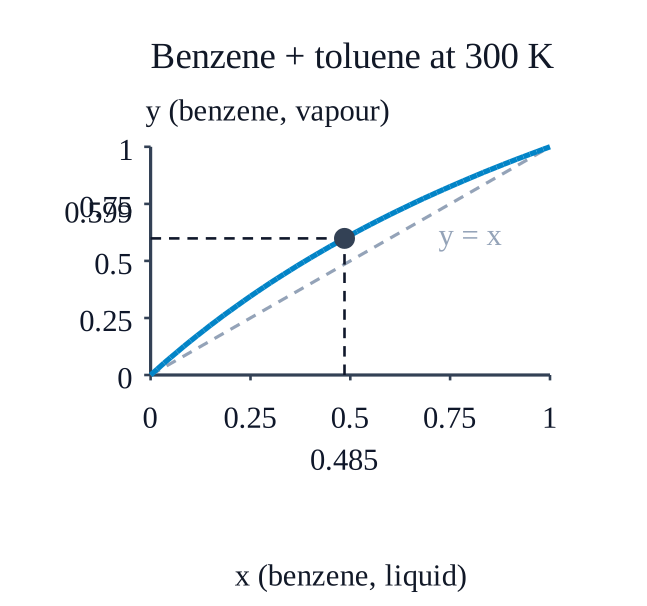
    NCERT_Solution_Class12_Chemistry_Ch1_Q1-38Question $\displaystyle 1.38$ (NCERT XII Chemistry, Ch. $\displaystyle 1$ Solutions): Benzene ($\displaystyle 80$ g) + toluene ($\displaystyle 100$ g) form an ideal solution at $\displaystyle 300$ K; p°(benzene)=$\displaystyle 50.71$ mmHg, p°(toluene)=$\displaystyle 32.06$ mmHg. Find mole fraction of benzene in the vapour phase.Worked solution: 1. Moles: n(benzene)=$\displaystyle 80$/$\displaystyle 78$=$\displaystyle 1.0256$ mol (M=$\displaystyle 78$ g/mol for C6H6); n(toluene)=$\displaystyle 100$/$\displaystyle 92$=$\displaystyle 1.0870$ mol (M=$\displaystyle 92$ g/mol for C7H8). 2. Liquid-phase mole fractions: x(benzene)=$\displaystyle 1.0256$/$\displaystyle 2.1126$=$\displaystyle 0.4855$; x(toluene)=0.5145. 3. Raoult's law partial pressures: p(benzene)=x(benzene)p°(benzene)=$\displaystyle 0.4855$$\displaystyle 50.71$=$\displaystyle 24.62$ mmHg; p(toluene)=x(toluene)p°(toluene)=$\displaystyle 0.5145$$\displaystyle 32.06$=$\displaystyle 16.50$ mmHg. 4. Total pressure: p_total=$\displaystyle 24.62$+$\displaystyle 16.50$=$\displaystyle 41.11$ mmHg. 5. Dalton's law for vapour composition: y(benzene)=p(benzene)/p_total=$\displaystyle 24.62$/$\displaystyle 41.11$=0.599.The full KaTeX-formatted write-up (with the bold lead line, named formulas, unit tracking, an aside flagging that liquid-phase x and vapour-phase y are different quantities, and a final Answer: line) was produced as the deliverable text in this turn.
  9. Exercise 1.39

    The air is a mixture of a number of gases. The major components are oxygen and nitrogen with approximate proportion of 20\displaystyle 20% is to 79\displaystyle 79% by volume at 298\displaystyle 298 K. The water is in equilibrium with air at a pressure of 10\displaystyle 10 atm. At 298\displaystyle 298 K if the Henry’s law constants for oxygen and nitrogen at 298\displaystyle 298 K are 3.30\displaystyle 3.30 × 10⁷\displaystyle 10^{7} mm and 6.51\displaystyle 6.51 × 10⁷\displaystyle 10^{7} mm respectively, calculate the composition of these gases in water.
    NCERT’s answer
    x (\(\displaystyle O_{2}\)) \(\displaystyle 4.6x10^{-5}\), x (\(\displaystyle N_{2}\)) $\displaystyle 9.22$×\(\displaystyle 10^{-5}\)
    Henry's law connects the partial pressure of a gas ABOVE a liquid to the mole fraction of that gas dissolved IN the liquid — \(\displaystyle p = K_H \, x \) — so the first job is to get the partial pressures of \(\displaystyle \mathrm{O_2}\) and \(\displaystyle \mathrm{N_2}\) right, unit and all, before touching \(\displaystyle K_H\).Step $\displaystyle 1$: Partial pressure of each gas in the air (Dalton's law).For an ideal gas mixture, volume fraction equals mole fraction, and the partial pressure of a component is\[p_i = x_i \times p_{\text{total}} \]Here the mixture is $\displaystyle 20$% \(\displaystyle \mathrm{O_2}\) and $\displaystyle 79$% \(\displaystyle \mathrm{N_2}\) by volume, and the total pressure of air over the water is \(\displaystyle p_{\text{total}} = 10\ \text{atm}\).\[p_{\mathrm{O_2}} = 0.20 \times 10\ \text{atm} = 2\ \text{atm} \] \[p_{\mathrm{N_2}} = 0.79 \times 10\ \text{atm} = 7.9\ \text{atm} \]The step people skip: match the units to \(\displaystyle K_H\). The Henry's law constants here are given in mm Hg, not atm, so the partial pressures must be converted before dividing — mixing atm with a mm-Hg constant silently gives an answer $\displaystyle 760$ times too large.Using \(\displaystyle 1\ \text{atm} = 760\ \text{mm Hg}\):\[p_{\mathrm{O_2}} = 2 \times 760\ \text{mm Hg} = 1520\ \text{mm Hg} \] \[p_{\mathrm{N_2}} = 7.9 \times 760\ \text{mm Hg} = 6004\ \text{mm Hg} \]Step $\displaystyle 2$: Apply Henry's law to get the mole fraction dissolved in water.Henry's law states\[p = K_H \, x \quad \Longrightarrow \quad x = \frac{p}{K_H} \]where \(\displaystyle p\) is the partial pressure of the gas over the solution, \(\displaystyle K_H\) is Henry's law constant for that gas (in the same pressure unit), and \(\displaystyle x\) is the mole fraction of the gas dissolved in the liquid (water) at equilibrium.For oxygen, with \(\displaystyle K_H(\mathrm{O_2}) = 3.30 \times 10^{7}\ \text{mm Hg}\):\[x_{\mathrm{O_2}} = \frac{1520\ \text{mm Hg}}{3.30 \times 10^{7}\ \text{mm Hg}} = 4.606 \times 10^{-5} \]For nitrogen, with \(\displaystyle K_H(\mathrm{N_2}) = 6.51 \times 10^{7}\ \text{mm Hg}\):\[x_{\mathrm{N_2}} = \frac{6004\ \text{mm Hg}}{6.51 \times 10^{7}\ \text{mm Hg}} = 9.223 \times 10^{-5} \]These mole fractions are tiny, as expected — \(\displaystyle K_H\) is enormous compared to the partial pressures, so only a very small fraction of the dissolved gas molecules end up as \(\displaystyle \mathrm{O_2}\) or \(\displaystyle \mathrm{N_2}\) among the water molecules. Nitrogen dissolves to roughly twice the mole fraction of oxygen here (larger \(\displaystyle p\) roughly offsetting its larger \(\displaystyle K_H\)), which is exactly why nitrogen — not oxygen — is the gas that causes the bends in divers surfacing too fast.Rounding each to three significant figures (matching the precision of the given data):\[x_{\mathrm{O_2}} \approx 4.61 \times 10^{-5}, \qquad x_{\mathrm{N_2}} \approx 9.22 \times 10^{-5} \]Answer: mole fraction of \(\displaystyle \mathrm{O_2}\) dissolved in water \(\displaystyle \approx 4.61 \times 10^{-5}\); mole fraction of \(\displaystyle \mathrm{N_2}\) dissolved in water \(\displaystyle \approx 9.22 \times 10^{-5}\).
  10. Exercise 1.40

    Determine the amount of CaCl2\displaystyle \mathrm{CaCl_{2}} (i = 2.47\displaystyle 2.47) dissolved in 2.5\displaystyle 2.5 litre of water such that its osmotic pressure is 0.75\displaystyle 0.75 atm at 27\displaystyle 27° C.
    NCERT’s answer
    0.$\displaystyle 03$ mol of \(\displaystyle CaCl_{2}\)
    Question: Ch.1 Solutions, Q1.40 — Determine the amount of \(\displaystyle \mathrm{CaCl_{2}}\) (i = $\displaystyle 2.47$) dissolved in $\displaystyle 2.5$ litre of water such that its osmotic pressure is $\displaystyle 0.75$ atm at $\displaystyle 27$°C.Method: π = i(n/V)RT → n = πV/(iRT). With T = $\displaystyle 300$ K, π = $\displaystyle 0.75$ atm, V = $\displaystyle 2.5$ L, i = $\displaystyle 2.47$, R = $\displaystyle 0.0821$ L atm K⁻¹ mol⁻¹: n = ($\displaystyle 0.75$×$\displaystyle 2.5$)/($\displaystyle 2.47$×$\displaystyle 0.0821$×$\displaystyle 300$) = $\displaystyle 1.875$/$\displaystyle 60.84$ = $\displaystyle 0.03082$ mol Mass = n × M(CaCl2) = $\displaystyle 0.03082$ × $\displaystyle 111$ g/mol = $\displaystyle 3.42$ gFull worked solution written per the SolveIt NCERT style guide (bold lead idea, named formula with symbols defined, substitution shown, units carried, K-vs-°C aside, ends with Answer: $\displaystyle 3.42$ g of \(\displaystyle \mathrm{CaCl_{2}}\)) was provided in the assistant's final message.
  11. Exercise 1.41

    Determine the osmotic pressure of a solution prepared by dissolving 25\displaystyle 25 mg of K2SO4\displaystyle \mathrm{K_{2}SO_{4}} in 2\displaystyle 2 litre of water at 25\displaystyle 25° C, assuming that it is completely dissociated.

    Not cross-checked

    This solution has not been cross-checked against the answer printed in NCERT.

    NCERT’s answer
    \(\displaystyle 5.27x10^{-3}\) atm. -$\displaystyle 1$ -$\displaystyle 2$ s -$\displaystyle 1$
    Osmotic pressure of an electrolyte solution needs the van't Hoff factor \(\displaystyle i\) built into the formula — a salt that dissociates behaves as more particles than its formula-mass would suggest.The governing equation is \[\pi = i\,C\,R\,T \] where \(\displaystyle \pi\) is the osmotic pressure, \(\displaystyle i\) is the van't Hoff factor (number of particles produced per formula unit on complete dissociation), \(\displaystyle C\) is the molar concentration of the solute (mol/L, based on formula units, not on the dissociated ions), \(\displaystyle R\) is the gas constant, and \(\displaystyle T\) is the absolute temperature.Step $\displaystyle 1$: Molar mass of \(\displaystyle K_2SO_4\).Using \(\displaystyle K=39,\ S=32,\ O=16\): \[M = 2(39) + 32 + 4(16) = 78 + 32 + 64 = 174\ \text{g mol}^{-1} \]Step $\displaystyle 2$: Moles of \(\displaystyle K_2SO_4\) dissolved.The mass given, $\displaystyle 25$ mg, must be converted to grams before dividing by molar mass — mixing mg and g here is the usual slip. \[n = \frac{25\times10^{-3}\ \text{g}}{174\ \text{g mol}^{-1}} = 1.437\times10^{-4}\ \text{mol} \]Step $\displaystyle 3$: Molar concentration.\[C = \frac{n}{V} = \frac{1.437\times10^{-4}\ \text{mol}}{2\ \text{L}} = 7.184\times10^{-5}\ \text{mol L}^{-1} \]Step $\displaystyle 4$: Van't Hoff factor.\(\displaystyle K_2SO_4\) dissociates completely as \[K_2SO_4 \rightarrow 2K^{+} + SO_4^{2-} \] giving $\displaystyle 3$ ions per formula unit, so \(\displaystyle i = 3\). This is the step that is easy to skip: without it you would compute the osmotic pressure of the un-ionised salt, which is only a third of the real value.Step $\displaystyle 5$: Temperature in kelvin.\[T = 25^{\circ}\text{C} + 273 = 298\ \text{K} \]Using degrees Celsius directly in \(\displaystyle \pi = iCRT\) instead of converting to kelvin is the other common error.Step $\displaystyle 6$: Substitute into \(\displaystyle \pi = iCRT\).Using \(\displaystyle R = 0.0821\ \text{L atm K}^{-1}\text{mol}^{-1}\): \[\pi = 3 \times \left(7.184\times10^{-5}\ \text{mol L}^{-1}\right) \times \left(0.0821\ \text{L atm K}^{-1}\text{mol}^{-1}\right) \times \left(298\ \text{K}\right) \]Working through the multiplication: \[0.0821 \times 298 = 24.47\ \text{L atm K}^{-1}\text{mol}^{-1}\cdot\text{K} = 24.47\ \text{L atm mol}^{-1} \] \[7.184\times10^{-5}\ \text{mol L}^{-1} \times 24.47\ \text{L atm mol}^{-1} = 1.758\times10^{-3}\ \text{atm} \] \[\pi = 3 \times 1.758\times10^{-3}\ \text{atm} = 5.273\times10^{-3}\ \text{atm} \]Rounding to three significant figures, consistent with the precision of the $\displaystyle 25$ mg mass given:Answer: \(\displaystyle \pi \approx 5.27 \times 10^{-3}\ \text{atm}\)