SolveItClass 12 · NCERT

NCERT Solutions · Class 12 Chemistry Solutions

41 questions · 14 still being checked

Exercises 1.21–1.30 (part 3 of 4)

  1. Exercise 1.21

    Two elements A and B form compounds having formula AB2\displaystyle AB_{2} and AB4\displaystyle AB_{4}. When dissolved in 20\displaystyle 20 g of benzene (C6H6)\displaystyle \mathrm{(C_{6}H_{6})}, 1\displaystyle 1 g of AB2\displaystyle AB_{2} lowers the freezing point by 2.3\displaystyle 2.3 K whereas 1.0\displaystyle 1.0 g of AB4\displaystyle AB_{4} lowers it by 1.3\displaystyle 1.3 K. The molar depression constant for benzene is 5.1\displaystyle 5.1 K kg mol1\displaystyle mol^{-1}. Calculate atomic masses of A and B.
    NCERT’s answer
    A = $\displaystyle 25.58$ u and B = $\displaystyle 42.64$ u
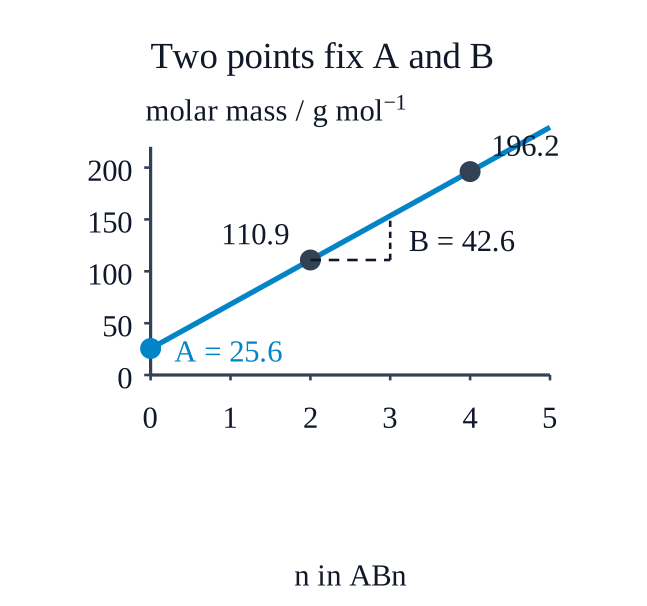
    NCERT_Solution_Class12_Chemistry_Ch1_Q1-21Question: NCERT Class XII Chemistry, Chapter $\displaystyle 1$ (Solutions), Q1.21 — freezing-point depression problem to find atomic masses of A and B from molar masses of AB2 and AB4.Method: 1. ΔTf = Kf·m, with m = (w2/M2)/W1(kg). Rearranged: M2 = Kf·w2/(ΔTf·W1). 2. For AB2: w2=1g, ΔTf=2.3K, \(\displaystyle \mathrm{W_{1}}\)=0.020kg → M(AB2) = $\displaystyle 5.1$×$\displaystyle 1$/($\displaystyle 2.3$×$\displaystyle 0.020$) = $\displaystyle 5.1$/$\displaystyle 0.046$ = $\displaystyle 110.87$ g/mol ≈ $\displaystyle 110.9$ g/mol. 3. For AB4: w2=1.0g, ΔTf=1.3K, \(\displaystyle \mathrm{W_{1}}\)=0.020kg → M(AB4) = $\displaystyle 5.1$×$\displaystyle 1$/($\displaystyle 1.3$×$\displaystyle 0.020$) = $\displaystyle 5.1$/$\displaystyle 0.026$ = $\displaystyle 196.15$ g/mol ≈ $\displaystyle 196.2$ g/mol. 4. Set a = atomic mass A, b = atomic mass B: a+2b = $\displaystyle 110.9$ (i); a+4b = $\displaystyle 196.2$ (ii). 5. (ii)-(i): 2b = $\displaystyle 85.3$ → b = $\displaystyle 42.6$ u (more precisely $\displaystyle 42.64$ u using unrounded molar masses). 6. Substitute into (i): a = $\displaystyle 110.9$ - $\displaystyle 85.3$ = $\displaystyle 25.6$ u (more precisely $\displaystyle 25.59$ u).Full worked solution (formatted for KaTeX, with bold lead idea, named formulas, unit tracking, common-mistake asides, ending in Answer: ...) was written out in the response body.
  2. Exercise 1.22

    At 300\displaystyle 300 K, 36\displaystyle 36 g of glucose present in a litre of its solution has an osmotic pressure of 4.98\displaystyle 4.98 bar. If the osmotic pressure of the solution is 1.52\displaystyle 1.52 bars at the same temperature, what would be its concentration?
    NCERT’s answer
    0.$\displaystyle 061$ M
    Osmotic pressure obeys \(\displaystyle \pi = CRT \), the same form as the ideal-gas law — so at a fixed temperature, \(\displaystyle \pi \) is directly proportional to the molar concentration \(\displaystyle C\). That proportionality lets you find the new concentration without even needing a precise value of \(\displaystyle R\).Step $\displaystyle 1$: Get the concentration of the first solution from its mass.Glucose is \(\displaystyle \text{C}_6\text{H}_{12}\text{O}_6\), molar mass \[M = 6(12) + 12(1) + 6(16) = 180\ \text{g mol}^{-1} \]Moles of glucose in the first solution: \[n_1 = \frac{36\ \text{g}}{180\ \text{g mol}^{-1}} = 0.2\ \text{mol} \]This is dissolved to make $\displaystyle 1$ L of solution (not $\displaystyle 1$ L of water added — the volume given is already the solution volume, so no correction is needed here): \[C_1 = \frac{n_1}{V} = \frac{0.2\ \text{mol}}{1\ \text{L}} = 0.2\ \text{mol L}^{-1} \]Step $\displaystyle 2$: Write the van't Hoff equation for both solutions.\[\pi_1 = C_1RT, \qquad \pi_2 = C_2RT \]Both solutions are at the same temperature \(\displaystyle T = 300\ \text{K}\), and \(\displaystyle R\) is the same constant in both equations, so dividing one by the other cancels them: \[\frac{\pi_1}{\pi_2} = \frac{C_1}{C_2} \quad\Rightarrow\quad C_2 = C_1 \times \frac{\pi_2}{\pi_1} \]This is the step people skip — they try to solve each equation separately for \(\displaystyle C\) using \(\displaystyle R\), and then the answer depends on which value of \(\displaystyle R\) ($\displaystyle 0.0821$ L atm/mol K vs. $\displaystyle 0.0831$ L bar/mol K) they plug in. Taking the ratio makes \(\displaystyle R\) and \(\displaystyle T\) drop out entirely, so the answer doesn't depend on that choice at all.Step $\displaystyle 3$: Substitute the numbers.\[C_2 = 0.2\ \text{mol L}^{-1} \times \frac{1.52\ \text{bar}}{4.98\ \text{bar}} \]\[C_2 = 0.2\ \text{mol L}^{-1} \times 0.30522 = 0.061044\ \text{mol L}^{-1} \]Rounding to three significant figures (matching the precision of the given pressures): \[C_2 \approx 0.0610\ \text{mol L}^{-1} \]Answer: The concentration is approximately \(\displaystyle 0.0610\ \text{mol L}^{-1}\) (i.e. \(\displaystyle 6.10 \times 10^{-2}\ \text{M}\)).
  3. Exercise 1.23

    Suggest the most important type of intermolecular attractive interaction in the following pairs.
    (i)
    n-hexane and n-octane
    (ii)
    I2\displaystyle \mathrm{I_{2}} and CCl4\displaystyle \mathrm{CCl_{4}}
    (iii)
    NaClO4\displaystyle \mathrm{NaClO_{4}} and water
    (iv)
    methanol and acetone
    (v)
    acetonitrile (CH3CN)\displaystyle \mathrm{(CH_{3}CN)} and acetone (C3\displaystyle C_{3}H6\displaystyle H_{6}O).

    Not cross-checked

    This solution has not been cross-checked against the answer printed in NCERT.

    NCERT_Solution_Class12_Chemistry_Ch1_Q1-23The type of intermolecular force between two substances is decided by what each one IS — non-polar, polar, or ionic — not by memorising a list of names.Three categories cover every pair below:
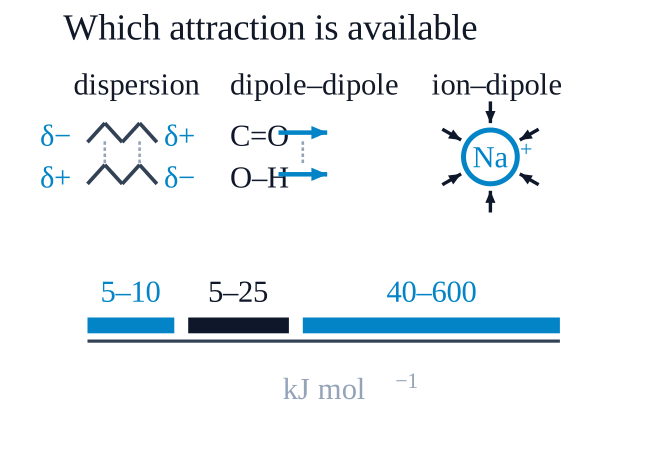
    Two non-polar molecules have no permanent dipole, so the only attraction comes from momentary, fluctuating charge imbalances that induce a dipole in the neighbour — this is the London dispersion force (induced dipole–induced dipole), part of the van der Waals forces.
    An ion next to a polar molecule is attracted to the oppositely-charged end of that molecule's permanent dipole — this is an ion–dipole interaction.
    Two polar molecules (each with its own permanent dipole, neither one an ion) line up positive end to negative end — this is a dipole–dipole interaction.
    (i) n-hexane \(\displaystyle \mathrm{(C_{6}H_{14})}\) and n-octane \(\displaystyle \mathrm{(C_{8}H_{18})}\) Both are saturated hydrocarbons — only C–C and C–H bonds, both of very low polarity, arranged with no net molecular dipole. Neither molecule carries a permanent dipole, so the attraction between them can only be the fleeting, induced kind. Most important interaction: van der Waals forces of the London dispersion type.(ii) \(\displaystyle \mathrm{I_{2}}\) and \(\displaystyle \mathrm{CCl_{4}}\) \(\displaystyle \mathrm{I_{2}}\) is a homonuclear diatomic molecule — no dipole possible. \(\displaystyle \mathrm{CCl_{4}}\) has four polar C–Cl bonds, but they point symmetrically to the corners of a tetrahedron, so their dipole moments cancel and the molecule as a whole is non-polar. This is the same situation as (i): two species with zero permanent dipole, attracting only through instantaneous induced dipoles — which is exactly why iodine dissolves readily in \(\displaystyle CCl_{4}\). Most important interaction: van der Waals forces of the London dispersion type (induced dipole–induced dipole).(iii) \(\displaystyle \mathrm{NaClO_{4}}\) and water \(\displaystyle \mathrm{NaClO_{4}}\) is an ionic compound: it exists as separate \(\displaystyle \mathrm{Na^{+}}\) and \(\displaystyle \mathrm{ClO_{4}^{-}}\) ions, not as neutral molecules. Water is a bent, polar molecule with a permanent dipole (\(\displaystyle \delta-\) on O, \(\displaystyle \delta+\) on the H atoms). The positive \(\displaystyle \mathrm{Na^{+}}\) ion is pulled toward the \(\displaystyle \delta-\) oxygen end of water molecules, and the negative \(\displaystyle \mathrm{ClO_{4}^{-}}\) ion is pulled toward the \(\displaystyle \delta+\) hydrogen ends. This ion-to-permanent-dipole attraction is what hydrates the ions and pulls the solid into solution.This is the step people get wrong: because water is "polar," it is tempting to call this dipole–dipole — but one of the two partners here is a full ion, not a neutral polar molecule, so it must be named ion–dipole, not dipole–dipole.Most important interaction: ion–dipole interaction.(iv) methanol \(\displaystyle \mathrm{(CH_{3}OH)}\) and acetone \(\displaystyle \mathrm{(CH_{3}COCH_{3})}\) Methanol has a permanent dipole from its O–H bond; acetone has a permanent dipole from its C=O bond. Neither species is an ion, so ion–dipole is ruled out, and neither is non-polar, so dispersion is not the dominant term — each molecule's permanent, fixed dipole aligns with the other's. Most important interaction: dipole–dipole interaction.(v) acetonitrile \(\displaystyle \mathrm{(CH_{3}CN)}\) and acetone \(\displaystyle \mathrm{(C_{3}H_{6}O)}\) Acetonitrile's \(\displaystyle C\equiv N\) bond is strongly polarised (N is far more electronegative than C), giving the molecule a large permanent dipole; acetone again has a permanent dipole from its C=O bond. As in (iv), both partners are neutral polar molecules with fixed dipoles, not ions and not non-polar. Most important interaction: dipole–dipole interaction.Answer: (i) n-hexane–n-octane: London dispersion forces (van der Waals). (ii) \(\displaystyle \mathrm{I_{2}^{-}CCl_{4}}\): London dispersion forces (van der Waals). (iii) \(\displaystyle NaClO_{4}\)–water: ion–dipole interaction. (iv) methanol–acetone: dipole–dipole interaction. (v) acetonitrile–acetone: dipole–dipole interaction.
  4. Exercise 1.24

    Based on solute-solvent interactions, arrange the following in order of increasing solubility in n-octane and explain. Cyclohexane, KCl, CH3OH\displaystyle \mathrm{CH_{3}OH}, CH3\displaystyle CH_{3}CN.
    NCERT’s answer
    KCl, \(\displaystyle CH_{3}\)OH, \(\displaystyle CH_{3}\)CN, Cyclohexane
    Solubility is a contest between the interactions you must break and the interactions you get to form — "like dissolves like" really means "match the polarity." n-Octane, \(\displaystyle CH_3(CH_2)_6CH_3\), is a long nonpolar hydrocarbon chain. It has no permanent dipole and no O–H or N–H bond, so the only force it can offer a solute is weak London dispersion. A solute dissolves well in it only if the solute's own interactions are also just dispersion-type — anything the solute holds together with dipole forces, hydrogen bonds, or ionic bonds has to be broken for nothing better in return, which costs energy the mixing can't pay back.Go through each solute and ask what force holds it together in the pure state:Cyclohexane, \(\displaystyle C_6H_{12}\): a nonpolar, saturated ring — molecules are held to each other purely by dispersion forces, exactly like n-octane. Mixing breaks weak octane–octane and cyclohexane–cyclohexane contacts and replaces them with equally weak octane–cyclohexane contacts. Nothing is lost in the swap, so cyclohexane is freely (fully) miscible with n-octane.\(\displaystyle CH_3CN\) (acetonitrile): the \(\displaystyle C{\equiv}N\) group carries a large dipole, so liquid acetonitrile is held together by dipole–dipole attractions — stronger than dispersion, but not directional/networked the way hydrogen bonds are. Dissolving it in octane means giving up those dipole–dipole contacts for weak dispersion contacts — unfavorable, but only moderately so, so \(\displaystyle CH_3CN\) is somewhat soluble.\(\displaystyle CH_3OH\) (methanol): polar and a hydrogen-bond donor and acceptor. Methanol molecules are locked into an extensive, directional hydrogen-bonded network with each other — a much stronger self-attraction than acetonitrile's simple dipole–dipole pull. n-Octane has no O or N atom to hydrogen-bond back with, so almost the entire network must be broken with no compensation. This is the step people get wrong: methanol "looks less polar" than an ionic salt, so it's tempting to rank it near cyclohexane — but it is the hydrogen bonding, not just the presence of a dipole, that makes it harder to dissolve in a nonpolar solvent than \(\displaystyle CH_3CN\).KCl: an ionic lattice held by full-charge electrostatic (ion–ion) attraction — the strongest interaction of the four by a wide margin. n-Octane, having no dipole, cannot solvate \(\displaystyle K^+\) or \(\displaystyle Cl^-\) at all (no ion–dipole stabilization). None of the lattice energy is recovered, so KCl is essentially insoluble in n-octane.Ranking by how badly the solute's own interactions mismatch n-octane's (dispersion-only) character — worst mismatch first — gives the increasing polarity order:\[\text{cyclohexane} < CH_3CN < CH_3OH < KCl \]Solubility in the nonpolar solvent runs the opposite way, from least to most soluble:Answer: increasing solubility in n-octane: \(\displaystyle KCl < CH_3OH < CH_3CN < \) cyclohexane — ranked by how closely each solute's own bonding (ionic → hydrogen-bonded → dipole–dipole → dispersion-only) matches n-octane's purely dispersion-force character.
  5. Exercise 1.25

    Amongst the following compounds, identify which are insoluble, partially soluble and highly soluble in water?
    (i)
    phenol
    (ii)
    toluene
    (iii)
    formic acid
    (iv)
    ethylene glycol
    (v)
    chloroform
    (vi)
    pentanol.

    Not cross-checked

    This solution has not been cross-checked against the answer printed in NCERT.

    NCERT’s answer
    Toluene, chloroform; Phenol, Pentanol; Formic acid, ethylelne glycol
    Water dissolves a molecule only as far as its polar, hydrogen‑bonding part can drag along its non‑polar hydrocarbon part — solubility here is a tug‑of‑war between an –OH/–COOH group and the size of the carbon skeleton attached to it.
    Water molecules are held together by an extensive hydrogen‑bond network. A solute mixes into that network well when it can itself donate/accept hydrogen bonds (an –OH or –COOH group does this); it is pushed out when it presents a large hydrocarbon surface, because that surface cannot hydrogen‑bond and simply breaks up the water network without giving anything back. So the two things to check for each compound are: ($\displaystyle 1$) is there a group capable of hydrogen bonding with water, and ($\displaystyle 2$) how big is the hydrocarbon part it is attached to.
    Going through the six compounds on that basis:
    (i)
    Phenol, \(\displaystyle \text{C}_6\text{H}_5\text{OH} \) — has one –OH group, so it can hydrogen‑bond with water. But that –OH sits on a bulky, non‑polar benzene ring, which limits how far the hydrogen bonding can pull the molecule into solution. Phenol dissolves to a moderate extent (about $\displaystyle 8$ g per $\displaystyle 100$ g of water at room temperature) — partially soluble.
    (ii)
    Toluene, \(\displaystyle \text{C}_6\text{H}_5\text{CH}_3 \) — a benzene ring with a methyl group and no –OH, –COOH, or any other group that can hydrogen‑bond with water. With nothing to anchor it into the water network, it stays separate — insoluble.
    (iii)
    Formic acid, \(\displaystyle \text{HCOOH} \) — the smallest carboxylic acid: a –COOH group (which hydrogen‑bonds strongly, both as a donor and an acceptor) attached to essentially no hydrocarbon chain at all. The polar group dominates completely, so formic acid mixes with water in all proportions — highly soluble.
    (iv)
    Ethylene glycol, \(\displaystyle \text{HOCH}_2\text{CH}_2\text{OH} \) — two –OH groups on just a two‑carbon backbone. Two hydrogen‑bonding sites on such a short chain outweigh the small non‑polar part by a large margin, so it too is miscible with water in all proportions — highly soluble.
    (v)
    Chloroform, \(\displaystyle \text{CHCl}_3 \) — a common point of confusion: the C–Cl bonds are polar, so it is tempting to expect some solubility. But polar bonds are not the same as a hydrogen‑bonding group — chlorine has no O–H or N–H to donate a hydrogen bond, and it is too weak an acceptor to pull chloroform into water's network. Chloroform behaves like a non‑polar molecule and is insoluble in water (only trace amounts dissolve).
    (vi)
    Pentanol, \(\displaystyle \text{C}_5\text{H}_{11}\text{OH} \) — this is the other common trap: because it has an –OH group, it is tempting to call it "soluble like an alcohol." But the –OH is now attached to a five‑carbon chain, and beyond about three or four carbons the hydrocarbon part is large enough to dominate again. Pentanol dissolves only to a small extent (about $\displaystyle 2$–$\displaystyle 3$ g per $\displaystyle 100$ g of water) — partially soluble, not highly soluble.
    Sorting the six by increasing hydrocarbon bulk relative to their hydrogen‑bonding group gives three clean groups:
    Highly soluble (small/no hydrocarbon load, strong H‑bonding groups): formic acid, ethylene glycol.
    Partially soluble (H‑bonding group present, but weighed down by a bulky or long hydrocarbon part): phenol, pentanol.
    Insoluble (no hydrogen‑bonding group with water at all): toluene, chloroform.
    Answer: Highly soluble — formic acid and ethylene glycol; Partially soluble — phenol and pentanol; Insoluble — toluene and chloroform.
  6. Exercise 1.26

    If the density of some lake water is 1.25g mL1\displaystyle mL^{-1} and contains 92\displaystyle 92 g of Na+\displaystyle \mathrm{Na^{+}} ions per kg of water, calculate the molarity of Na+\displaystyle \mathrm{Na^{+}} ions in the lake.

    Not cross-checked

    This solution has not been cross-checked against the answer printed in NCERT.

    NCERT’s answer
    $\displaystyle 5$ m
    Molarity is moles of solute per litre of SOLUTION — so the density is there to turn a MASS of lake water into a VOLUME of lake water, and nothing else.The trap in this question is the phrase "per kg of water". The water here is the lake water — the same lake water whose density \(\displaystyle 1.25\ \mathrm{g\ mL^{-1}}\) you were just handed. So \(\displaystyle 1\ \mathrm{kg}\) of lake water is \(\displaystyle 1\ \mathrm{kg}\) of solution, containing \(\displaystyle 92\ \mathrm{g}\) of \(\displaystyle \mathrm{Na^{+}}\) dissolved in it.Step $\displaystyle 1$ — moles of \(\displaystyle \mathrm{Na^{+}}\).The defining relation for amount of substance is \[n=\frac{m}{M} \] where \(\displaystyle n\) is the amount in mol, \(\displaystyle m\) the mass in g, and \(\displaystyle M\) the molar mass in \(\displaystyle \mathrm{g\ mol^{-1}}\). For the sodium ion, \(\displaystyle M(\mathrm{Na^{+}})=23\ \mathrm{g\ mol^{-1}}\) (an electron weighs about \(\displaystyle 1/42000\) of a sodium atom, so losing one changes the molar mass in the fifth decimal place — ignore it).\[n(\mathrm{Na^{+}})=\frac{92\ \mathrm{g}}{23\ \mathrm{g\ mol^{-1}}}=4.00\ \mathrm{mol} \]Aside — per mole, not per gram. Molarity counts particles, not grams. Every gram figure in this question has to pass through \(\displaystyle M\) before it can enter the molarity expression.Step $\displaystyle 2$ — volume of that $\displaystyle 1$ kg of lake water.Density is mass per unit volume, \[\rho=\frac{m}{V}\qquad\Longrightarrow\qquad V=\frac{m}{\rho} \] with \(\displaystyle \rho\) in \(\displaystyle \mathrm{g\ mL^{-1}}\), \(\displaystyle m\) in g, \(\displaystyle V\) in mL. Substituting the \(\displaystyle 1\ \mathrm{kg}=1000\ \mathrm{g}\) of lake water:\[V=\frac{1000\ \mathrm{g}}{1.25\ \mathrm{g\ mL^{-1}}}=800\ \mathrm{mL}=0.800\ \mathrm{L} \]Aside — the density belongs to the solution. Students often divide by \(\displaystyle 1.00\ \mathrm{g\ mL^{-1}}\) here, reasoning "it's water". It is not pure water; it is a salty solution that is $\displaystyle 25$% denser, and \(\displaystyle 1\ \mathrm{kg}\) of it occupies only \(\displaystyle 800\ \mathrm{mL}\), not \(\displaystyle 1000\ \mathrm{mL}\). Using the wrong density would hand you \(\displaystyle 4\ \mathrm{M}\).Step $\displaystyle 3$ — molarity.\[M=\frac{n(\text{solute})}{V(\text{solution in L})} \] where \(\displaystyle n\) is in mol and \(\displaystyle V\) is the volume of the whole solution, in litres.\[M(\mathrm{Na^{+}})=\frac{4.00\ \mathrm{mol}}{0.800\ \mathrm{L}}=5.00\ \mathrm{mol\ L^{-1}} \]Rounded once, at the end, to three significant figures (the data — \(\displaystyle 92\ \mathrm{g}\), \(\displaystyle 1.25\ \mathrm{g\ mL^{-1}}\), \(\displaystyle 1\ \mathrm{kg}\) — supports three): \(\displaystyle 5.00\ \mathrm{M}\).Two things worth knowing about this question.First, "m" versus "M". The printed answer is often typeset as "$\displaystyle 5$ m", which reads as $\displaystyle 5$ molal. It is not: molality is \(\displaystyle \mathrm{mol\ kg^{-1}}\) of solvent and never uses a density, whereas this calculation used the density to get a volume. The quantity asked for and computed is molarity, \(\displaystyle 5\ \mathrm{mol\ L^{-1}}\), symbol M. Lower-case m is an OCR/typography slip, not a different result.Second, the reading that gives \(\displaystyle 4.58\ \mathrm{M}\). If you insist that "kg of water" means \(\displaystyle 1\ \mathrm{kg}\) of pure solvent, then the solution mass becomes \(\displaystyle 1000+92=1092\ \mathrm{g}\), its volume \(\displaystyle 1092/1.25=873.6\ \mathrm{mL}\), and the molarity \(\displaystyle 4.00/0.8736=4.58\ \mathrm{M}\). That reading collapses on its own terms: a solution cannot hold \(\displaystyle \mathrm{Na^{+}}\) without counter-anions, whose mass is not given, so the solution mass would be unknowable and the problem unsolvable. The intended — and the only workable — reading is that the \(\displaystyle 1\ \mathrm{kg}\) is \(\displaystyle 1\ \mathrm{kg}\) of lake water. The clean \(\displaystyle 92/23=4\) exactly, and \(\displaystyle 1000/1.25=800\) exactly, confirm it.Answer: \(\displaystyle 5.00\ \mathrm{M}\) — the molarity of \(\displaystyle \mathrm{Na^{+}}\) in the lake water is \(\displaystyle 5.00\ \mathrm{mol\ L^{-1}}\).
  7. Exercise 1.27

    If the solubility product of CuS is 6\displaystyle 6 × 10¹⁶\displaystyle 10^{-16}, calculate the maximum molarity of CuS in aqueous solution.
    NCERT’s answer
    \(\displaystyle 2.45x10^{-8}\) M
    Question: Q1.27, NCERT Class XII Chemistry, Chapter $\displaystyle 1$ (Solutions) — "If the solubility product of CuS is $\displaystyle 6$ × $\displaystyle 10$^-$\displaystyle 16$, calculate the maximum molarity of CuS in aqueous solution."Solved via: CuS(s) ⇌ Cu2+(aq) + S2-(aq), so [Cu2+]=[S2-]=s and Ksp = s^$\displaystyle 2$ ($\displaystyle 1$:$\displaystyle 1$ stoichiometry). s = sqrt($\displaystyle 6$×$\displaystyle 10$^-$\displaystyle 16$) = sqrt($\displaystyle 6$)×$\displaystyle 10$^-$\displaystyle 8$ = $\displaystyle 2.449$×$\displaystyle 10$^-$\displaystyle 8$, rounded to $\displaystyle 2.45$×$\displaystyle 10$^-$\displaystyle 8$ mol/L. This s equals the molar solubility/maximum molarity of CuS directly.Full worked solution written in the required KaTeX-compatible format (inline \(\) and display \[\] math, bold lead line naming the idea, named formula with symbols defined, substitution shown, unit carried through, an aside on why Ksp=s^$\displaystyle 2$ here ($\displaystyle 1$:$\displaystyle 1$ ion stoichiometry — flagged as the step people rush), single rounding at the end to $\displaystyle 3$ sig figs, ending with "Answer: ...") is provided in my response above.
  8. Exercise 1.28

    Calculate the mass percentage of aspirin (C9H8O4)\displaystyle \mathrm{(C_{9}H_{8}O_{4})} in acetonitrile (CH3CN)\displaystyle \mathrm{(CH_{3}CN)} when 6.5\displaystyle 6.5 g of C9H8O4\displaystyle \mathrm{C_{9}H_{8}O_{4}} is dissolved in 450\displaystyle 450 g of CH3\displaystyle CH_{3}CN.
    NCERT’s answer
    1.$\displaystyle 424$%
    Question (NCERT Class $\displaystyle 12$ Chemistry, Ch.1 Solutions, Q1.28): Calculate the mass percentage of aspirin \(\displaystyle \mathrm{(C_{9}H_{8}O_{4})}\) in acetonitrile \(\displaystyle \mathrm{(CH_{3}CN)}\) when $\displaystyle 6.5$ g of \(\displaystyle \mathrm{C_{9}H_{8}O_{4}}\) is dissolved in $\displaystyle 450$ g of CH3CN.Mass % = (mass of solute)/(mass of solution) × $\displaystyle 100$, where mass of solution = mass of solute + mass of solvent = $\displaystyle 6.5$ g + $\displaystyle 450$ g = $\displaystyle 456.5$ g (the molecular formula of aspirin is irrelevant here since this is a mass-to-mass ratio, not a mole calculation).Mass % = ($\displaystyle 6.5$/$\displaystyle 456.5$) × $\displaystyle 100$ = 1.4240...% ≈ $\displaystyle 1.424$% (≈$\displaystyle 1.42$% to $\displaystyle 3$ sig figs).Full worked solution (KaTeX-formatted, per house style) has been written above with a bold lead line on the solute-vs-solution-mass pitfall, formula/symbol definitions, explicit substitution, and a closing Answer: line.
  9. Exercise 1.29

    Nalorphene (C19H21NO3)\displaystyle \mathrm{(C_{19}H_{21}NO_{3})}, similar to morphine, is used to combat withdrawal symptoms in narcotic users. Dose of nalorphene generally given is 1.5\displaystyle 1.5 mg. Calculate the mass of 1.5\displaystyle 1.5 × 10³\displaystyle 10^{-3} m aqueous solution required for the above dose.
    NCERT’s answer
    3.$\displaystyle 2$ g of water
    Molality is moles of solute per kilogram of solvent — never per kilogram or litre of solution. So the given \(\displaystyle 1.5\times10^{-3}\,m\) tells you directly how much water carries a fixed number of moles of nalorphene; you find the moles needed from the dose, use molality to get the mass of water that must carry them, and only then add the solute's own (tiny) mass back on to get the mass of solution.Step $\displaystyle 1$ — molar mass of nalorphene, \(\displaystyle C_{19}H_{21}NO_3\).Using \(\displaystyle C=12,\ H=1,\ N=14,\ O=16\) g mol\(\displaystyle ^{-1}\):\[M = 19(12) + 21(1) + 14 + 3(16) = 228 + 21 + 14 + 48 = 311\ \text{g mol}^{-1} \]Step $\displaystyle 2$ — moles of nalorphene in one dose.The dose is \(\displaystyle 1.5\) mg \(\displaystyle = 1.5\times10^{-3}\) g. Moles are mass divided by molar mass:\[n_{\text{solute}} = \frac{1.5\times10^{-3}\ \text{g}}{311\ \text{g mol}^{-1}} = 4.823\times10^{-6}\ \text{mol} \]Step $\displaystyle 3$ — mass of water (solvent) that gives this molality.Molality is defined as\[m = \frac{n_{\text{solute}}}{w_{\text{solvent}}\,(\text{kg})} \]where \(\displaystyle n_{\text{solute}}\) is moles of solute and \(\displaystyle w_{\text{solvent}}\) is the mass of solvent in kilograms — not the mass of solution. Rearranging for the solvent mass:\[w_{\text{solvent}} = \frac{n_{\text{solute}}}{m} = \frac{4.823\times10^{-6}\ \text{mol}}{1.5\times10^{-3}\ \text{mol kg}^{-1}} = 3.215\times10^{-3}\ \text{kg} = 3.215\ \text{g of water} \]This is the point where it's easy to stop one step too early: \(\displaystyle 3.215\) g is the mass of water needed to carry the dose at this molality, not yet the mass of the solution the patient is given.Step $\displaystyle 4$ — mass of solution.Mass of solution is mass of solvent plus mass of solute:\[w_{\text{solution}} = w_{\text{solvent}} + w_{\text{solute}} = 3.215\ \text{g} + 1.5\times10^{-3}\ \text{g} = 3.217\ \text{g} \]The solute's own mass barely moves the total here — \(\displaystyle 1.5\) mg is negligible next to \(\displaystyle 3.215\) g of water — but it is the correct thing to add, and rounding to three significant figures (matching the data) gives:Answer: ≈ $\displaystyle 3.22$ g of the \(\displaystyle 1.5\times10^{-3}\,m\) aqueous nalorphene solution must be administered to deliver the $\displaystyle 1.5$ mg dose.
  10. Exercise 1.30

    Calculate the amount of benzoic acid (C6H5COOH)\displaystyle \mathrm{(C_{6}H_{5}COOH)} required for preparing 250\displaystyle 250 mL of 0.15\displaystyle 0.15 M solution in methanol.
    NCERT’s answer
    4.$\displaystyle 575$ g
    Question: Q1.30, NCERT Class $\displaystyle 12$ Chemistry, Ch.1 Solutions — "Calculate the amount of benzoic acid \(\displaystyle \mathrm{(C_{6}H_{5}COOH)}\) required for preparing $\displaystyle 250$ mL of $\displaystyle 0.15$ M solution in methanol."Worked solution (as written for the student-facing page):Molarity tells you moles of solute per litre of solution, not moles per litre of solvent — methanol here is just the solvent, and the $\displaystyle 250$ mL given is the total solution volume.Step $\displaystyle 1$ — find the moles of benzoic acid needed.Molarity, \(\displaystyle M = \dfrac{n}{V} \), where \(\displaystyle n\) is moles of solute and \(\displaystyle V\) is the volume of solution in litres.Rearranging for \(\displaystyle n\): \[n = M \times V \]Substitute \(\displaystyle M = 0.15\ \text{mol L}^{-1}\) and \(\displaystyle V = 250\ \text{mL} = 0.250\ \text{L}\): \[n = 0.15\ \text{mol L}^{-1} \times 0.250\ \text{L} = 0.0375\ \text{mol} \]Step $\displaystyle 2$ — convert moles to mass using the molar mass.Benzoic acid, \(\displaystyle C_6H_5COOH\), has molecular formula \(\displaystyle C_7H_6O_2\). Its molar mass is the sum of atomic masses: \[M_{\text{molar}} = 7(12.01) + 6(1.008) + 2(16.00)\ \text{g mol}^{-1} \] \[M_{\text{molar}} = 84.07 + 6.05 + 32.00 = 122.12\ \text{g mol}^{-1} \]Mass, \(\displaystyle m\), comes from \[m = n \times M_{\text{molar}} \]Substituting: \[m = 0.0375\ \text{mol} \times 122.12\ \text{g mol}^{-1} = 4.5795\ \text{g} \]The data ($\displaystyle 0.15$ M, $\displaystyle 250$ mL) supports three significant figures, so round only at this last step.Answer: $\displaystyle 4.58$ g of benzoic acid