Exercise 1.11
Why do gases always tend to be less soluble in liquids as the temperature is raised?
Not cross-checked
This solution has not been cross-checked against the answer printed in NCERT.
Dissolving a gas in a liquid is an exothermic process, so raising the temperature pushes the equilibrium back toward the free gas.When a gas dissolves in a liquid, its molecules go from a highly disordered, high-energy gaseous state into a more ordered state trapped among solvent molecules. This process releases heat, so it is written as\[\text{Gas} + \text{Solvent} \rightleftharpoons \text{Solution} + \text{Heat}, \qquad \Delta H_{\text{dissolution}} < 0
\]Here \(\displaystyle \Delta H_{\text{dissolution}} \) is the enthalpy change when the gas dissolves — negative because dissolution is exothermic.Le Chatelier's principle says that when a system at equilibrium is heated, the equilibrium shifts in the direction that absorbs the added heat — that is, in the endothermic direction. Since dissolution is exothermic, the reverse process (the gas coming back out of solution) is endothermic. So supplying heat by raising the temperature drives the equilibrium to the left, back toward undissolved gas, and less of it stays dissolved. This is exactly why the solubility of a gas falls as \(\displaystyle T \) rises — it is the same reasoning that makes solubility decrease when you increase the partial pressure of the gas above the liquid go down, only here the "stress" being relieved is heat instead of pressure.There is also a molecular-kinetic-energy way to see the same result. Gas molecules that are dissolved are held in the liquid only loosely, by weak intermolecular attractions with the solvent. Raising the temperature increases the average kinetic energy of these dissolved gas molecules (a rise in \(\displaystyle T \) means a rise in average molecular kinetic energy, by the kinetic theory of matter). With more kinetic energy, a larger fraction of the dissolved molecules have enough energy to overcome the attractive forces holding them in the liquid and escape back into the gas phase. The tendency of the dissolved gas to escape (its effective escaping tendency, or vapour pressure above the solution) increases with temperature, so the amount that stays in solution at equilibrium goes down.This is why, for example, a bottle of soda water goes flat much faster when warm than when cold, and why fish need more dissolved oxygen-rich (cooler) water — warm water simply cannot hold as much dissolved \(\displaystyle \mathrm{O_2} \) as cold water.Answer: Because dissolving a gas in a liquid is exothermic, heating the system (by Le Chatelier's principle) shifts the equilibrium in the endothermic direction — back toward the gas escaping the liquid — so gas solubility in liquids always decreases as temperature is raised.
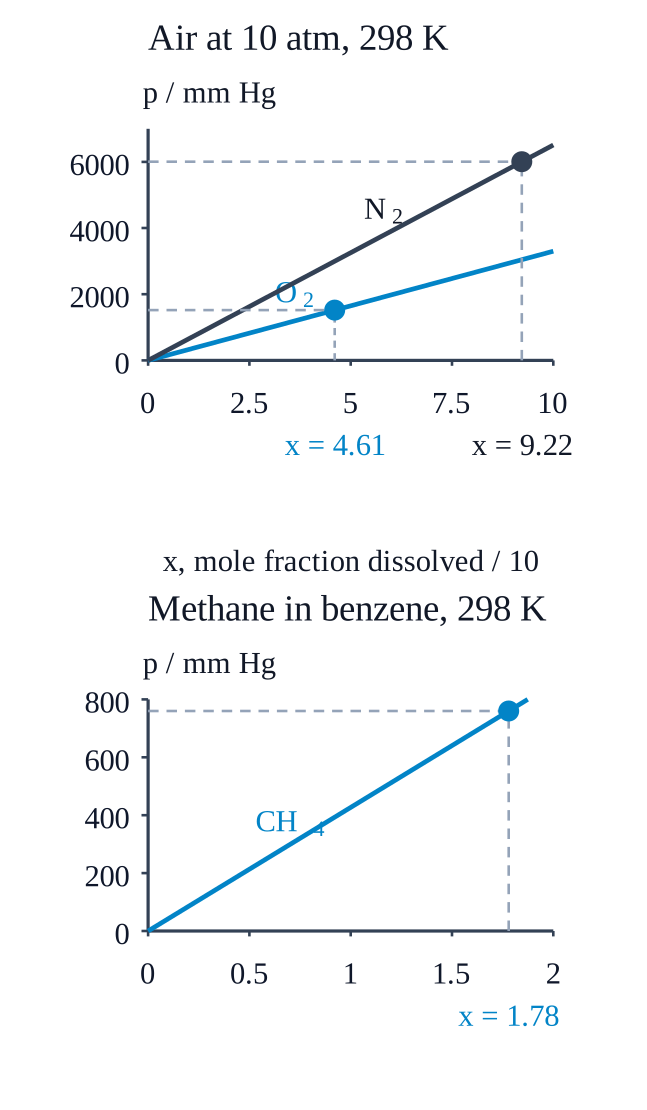 Henry's law is a straight line through the origin. p = Kₕx, so the constant IS the slope. A steeper line therefore means a LESS soluble gas, which reads backwards until you see it: at the same partial pressure the steep line has got there on a smaller mole fraction. This is why nitrogen, with the larger Kₕ, dissolves less than oxygen even though there is far more of it in air.A gas is only as soluble as the pressure pushing it in — more pressure above the liquid forces more gas into it.Henry's law: at a fixed temperature, the amount of a gas that dissolves in a liquid is directly proportional to the partial pressure of that gas above the liquid surface. In the most common statement, the partial pressure of the gas in the vapour phase, \(\displaystyle p \), is proportional to the mole fraction of the gas dissolved in the solution, \(\displaystyle x \):\[p = K_H \, x
\]Here \(\displaystyle p \) is the partial pressure of the gas over the solution, \(\displaystyle x \) is the mole fraction of the dissolved gas in the solution, and \(\displaystyle K_H \) is the Henry's law constant — a number that depends on the identity of the gas and the solvent, and on temperature (it is not a universal constant like \(\displaystyle R \)).A step people get wrong: \(\displaystyle K_H \) is not "solubility" itself — it is inversely related to it. A gas with a high \(\displaystyle K_H \) in a given solvent is less soluble, because for the same mole fraction \(\displaystyle x \) you'd need a much bigger \(\displaystyle p \) to hold it there. Also, \(\displaystyle K_H \) increases with temperature, which is the direct statement of the everyday fact that gases become less soluble in liquids as the liquid warms up — dissolved gas is driven off when a glass of cold water is left to stand and warm to room temperature.Some important applications of Henry's law:
Henry's law is a straight line through the origin. p = Kₕx, so the constant IS the slope. A steeper line therefore means a LESS soluble gas, which reads backwards until you see it: at the same partial pressure the steep line has got there on a smaller mole fraction. This is why nitrogen, with the larger Kₕ, dissolves less than oxygen even though there is far more of it in air.A gas is only as soluble as the pressure pushing it in — more pressure above the liquid forces more gas into it.Henry's law: at a fixed temperature, the amount of a gas that dissolves in a liquid is directly proportional to the partial pressure of that gas above the liquid surface. In the most common statement, the partial pressure of the gas in the vapour phase, \(\displaystyle p \), is proportional to the mole fraction of the gas dissolved in the solution, \(\displaystyle x \):\[p = K_H \, x
\]Here \(\displaystyle p \) is the partial pressure of the gas over the solution, \(\displaystyle x \) is the mole fraction of the dissolved gas in the solution, and \(\displaystyle K_H \) is the Henry's law constant — a number that depends on the identity of the gas and the solvent, and on temperature (it is not a universal constant like \(\displaystyle R \)).A step people get wrong: \(\displaystyle K_H \) is not "solubility" itself — it is inversely related to it. A gas with a high \(\displaystyle K_H \) in a given solvent is less soluble, because for the same mole fraction \(\displaystyle x \) you'd need a much bigger \(\displaystyle p \) to hold it there. Also, \(\displaystyle K_H \) increases with temperature, which is the direct statement of the everyday fact that gases become less soluble in liquids as the liquid warms up — dissolved gas is driven off when a glass of cold water is left to stand and warm to room temperature.Some important applications of Henry's law: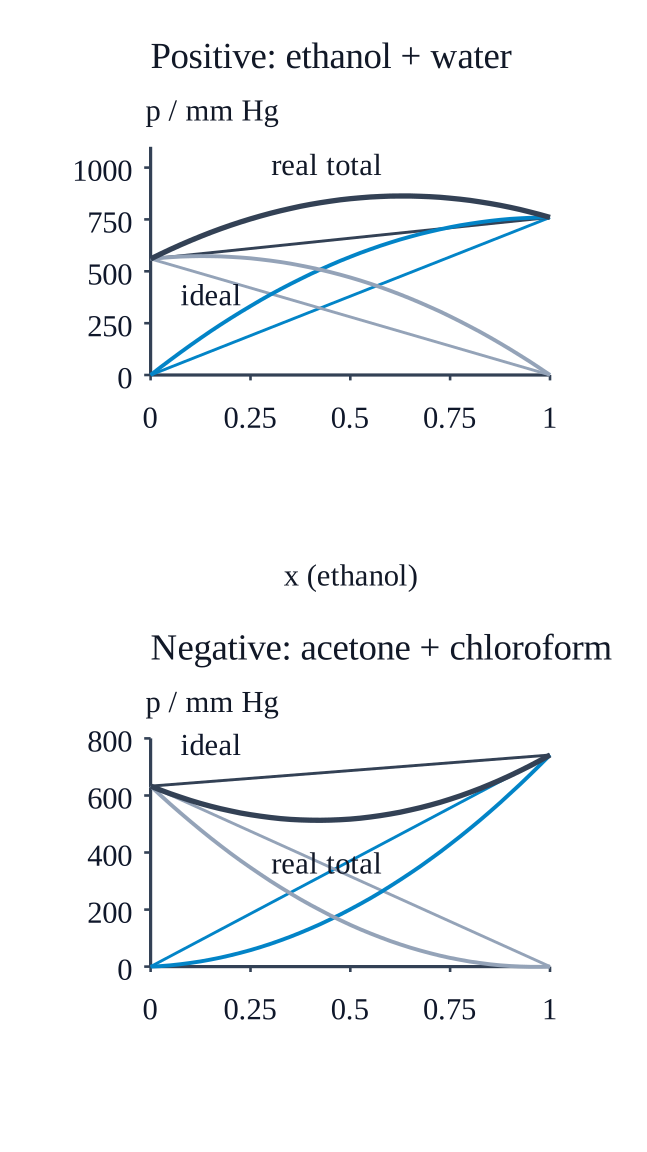 Positive and negative deviation, each leaving its own ideal line. The dashed line is what Raoult's law predicts; the curve is what is measured. Bowing ABOVE it means the new A–B attraction is weaker than the A–A and B–B it replaced, so molecules escape more easily — positive deviation, with ΔmixH positive. Bowing below means the opposite.Deviation from Raoult's law is a mismatch between the A–B attraction in the mixture and the A–A, B–B attractions in the two pure liquids — and that same mismatch fixes the sign of \(\displaystyle Δ_{mix}H\).For an ideal solution, Raoult's law gives the partial vapour pressures
\[p_A = p_A^{\circ}x_A, \qquad p_B = p_B^{\circ}x_B
\]
where \(\displaystyle p_A^{\circ}, p_B^{\circ}\) are the vapour pressures of the pure liquids and \(\displaystyle x_A, x_B\) are their mole fractions in solution. This holds only when A–A, B–B and A–B interactions are all essentially equal in strength — nothing changes on mixing, so \(\displaystyle Δ_{mix}H = 0\) and \(\displaystyle Δ_{mix}V = 0\).Positive deviation.
Positive and negative deviation, each leaving its own ideal line. The dashed line is what Raoult's law predicts; the curve is what is measured. Bowing ABOVE it means the new A–B attraction is weaker than the A–A and B–B it replaced, so molecules escape more easily — positive deviation, with ΔmixH positive. Bowing below means the opposite.Deviation from Raoult's law is a mismatch between the A–B attraction in the mixture and the A–A, B–B attractions in the two pure liquids — and that same mismatch fixes the sign of \(\displaystyle Δ_{mix}H\).For an ideal solution, Raoult's law gives the partial vapour pressures
\[p_A = p_A^{\circ}x_A, \qquad p_B = p_B^{\circ}x_B
\]
where \(\displaystyle p_A^{\circ}, p_B^{\circ}\) are the vapour pressures of the pure liquids and \(\displaystyle x_A, x_B\) are their mole fractions in solution. This holds only when A–A, B–B and A–B interactions are all essentially equal in strength — nothing changes on mixing, so \(\displaystyle Δ_{mix}H = 0\) and \(\displaystyle Δ_{mix}V = 0\).Positive deviation.
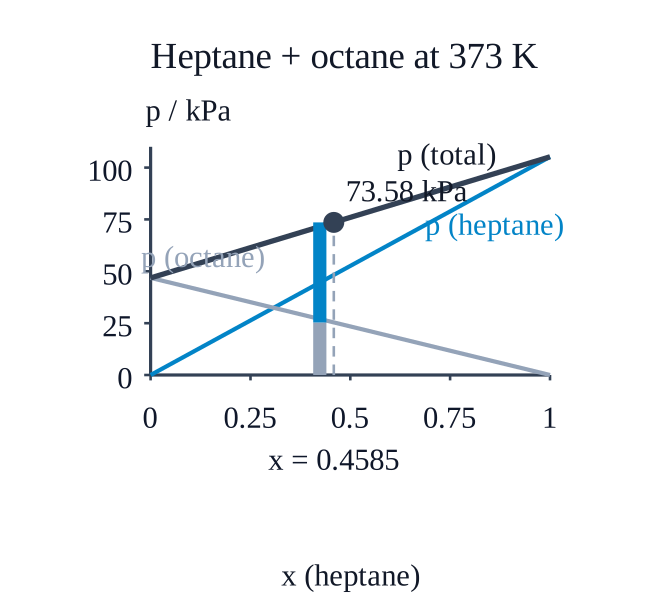 Heptane + octane at $\displaystyle 373$ K. Ideal means STRAIGHT: each partial pressure is a straight line from $\displaystyle 0$ to its own pure value, and because the total is their sum it is a straight line too. The stack at any composition is Dalton's law drawn out — the two partial pressures adding to the total.In an ideal solution, each component's partial vapour pressure follows Raoult's law: \(\displaystyle p_i = x_i \, p_i^{\circ} \), where \(\displaystyle x_i\) is the MOLE fraction of that component in the liquid — not its mass fraction. The total vapour pressure is just the sum of the two partial pressures, \(\displaystyle p_{\text{total}} = p_1 + p_2\). So the real work here is converting grams to moles, then moles to mole fractions.Step $\displaystyle 1$: Molar massesHeptane is \(\displaystyle \text{C}_7\text{H}_{16} \):
\[M_{\text{heptane}} = 7(12) + 16(1) = 100 \ \text{g mol}^{-1} \]Octane is \(\displaystyle \text{C}_8\text{H}_{18} \):
\[M_{\text{octane}} = 8(12) + 18(1) = 114 \ \text{g mol}^{-1} \]Step $\displaystyle 2$: Moles of each component\[n_{\text{heptane}} = \frac{26.0 \ \text{g}}{100 \ \text{g mol}^{-1}} = 0.260 \ \text{mol} \]\[n_{\text{octane}} = \frac{35.0 \ \text{g}}{114 \ \text{g mol}^{-1}} = 0.30702 \ \text{mol} \]\[n_{\text{total}} = 0.260 + 0.30702 = 0.56702 \ \text{mol} \]Step $\displaystyle 3$: Mole fractionsThis is the step people skip — you need mole fraction, not the ratio of masses, because vapour pressure depends on the number of molecules escaping the surface, and moles count molecules while grams don't.\[x_{\text{heptane}} = \frac{0.260}{0.56702} = 0.4586 \]\[x_{\text{octane}} = \frac{0.30702}{0.56702} = 1 - 0.4586 = 0.5414 \]Step $\displaystyle 4$: Partial pressures, using Raoult's law\[p_{\text{heptane}} = x_{\text{heptane}} \, p^{\circ}_{\text{heptane}} = 0.4586 \times 105.2 \ \text{kPa} = 48.24 \ \text{kPa} \]\[p_{\text{octane}} = x_{\text{octane}} \, p^{\circ}_{\text{octane}} = 0.5414 \times 46.8 \ \text{kPa} = 25.34 \ \text{kPa} \]Step $\displaystyle 5$: Total vapour pressure of the mixture\[p_{\text{total}} = p_{\text{heptane}} + p_{\text{octane}} = 48.24 + 25.34 = 73.58 \ \text{kPa} \]The data (masses to three sig figs, pressures to three or four sig figs) supports rounding to three significant figures.Answer: \(\displaystyle p_{\text{total}} \approx 73.6 \ \text{kPa} \) (with heptane contributing about $\displaystyle 48.2$ kPa and octane about $\displaystyle 25.3$ kPa of that total).
Heptane + octane at $\displaystyle 373$ K. Ideal means STRAIGHT: each partial pressure is a straight line from $\displaystyle 0$ to its own pure value, and because the total is their sum it is a straight line too. The stack at any composition is Dalton's law drawn out — the two partial pressures adding to the total.In an ideal solution, each component's partial vapour pressure follows Raoult's law: \(\displaystyle p_i = x_i \, p_i^{\circ} \), where \(\displaystyle x_i\) is the MOLE fraction of that component in the liquid — not its mass fraction. The total vapour pressure is just the sum of the two partial pressures, \(\displaystyle p_{\text{total}} = p_1 + p_2\). So the real work here is converting grams to moles, then moles to mole fractions.Step $\displaystyle 1$: Molar massesHeptane is \(\displaystyle \text{C}_7\text{H}_{16} \):
\[M_{\text{heptane}} = 7(12) + 16(1) = 100 \ \text{g mol}^{-1} \]Octane is \(\displaystyle \text{C}_8\text{H}_{18} \):
\[M_{\text{octane}} = 8(12) + 18(1) = 114 \ \text{g mol}^{-1} \]Step $\displaystyle 2$: Moles of each component\[n_{\text{heptane}} = \frac{26.0 \ \text{g}}{100 \ \text{g mol}^{-1}} = 0.260 \ \text{mol} \]\[n_{\text{octane}} = \frac{35.0 \ \text{g}}{114 \ \text{g mol}^{-1}} = 0.30702 \ \text{mol} \]\[n_{\text{total}} = 0.260 + 0.30702 = 0.56702 \ \text{mol} \]Step $\displaystyle 3$: Mole fractionsThis is the step people skip — you need mole fraction, not the ratio of masses, because vapour pressure depends on the number of molecules escaping the surface, and moles count molecules while grams don't.\[x_{\text{heptane}} = \frac{0.260}{0.56702} = 0.4586 \]\[x_{\text{octane}} = \frac{0.30702}{0.56702} = 1 - 0.4586 = 0.5414 \]Step $\displaystyle 4$: Partial pressures, using Raoult's law\[p_{\text{heptane}} = x_{\text{heptane}} \, p^{\circ}_{\text{heptane}} = 0.4586 \times 105.2 \ \text{kPa} = 48.24 \ \text{kPa} \]\[p_{\text{octane}} = x_{\text{octane}} \, p^{\circ}_{\text{octane}} = 0.5414 \times 46.8 \ \text{kPa} = 25.34 \ \text{kPa} \]Step $\displaystyle 5$: Total vapour pressure of the mixture\[p_{\text{total}} = p_{\text{heptane}} + p_{\text{octane}} = 48.24 + 25.34 = 73.58 \ \text{kPa} \]The data (masses to three sig figs, pressures to three or four sig figs) supports rounding to three significant figures.Answer: \(\displaystyle p_{\text{total}} \approx 73.6 \ \text{kPa} \) (with heptane contributing about $\displaystyle 48.2$ kPa and octane about $\displaystyle 25.3$ kPa of that total).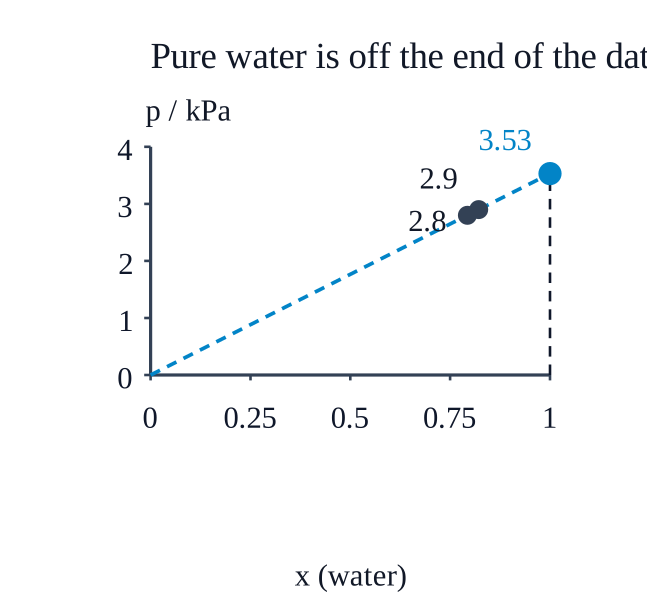 Pure water is off the end of the data. Both measurements are of SOLUTIONS, so neither is p° for water. The line through them is extrapolated back to zero solute, and where it meets the axis is the pure solvent's vapour pressure — a value the experiment never measures directly.Raoult's Law says the vapour pressure of the solution equals the vapour pressure of the pure solvent times the solvent's mole fraction — and the relative drop in vapour pressure equals the solute's mole fraction. Two vapour-pressure readings on the same amount of solute (only water is added between them) give two equations for two unknowns: the molar mass of the solute and the vapour pressure of pure water.Setting up the relationFor a solution of a non-volatile solute in a volatile solvent,
\[p_1 = p_1^{\circ}\,x_1 \qquad \Rightarrow \qquad \frac{p_1^{\circ}-p_1}{p_1^{\circ}} = x_2 = \frac{n_2}{n_1+n_2}
\]
where \(\displaystyle p_1\) is the vapour pressure of the solution, \(\displaystyle p_1^{\circ}\) is the vapour pressure of pure water (unknown), \(\displaystyle n_1\) is moles of water (solvent), and \(\displaystyle n_2\) is moles of solute. The solute is non-volatile, so \(\displaystyle n_2\) is the same number of moles in both readings — only \(\displaystyle n_1\) changes when water is added. That is the fact that lets two readings pin down two unknowns.Reading $\displaystyle 1$: $\displaystyle 90$ g water, \(\displaystyle p_1 = 2.8\) kPaMoles of water:
\[n_1 = \frac{90\ \text{g}}{18\ \text{g mol}^{-1}} = 5\ \text{mol}
\]
Let \(\displaystyle n_2\) mol be the (unknown, fixed) amount of solute. Then
\[\frac{p_1^{\circ}-2.8}{p_1^{\circ}} = \frac{n_2}{5+n_2}
\]
Rearranging (this is the step people skip, and it's the one that makes the algebra tractable):
\[p_1^{\circ}\left(1-\frac{n_2}{5+n_2}\right)=2.8 \quad\Rightarrow\quad p_1^{\circ}\cdot\frac{5}{5+n_2}=2.8 \quad\Rightarrow\quad p_1^{\circ}=\frac{2.8(5+n_2)}{5} \qquad (1)
\]Reading $\displaystyle 2$: $\displaystyle 108$ g water, \(\displaystyle p_1 = 2.9\) kPaAfter adding $\displaystyle 18$ g water, the water totals \(\displaystyle 90+18=108\) g — mass of solution, not just solvent, is a common slip here, but Raoult's Law only ever needs the solvent mass. Moles of water now:
\[n_1' = \frac{108\ \text{g}}{18\ \text{g mol}^{-1}} = 6\ \text{mol}
\]
The same \(\displaystyle n_2\) mol of solute is still dissolved (nothing was removed), so
\[\frac{p_1^{\circ}-2.9}{p_1^{\circ}} = \frac{n_2}{6+n_2} \quad\Rightarrow\quad p_1^{\circ}=\frac{2.9(6+n_2)}{6} \qquad (2)
\]Solving the two equations for \(\displaystyle n_2\)Set ($\displaystyle 1$) equal to ($\displaystyle 2$):
\[\frac{2.8(5+n_2)}{5} = \frac{2.9(6+n_2)}{6}
\]
Multiply both sides by $\displaystyle 30$ to clear denominators:
\[6\times 2.8(5+n_2) = 5\times 2.9(6+n_2)
\]
\[16.8(5+n_2) = 14.5(6+n_2)
\]
\[84 + 16.8\,n_2 = 87 + 14.5\,n_2
\]
\[2.3\,n_2 = 3 \quad\Rightarrow\quad n_2 = \frac{3}{2.3} = 1.304\ \text{mol}
\]Part (i): molar mass of the soluteThe $\displaystyle 30$ g of solute corresponds to this \(\displaystyle n_2\):
\[M_2 = \frac{w_2}{n_2} = \frac{30\ \text{g}}{1.304\ \text{mol}} = 23.0\ \text{g mol}^{-1}
\]Part (ii): vapour pressure of pure waterSubstitute \(\displaystyle n_2 = 1.304\) mol back into equation ($\displaystyle 1$):
\[p_1^{\circ} = \frac{2.8(5+1.304)}{5} = \frac{2.8\times 6.304}{5} = \frac{17.65}{5} = 3.530\ \text{kPa}
\]
Checking with equation ($\displaystyle 2$) as well:
\[p_1^{\circ} = \frac{2.9(6+1.304)}{6} = \frac{2.9\times 7.304}{6} = \frac{21.18}{6} = 3.530\ \text{kPa}
\]
Both readings agree, confirming the value.Answer: molar mass of the solute \(\displaystyle M_2 \approx 23.0\ \text{g mol}^{-1}\); vapour pressure of pure water at $\displaystyle 298$ K, \(\displaystyle p_1^{\circ} \approx 3.53\ \text{kPa}\).
Pure water is off the end of the data. Both measurements are of SOLUTIONS, so neither is p° for water. The line through them is extrapolated back to zero solute, and where it meets the axis is the pure solvent's vapour pressure — a value the experiment never measures directly.Raoult's Law says the vapour pressure of the solution equals the vapour pressure of the pure solvent times the solvent's mole fraction — and the relative drop in vapour pressure equals the solute's mole fraction. Two vapour-pressure readings on the same amount of solute (only water is added between them) give two equations for two unknowns: the molar mass of the solute and the vapour pressure of pure water.Setting up the relationFor a solution of a non-volatile solute in a volatile solvent,
\[p_1 = p_1^{\circ}\,x_1 \qquad \Rightarrow \qquad \frac{p_1^{\circ}-p_1}{p_1^{\circ}} = x_2 = \frac{n_2}{n_1+n_2}
\]
where \(\displaystyle p_1\) is the vapour pressure of the solution, \(\displaystyle p_1^{\circ}\) is the vapour pressure of pure water (unknown), \(\displaystyle n_1\) is moles of water (solvent), and \(\displaystyle n_2\) is moles of solute. The solute is non-volatile, so \(\displaystyle n_2\) is the same number of moles in both readings — only \(\displaystyle n_1\) changes when water is added. That is the fact that lets two readings pin down two unknowns.Reading $\displaystyle 1$: $\displaystyle 90$ g water, \(\displaystyle p_1 = 2.8\) kPaMoles of water:
\[n_1 = \frac{90\ \text{g}}{18\ \text{g mol}^{-1}} = 5\ \text{mol}
\]
Let \(\displaystyle n_2\) mol be the (unknown, fixed) amount of solute. Then
\[\frac{p_1^{\circ}-2.8}{p_1^{\circ}} = \frac{n_2}{5+n_2}
\]
Rearranging (this is the step people skip, and it's the one that makes the algebra tractable):
\[p_1^{\circ}\left(1-\frac{n_2}{5+n_2}\right)=2.8 \quad\Rightarrow\quad p_1^{\circ}\cdot\frac{5}{5+n_2}=2.8 \quad\Rightarrow\quad p_1^{\circ}=\frac{2.8(5+n_2)}{5} \qquad (1)
\]Reading $\displaystyle 2$: $\displaystyle 108$ g water, \(\displaystyle p_1 = 2.9\) kPaAfter adding $\displaystyle 18$ g water, the water totals \(\displaystyle 90+18=108\) g — mass of solution, not just solvent, is a common slip here, but Raoult's Law only ever needs the solvent mass. Moles of water now:
\[n_1' = \frac{108\ \text{g}}{18\ \text{g mol}^{-1}} = 6\ \text{mol}
\]
The same \(\displaystyle n_2\) mol of solute is still dissolved (nothing was removed), so
\[\frac{p_1^{\circ}-2.9}{p_1^{\circ}} = \frac{n_2}{6+n_2} \quad\Rightarrow\quad p_1^{\circ}=\frac{2.9(6+n_2)}{6} \qquad (2)
\]Solving the two equations for \(\displaystyle n_2\)Set ($\displaystyle 1$) equal to ($\displaystyle 2$):
\[\frac{2.8(5+n_2)}{5} = \frac{2.9(6+n_2)}{6}
\]
Multiply both sides by $\displaystyle 30$ to clear denominators:
\[6\times 2.8(5+n_2) = 5\times 2.9(6+n_2)
\]
\[16.8(5+n_2) = 14.5(6+n_2)
\]
\[84 + 16.8\,n_2 = 87 + 14.5\,n_2
\]
\[2.3\,n_2 = 3 \quad\Rightarrow\quad n_2 = \frac{3}{2.3} = 1.304\ \text{mol}
\]Part (i): molar mass of the soluteThe $\displaystyle 30$ g of solute corresponds to this \(\displaystyle n_2\):
\[M_2 = \frac{w_2}{n_2} = \frac{30\ \text{g}}{1.304\ \text{mol}} = 23.0\ \text{g mol}^{-1}
\]Part (ii): vapour pressure of pure waterSubstitute \(\displaystyle n_2 = 1.304\) mol back into equation ($\displaystyle 1$):
\[p_1^{\circ} = \frac{2.8(5+1.304)}{5} = \frac{2.8\times 6.304}{5} = \frac{17.65}{5} = 3.530\ \text{kPa}
\]
Checking with equation ($\displaystyle 2$) as well:
\[p_1^{\circ} = \frac{2.9(6+1.304)}{6} = \frac{2.9\times 7.304}{6} = \frac{21.18}{6} = 3.530\ \text{kPa}
\]
Both readings agree, confirming the value.Answer: molar mass of the solute \(\displaystyle M_2 \approx 23.0\ \text{g mol}^{-1}\); vapour pressure of pure water at $\displaystyle 298$ K, \(\displaystyle p_1^{\circ} \approx 3.53\ \text{kPa}\).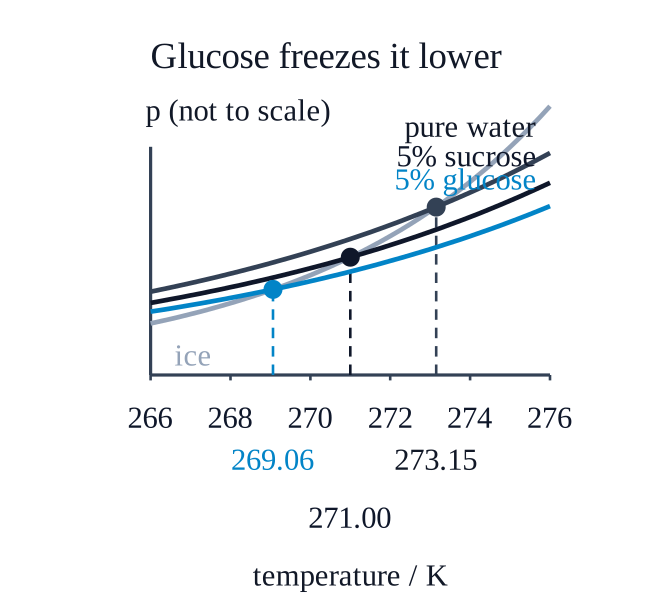 Glucose freezes it lower. A freezing point is where the solution curve MEETS the solid solvent's, and dissolving anything lowers the solution curve. The same $\displaystyle 5$% by mass is more moles of glucose than of sucrose, because glucose is the lighter molecule — and depression counts particles, not mass, so glucose depresses it further.Solved Q1.20 (NCERT Class $\displaystyle 12$ Chemistry, Ch.1 Solutions) — the sucrose/glucose freezing-point depression problem. Verified all arithmetic numerically with a Python check (mol masses: sucrose $\displaystyle 342$ g/mol, glucose $\displaystyle 180$ g/mol; $\displaystyle 5$% by mass means $\displaystyle 5$ g solute per $\displaystyle 100$ g solution, i.e. $\displaystyle 95$ g solvent). Key results: ΔTf(sucrose) = $\displaystyle 2.15$ K, molality = $\displaystyle 0.15389$ mol/kg, implied Kf(water) = $\displaystyle 13.97$ K·kg/mol from the given data; molality of $\displaystyle 5$% glucose = $\displaystyle 0.29240$ mol/kg; ΔTf(glucose) = $\displaystyle 4.085$ K (confirmed independently via the M1/M2 ratio shortcut: $\displaystyle 2.15$ × $\displaystyle 342$/$\displaystyle 180$ = $\displaystyle 4.085$ exactly); final freezing point = $\displaystyle 273.15$ − $\displaystyle 4.085$ = $\displaystyle 269.065$ K ≈ $\displaystyle 269.07$ K.Wrote the full worked solution in the required format (bold opening insight, named formulas, substitution shown, units carried, aside on the "$\displaystyle 5$% by mass = per $\displaystyle 100$ g solution not solvent" trap, KaTeX \(\) / \[\] delimiters, no markdown headings, ending in "Answer: ...").