SolveIt is under development
SolveItClass 12 · Exemplar

NCERT Exemplar · Class 12 Physics Nuclei

26 questions

Very Short Answer Questions 11–15 (part 3 of 5)

  1. Exercise 11

    He23\displaystyle \mathrm{He}_2^3 and He13\displaystyle \mathrm{He}_1^3 nuclei have the same mass number. Do they have the same binding energy?
    NCERT’s answer
    No, the binding energy of \(\displaystyle \mathrm{H}_1{ }^3\) is greater.
    No.\[{}^3_2\mathrm{He}:\ 2p+1n \qquad {}^3_1\mathrm{H}:\ 1p+2n \]\[B=\left[Zm_p+(A-Z)m_n-M\right]c^2 \]\[B({}^3_2\mathrm{He})\approx 7.7\ \mathrm{MeV},\qquad B({}^3_1\mathrm{H})\approx 8.5\ \mathrm{MeV} \]Same \(\displaystyle A\), but different \(\displaystyle Z\) and \(\displaystyle N\).Answer: No, their binding energies differ.
  2. Exercise 12

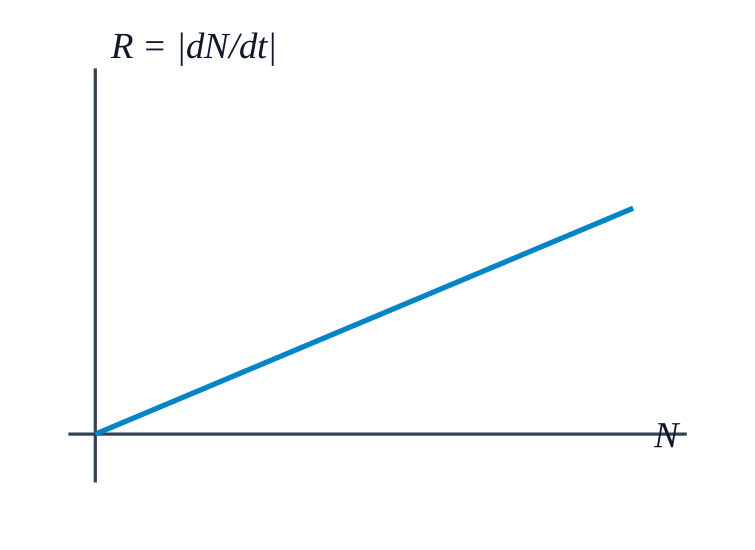
    Draw a graph showing the variation of decay rate with number of active nuclei.
    NCERT’s answer
    NCERT_Solution_Class12_Physics_Exemplar_Ch13_Q12_ncert
    \[R=\left|\frac{dN}{dt}\right|=\lambda N \]NCERT_Solution_Class12_Physics_Exemplar_Ch13_Q12Straight line through the origin, slope \(\displaystyle \lambda\).Answer: Decay rate is directly proportional to \(\displaystyle N\): a straight line through the origin.
  3. Exercise 13

    Which sample, A or B shown in Fig. 13.2\displaystyle 13.2 has shorter mean-life? NCERT_Question_Class12_Physics_Exemplar_Ch13_Q13
    NCERT’s answer
    B has shorter mean life as \(\displaystyle \lambda\) is greater for B.
    \[R=\left|\frac{dN}{dt}\right|=R_0e^{-\lambda t} \]\[\left.\frac{dR}{dt}\right|_{t=0}=-\lambda R_0 \]Both curves start at the same \(\displaystyle R_0\); B falls more steeply, so\[\lambda_B>\lambda_A \]\[\tau=\frac{1}{\lambda}\;\Rightarrow\;\tau_B<\tau_A \]Answer: Sample B has the shorter mean life.
  4. Exercise 14

    Which one of the following cannot emit radiation and why? Excited nucleus, excited electron.
    NCERT’s answer
    Excited electron because energy of electronic energy levels is in the range of eV, only not in MeV. as \(\displaystyle \gamma\)-radiation has energy in MeV.
    \[\Delta E_{\text{electron levels}}\sim\mathrm{eV} \]\[\Delta E_{\text{nuclear levels}}\sim\mathrm{MeV}\;\Rightarrow\;{}^{A}_{Z}\mathrm{X}^{*}\to{}^{A}_{Z}\mathrm{X}+\gamma \]Answer: Excited electron: its levels are only eV apart, so it cannot emit MeV gamma radiation.
  5. Exercise 15

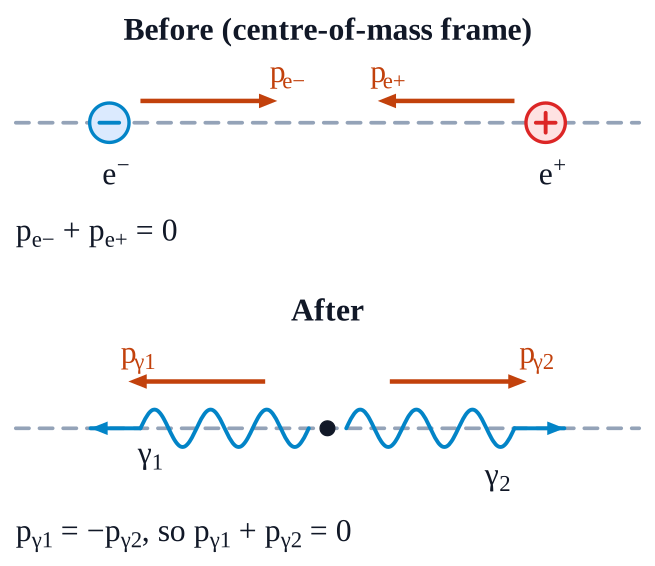
    In pair annihilation, an electron and a positron destroy each other to produce gamma radiation. How is the momentum conserved?
    NCERT’s answer
    \(\displaystyle 2 \gamma\) photons are produced which move in opposite directions to conserve momentum.
    \[e^-+e^+\;\to\;\gamma+\gamma \]NCERT_Solution_Class12_Physics_Exemplar_Ch13_Q15\[\mathbf{p}_{e^-}+\mathbf{p}_{e^+}=\mathbf{0}\quad\text{(centre-of-mass frame)} \]\[\mathbf{p}_{\gamma_1}+\mathbf{p}_{\gamma_2}=\mathbf{0}\;\Rightarrow\;\mathbf{p}_{\gamma_1}=-\mathbf{p}_{\gamma_2} \]One photon alone has \(\displaystyle p=E/c\neq 0\), so two are needed.Answer: Two photons leave in opposite directions with equal and opposite momenta, so the total momentum stays zero.