SolveIt is under development
SolveItClass 12 · Exemplar

NCERT Exemplar · Class 12 Physics Nuclei

26 questions

Long Answer Questions 21–26 (part 5 of 5)

  1. Exercise 21

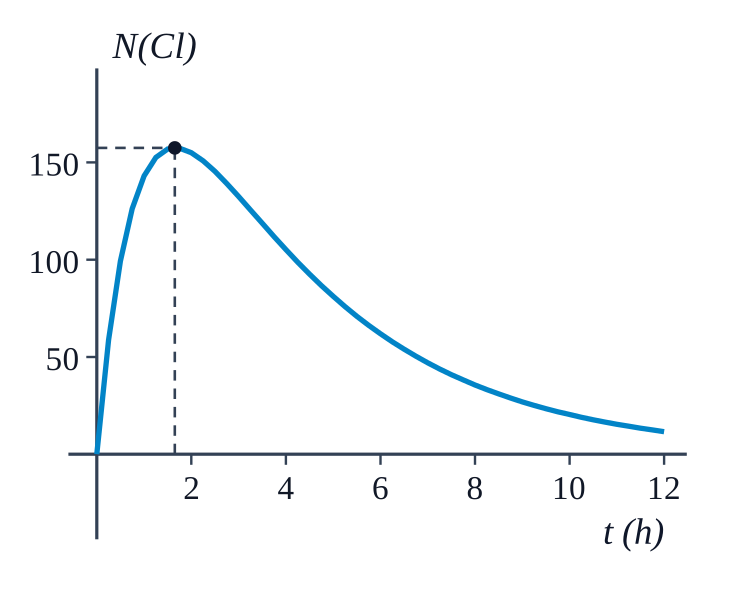
    Sometimes a radioactive nucleus decays into a nucleus which itself is radioactive. An example is : 38 Sulphur →=2.48 h half-life 38Cl→=0.62 h half-life 38Ar (stable) .{ }^{38} \text { Sulphur } \xrightarrow[=2.48 \mathrm{~h}]{\text { half-life }}{ }^{38} \mathrm{Cl} \xrightarrow[=0.62 \mathrm{~h}]{\text { half-life }}{ }^{38} \mathrm{Ar} \text { (stable) } . Assume that we start with 100038 S\displaystyle 1000{ }^{38} \mathrm{~S} nuclei at time t=0\displaystyle t=0. The number of 38Cl\displaystyle { }^{38} \mathrm{Cl} is of count zero at t=0\displaystyle t=0 and will again be zero at t=∞\displaystyle t=\infty. At what value of t\displaystyle t, would the number of counts be a maximum?
    \[\frac{dN_{\mathrm{Cl}}}{dt}=\lambda_1N_{\mathrm S}-\lambda_2N_{\mathrm{Cl}},\qquad N_{\mathrm S}=N_0e^{-\lambda_1t} \] \[N_{\mathrm{Cl}}=\frac{\lambda_1N_0}{\lambda_2-\lambda_1}\left(e^{-\lambda_1t}-e^{-\lambda_2t}\right)\qquad(N_{\mathrm{Cl}}=0\ \text{at}\ t=0) \] Maximum when \(\displaystyle dN_{\mathrm{Cl}}/dt=0\), i.e. when formation equals decay: \[\lambda_1e^{-\lambda_1t}=\lambda_2e^{-\lambda_2t}\ \Rightarrow\ t_{\max}=\frac{\ln(\lambda_2/\lambda_1)}{\lambda_2-\lambda_1} \] \[\lambda_1=\frac{0.693}{2.48\ \mathrm h}=0.279\ \mathrm{h^{-1}},\qquad \lambda_2=\frac{0.693}{0.62\ \mathrm h}=1.118\ \mathrm{h^{-1}} \] \[t_{\max}=\frac{\ln4}{(1.118-0.279)\ \mathrm{h^{-1}}}=\frac{1.386}{0.839}\ \mathrm h=1.65\ \mathrm h \] NCERT_Solution_Class12_Physics_Exemplar_Ch13_Q21 \[N_{\mathrm{Cl}}(t_{\max})=\frac{\lambda_1}{\lambda_2}N_{\mathrm S}=\frac{630}{4}\approx157 \] The Cl counts \(\displaystyle \lambda_2N_{\mathrm{Cl}}\) peak at the same instant.Answer: \(\displaystyle t\approx1.65\ \mathrm h\)
  2. Exercise 22

    Deuteron is a bound state of a neutron and a proton with a binding energy B=2.2MeV\displaystyle \mathrm{B}=2.2 \mathrm{MeV}. A γ\displaystyle \gamma-ray of energy E\displaystyle E is aimed at a deuteron nucleus to try to break it into a (neutron + proton) such that the n\displaystyle n and p\displaystyle p move in the direction of the incident γ\displaystyle \gamma-ray. If E=B\displaystyle E=B, show that this cannot happen. Hence calculate how much bigger than B\displaystyle B must E\displaystyle E be for such a process to happen.
    NCERT’s answer
    From conservation of energy \[\begin{equation*} E-B=K_n+K_p=\frac{p_n{ }^2}{2 m}+\frac{p_p{ }^2}{2 m} \tag{1} \end{equation*} \] From conservation of momentum \[\begin{equation*} p_n+p_p=\frac{E}{c} \tag{2} \end{equation*} \] If \(\displaystyle E=B\), the first equation gives \(\displaystyle p_n=p_p=0\) and hence the second equation cannot be satisfied, and the process cannot take place. For the process to take place, Let \(\displaystyle E=B+\lambda\), where \(\displaystyle \lambda\) would be \(\displaystyle \ll B\). Then : substituting for \(\displaystyle p_n\) from Equation ($\displaystyle 2$) into Equation ($\displaystyle 1$), \[\begin{aligned} & \lambda=\frac{1}{2 m}\left(p_p^2+p_n^2\right)=\frac{1}{2 m}\left(p_p^2+\left(p_p-E / c\right)^2\right) \\ & \therefore 2 p_p^2-\frac{2 E}{c} p_p+\left(\frac{E^2}{c^2}-2 m \lambda\right)=0 \\ & \therefore p_p=\frac{2 E / c \pm \sqrt{4 E^2 / c^2-8\left(\dfrac{E^2}{c^2}-2 m \lambda\right)}}{4} \end{aligned} \] Since the determinant must be positive for \(\displaystyle p_p\) to be real : \[\frac{4 E^2}{c^2}-8\left(\frac{E^2}{c^2}-2 m \lambda\right)=0 \] Or, \(\displaystyle 16 m \lambda=\frac{4 E^2}{c^2}, \therefore \lambda=\frac{E^2}{4 m c^2} \approx \frac{B^2}{4 m c^2}\).
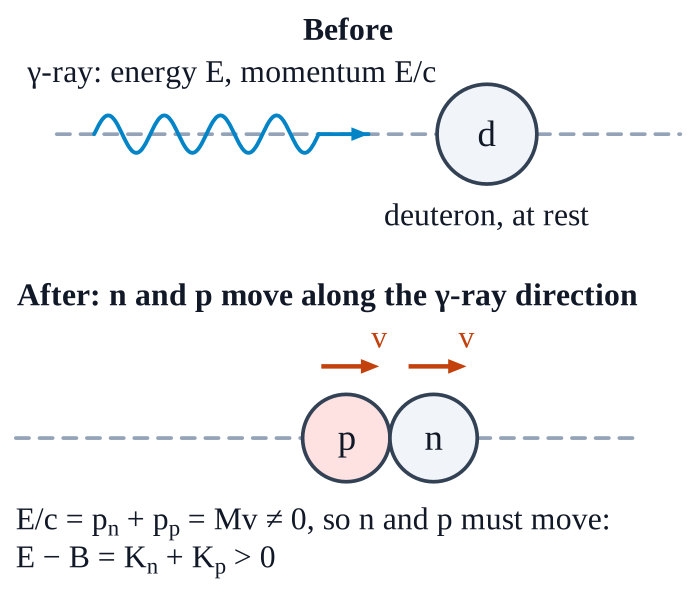
    Deuteron at rest; \(\displaystyle M=m_n+m_p\), \(\displaystyle m_dc^2=Mc^2-B\). NCERT_Solution_Class12_Physics_Exemplar_Ch13_Q22 \[\text{momentum:}\quad \frac{E}{c}=p_n+p_p \] \[\text{energy:}\quad E+m_dc^2=(m_nc^2+K_n)+(m_pc^2+K_p)\ \Rightarrow\ E-B=K_n+K_p \] For \(\displaystyle E=B\): \[K_n+K_p=0\ \Rightarrow\ p_n=p_p=0,\qquad\text{but}\quad \frac{E}{c}=\frac{B}{c}\neq0 \] The photon's momentum cannot be absorbed, so the process cannot happen.Least \(\displaystyle E\): for a fixed total momentum the kinetic energy is smallest when \(\displaystyle n\) and \(\displaystyle p\) share one velocity \(\displaystyle v\). \[\frac{E}{c}=Mv,\qquad E-B=\tfrac12Mv^2=\frac{E^2}{2Mc^2} \] Since \(\displaystyle E-B\ll B\), put \(\displaystyle E\approx B\) on the right: \[E-B\approx\frac{B^2}{2Mc^2}=\frac{(2.2\ \mathrm{MeV})^2}{2\,(1878\ \mathrm{MeV})}\approx1.3\times10^{-3}\ \mathrm{MeV} \]Answer: \(\displaystyle E\) must exceed \(\displaystyle B\) by about \(\displaystyle 1.3\ \mathrm{keV}\).
  3. Exercise 23

    The deuteron is bound by nuclear forces just as H-atom is made up of p\displaystyle p and e\displaystyle e bound by electrostatic forces. If we consider the force between neutron and proton in deuteron as given in the form of a Coulomb potential but with an effective charge e′\displaystyle e^{\prime} : F=14πε0e′2rF=\frac{1}{4 \pi \varepsilon_0} \frac{e^{\prime 2}}{r} estimate the value of (e′/e)\displaystyle \left(e^{\prime} / e\right) given that the binding energy of a deuteron is 2.2\displaystyle 2.2 MeV.
    Take the potential energy \(\displaystyle U=-\frac{1}{4\pi\varepsilon_0}\frac{e'^2}{r}\): hydrogen's ground state with \(\displaystyle e^2\to e'^2\). \(\displaystyle n\) and \(\displaystyle p\) circle their common centre, so use the reduced mass, not \(\displaystyle m_p\): \[\mu=\frac{m_nm_p}{m_n+m_p}\approx\frac{m_p}{2}\approx469\ \mathrm{MeV}/c^2 \] \[B_{\mathrm H}=\frac{m_ee^4}{2(4\pi\varepsilon_0)^2\hbar^2}=13.6\ \mathrm{eV},\qquad B_d=\frac{\mu e'^4}{2(4\pi\varepsilon_0)^2\hbar^2}=2.2\ \mathrm{MeV} \] Dividing: \[\left(\frac{e'}{e}\right)^4=\frac{B_d}{B_{\mathrm H}}\cdot\frac{m_e}{\mu}=\frac{2.2\times10^{6}\ \mathrm{eV}}{13.6\ \mathrm{eV}}\times\frac{0.511\ \mathrm{MeV}}{469\ \mathrm{MeV}} \] \[=1.62\times10^{5}\times1.09\times10^{-3}\approx176 \] \[\frac{e'}{e}=(176)^{1/4}\approx3.6 \]Answer: \(\displaystyle e'/e\approx3.6\)
  4. Exercise 24

    Before the neutrino hypothesis, the beta decay process was throught to be the transition, n→p+eˉn \rightarrow p+\bar{e} If this was true, show that if the neutron was at rest, the proton and electron would emerge with fixed energies and calculate them.Experimentally, the electron energy was found to have a large range.
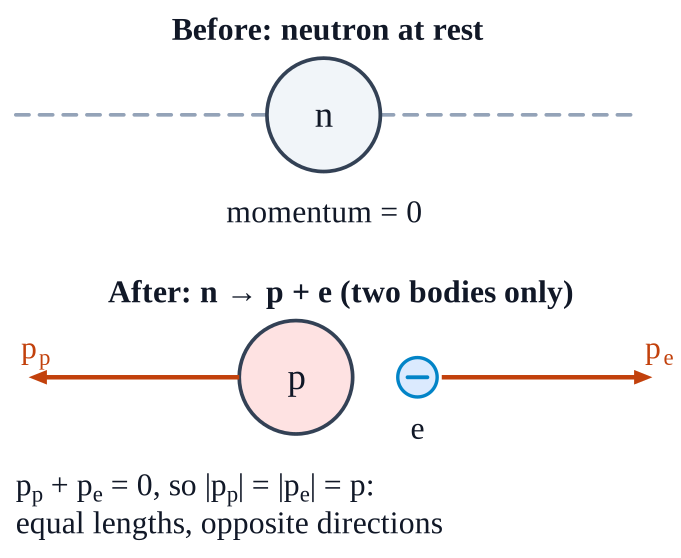
    Neutron at rest, two bodies emerge: NCERT_Solution_Class12_Physics_Exemplar_Ch13_Q24 \[\mathbf p_p+\mathbf p_e=0\ \Rightarrow\ |\mathbf p_p|=|\mathbf p_e|=p \] \[m_nc^2=\sqrt{p^2c^2+m_p^2c^4}+\sqrt{p^2c^2+m_e^2c^4} \] One equation, one unknown \(\displaystyle p\): a single value of \(\displaystyle p\), so fixed energies. With \(\displaystyle E_p+E_e=m_nc^2\) and \(\displaystyle E_p^2-E_e^2=(m_p^2-m_e^2)c^4\): \[E_e=\frac{m_n^2+m_e^2-m_p^2}{2m_n}c^2,\qquad E_p=\frac{m_n^2+m_p^2-m_e^2}{2m_n}c^2 \] Using \(\displaystyle m_nc^2=939.565\), \(\displaystyle m_pc^2=938.272\), \(\displaystyle m_ec^2=0.511\ \mathrm{MeV}\): \[K_p=E_p-m_pc^2=\frac{(m_n-m_p)^2c^4-m_e^2c^4}{2m_nc^2}=\frac{(1.293)^2-(0.511)^2}{2(939.565)}\ \mathrm{MeV}\approx7.5\times10^{-4}\ \mathrm{MeV} \] \[K_e=(m_n-m_p-m_e)c^2-K_p=(0.782-0.001)\ \mathrm{MeV}\approx0.78\ \mathrm{MeV} \] Observed electrons carry every energy from \(\displaystyle 0\) to about \(\displaystyle 0.78\ \mathrm{MeV}\), so a third particle (neutrino) shares the energy.Answer: \(\displaystyle K_e\approx0.78\ \mathrm{MeV}\), \(\displaystyle K_p\approx0.75\ \mathrm{keV}\), both fixed.
  5. Exercise 25

    The activity R\displaystyle R of an unknown radioactive nuclide is measured at hourly intervals. The results found are tabulated as follows:
    t( h)\displaystyle t(\mathrm{~h})0\displaystyle 01\displaystyle 12\displaystyle 23\displaystyle 34\displaystyle 4
    R(MBq)\displaystyle R(\mathrm{MBq})100\displaystyle 10035.36\displaystyle 35.3612.51\displaystyle 12.514.42\displaystyle 4.421.56\displaystyle 1.56
    (i)
    Plot the graph of R\displaystyle R versus t\displaystyle t and calculate half-life from the graph.
    (ii)
    Plot the graph of ln⁡(RR0)\displaystyle \ln \left(\frac{R}{R_0}\right) versus t\displaystyle t and obtain the value of half-life from the graph.
    NCERT’s answer
    (i)
    \(\displaystyle t_{1 / 2}=40 \mathrm{~min}\) (approx).
    (ii)
    Slope of graph \(\displaystyle =-\lambda\)
    So \(\displaystyle \lambda=-\left(\frac{-4.16+3.11}{1}\right)=1.05 \mathrm{~h}\)
    So \(\displaystyle t_{1 / 2}=\frac{0.693}{1.05}=0.66 \mathrm{~h}=39.6\) min or $\displaystyle 40$ min (approx).
    NCERT_Solution_Class12_Physics_Exemplar_Ch13_Q25_ncert
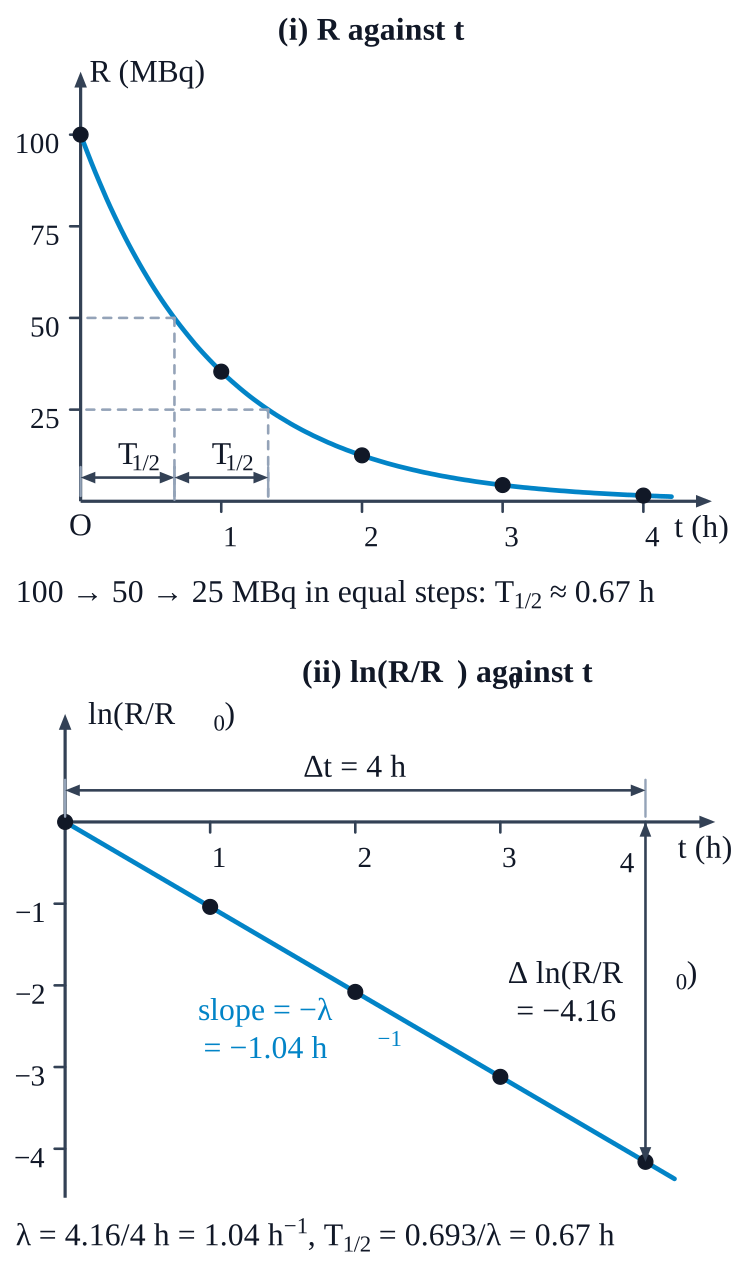
    Ratio of successive readings: \[\frac{35.36}{100}=0.354,\quad\frac{12.51}{35.36}=0.354,\quad\frac{4.42}{12.51}=0.353,\quad\frac{1.56}{4.42}=0.353 \] A constant factor per hour: exponential decay, \(\displaystyle R=R_0e^{-\lambda t}\). NCERT_Solution_Class12_Physics_Exemplar_Ch13_Q25 (i) On the smooth curve \(\displaystyle R\) falls to half of \(\displaystyle 100\ \mathrm{MBq}\) at \(\displaystyle t\approx0.67\ \mathrm h\), and from \(\displaystyle 50\) to \(\displaystyle 25\ \mathrm{MBq}\) between \(\displaystyle 0.67\) and \(\displaystyle 1.33\ \mathrm h\): \[T_{1/2}\approx0.67\ \mathrm h \] Read the halving time on the curve itself, not between plotted points.(ii) \[\ln\frac{R}{R_0}=-\lambda t:\qquad 0,\ -1.04,\ -2.08,\ -3.12,\ -4.16\quad\text{at}\ t=0,1,2,3,4\ \mathrm h \] Points lie on a straight line through the origin. \[\text{slope}=\frac{-4.16-0}{4\ \mathrm h-0}=-1.04\ \mathrm{h^{-1}}\ \Rightarrow\ \lambda=1.04\ \mathrm{h^{-1}} \] \[T_{1/2}=\frac{\ln2}{\lambda}=\frac{0.693}{1.04\ \mathrm{h^{-1}}}=0.67\ \mathrm h \] Take the slope over the whole line, using natural log.Answer: \(\displaystyle T_{1/2}\approx0.67\ \mathrm h\) (about $\displaystyle 40$ min) from both graphs.
  6. Exercise 26

    Nuclei with magic no. of proton Z=2,8,20,28,50,52\displaystyle Z=2,8,20,28,50,52 and magic no. of neutrons N=2,8,20,28,50,82\displaystyle N=2,8,20,28,50,82 and 126\displaystyle 126 are found to be very stable. (i) Verify this by calculating the proton separation energy Sp\displaystyle S_p for 120Sn(Z=50)\displaystyle { }^{120} \mathrm{Sn}(Z=50) and 121Sb=(Z=51)\displaystyle { }^{121} \mathrm{Sb}=(Z=51).
    The proton separation energy for a nuclide is the minimum energy required to separate the least tightly bound proton from a nucleus of that nuclide. It is given by
    Sp=(MZ−1,N+MH−MZ,N)c2.\mathrm{S}_{\mathrm{p}}=\left(M_{Z-1},{ }_N+M_H-M_{Z, N}\right) c^2 .
    Given 119In=118.9058u,120Sn=119.902199u\displaystyle { }^{119} \mathrm{In}=118.9058 \mathrm{u},{ }^{120} \mathrm{Sn}=119.902199 \mathrm{u}, 121Sb=120.903824u,1H=1.0078252u\displaystyle { }^{121} \mathrm{Sb}=120.903824 \mathrm{u},{ }^1 \mathrm{H}=1.0078252 \mathrm{u}.
    (ii)
    What does the existance of magic number indicate?
    Removing a proton from \(\displaystyle ^{120}\mathrm{Sn}\) leaves \(\displaystyle ^{119}\mathrm{In}\); from \(\displaystyle ^{121}\mathrm{Sb}\) it leaves \(\displaystyle ^{120}\mathrm{Sn}\). Use the given atomic masses with \(\displaystyle M_{\mathrm H}\), not \(\displaystyle m_p\), so the electrons cancel.(i) \[S_p(\mathrm{Sn})=\left(M_{^{119}\mathrm{In}}+M_{\mathrm H}-M_{^{120}\mathrm{Sn}}\right)c^2 \] \[=(118.9058+1.0078252-119.902199)\ \mathrm u\times931.5\ \mathrm{MeV\,u^{-1}}=0.011426\ \mathrm u\times931.5\approx10.6\ \mathrm{MeV} \] \[S_p(\mathrm{Sb})=\left(M_{^{120}\mathrm{Sn}}+M_{\mathrm H}-M_{^{121}\mathrm{Sb}}\right)c^2 \] \[=(119.902199+1.0078252-120.903824)\ \mathrm u\times931.5\ \mathrm{MeV\,u^{-1}}=0.006200\ \mathrm u\times931.5\approx5.78\ \mathrm{MeV} \] \[S_p(\mathrm{Sn},\ Z=50)\approx10.6\ \mathrm{MeV}\ >\ S_p(\mathrm{Sb},\ Z=51)\approx5.8\ \mathrm{MeV} \] The 50th proton is bound about twice as firmly as the 51st.(ii) Magic numbers mean nucleons fill closed energy shells, as electrons do in a noble gas, so such nuclei are unusually stable.Answer: \(\displaystyle S_p\approx10.6\ \mathrm{MeV}\) (Sn) and \(\displaystyle 5.8\ \mathrm{MeV}\) (Sb): \(\displaystyle Z=50\) is magic; magic numbers show closed shells and extra stability.