SolveIt is under development
SolveItClass 12 · Exemplar

NCERT Exemplar · Class 12 Physics Nuclei

26 questions

Multiple Choice Questions (Type I) 1–7 (part 1 of 5)

  1. Exercise 1

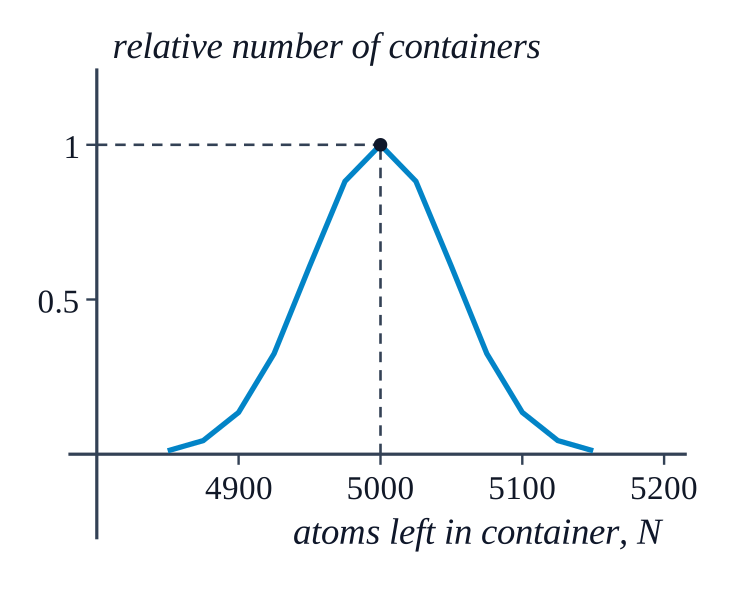
    Suppose we consider a large number of containers each containing initially 10000\displaystyle 10000 atoms of a radioactive material with a half life of 1\displaystyle 1 year. After 1\displaystyle 1 year,
    (a)
    all the containers will have 5000\displaystyle 5000 atoms of the material.
    (b)
    all the containers will contain the same number of atoms of the material but that number will only be approximately 5000.
    (c)
    the containers will in general have different numbers of the atoms of the material but their average will be close to 5000.
    (d)
    none of the containers can have more than 5000\displaystyle 5000 atoms.
    NCERT’s answer
    (c)
    (c) Each atom decays independently with probability \(\displaystyle \tfrac12\) in one half-life, so the counts differ from container to container but average 5000.\[\langle N\rangle = N_0\,p = 10000\times\tfrac12 = 5000 \] \[\sigma=\sqrt{N_0\,p\,(1-p)}=\sqrt{10000\times\tfrac12\times\tfrac12}=50 \] NCERT_Solution_Class12_Physics_Exemplar_Ch13_Q1 \[N\approx 5000\pm 50\ \Rightarrow\ \text{some containers hold} > 5000\ \text{atoms} \]
  2. Exercise 2

    The gravitational force between a H-atom and another particle of mass m\displaystyle m will be given by Newton's law:
    F=GM.mr2\displaystyle F=G \frac{M . m}{r^2}, where r\displaystyle r is in km and
    (a)
    M=mproton +melectron \displaystyle M=m_{\text {proton }}+m_{\text {electron }}.
    (b)
    M=mproton +melectron −Bc2(B=13.6eV)\displaystyle M=m_{\text {proton }}+m_{\text {electron }}-\frac{B}{c^2}(B=13.6 \mathrm{eV}).
    (c)
    M\displaystyle M is not related to the mass of the hydrogen atom.
    (d)
    M=mproton +melectron −∣V∣c2(∣V∣=\displaystyle M=m_{\text {proton }}+m_{\text {electron }}-\frac{|V|}{c^2}(|V|= magnitude of the potential energy of electron in the H-atom).
    NCERT’s answer
    (b)
    (b) The atom is lighter than its free proton and electron by the binding-energy mass \(\displaystyle B/c^2\); \(\displaystyle |V|\) is twice \(\displaystyle B\), so (d) subtracts too much.\[Mc^2 = m_{\text{proton}}c^2 + m_{\text{electron}}c^2 + E,\qquad E=-B=-13.6\ \mathrm{eV} \] \[\Rightarrow\ M = m_{\text{proton}} + m_{\text{electron}} - \frac{B}{c^2} \] \[E = K+V,\quad K=-E,\ V=2E\ \Rightarrow\ |V| = 2B = 27.2\ \mathrm{eV}\neq B \]
  3. Exercise 3

    When a nucleus in an atom undergoes a radioactive decay, the electronic energy levels of the atom
    (a)
    do not change for any type of radioactivity .
    (b)
    change for α\displaystyle \alpha and β\displaystyle \beta radioactivity but not for γ\displaystyle \gamma-radioactivity.
    (c)
    change for α\displaystyle \alpha-radioactivity but not for others.
    (d)
    change for β\displaystyle \beta-radioactivity but not for others.
    NCERT’s answer
    (b)
    (b) \(\displaystyle \alpha\) and \(\displaystyle \beta\) decay change the nuclear charge \(\displaystyle Z\), so the electrons see a different nucleus; \(\displaystyle \gamma\) emission leaves \(\displaystyle Z\) unchanged.\[\alpha:\ {}^{A}_{Z}\mathrm{X}\to{}^{A-4}_{Z-2}\mathrm{Y}+{}^{4}_{2}\mathrm{He}\qquad Z\to Z-2 \] \[\beta^-:\ {}^{A}_{Z}\mathrm{X}\to{}^{A}_{Z+1}\mathrm{Y}+e^-+\bar\nu\qquad Z\to Z+1 \] \[\gamma:\ {}^{A}_{Z}\mathrm{X}^*\to{}^{A}_{Z}\mathrm{X}+\gamma\qquad Z\to Z \] \[\Delta Z\neq 0\ \Rightarrow\ \text{electronic levels change} \]
  4. Exercise 4

    Mx\displaystyle M_{\mathrm{x}} and My\displaystyle M_{\mathrm{y}} denote the atomic masses of the parent and the daughter nuclei respectively in a radioactive decay. The Q\displaystyle Q-value for a β−\displaystyle \beta^{-} decay is Q1\displaystyle Q_1 and that for a β+\displaystyle \beta^{+} decay is Q2\displaystyle Q_2. If me\displaystyle m_{\mathrm{e}} denotes the mass of an electron, then which of the following statements is correct?
    (a)
    Q1=(Mx−My)c2\displaystyle Q_1=\left(M_x-M_y\right) c^2 and Q2=(Mx−My−2me)c2\displaystyle \mathrm{Q}_2=\left(M_x-M_y-2 m_{\mathrm{e}}\right) \mathrm{c}^2
    (b)
    Q1=(Mx−My)c2\displaystyle Q_1=\left(M_x-M_y\right) c^2 and Q2=(Mx−My)c2\displaystyle \mathrm{Q}_2=\left(M_x-M_y\right) c^2
    (c)
    Q1=(Mx−My−2me)c2\displaystyle Q_1=\left(M_x-M_y-2 m_{\mathrm{e}}\right) c^2 and Q2=(Mx−My+2me)c2\displaystyle \mathrm{Q}_2=\left(M_x-M_y+2 m_{\mathrm{e}}\right) c^2
    (d)
    Q1=(Mx−My+2me)c2\displaystyle Q_1=\left(M_x-M_y+2 m_{\mathrm{e}}\right) c^2 and Q2=(Mx−My+2me)c2\displaystyle \mathrm{Q}_2=\left(M_x-M_y+2 m_{\mathrm{e}}\right) c^2
    NCERT’s answer
    (a)
    (a) Atomic masses already include the orbital electrons; they cancel for \(\displaystyle \beta^-\) but leave an extra \(\displaystyle 2m_e\) to subtract for \(\displaystyle \beta^+\).\[\beta^-:\ {}^{A}_{Z}\mathrm{X}\to{}^{A}_{Z+1}\mathrm{Y}+e^-+\bar\nu \] \[Q_1=\left[(M_x-Zm_e)-(M_y-(Z+1)m_e)-m_e\right]c^2=(M_x-M_y)c^2 \] \[\beta^+:\ {}^{A}_{Z}\mathrm{X}\to{}^{A}_{Z-1}\mathrm{Y}+e^++\nu \] \[Q_2=\left[(M_x-Zm_e)-(M_y-(Z-1)m_e)-m_e\right]c^2=(M_x-M_y-2m_e)c^2 \]
  5. Exercise 5

    Tritium is an isotope of hydrogen whose nucleus Triton contains 2\displaystyle 2 neutrons and 1\displaystyle 1 proton. Free neutrons decay into p+e‾+νˉ\displaystyle p+\overline{\mathrm{e}}+\bar{\nu}. If one of the neutrons in Triton decays, it would transform into He3\displaystyle \mathrm{He}^3 nucleus. This does not happen. This is because
    (a)
    Triton energy is less than that of a He3\displaystyle \mathrm{He}^3 nucleus.
    (b)
    the electron created in the beta decay process cannot remain in the nucleus.
    (c)
    both the neutrons in triton have to decay simultaneously resulting in a nucleus with 3\displaystyle 3 protons, which is not a He3\displaystyle \mathrm{He}^3 nucleus.
    (d)
    because free neutrons decay due to external perturbations which is absent in a triton nucleus.
    NCERT’s answer
    (a)
    (a) One neutron turning into a proton does give \(\displaystyle \mathrm{He^3}\) (2p + 1n), so (c) fails. A decay needs \(\displaystyle Q>0\); no decay means \(\displaystyle Q\le0\), i.e. the Triton is not heavier than \(\displaystyle \mathrm{He^3}\).\[{}^{3}_{1}\mathrm{H}\to{}^{3}_{2}\mathrm{He}+e^-+\bar\nu \] \[Q=\left(M_{\mathrm{H^3}}-M_{\mathrm{He^3}}\right)c^2 \] \[\text{no decay}\ \Rightarrow\ Q\le 0\ \Rightarrow\ M_{\mathrm{H^3}}\le M_{\mathrm{He^3}} \]
  6. Exercise 6

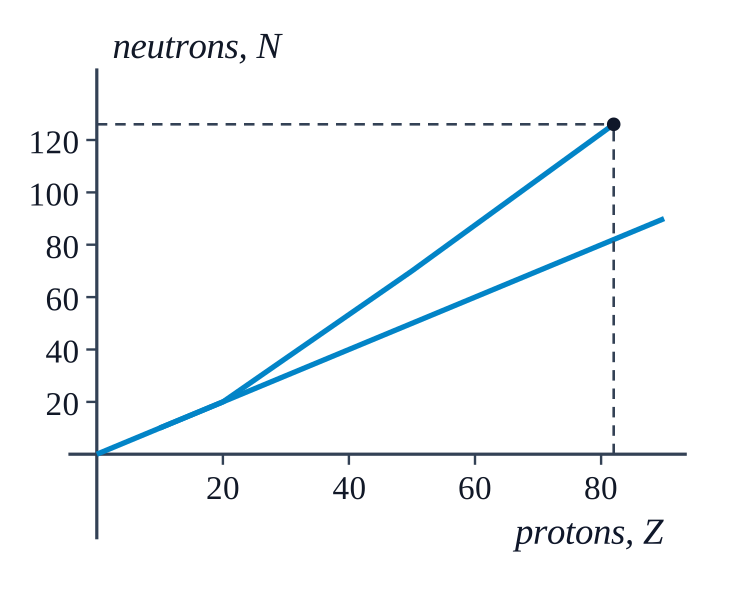
    Heavy stable nucle have more neutrons than protons. This is because of the fact that
    (a)
    neutrons are heavier than protons.
    (b)
    electrostatic force between protons are repulsive.
    (c)
    neutrons decay into protons through beta decay.
    (d)
    nuclear forces between neutrons are weaker than that between protons.
    NCERT’s answer
    (b)
    (b) Protons repel one another across the whole nucleus, while the nuclear force acts only between near neighbours; extra neutrons add attraction without adding repulsion.\[Z\uparrow\ \Rightarrow\ \text{Coulomb repulsion}\uparrow\ \Rightarrow\ N\ \text{must grow faster than}\ Z \] \[{}^{40}_{20}\mathrm{Ca}:\ \frac{N}{Z}=\frac{20}{20}=1\qquad {}^{208}_{82}\mathrm{Pb}:\ \frac{N}{Z}=\frac{208-82}{82}=\frac{126}{82}\approx 1.54 \] NCERT_Solution_Class12_Physics_Exemplar_Ch13_Q6
  7. Exercise 7

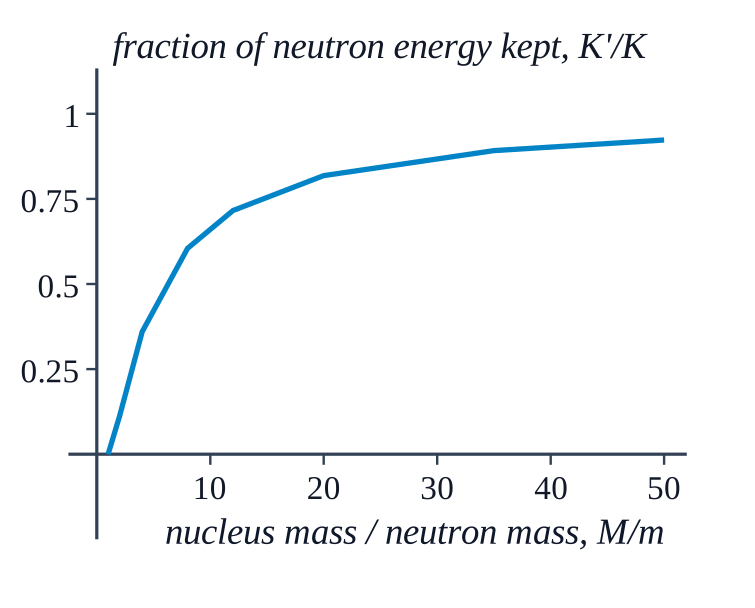
    In a nuclear reactor, moderators slow down the neutrons which come out in a fission process. The moderator used have light nuclei. Heavy nuclei will not serve the purpose because
    (a)
    they will break up.
    (b)
    elastic collision of neutrons with heavy nuclei will not slow them down.
    (c)
    the net weight of the reactor would be unbearably high.
    (d)
    substances with heavy nuclei do not occur in liquid or gaseous state at room temperature.
    NCERT’s answer
    (b)
    (b) Against a much heavier nucleus an elastic collision just reflects the neutron at nearly full speed, so it loses almost no energy.Head-on, nucleus (\(\displaystyle M\)) at rest, neutron (\(\displaystyle m\), speed \(\displaystyle u\)): \[v=\frac{m-M}{m+M}\,u\qquad \frac{K'}{K}=\left(\frac{M-m}{M+m}\right)^2 \] \[M=m:\ \frac{K'}{K}=0\qquad M=12m:\ \left(\tfrac{11}{13}\right)^2\approx 0.72\qquad M=200m:\ \left(\tfrac{199}{201}\right)^2\approx 0.98 \] NCERT_Solution_Class12_Physics_Exemplar_Ch13_Q7