SolveIt is under development
SolveItClass 12 · Exemplar

NCERT Exemplar · Class 12 Physics Nuclei

26 questions

Short Answer Questions 16–20 (part 4 of 5)

  1. Exercise 16

    Why do stable nuclei never have more protons than neutrons?
    NCERT’s answer
    Protons are positively charged and repel one another electrically. This repulsion becomes so great in nuclei with more than $\displaystyle 10$ protons or so, that an excess of neutrons which produce only attractive forces, is required for stability.
    Protons repel by the long-range Coulomb force; the attractive nuclear force is short-range and the same for p–p, n–n and p–n pairs.\[Z\uparrow \;\Rightarrow\; \text{Coulomb repulsion}\uparrow \text{ faster than nuclear attraction} \]Neutrons add attraction but no repulsion:\[{}^{208}_{\ 82}\mathrm{Pb}:\quad N = A - Z = 208 - 82 = 126,\qquad \frac{N}{Z} = \frac{126}{82} \approx 1.5 \]So \(\displaystyle N \ge Z\); only \(\displaystyle {}^{1}_{1}\mathrm{H}\) and \(\displaystyle {}^{3}_{2}\mathrm{He}\) are exceptions, too light for repulsion to matter.Answer: Extra neutrons offset the proton–proton Coulomb repulsion, so stable nuclei have \(\displaystyle N \ge Z\).
  2. Exercise 17

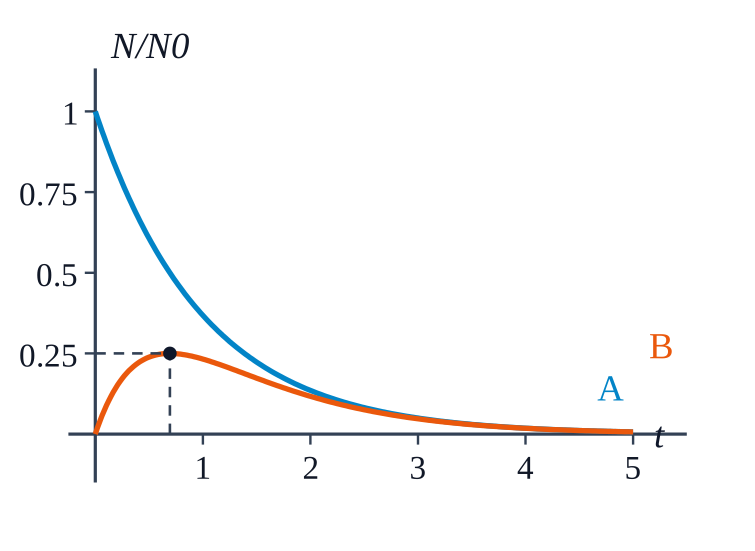
    Consider a radioactive nucleus A which decays to a stable nucleus C through the following sequence: A→ B→C\mathrm{A} \rightarrow \mathrm{~B} \rightarrow \mathrm{C} Here B is an intermediate nuclei which is also radioactive. Considering that there are N0\displaystyle N_0 atoms of A initially, plot the graph showing the variation of number of atoms of A and B versus time.
    NCERT’s answer
    At \(\displaystyle t=0, N_A=N_O\) while \(\displaystyle N_B=0\). As time increases, \(\displaystyle N_A\) falls off exponentially, the number of atoms of B increases, becomes maximum and finally decays to zero at \(\displaystyle \infty\) (following exponential decay law). NCERT_Solution_Class12_Physics_Exemplar_Ch13_Q17_ncert
    Both curves follow from the decay rates:\[\frac{dN_A}{dt} = -\lambda_A N_A \;\Rightarrow\; N_A = N_0\, e^{-\lambda_A t} \]\[\frac{dN_B}{dt} = \lambda_A N_A - \lambda_B N_B \;\Rightarrow\; N_B = \frac{\lambda_A N_0}{\lambda_B - \lambda_A}\left(e^{-\lambda_A t} - e^{-\lambda_B t}\right) \]\[t = 0:\; N_A = N_0,\; N_B = 0 \qquad\quad t\to\infty:\; N_A \to 0,\; N_B \to 0 \]NCERT_Solution_Class12_Physics_Exemplar_Ch13_Q17B peaks where its production equals its decay:\[\frac{dN_B}{dt} = 0 \;\Rightarrow\; \lambda_A N_A = \lambda_B N_B \]Answer: \(\displaystyle N_A\) falls exponentially from \(\displaystyle N_0\); \(\displaystyle N_B\) rises from zero, peaks, then falls to zero.
  3. Exercise 18

    A piece of wood from the ruins of an ancient building was found to have a 14C\displaystyle { }^{14} \mathrm{C} activity of 12\displaystyle 12 disintegrations per minute per gram of its carbon content. The 14C\displaystyle { }^{14} \mathrm{C} activity of the living wood is 16\displaystyle 16 disintegrations per minute per gram. How long ago did the tree, from which the wooden sample came, die? Given half-life of 14C\displaystyle { }^{14} \mathrm{C} is 5760\displaystyle 5760 years.
    NCERT’s answer
    \(\displaystyle t=\frac{1}{\lambda} \ln \frac{R_0}{R}\) \[\begin{aligned} & =\frac{5760}{0.693} \ln \frac{16}{12}=\frac{5760}{0.693} \ln \frac{4}{3} \\ & =\frac{5760}{0.693} \times 2.303 \log \frac{4}{3}=\quad 2391.12 \text { years } . \end{aligned} \]
    \[A = A_0\, e^{-\lambda t}, \qquad \lambda = \frac{\ln 2}{T_{1/2}} \]\[\frac{A}{A_0} = \frac{12}{16} = \frac{3}{4} = e^{-\lambda t} \;\Rightarrow\; t = \frac{1}{\lambda}\ln\frac{4}{3} = \frac{T_{1/2}}{\ln 2}\,\ln\frac{4}{3} \]\[t = \frac{5760\ \mathrm{y}}{0.693}\times 0.288 \approx 2.39\times 10^{3}\ \mathrm{y} \]\(\displaystyle A_0\) is the activity of living wood, not of the sample. Check: \(\displaystyle A/A_0 > \tfrac12\), so \(\displaystyle t < T_{1/2} = 5760\ \mathrm{y}\).Answer: The tree died about \(\displaystyle 2.4\times10^{3}\) years ago (≈ $\displaystyle 2390$ years).
  4. Exercise 19

    Are the nucleons fundamental particles, or do they consist of still smaller parts? One way to find out is to probe a nucleon just as Rutherford probed an atom. What should be the kinetic energy of an electron for it to be able to probe a nucleon? Assume the diameter of a nucleon to be approximately 10−15 m\displaystyle 10^{-15} \mathrm{~m}.
    NCERT’s answer
    To resolve two objects separated by distance \(\displaystyle d\), the wavelength \(\displaystyle \lambda\) of the proving signal must be less than \(\displaystyle d\). Therefore, to detect separate parts inside a nucleon, the electron must have a wavelength less than \(\displaystyle 10^{-15} \mathrm{~m}\). \[\begin{aligned} \lambda & =\frac{h}{p} \text { and } K \approx p c \Rightarrow K \approx p c=\frac{h c}{\lambda} \\ & =\frac{6.63 \times 10^{34} \times 3 \times 10^8}{1.6 \times 10^{-19} \times 10^{-15}} \mathrm{eV} \\ & =10^9 \mathrm{eV} .=1 \mathrm{GeV} . \end{aligned} \]
    A probe resolves a structure only if its de Broglie wavelength is no larger than the structure:\[\lambda \approx d = 10^{-15}\ \mathrm{m} \]\[p = \frac{h}{\lambda} = \frac{6.63\times10^{-34}\ \mathrm{J\,s}}{10^{-15}\ \mathrm{m}} = 6.63\times10^{-19}\ \mathrm{kg\,m\,s^{-1}} \]\[pc = 6.63\times10^{-19}\times 3\times10^{8}\ \mathrm{J} = 1.99\times10^{-10}\ \mathrm{J} \approx 1.24\times10^{9}\ \mathrm{eV} \]Do not use \(\displaystyle \tfrac12 mv^2\): \(\displaystyle p/m \approx 7\times10^{11}\ \mathrm{m\,s^{-1}} \gg c\). Here \(\displaystyle pc \gg m_ec^2 = 0.511\ \mathrm{MeV}\), so:\[K = \sqrt{p^2c^2 + m_e^2c^4} - m_ec^2 \approx pc \approx 1.24\ \mathrm{GeV} \]Answer: \(\displaystyle K \approx 1.24\ \mathrm{GeV}\) (about \(\displaystyle 10^{9}\ \mathrm{eV}\)); electrons this energetic scatter off a nucleon's interior and show whether it has parts.
  5. Exercise 20

    A nuclide 1\displaystyle 1 is said to be the mirror isobar of nuclide 2\displaystyle 2 if Z1=N2\displaystyle Z_1=N_2 and Z2=N1\displaystyle Z_2=N_1. (a) What nuclide is a mirror isobar of 1123Na\displaystyle { }_{11}^{23} \mathrm{Na} ? (b) Which nuclide out of the two mirror isobars have greater binding energy and why?
    (a) Interchange the numbers of protons and neutrons of \(\displaystyle {}^{23}_{11}\mathrm{Na}\):\[Z_1 = 11,\quad N_1 = 23 - 11 = 12 \]\[Z_2 = N_1 = 12,\quad N_2 = Z_1 = 11,\quad A = 12 + 11 = 23 \;\Rightarrow\; {}^{23}_{12}\mathrm{Mg} \](b) Same \(\displaystyle A\), and the nuclear force is charge-independent (p–p = n–n), so only the Coulomb repulsion differs:\[\text{proton pairs} = \frac{Z(Z-1)}{2}:\qquad \mathrm{Na}:\ 55 \;<\; \mathrm{Mg}:\ 66 \]\[\text{Coulomb repulsion}_{\mathrm{Mg}} > \text{Coulomb repulsion}_{\mathrm{Na}} \;\Rightarrow\; \text{binding energy}_{\mathrm{Na}} > \text{binding energy}_{\mathrm{Mg}} \]Answer: (a) \(\displaystyle {}^{23}_{12}\mathrm{Mg}\); (b) \(\displaystyle {}^{23}_{11}\mathrm{Na}\), with fewer protons and so less Coulomb repulsion.