Exercise 19
Prove that a closed equipotential surface with no charge within itself must enclose an equipotential volume.
NCERT’s answer
Suppose this were not true. The potential just inside the surface would be different from that at the surface resulting in a potential gradient. This would mean that there are field lines pointing inwards or outwards from the surface. These lines cannot at the other end be again on the surface, since the surface is equipotential. Thus, this is possible only if the other end of the lines are at charges inside, contradicting the premise. Hence, the entire volume inside must be at the same potential.
Let the closed surface be at potential \(\displaystyle V_S\), with no charge inside.\[\oint \mathbf{E}\cdot d\mathbf{A}=\frac{q_{\text{in}}}{\varepsilon_0}=0 \]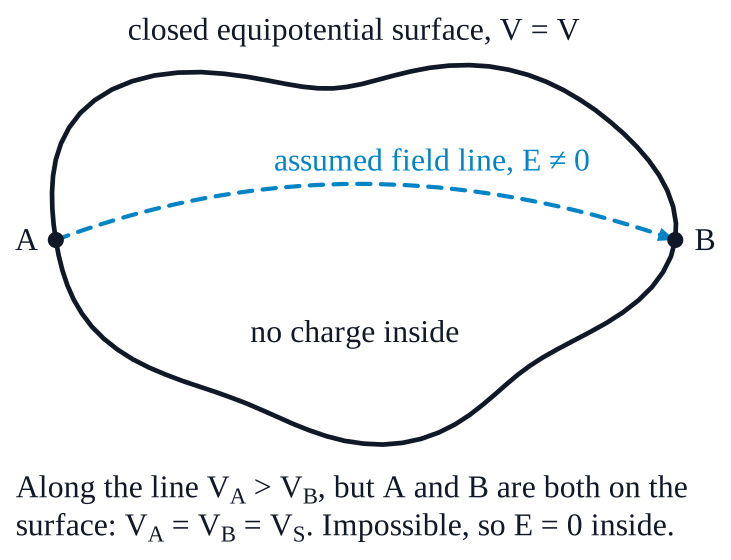 No field line starts or ends inside. Suppose \(\displaystyle \mathbf{E}\neq 0\) somewhere inside. Its line cannot close on itself (\(\displaystyle \oint\mathbf{E}\cdot d\mathbf{l}=0\)), so it runs from a point A on the surface to a point B on it, with \(\displaystyle \mathbf{E}\cdot d\mathbf{l}>0\) all along:\[V_A-V_B=\int_A^B \mathbf{E}\cdot d\mathbf{l}>0 \]But \(\displaystyle V_A=V_B=V_S\) \(\displaystyle \Rightarrow\) contradiction. Hence\[\mathbf{E}=0 \;\Rightarrow\; V=V_S\ \text{at every point inside} \]Answer: The enclosed volume is equipotential, at \(\displaystyle V_S\).
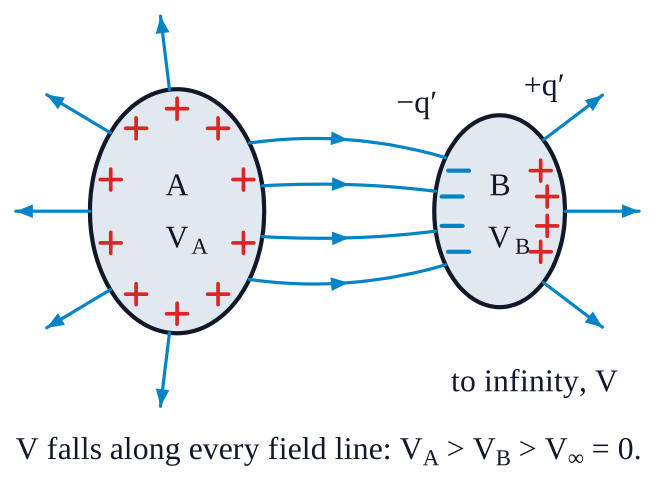 Lines from A end on the \(\displaystyle -q'\) face; lines from the \(\displaystyle +q'\) face can only go to infinity (no other conductor). Potential falls along a field line:\[V_A-V_B=\int_A^B \mathbf{E}\cdot d\mathbf{l}>0 \]\[V_B-V_\infty=\int_B^\infty \mathbf{E}\cdot d\mathbf{l}>0 \]\[V_A>V_B>V_\infty=0 \]Answer: B lies between A and infinity in potential.

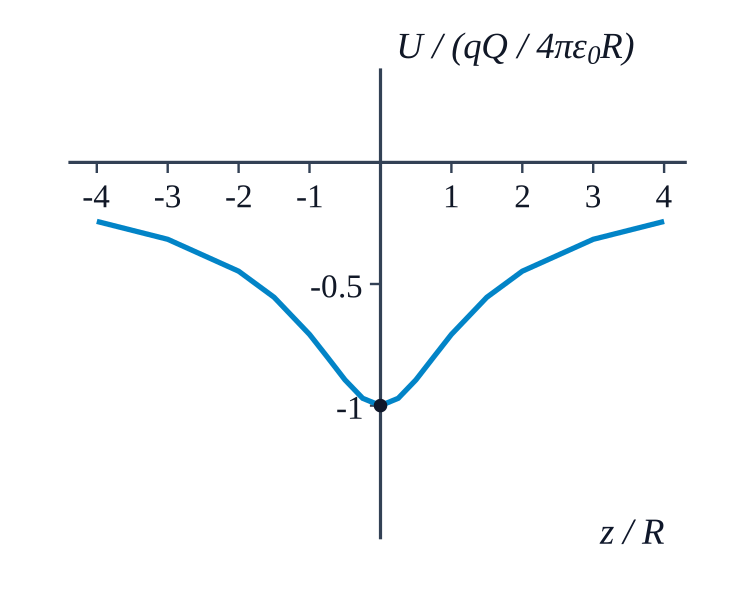 \(\displaystyle U\) is symmetric in \(\displaystyle z\), lowest at the centre, and tends to zero far away:\[U(0)=-\frac{qQ}{4\pi\varepsilon_0 R},\qquad U(\infty)=0 \]For a small displacement \(\displaystyle z\ll R\), with \(\displaystyle \sqrt{R^2+z^2}\approx R\left(1+\dfrac{z^2}{2R^2}\right)\):\[U\approx-\frac{qQ}{4\pi\varepsilon_0 R}\left(1-\frac{z^2}{2R^2}\right),\qquad F=-\frac{dU}{dz}=-\frac{qQ}{4\pi\varepsilon_0 R^3}\,z \]The force points back to the centre: stable equilibrium, so \(\displaystyle -q\) oscillates along the axis about the centre (mass \(\displaystyle m\)):\[\omega=\sqrt{\frac{qQ}{4\pi\varepsilon_0\,mR^3}} \]Answer: \(\displaystyle U=-\dfrac{qQ}{4\pi\varepsilon_0\sqrt{R^2+z^2}}\); on a small displacement \(\displaystyle -q\) oscillates about the centre.

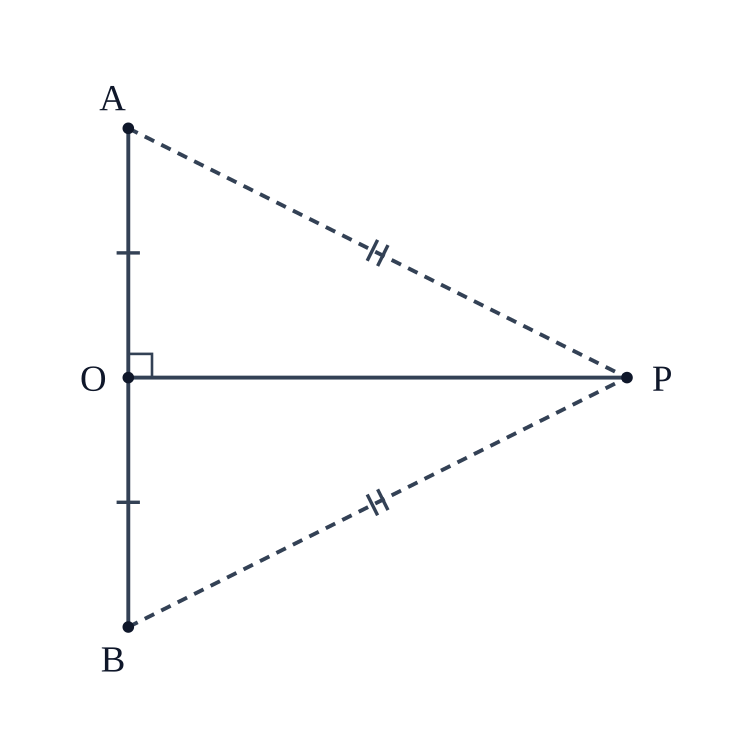 \[r=\sqrt{R^2+z^2} \]\[dV=\frac{1}{4\pi\varepsilon_0}\,\frac{dq}{\sqrt{R^2+z^2}} \]Potential is a scalar, so the contributions add algebraically, with no direction components:\[V=\frac{1}{4\pi\varepsilon_0}\,\frac{1}{\sqrt{R^2+z^2}}\int dq=\frac{1}{4\pi\varepsilon_0}\,\frac{Q}{\sqrt{R^2+z^2}} \]Checks:\[z=0:\ V=\frac{Q}{4\pi\varepsilon_0 R},\qquad z\gg R:\ V\approx\frac{Q}{4\pi\varepsilon_0 z} \]Answer: \(\displaystyle V=\dfrac{Q}{4\pi\varepsilon_0\sqrt{R^2+z^2}}\)