SolveIt is under development
SolveItClass 12 · Exemplar

NCERT Exemplar · Class 12 Physics Electrostatic Potential and Capacitance

33 questions

Multiple Choice Questions (Type I) 1–6 (part 1 of 5)

  1. Exercise 1

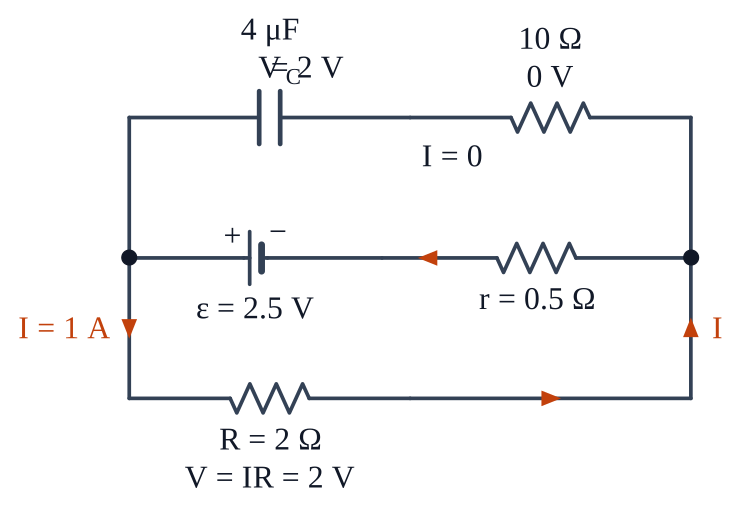
    A capacitor of 4μ F\displaystyle 4 \mu \mathrm{~F} is connected as shown in the circuit (Fig. 2.1\displaystyle 2.1). The internal resistance of the battery is 0.5Ω\displaystyle 0.5 \Omega. The amount of charge on the capacitor plates will be
    (a)
    0\displaystyle 0 (b) 4μC\displaystyle 4 \mu \mathrm{C}
    (c)
    16μC\displaystyle 16 \mu \mathrm{C}
    (d)
    8μC\displaystyle 8 \mu \mathrm{C}
    NCERT_Question_Class12_Physics_Exemplar_Ch2_Q1
    NCERT’s answer
    (d)
    (d) \(\displaystyle 8\,\mu\mathrm{C}\) — at steady state the capacitor branch carries no current, so the \(\displaystyle 10\,\Omega\) drops nothing; only \(\displaystyle r\) and the \(\displaystyle 2\,\Omega\) carry current.NCERT_Solution_Class12_Physics_Exemplar_Ch2_Q1\[I=\frac{\varepsilon}{R+r}=\frac{2.5\,\mathrm{V}}{2\,\Omega+0.5\,\Omega}=1\,\mathrm{A} \] \[V_C=V_{2\,\Omega}=IR=1\,\mathrm{A}\times 2\,\Omega=2\,\mathrm{V} \] \[Q=CV_C=4\,\mu\mathrm{F}\times 2\,\mathrm{V}=8\,\mu\mathrm{C} \]
  2. Exercise 2

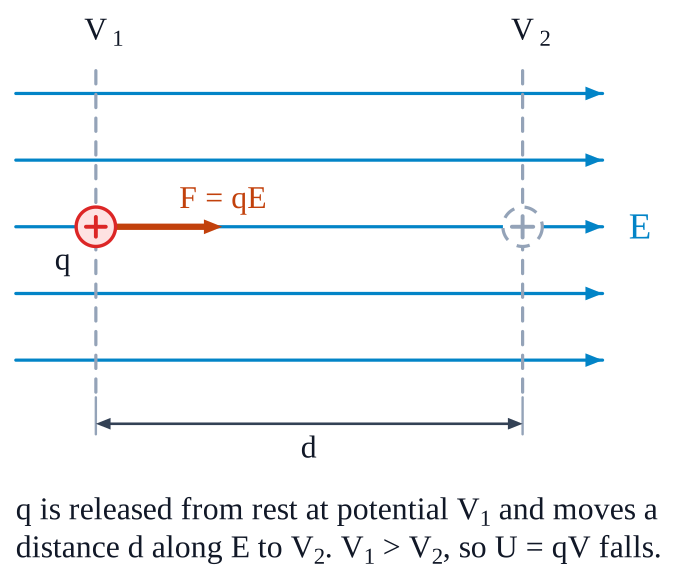
    A positively charged particle is released from rest in an uniform electric field. The electric potential energy of the charge
    (a)
    remains a constant because the electric field is uniform.
    (b)
    increases because the charge moves along the electric field.
    (c)
    decreases because the charge moves along the electric field.
    (d)
    decreases because the charge moves opposite to the electric field.
    NCERT’s answer
    (c)
    (c) — the force \(\displaystyle q\mathbf{E}\) points along \(\displaystyle \mathbf{E}\) and the charge moves along it, so the field does positive work and \(\displaystyle U\) falls.NCERT_Solution_Class12_Physics_Exemplar_Ch2_Q2\[\mathbf{F}=q\mathbf{E},\qquad q>0 \] \[W=qEd>0 \] \[\Delta U=-W=-qEd<0 \]
  3. Exercise 3

    Figure 2.2\displaystyle 2.2 shows some equipotential lines distributed in space. A charged object is moved from point A to point B.
    (a)
    The work done in Fig. (i) is the greatest.
    (b)
    The work done in Fig. (ii) is least.
    (c)
    The work done is the same in Fig. (i), Fig. (ii) and Fig. (iii).
    (d)
    The work done in Fig. (iii) is greater than Fig. (ii)but equal to that in Fig. (i).
    NCERT_Question_Class12_Physics_Exemplar_Ch2_Q3
    NCERT’s answer
    (c)
    (c) — work depends only on the end potentials: A is on the \(\displaystyle 20\,\mathrm{V}\) line and B on the \(\displaystyle 40\,\mathrm{V}\) line in all three figures; the spacing does not matter.\[W_{A\to B}=q\,(V_B-V_A) \] \[W=q\,(40\,\mathrm{V}-20\,\mathrm{V})=(20\,\mathrm{V})\,q \] \[W_{(\mathrm{i})}=W_{(\mathrm{ii})}=W_{(\mathrm{iii})} \]
  4. Exercise 4

    The electrostatic potential on the surface of a charged conducting sphere is 100V. Two statments are made in this regard:
    S1\displaystyle \mathrm{S}_1 : At any point inside the sphere, electric intensity is zero.
    S2\displaystyle \mathrm{S}_2 : At any point inside the sphere, the electrostatic potential is 100V.
    Which of the following is a correct statement?
    (a)
    S1\displaystyle \mathrm{S}_1 is true but S2\displaystyle \mathrm{S}_2 is false.
    (b)
    Both S1& S2\displaystyle \mathrm{S}_1 \& \mathrm{~S}_2 are false.
    (c)
    S1\displaystyle \mathrm{S}_1 is true, S2\displaystyle \mathrm{S}_2 is also true and S1\displaystyle \mathrm{S}_1 is the cause of S2\displaystyle \mathrm{S}_2.
    (d)
    S1\displaystyle \mathrm{S}_1 is true, S2\displaystyle \mathrm{S}_2 is also true but the statements are independant.
    NCERT’s answer
    (c)
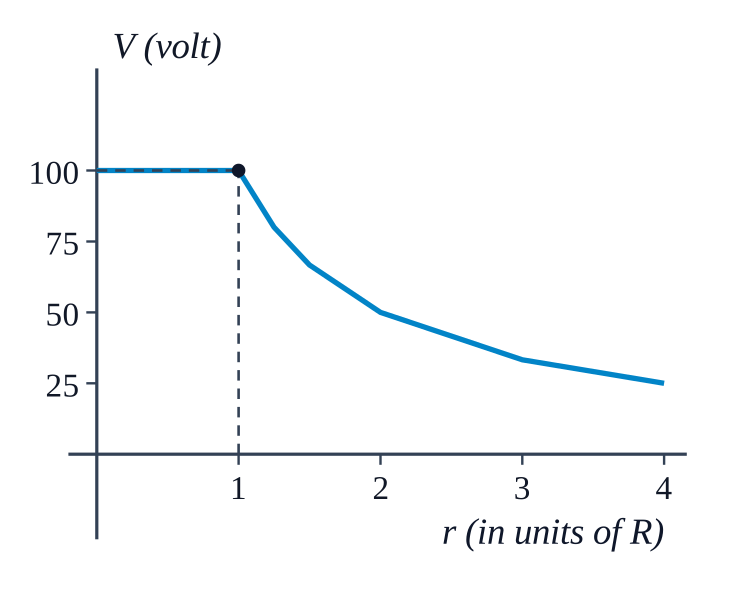
    (c) — \(\displaystyle E=0\) inside a conductor, so the potential cannot change from its surface value; \(\displaystyle S_1\) is the cause of \(\displaystyle S_2\).\[\mathbf{E}_{\mathrm{in}}=0 \] \[V(r)-V(R)=-\int_R^{r}\mathbf{E}\cdot d\mathbf{l}=0\qquad(r<R) \] \[V_{\mathrm{in}}=V_{\mathrm{surface}}=100\,\mathrm{V} \]NCERT_Solution_Class12_Physics_Exemplar_Ch2_Q4
  5. Exercise 5

    Equipotentials at a great distance from a collection of charges whose total sum is not zero are approximately
    (a)
    spheres.
    (b)
    planes.
    (c)
    paraboloids
    (d)
    ellipsoids.
    NCERT’s answer
    (a)
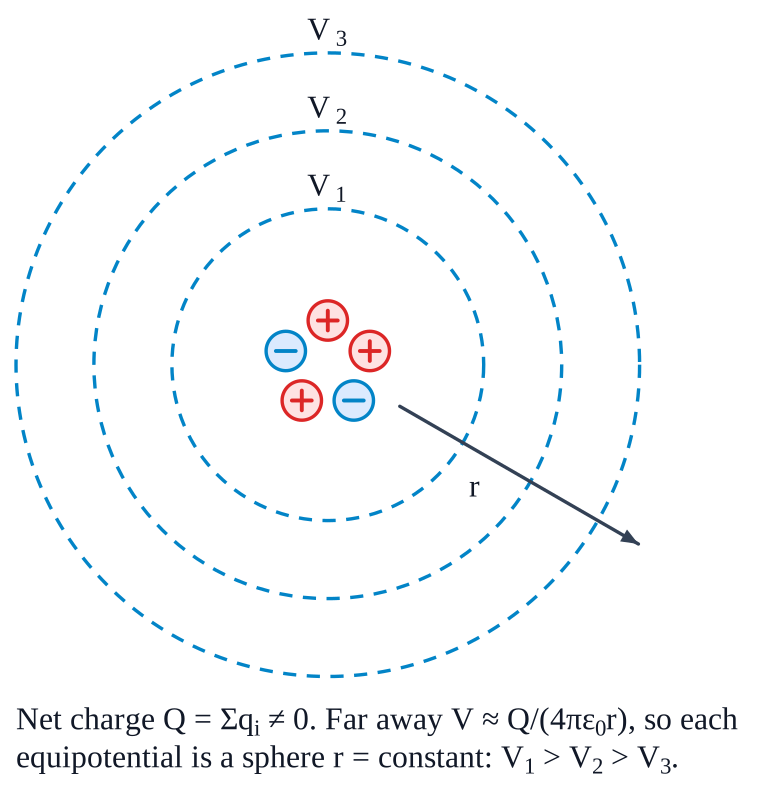
    (a) — far away the charges act like one point charge \(\displaystyle Q=\sum q_i\neq 0\); constant \(\displaystyle V\) then means constant \(\displaystyle r\), a sphere.\[V\approx\frac{1}{4\pi\varepsilon_0}\,\frac{Q}{r},\qquad Q=\sum q_i\neq 0 \] \[V=\text{const}\ \Rightarrow\ r=\text{const}\ \Rightarrow\ \text{sphere} \]NCERT_Solution_Class12_Physics_Exemplar_Ch2_Q5
  6. Exercise 6

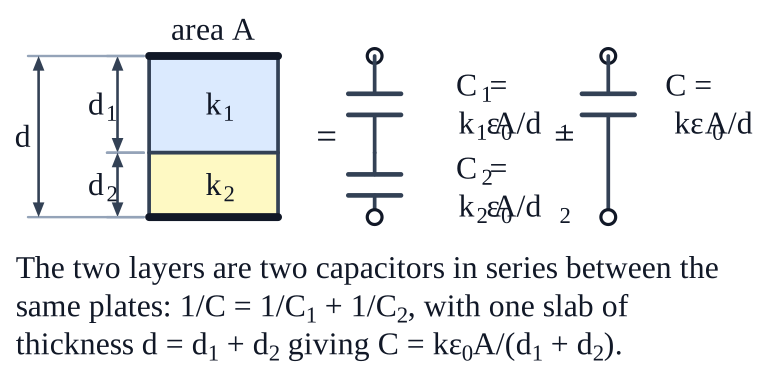
    A parallel plate capacitor is made of two dielectric blocks in series. One of the blocks has thickness d1\displaystyle d_1 and dielectric constant k1\displaystyle k_1 and the other has thickness d2\displaystyle d_2 and dielectric constant k2\displaystyle k_2 as shown in Fig. 2.3. This arrangement can be thought as a dielectric slab of thickness d(=d1+d2)\displaystyle d\left(=d_1+d_2\right) and effective dielectric constant k\displaystyle k. The k\displaystyle k is
    (a)
    k1d1+k2d2d1+d2\displaystyle \frac{k_1 d_1+k_2 d_2}{d_1+d_2}
    (b)
    k1d1+k2d2k1+k2\displaystyle \frac{k_1 d_1+k_2 d_2}{k_1+k_2}
    (c)
    k1k2(d1+d2)(k1d1+k2d2)\displaystyle \frac{k_1 k_2\left(d_1+d_2\right)}{\left(k_1 d_1+k_2 d_2\right)}
    (d)
    2k1k2k1+k2\displaystyle \frac{2 k_1 k_2}{k_1+k_2}
    NCERT_Question_Class12_Physics_Exemplar_Ch2_Q6
    (c) — it has this form, but the correct denominator is \(\displaystyle k_2d_1+k_1d_2\); the printed one has \(\displaystyle d_1,d_2\) swapped.NCERT_Solution_Class12_Physics_Exemplar_Ch2_Q6\[C_1=\frac{k_1\varepsilon_0A}{d_1},\qquad C_2=\frac{k_2\varepsilon_0A}{d_2} \] \[\frac{1}{C}=\frac{1}{C_1}+\frac{1}{C_2}=\frac{d_1}{k_1\varepsilon_0A}+\frac{d_2}{k_2\varepsilon_0A} \] \[C=\frac{k\varepsilon_0A}{d_1+d_2}\ \Rightarrow\ \frac{d_1+d_2}{k}=\frac{d_1}{k_1}+\frac{d_2}{k_2} \] \[k=\frac{k_1k_2\,(d_1+d_2)}{k_2d_1+k_1d_2} \]