SolveIt is under development
SolveItClass 12 · Exemplar

NCERT Exemplar · Class 12 Physics Electrostatic Potential and Capacitance

33 questions

Long Answer Questions 24–33 (part 5 of 5)

  1. Exercise 24

    Find the equation of the equipotentials for an infinite cylinder of radius r0\displaystyle r_0, carrying charge of linear density λ\displaystyle \lambda.
    NCERT’s answer
    To find the potential at distance \(\displaystyle r\) from the line consider the electric field. We note that from symmetry the field lines must be radially outward. Draw a cylindrical Gaussian surface of radius \(\displaystyle r\) and length \(\displaystyle l\). Then \[\oint \mathbf{E} . \mathrm{d} \mathbf{S}=\frac{1}{\varepsilon_0} \lambda \mathrm{l}\] Or \(\displaystyle \mathrm{E}_{\mathrm{r}} 2 \pi \mathrm{rl}=\frac{1}{\varepsilon_0} \lambda \mathrm{l}\) \[\Rightarrow \mathrm{E}_{\mathrm{r}}=\frac{\lambda}{2 \pi \varepsilon_0 \mathrm{r}}\] Hence, if \(\displaystyle \mathrm{r}_0\) is the radius, \[V(\mathrm{r})-V\left(\mathrm{r}_0\right)=-\int_{\mathrm{r}_0}^{\mathrm{r}} \mathbf{E} . \mathrm{d} \mathbf{l}=\frac{\lambda}{2 \pi \varepsilon_0} \ln \frac{r_0}{r}\] For a given V, \[\ln \frac{r}{r_0}=-\frac{2 \pi \varepsilon_0}{\lambda}\left[\mathrm{V}(\mathrm{r})-\mathrm{V}\left(\mathrm{r}_0\right)\right]\] \[\Rightarrow r=r_0 \mathrm{e}^{-2 \pi \varepsilon_0 V r_0 / \lambda} . \mathrm{e}^{+2 \pi \varepsilon_0 V(r) / \lambda}\] The equipotential surfaces are cylinders of radius \[r=r_0 \mathrm{e}^{-2 \pi \varepsilon_0\left[V(r)-V\left(r_0\right)\right] / \lambda}\] NCERT_Solution_Class12_Physics_Exemplar_Ch2_Q24_ncert
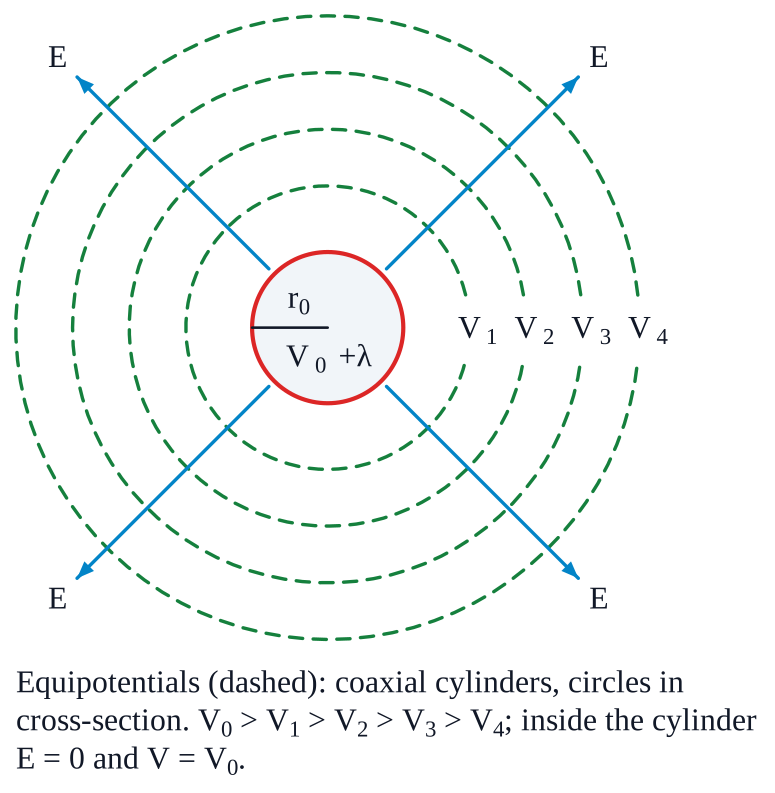
    Axis along \(\displaystyle z\), charge on the surface. Gauss's law on a coaxial surface of length \(\displaystyle L\), outside the cylinder: \[E\,(2\pi rL)=\frac{\lambda L}{\varepsilon_0}\;\Rightarrow\;E=\frac{\lambda}{2\pi\varepsilon_0 r}\qquad (r\ge r_0) \] NCERT_Solution_Class12_Physics_Exemplar_Ch2_Q24 Potential measured from the surface value \(\displaystyle V_0\): \[V-V_0=-\int_{r_0}^{r}E\,dr=-\frac{\lambda}{2\pi\varepsilon_0}\ln\frac{r}{r_0} \] \[r=r_0\exp\!\left[-\frac{2\pi\varepsilon_0\,(V-V_0)}{\lambda}\right],\qquad r^2=x^2+y^2 \] \[x^2+y^2=r_0^2\exp\!\left[-\frac{4\pi\varepsilon_0\,(V-V_0)}{\lambda}\right] \] Inside, \(\displaystyle E=0\Rightarrow V=V_0\) for all \(\displaystyle x^2+y^2\le r_0^2\).Caution: an infinite line charge cannot have \(\displaystyle V=0\) at infinity, so \(\displaystyle V\) is referred to the surface, not to \(\displaystyle r\to\infty\).Answer: The equipotentials are coaxial cylinders \(\displaystyle x^2+y^2=\text{constant}\); for potential \(\displaystyle V\) the radius is \(\displaystyle r=r_0\,e^{-2\pi\varepsilon_0 (V-V_0)/\lambda}\).
  2. Exercise 25

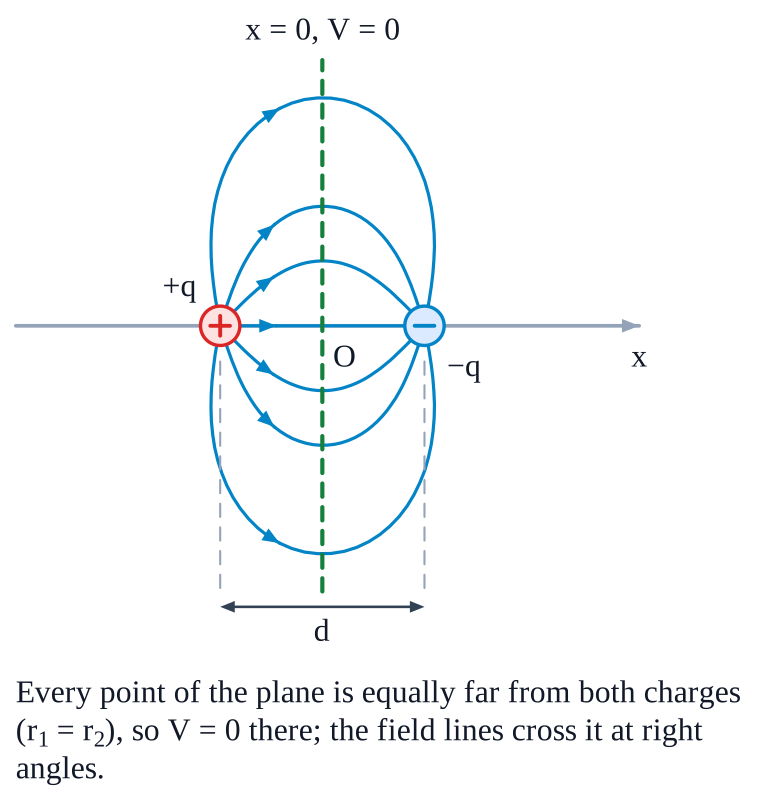
    Two point charges of magnitude +q\displaystyle +q and −q\displaystyle -q are placed at (−d/2,0,0)\displaystyle (-d / 2,0,0) and (d/2,0,0)\displaystyle (d / 2,0,0), respectively. Find the equation of the equipoential surface where the potential is zero.
    NCERT’s answer
    Let the plane be at a distance \(\displaystyle x\) from the origin. The potential at the point P is \[\frac{1}{4 \pi \varepsilon_0} \frac{q}{\left[(x+d / 2)^2+h^2\right]^{1 / 2}}-\frac{1}{4 \pi \varepsilon_0} \frac{q}{\left[(x-d / 2)^2+h^2\right]^{1 / 2}}\] If this is to be zero. \[\frac{1}{\left[(x+d / 2)^2+h^2\right]^{1 / 2}}=\frac{1}{\left[(x-d / 2)^2+h^2\right]^{1 / 2}}\] Or, \(\displaystyle (x-d / 2)^2+h^2=(x+d / 2)^2+h^2\) \[\Rightarrow x^2-d x+d^2 / 4=x^2+d x+d^2 / 4\] Or, \(\displaystyle 2 d x=0\) \[\Rightarrow x=0\] The equation is that of a plane \(\displaystyle x=0\). NCERT_Solution_Class12_Physics_Exemplar_Ch2_Q25_ncert
    For a point \(\displaystyle P(x,y,z)\), with the \(\displaystyle +q\) charge at \(\displaystyle (-d/2,0,0)\) and the \(\displaystyle -q\) charge at \(\displaystyle (d/2,0,0)\): \[V=\frac{q}{4\pi\varepsilon_0}\left[\frac{1}{r_1}-\frac{1}{r_2}\right] \] \[r_1^2=\left(x+\tfrac d2\right)^2+y^2+z^2,\qquad r_2^2=\left(x-\tfrac d2\right)^2+y^2+z^2 \] \[V=0\;\Rightarrow\; r_1=r_2\;\Rightarrow\;\left(x+\tfrac d2\right)^2-\left(x-\tfrac d2\right)^2=0 \] \[2xd=0\;\Rightarrow\;x=0 \] NCERT_Solution_Class12_Physics_Exemplar_Ch2_Q25 It holds for every \(\displaystyle y\) and \(\displaystyle z\): the plane through the midpoint, perpendicular to the line joining the charges.Answer: \(\displaystyle x=0\) (the \(\displaystyle yz\)-plane, the perpendicular bisector plane of the two charges).
  3. Exercise 26

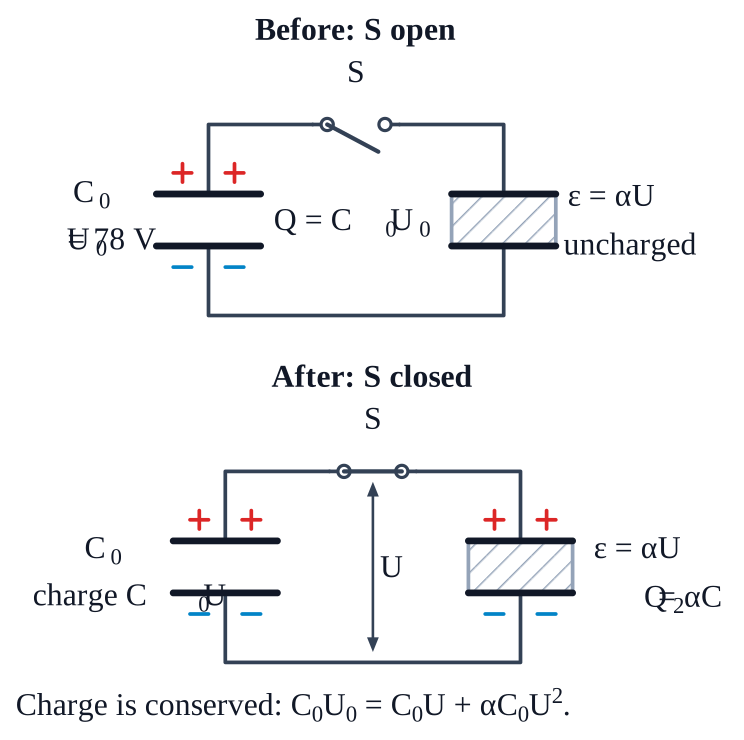
    A parallel plate capacitor is filled by a dielectric whose relative permittivity varies with the applied voltage (U)\displaystyle (U) as ε=αU\displaystyle \varepsilon=\alpha U where α=2 V−1\displaystyle \alpha=2 \mathrm{~V}^{-1}.A similar capacitor with no dielectric is charged to U0=78 V\displaystyle \mathrm{U}_0=78 \mathrm{~V}. It is then connected to the uncharged capacitor with the dielectric. Find the final voltage on the capacitors.
    NCERT’s answer
    Let the final voltage be \(\displaystyle U\): If \(\displaystyle C\) is the capacitance of the capacitor without the dielectric, then the charge on the capacitor is \[Q_1=C U\] The capacitor with the dielectric has a capacitance \(\displaystyle \varepsilon C\). Hence the charge on the capacitor is \[Q_2=\varepsilon U=\alpha C U^2\] The initial charge on the capacitor that was charged is \[Q_0=\mathrm{CU}_0\] From the conservation of charges, \[Q_0=Q_1+Q_2\] Or, \(\displaystyle \mathrm{CU}_0=\mathrm{CU}+\alpha \mathrm{CU}^2\) \[\Rightarrow \alpha U^2+U-u_0=0\] \[\therefore U=\frac{-1 \pm \sqrt{1+4 \alpha U_0}}{2 \alpha}\] \[=\frac{-1 \pm \sqrt{1+624}}{4}\] \[=\frac{-1 \pm \sqrt{625}}{4} \text { volts }\] As U is positive \[U=\frac{\sqrt{625}-1}{4}=\frac{24}{4}=6 \mathrm{~V}\]
    Empty capacitor: \(\displaystyle C_0=\varepsilon_0A/d\). With the dielectric at voltage \(\displaystyle U\): \[C=\varepsilon C_0=\alpha U\,C_0,\qquad Q_2=CU=\alpha C_0U^2 \] NCERT_Solution_Class12_Physics_Exemplar_Ch2_Q26 Charge before connecting is on the empty capacitor only: \(\displaystyle Q=C_0U_0\). After connecting in parallel the voltage \(\displaystyle U\) is common, and charge is conserved: \[C_0U_0=C_0U+\alpha C_0U^2 \] \[\alpha U^2+U-U_0=0\;\Rightarrow\;2U^2+U-78=0 \] \[U=\frac{-1\pm\sqrt{1+8\times78}}{4}=\frac{-1\pm25}{4} \] \[U=6\ \mathrm{V}\quad(\text{reject }-6.5\ \mathrm{V},\ \text{since }\varepsilon=\alpha U>0) \]Caution: \(\displaystyle C\) is not fixed, so the charge on the dielectric capacitor is \(\displaystyle \alpha C_0U^2\), not a constant times \(\displaystyle U\).Answer: \(\displaystyle U=6\ \mathrm{V}\) on each capacitor.
  4. Exercise 27

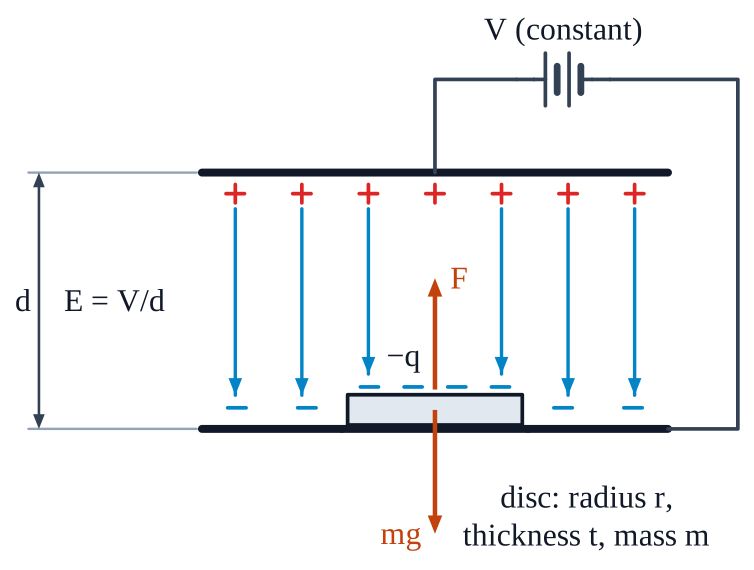
    A capacitor is made of two circular plates of radius R\displaystyle R each, separated by a distance d≪R\displaystyle d \ll R. The capacitor is connected to a constant voltage. A thin conducting disc of radius r≪R\displaystyle r \ll R and thickness t≪r\displaystyle t \ll r is placed at a centre of the bottom plate. Find the minimum voltage required to lift the disc if the mass of the disc is m\displaystyle m.
    The disc touches the bottom plate, so it is at the plate's potential. Field in the gap above it (thin disc): \[E=\frac{V}{d-t}\approx\frac{V}{d} \] The field inside the disc is zero, so its top face carries \[\sigma=\varepsilon_0E,\qquad q=\sigma\,\pi r^2=\frac{\varepsilon_0\pi r^2V}{d} \] NCERT_Solution_Class12_Physics_Exemplar_Ch2_Q27 Only the field of the other charges acts on this charge, which is half of the surface field: \[F=q\,\frac{E}{2}=\frac{\varepsilon_0\pi r^2V^2}{2d^2} \] The disc just lifts when \(\displaystyle F=mg\): \[\frac{\varepsilon_0\pi r^2V^2}{2d^2}=mg\;\Rightarrow\;V_{\min}=\frac{d}{r}\sqrt{\frac{2mg}{\pi\varepsilon_0}} \]Caution: use \(\displaystyle E/2\), not \(\displaystyle E\); the disc's own charge exerts no net force on itself.Answer: \(\displaystyle V_{\min}=\dfrac{d}{r}\sqrt{\dfrac{2mg}{\pi\varepsilon_0}}\)
  5. Exercise 28

    (a)
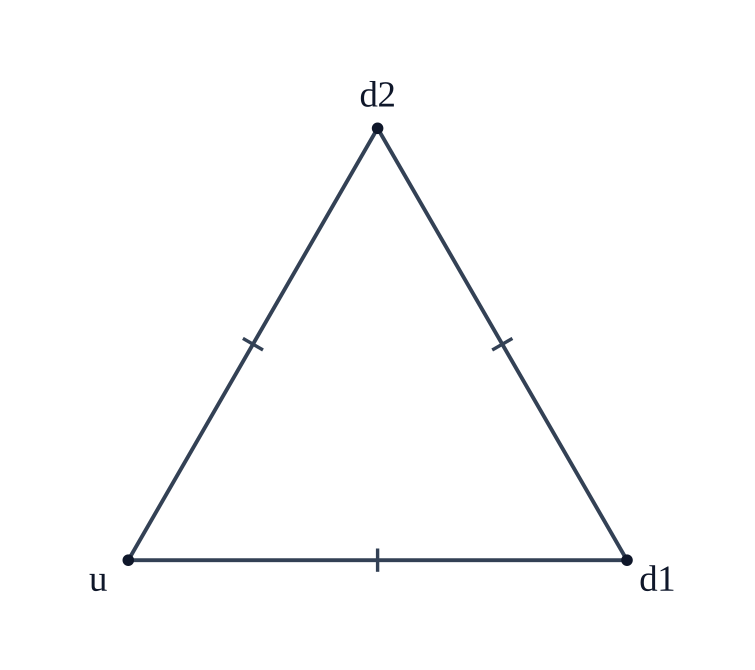
    In a quark model of elementary particles, a neutron is made of one up quarks [charge (2/3)e\displaystyle (2 / 3) e ] and two down quarks [charges −(1/3)e]\displaystyle -(1 / 3) e]. Assume that they have a triangle configuration with side length of the order of 10−15 m\displaystyle 10^{-15} \mathrm{~m}. Calculate electrostatic potential energy of neutron and compare it with its mass 939\displaystyle 939 MeV.
    (b)
    Repeat above exercise for a proton which is made of two up and one down quark.
    NCERT’s answer
    \(\displaystyle \mathrm{U}=\frac{1}{4 \pi \varepsilon_0}\left\{\frac{q_d q_d}{r}-\frac{q_u q_d}{r}-\frac{q_u q_d}{r}\right\}\) \[=\frac{9 \times 10^9}{10^{-15}}\left(1.6 \times 10^{-19}\right)^2\left\{(1 / 3)^2-(2 / 3)(1 / 3)-(2 / 3)(1 / 3)\right\}\] \[=2.304 \times 10^{-13}\left\{\frac{1}{9}-\frac{4}{9}\right\}=-7.68 \times 10^{-14} \mathrm{~J}\] \[=4.8 \times 10^5 \mathrm{eV}=0.48 \mathrm{MeV}=5.11 \times 10^{-4}\left(m_n c^2\right)\]
    (a) Neutron (u, d, d), side \(\displaystyle a=10^{-15}\ \mathrm{m}\). Sum over the three pairs: \[U_n=\frac{1}{4\pi\varepsilon_0a}\left[q_uq_d+q_uq_d+q_dq_d\right]=\frac{e^2}{4\pi\varepsilon_0a}\left[-\frac29-\frac29+\frac19\right]=-\frac13\,\frac{e^2}{4\pi\varepsilon_0a} \] NCERT_Solution_Class12_Physics_Exemplar_Ch2_Q28 \[\frac{e^2}{4\pi\varepsilon_0a}=\frac{9\times10^{9}\times(1.6\times10^{-19})^2}{10^{-15}}\ \mathrm{J}=2.3\times10^{-13}\ \mathrm{J}=1.44\ \mathrm{MeV} \] \[U_n=-0.48\ \mathrm{MeV},\qquad \frac{|U_n|}{939\ \mathrm{MeV}}\approx5\times10^{-4} \](b) Proton (u, u, d): \[U_p=\frac{e^2}{4\pi\varepsilon_0a}\left[\frac49-\frac29-\frac29\right]=0 \] The electrostatic energy is a tiny fraction of the rest energy.Answer: (a) \(\displaystyle U_n\approx-0.48\ \mathrm{MeV}\), about \(\displaystyle 0.05\%\) of $\displaystyle 939$ MeV; (b) \(\displaystyle U_p=0\).
  6. Exercise 29

    Two metal spheres, one of radius R\displaystyle R and the other of radius 2R\displaystyle 2 R, both have same surface charge density σ\displaystyle \sigma. They are brought in contact and separated. What will be new surface charge densities on them?
    NCERT’s answer
    Before contact \[Q_1=\sigma .4 \pi R^2\] \[Q_2=\sigma .4 \pi\left(2 R^2\right)=4\left(\sigma .4 \pi R^2\right)=4 Q_1\] After contact : \[\mathrm{Q}_1^{\prime}+\mathrm{Q}_2^{\prime}=\mathrm{Q}_1+\mathrm{Q}_2=5 \mathrm{Q}_1,\] \[=5\left(\sigma .4 \pi R^2\right)\] They will be at equal potentials: \[\frac{Q_1^{\prime}}{R}=\frac{Q_2^{\prime}}{2 R}\] \[\therefore \mathrm{Q}_2^{\prime}=2 \mathrm{Q}^{\prime} .\] \[\therefore 3 \mathrm{Q}_1^{\prime}=5\left(\sigma .4 \pi \mathrm{R}^2\right)\] \[\therefore \mathrm{Q}_1^{\prime}=\frac{5}{3}\left(\sigma .4 \pi \mathrm{R}^2\right) \text { and } Q_2^{\prime}=\frac{10}{3}\left(\sigma .4 \pi \mathrm{R}^2\right)\] \[\therefore \sigma_1=5 / 3 \sigma \text { and } \therefore \sigma_2=\frac{5}{6} \sigma .\]
    \[Q_1 = 4\pi R^2\sigma,\qquad Q_2 = 4\pi (2R)^2\sigma = 16\pi R^2\sigma \]Charge is conserved:\[Q_1' + Q_2' = Q_1 + Q_2 = 20\pi R^2\sigma \]Contact makes the potentials equal (the charges do not):\[\frac{Q_1'}{4\pi\varepsilon_0 R} = \frac{Q_2'}{4\pi\varepsilon_0 (2R)} \;\Rightarrow\; Q_2' = 2Q_1' \]\[3Q_1' = 20\pi R^2\sigma \;\Rightarrow\; Q_1' = \tfrac{20}{3}\pi R^2\sigma,\qquad Q_2' = \tfrac{40}{3}\pi R^2\sigma \]\[\sigma_1' = \frac{Q_1'}{4\pi R^2} = \frac{5}{3}\sigma,\qquad \sigma_2' = \frac{Q_2'}{4\pi (2R)^2} = \frac{5}{6}\sigma \]\[\frac{\sigma_1'}{\sigma_2'} = 2 \quad\text{(the smaller sphere carries the larger density)} \]Answer: \(\displaystyle \sigma' = \tfrac{5}{3}\sigma\) on the sphere of radius \(\displaystyle R\) and \(\displaystyle \sigma' = \tfrac{5}{6}\sigma\) on the sphere of radius \(\displaystyle 2R\).
  7. Exercise 30

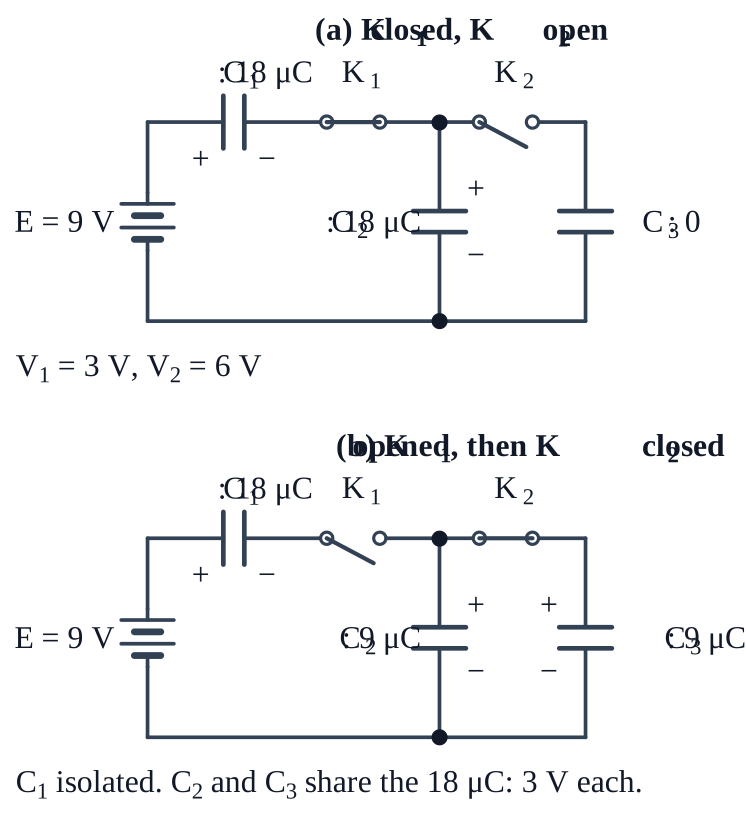
    In the circuit shown in Fig. 2.7\displaystyle 2.7, initially K1\displaystyle \mathrm{K}_1 is closed and K2\displaystyle \mathrm{K}_2 is open. What are the charges on each capacitors. Then K1\displaystyle \mathrm{K}_1 was opened and K2\displaystyle \mathrm{K}_2 was closed (order is important), What will be the charge on each capacitor now? [C=1μ F]\displaystyle [C=1 \mu \mathrm{~F}] NCERT_Question_Class12_Physics_Exemplar_Ch2_Q30
    With \(\displaystyle \mathrm{K}_1\) closed and \(\displaystyle \mathrm{K}_2\) open, \(\displaystyle C_3\) is cut off; \(\displaystyle C_1\) and \(\displaystyle C_2\) are in series across \(\displaystyle 9\ \mathrm{V}\).\[C_{eq} = \frac{6C\times 3C}{6C+3C} = 2C = 2\ \mu\mathrm{F} \]\[Q_1 = Q_2 = C_{eq}E = 2\ \mu\mathrm{F}\times 9\ \mathrm{V} = 18\ \mu\mathrm{C},\qquad Q_3 = 0 \]\[V_1 = \frac{18\ \mu\mathrm{C}}{6\ \mu\mathrm{F}} = 3\ \mathrm{V},\qquad V_2 = \frac{18\ \mu\mathrm{C}}{3\ \mu\mathrm{F}} = 6\ \mathrm{V}\qquad (3+6 = 9\ \mathrm{V}) \]NCERT_Solution_Class12_Physics_Exemplar_Ch2_Q30With \(\displaystyle \mathrm{K}_1\) opened and then \(\displaystyle \mathrm{K}_2\) closed, \(\displaystyle C_1\) is isolated and keeps its charge. \(\displaystyle C_2\) shares its charge with the uncharged \(\displaystyle C_3\), now in parallel.\[Q_1' = 18\ \mu\mathrm{C} \]\[Q_2' + Q_3' = 18\ \mu\mathrm{C},\qquad V_2' = V_3' \;\Rightarrow\; \frac{Q_2'}{3\ \mu\mathrm{F}} = \frac{Q_3'}{3\ \mu\mathrm{F}} \]\[Q_2' = Q_3' = 9\ \mu\mathrm{C},\qquad V_2' = V_3' = \frac{9\ \mu\mathrm{C}}{3\ \mu\mathrm{F}} = 3\ \mathrm{V} \]Caution: \(\displaystyle \mathrm{K}_1\) must open first; with the battery still connected it would keep charging \(\displaystyle C_2\) and \(\displaystyle C_3\).Answer: first \(\displaystyle Q_1 = Q_2 = 18\ \mu\mathrm{C}\), \(\displaystyle Q_3 = 0\); then \(\displaystyle Q_1 = 18\ \mu\mathrm{C}\), \(\displaystyle Q_2 = Q_3 = 9\ \mu\mathrm{C}\).
  8. Exercise 31

    Calculate potential on the axis of a disc of radius R\displaystyle R due to a charge Q\displaystyle Q uniformly distributed on its surface.
    NCERT’s answer
    \(\displaystyle \sigma=\frac{Q}{\pi R^2}\) \[d U=\frac{1}{4 \pi \varepsilon_0} \frac{\sigma .2 \pi r d r}{\sqrt{r^2+z^2}}\] \[\therefore U=\frac{\pi \sigma}{4 \pi \varepsilon_0} \int_{\mathrm{O}}^{\mathrm{R}} \frac{2 r d r}{\sqrt{r^2+z^2}}\] \[=\frac{2 \pi \sigma}{4 \pi \varepsilon_0}\left[\sqrt{r^2+z^2}\right]_{\mathrm{O}}^{\mathrm{R}}=\frac{2 \pi \sigma}{4 \pi \varepsilon_0}\left[\sqrt{R^2+z^2}-z\right]\] \[=\frac{2 \mathrm{Q}}{4 \pi \varepsilon_0 R^2}\left[\sqrt{R^2+z^2}-z\right]\] NCERT_Solution_Class12_Physics_Exemplar_Ch2_Q31_ncert
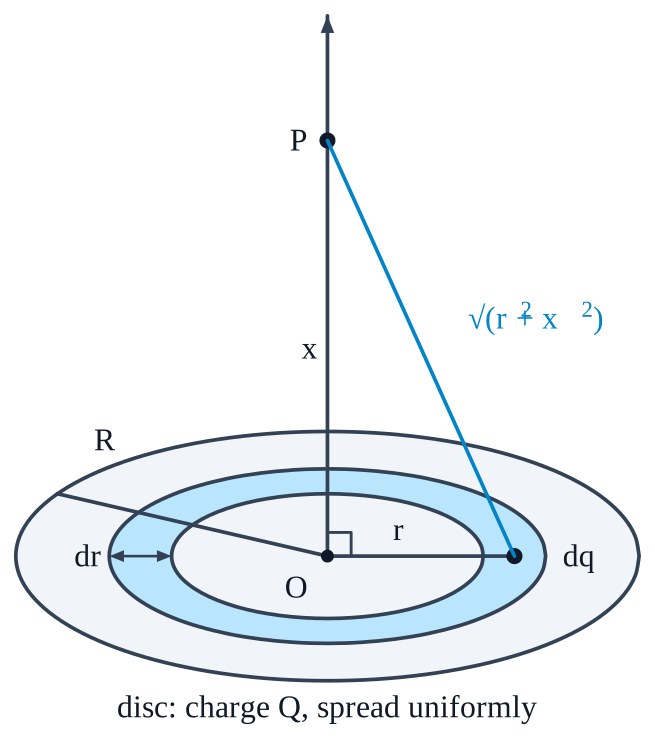
    Take \(\displaystyle P\) at distance \(\displaystyle x\) from the centre, on the axis, and a ring of radius \(\displaystyle r\) and width \(\displaystyle dr\) as the element.NCERT_Solution_Class12_Physics_Exemplar_Ch2_Q31\[\sigma = \frac{Q}{\pi R^2},\qquad dq = \sigma\,(2\pi r\,dr) = \frac{2Q\,r\,dr}{R^2} \]Potential is a scalar and every point of the ring is at the same distance from \(\displaystyle P\), so add directly:\[dV = \frac{1}{4\pi\varepsilon_0}\frac{dq}{\sqrt{r^2+x^2}} = \frac{Q}{2\pi\varepsilon_0 R^2}\,\frac{r\,dr}{\sqrt{r^2+x^2}} \]\[V = \frac{Q}{2\pi\varepsilon_0 R^2}\int_0^R \frac{r\,dr}{\sqrt{r^2+x^2}} = \frac{Q}{2\pi\varepsilon_0 R^2}\Big[\sqrt{r^2+x^2}\Big]_0^R \]\[V = \frac{Q}{2\pi\varepsilon_0 R^2}\left(\sqrt{R^2+x^2} - |x|\right) \]Check, \(\displaystyle x\gg R\):\[\sqrt{R^2+x^2} - x \approx \frac{R^2}{2x} \;\Rightarrow\; V \approx \frac{Q}{4\pi\varepsilon_0 x} \]Answer: \(\displaystyle V = \dfrac{Q}{2\pi\varepsilon_0 R^2}\left(\sqrt{R^2+x^2} - |x|\right)\)
  9. Exercise 32

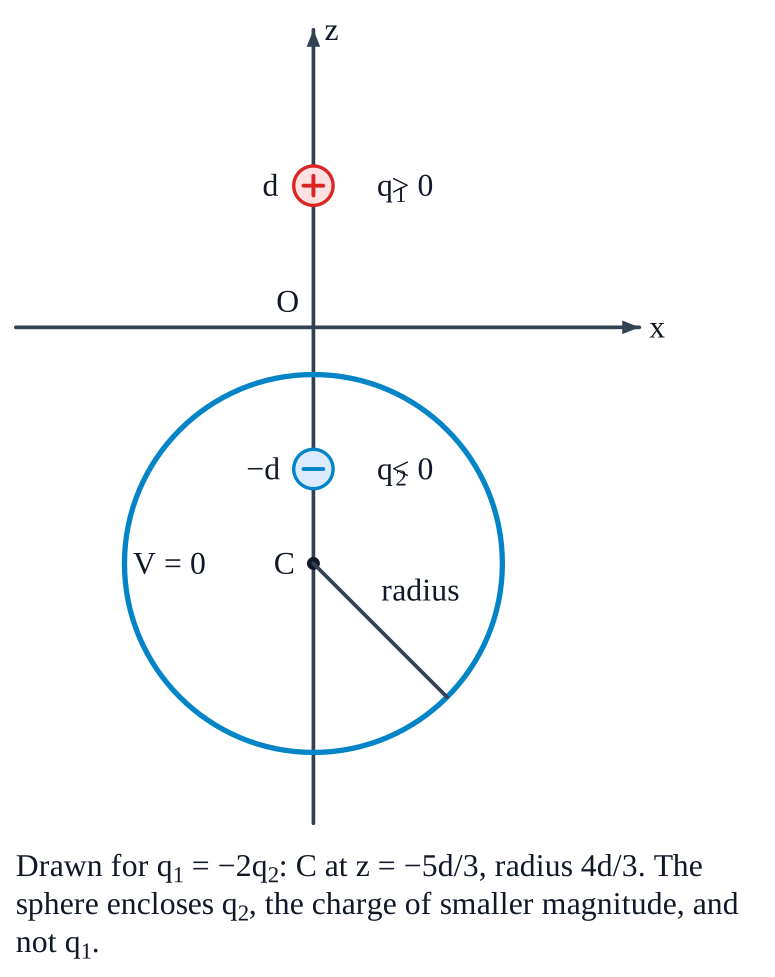
    Two charges q1\displaystyle q_1 and q2\displaystyle q_2 are placed at (0,0,d)\displaystyle (0,0, d) and (0,0,−d)\displaystyle (0,0,-d) respectively. Find locus of points where the potential a zero.
    For a point \(\displaystyle P(x,y,z)\):\[V = \frac{1}{4\pi\varepsilon_0}\left[\frac{q_1}{\sqrt{x^2+y^2+(z-d)^2}} + \frac{q_2}{\sqrt{x^2+y^2+(z+d)^2}}\right] = 0 \]\[q_1^2\left[x^2+y^2+(z+d)^2\right] = q_2^2\left[x^2+y^2+(z-d)^2\right] \]Caution: squaring also lets in \(\displaystyle q_1q_2>0\), where \(\displaystyle V\) is never zero, so \(\displaystyle q_1\) and \(\displaystyle q_2\) must have opposite signs.\[(q_1^2-q_2^2)(x^2+y^2+z^2+d^2) + 2zd\,(q_1^2+q_2^2) = 0 \]For \(\displaystyle |q_1|\neq|q_2|\), with \(\displaystyle s = \dfrac{q_1^2+q_2^2}{q_1^2-q_2^2}\):\[x^2+y^2+(z+sd)^2 = d^2(s^2-1) = \left(\frac{2q_1q_2\,d}{q_1^2-q_2^2}\right)^2 \]NCERT_Solution_Class12_Physics_Exemplar_Ch2_Q32For \(\displaystyle q_1=-q_2\) the equation reduces to\[2zd\,(2q_1^2) = 0 \;\Rightarrow\; z = 0 \]Answer: a sphere with centre \(\displaystyle \left(0,0,-\dfrac{q_1^2+q_2^2}{q_1^2-q_2^2}\,d\right)\) and radius \(\displaystyle \dfrac{2|q_1q_2|\,d}{|q_1^2-q_2^2|}\); the plane \(\displaystyle z=0\) if \(\displaystyle |q_1|=|q_2|\).
  10. Exercise 33

    Two charges −q\displaystyle -q each are separated by distance 2d\displaystyle 2 d. A third charge +q\displaystyle +q is kept at mid point O. Find potential energy of +q\displaystyle +q as a function of small distance x\displaystyle x from O due to −q\displaystyle -q charges. Sketch P.E. v/s x\displaystyle x and convince yourself that the charge at O is in an unstable equilibrium.
    NCERT’s answer
    \[\mathrm{U}=\frac{1}{4 \pi \varepsilon_0}\left\{\frac{-q^2}{(d-x)}+\frac{-q^2}{(d-x)}\right\}\] \[\mathrm{U}=\frac{-q^2}{4 \pi \varepsilon_0} \frac{2 d}{\left(d^2-x^2\right)}\] \[\frac{\mathrm{dU}}{\mathrm{dx}}=\frac{-q^2 .2 d}{4 \pi \epsilon_0} \cdot \frac{2 x}{\left(d^2-x^2\right)^2}\] \[U_0=\frac{2 q^2}{4 \pi \varepsilon_0 d} \quad \frac{\mathrm{dU}}{\mathrm{dx}}=0 \text { at } x=0\] \(\displaystyle x=0\) is an equilibrium point. \[\frac{\mathrm{d}^2 \mathrm{U}}{\mathrm{dx}^2}=\left(\frac{-2 d q^2}{4 \pi \epsilon_0}\right)\left[\frac{2}{\left(d^2-x^2\right)^2}-\frac{8 x^2}{\left(d^2-x^2\right)^3}\right]\] \[=\left(\frac{-2 d q^2}{4 \pi \epsilon_0}\right) \frac{1}{\left(d^2-x^2\right)^3}\left[2\left(d^2-x^2\right)^2-8 x^2\right]\] At \(\displaystyle x=0\) \[\frac{d^2 \mathrm{U}}{\mathrm{dx}^2}=\left(\frac{-2 d q^2}{4 \pi \epsilon_0}\right)\left(\frac{1}{d^6}\right)\left(2 d^2\right), \text { which is }<0 .\] Hence, unstable equilibrium. NCERT_Solution_Class12_Physics_Exemplar_Ch2_Q33_ncert
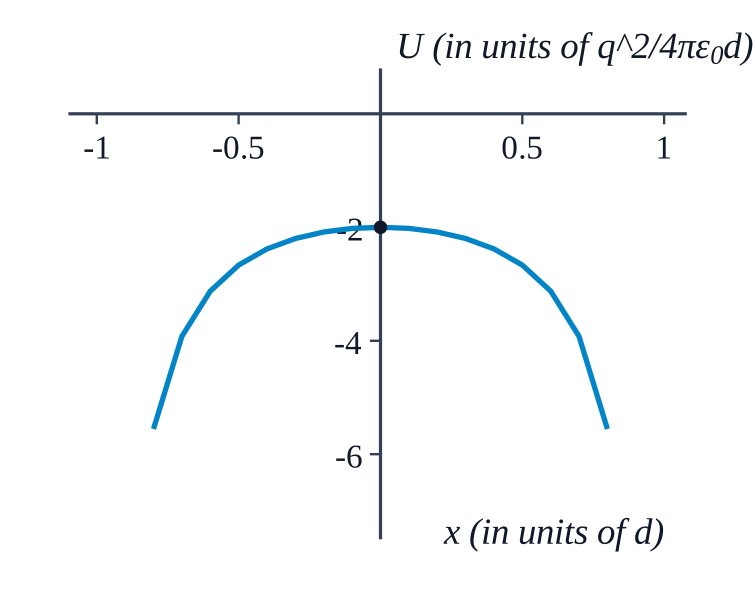
    Move \(\displaystyle +q\) a distance \(\displaystyle x\) from O along the line joining the two \(\displaystyle -q\) charges; its distances from them are \(\displaystyle d-x\) and \(\displaystyle d+x\).\[U(x) = -\frac{q^2}{4\pi\varepsilon_0}\left[\frac{1}{d-x} + \frac{1}{d+x}\right] = -\frac{q^2}{4\pi\varepsilon_0}\,\frac{2d}{d^2-x^2} \]For \(\displaystyle x\ll d\):\[U(x) \approx -\frac{q^2}{2\pi\varepsilon_0 d}\left(1+\frac{x^2}{d^2}\right) \]NCERT_Solution_Class12_Physics_Exemplar_Ch2_Q33\[\left.\frac{dU}{dx}\right|_{x=0} = 0,\qquad \frac{d^2U}{dx^2} = -\frac{q^2}{\pi\varepsilon_0 d^3} < 0 \]\[F = -\frac{dU}{dx} = +\frac{q^2}{\pi\varepsilon_0 d^3}\,x \]\(\displaystyle U\) is a maximum at O \(\displaystyle \Rightarrow\) any displacement along the line lowers \(\displaystyle U\) \(\displaystyle \Rightarrow\) \(\displaystyle F\) points along \(\displaystyle x\), away from O.Answer: \(\displaystyle U(x) \approx -\dfrac{q^2}{2\pi\varepsilon_0 d}\left(1+\dfrac{x^2}{d^2}\right)\); O is a maximum of \(\displaystyle U\), so the equilibrium is unstable.