SolveIt is under development
SolveItClass 12 · Exemplar

NCERT Exemplar · Class 12 Physics Electrostatic Potential and Capacitance

33 questions

Multiple Choice Questions (Type II) 7–13 (part 2 of 5)

  1. Exercise 7

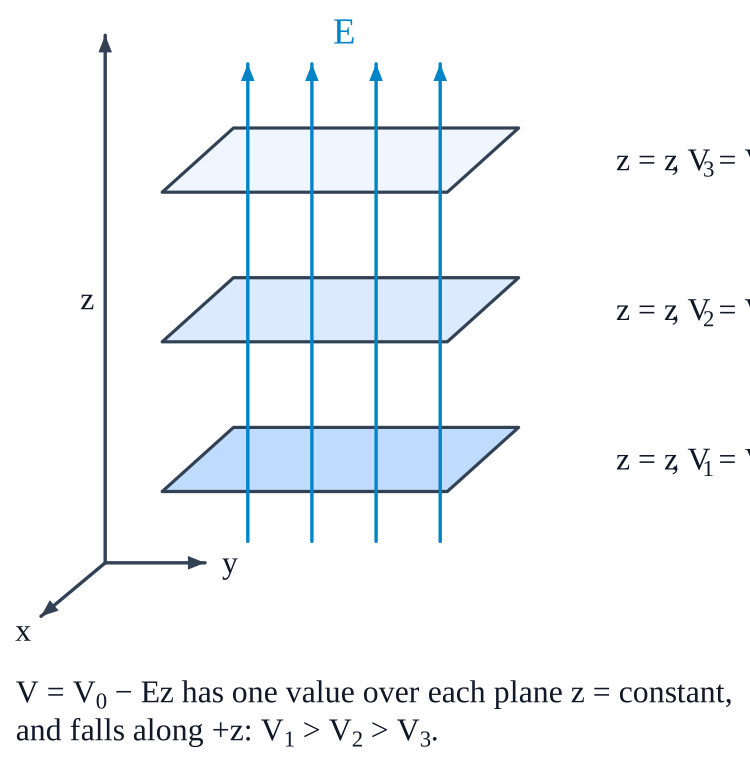
    Consider a uniform electric field in the z^\displaystyle \hat{\mathbf{z}} direction. The potential is a constant
    (a)
    in all space.
    (b)
    for any x\displaystyle x for a given z\displaystyle z.
    (c)
    for any y\displaystyle y for a given z\displaystyle z.
    (d)
    on the x−y\displaystyle x-y plane for a given z.
    NCERT’s answer
    (b), (c), (d)
    (b), (c), (d) Only \(\displaystyle E_z\) is non-zero, so \(\displaystyle V\) depends on \(\displaystyle z\) alone.\[E_x=-\frac{\partial V}{\partial x}=0,\qquad E_y=-\frac{\partial V}{\partial y}=0,\qquad E_z=-\frac{\partial V}{\partial z}=E \]\[V(z)=V_0-Ez \]NCERT_Solution_Class12_Physics_Exemplar_Ch2_Q7Every plane \(\displaystyle z=\) const is an equipotential; (a) fails because \(\displaystyle V\) changes with \(\displaystyle z\).
  2. Exercise 8

    Equipotential surfaces
    (a)
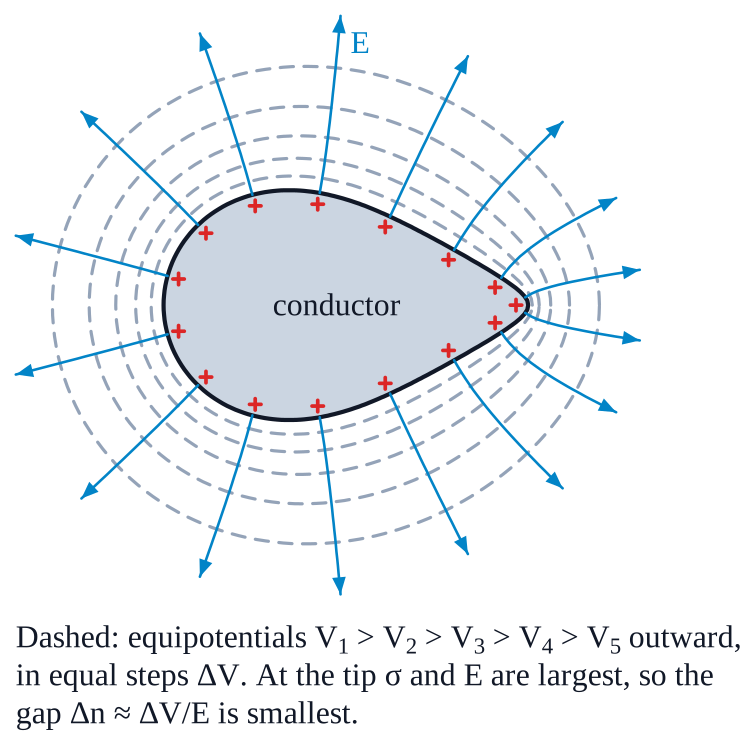
    are closer in regions of large electric fields compared to regions of lower electric fields.
    (b)
    will be more crowded near sharp edges of a conductor.
    (c)
    will be more crowded near regions of large charge densities.
    (d)
    will always be equally spaced.
    NCERT’s answer
    (a), (b), (c)
    (a), (b), (c) For equal steps \(\displaystyle \Delta V\), the gap between surfaces shrinks where the field is strong.\[E\approx\frac{\Delta V}{\Delta n}\ \Rightarrow\ \Delta n\approx\frac{\Delta V}{E} \]NCERT_Solution_Class12_Physics_Exemplar_Ch2_Q8A sharp edge has large \(\displaystyle \sigma\):\[\sigma\uparrow\ \Rightarrow\ E=\frac{\sigma}{\varepsilon_0}\uparrow\ \Rightarrow\ \Delta n\downarrow \]The gap depends on \(\displaystyle E\), so (d) is false.
  3. Exercise 9

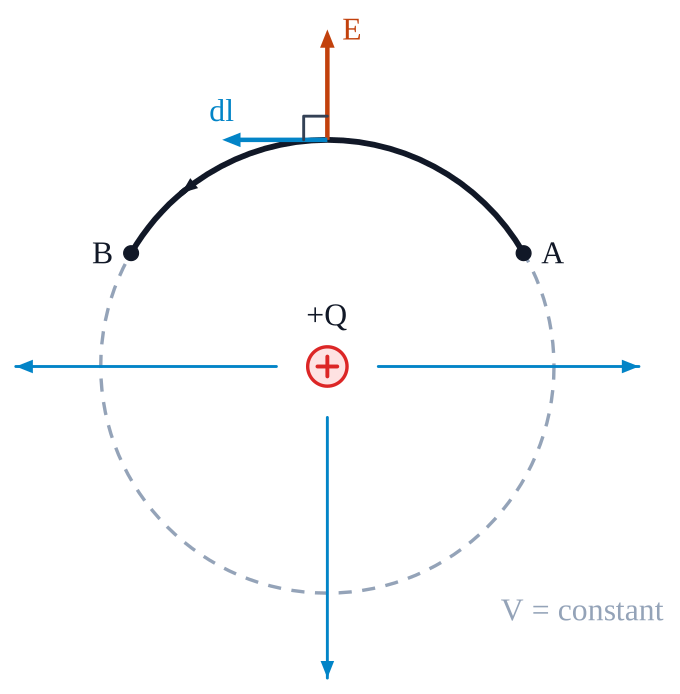
    The work done to move a charge along an equipotential from A to B
    (a)
    cannot be defined as −∫ABE.dl\displaystyle -\int_{\mathrm{A}}^{\mathrm{B}} \mathbf{E} . d \mathbf{l}
    (b)
    must be defined as −∫ABE.dl\displaystyle -\int_{\mathrm{A}}^{\mathrm{B}} \mathbf{E} . d \mathbf{l}
    (c)
    is zero.
    (d)
    can have a non-zero value.
    NCERT’s answer
    (b), (c)
    (b), (c) On an equipotential \(\displaystyle \mathbf{E}\perp d\mathbf{l}\) everywhere, so the integral is still the right expression and it vanishes.NCERT_Solution_Class12_Physics_Exemplar_Ch2_Q9\[W_{AB}=-q\int_A^B\mathbf{E}\cdot d\mathbf{l}=-q\int_A^B E\,dl\cos90^\circ=0 \]\[W_{AB}=q\,(V_B-V_A)=0 \](a) and (d) are false.
  4. Exercise 10

    In a region of constant potential
    (a)
    the electric field is uniform
    (b)
    the electric field is zero
    (c)
    there can be no charge inside the region.
    (d)
    the electric field shall necessarily change if a charge is placed outside the region.
    NCERT’s answer
    (b), (c)
    (b), (c) Constant \(\displaystyle V\) means zero field; zero field means zero flux through every closed surface in the region, so no charge there.\[\mathbf{E}=-\nabla V=0 \]\[\oint\mathbf{E}\cdot d\mathbf{A}=\frac{q_{enc}}{\varepsilon_0}=0\ \Rightarrow\ q_{enc}=0 \]
  5. Exercise 11

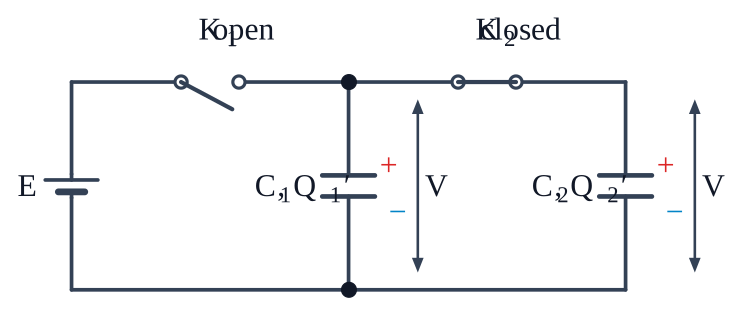
    In the circuit shown in Fig. 2.4. initially key K1\displaystyle \mathrm{K}_1 is closed and key K2\displaystyle \mathrm{K}_2 is open. Then K1\displaystyle \mathrm{K}_1 is opened and K2\displaystyle \mathrm{K}_2 is closed (order is important).
    [Take Q1′\displaystyle \mathrm{Q}_1{ }^{\prime} and Q2′\displaystyle \mathrm{Q}_2{ }^{\prime} as charges on C1\displaystyle \mathrm{C}_1 and C2\displaystyle \mathrm{C}_2 and V1\displaystyle V_1 and V2\displaystyle V_2 as voltage respectively.]
    Then
    (a)
    charge on C1\displaystyle C_1 gets redistributed such that V1=V2\displaystyle V_1=V_2
    (b)
    charge on C1\displaystyle C_1 gets redistributed such that Q1′=Q2′\displaystyle Q_1{ }^{\prime}=Q_2{ }^{\prime}
    (c)
    charge on C1\displaystyle C_1 gets redistributed such that C1V1+C2V2=C1E\displaystyle C_1 V_1+C_2 V_2=C_1 E
    (d)
    charge on C1\displaystyle C_1 gets redistributed such that Q1′+Q2′=Q\displaystyle Q_1{ }^{\prime}+Q_2{ }^{\prime}=Q
    NCERT_Question_Class12_Physics_Exemplar_Ch2_Q11
    (a), (c), (d) Opening \(\displaystyle K_1\) traps the charge of \(\displaystyle C_1\); closing \(\displaystyle K_2\) shares it with the initially uncharged \(\displaystyle C_2\) at one common voltage. \(\displaystyle Q_1'=Q_2'\) holds only if \(\displaystyle C_1=C_2\).NCERT_Solution_Class12_Physics_Exemplar_Ch2_Q11\[Q=C_1E\quad(\text{before}) \]\[V_1=V_2=V,\qquad Q_1'+Q_2'=Q \]\[C_1V_1+C_2V_2=C_1E \]\[V=\frac{C_1E}{C_1+C_2},\qquad Q_1'=\frac{C_1^2E}{C_1+C_2},\qquad Q_2'=\frac{C_1C_2E}{C_1+C_2} \]
  6. Exercise 12

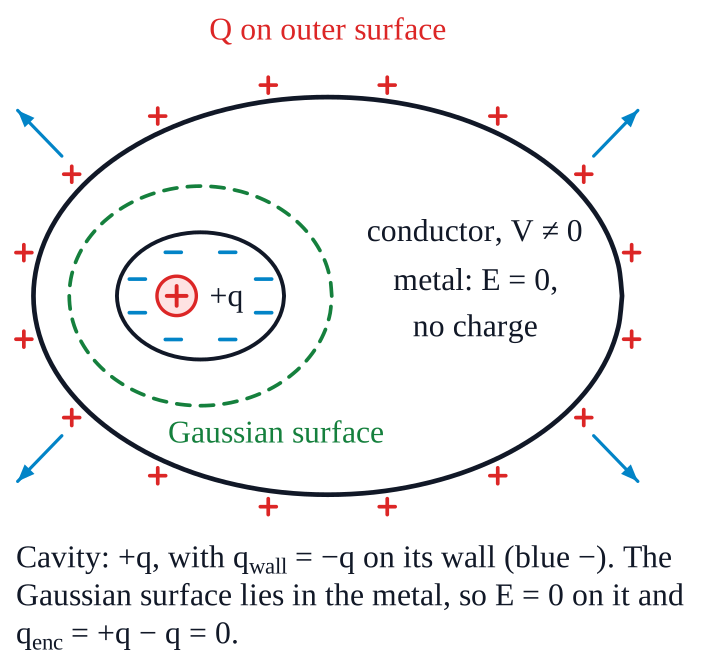
    If a conductor has a potential V≠0\displaystyle V \neq 0 and there are no charges anywhere else outside, then
    (a)
    there must be charges on the surface or inside itself.
    (b)
    there cannot be any charge in the body of the conductor.
    (c)
    there must be charges only on the surface.
    (d)
    there must be charges inside the surface.
    NCERT’s answer
    (a), (b)
    (a), (b) \(\displaystyle V\neq0\) needs charge somewhere; none lies in the body itself, though a cavity may hold some, so (c) and (d) are not forced.\[V=\frac{Q}{C}\neq0\ \Rightarrow\ Q\neq0 \]\[\mathbf{E}_{body}=0\ \Rightarrow\ \oint\mathbf{E}\cdot d\mathbf{A}=\frac{q_{enc}}{\varepsilon_0}=0 \]NCERT_Solution_Class12_Physics_Exemplar_Ch2_Q12\[q_{cavity}+q_{wall}=0\ \Rightarrow\ q_{wall}=-q \]
  7. Exercise 13

    A parallel plate capacitor is connected to a battery as shown in Fig. 2.5. Consider two situations:
    A: Key K is kept closed and plates of capacitors are moved apart using insulating handle.
    B: Key K is opened and plates of capacitors are moved apart using insulating handle.
    Choose the correct option(s).
    (a)
    In A : Q\displaystyle Q remains same but C\displaystyle C changes.
    (b)
    In B : V\displaystyle V remains same but C\displaystyle C changes.
    (c)
    In A : V\displaystyle V remains same and hence Q\displaystyle Q changes.
    (d)
    In B : Q\displaystyle Q remains same and hence V\displaystyle V changes.
    NCERT_Question_Class12_Physics_Exemplar_Ch2_Q13
    NCERT’s answer
    (c) and (d)
    (c), (d) In A the battery fixes \(\displaystyle V\); in B the isolated plates fix \(\displaystyle Q\).\[C=\frac{\varepsilon_0A}{d},\qquad d\uparrow\ \Rightarrow\ C\downarrow \]\[\text{A: } V=\text{const},\qquad Q=CV\downarrow \]\[\text{B: } Q=\text{const},\qquad V=\frac{Q}{C}\uparrow \](a) and (b) each hold the wrong quantity fixed.